
Solutions
Network Switch Refresh
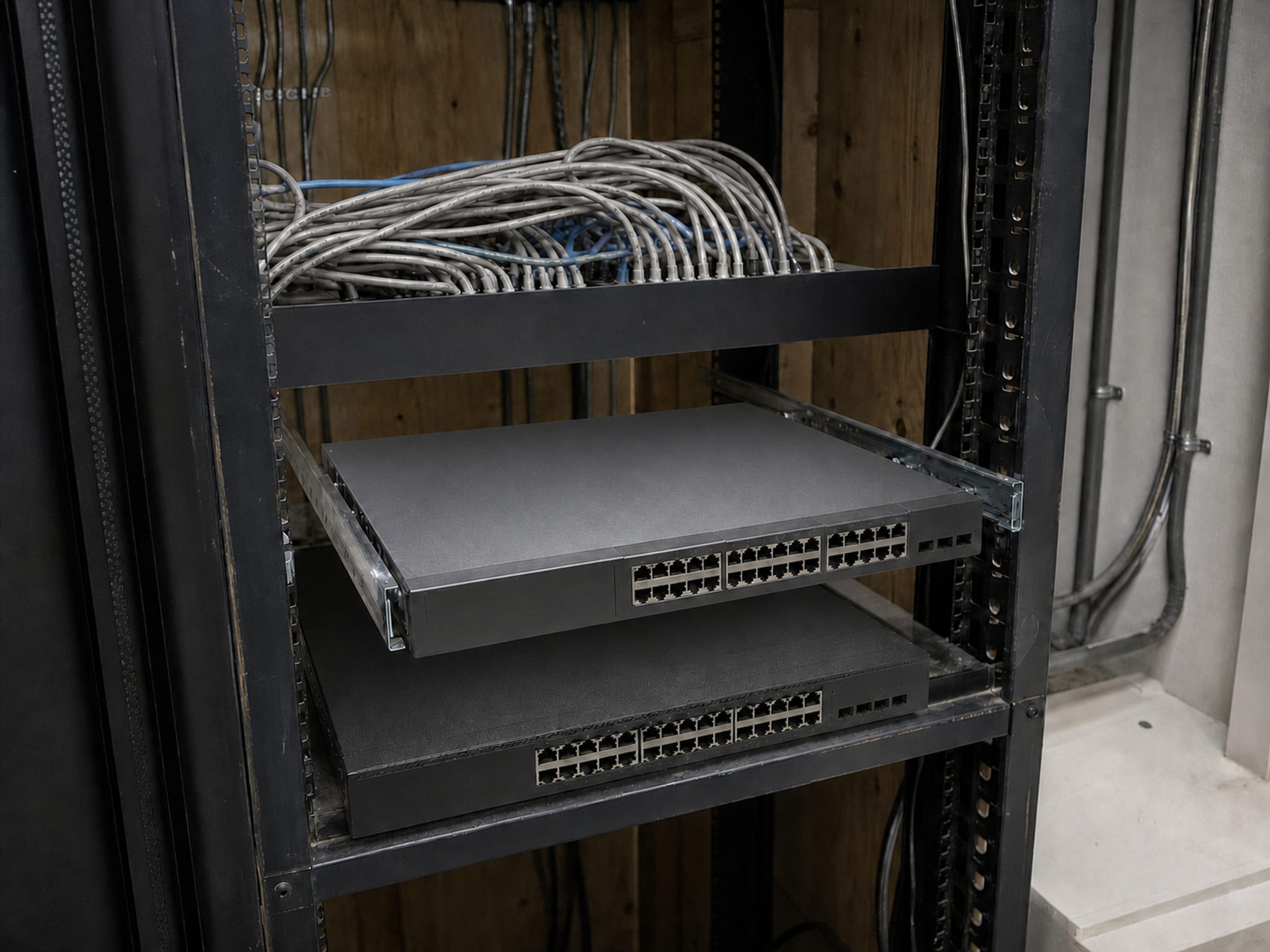
A switch refresh is rarely held up by the switch. It stalls on port counts nobody re-counted, a PoE budget that quietly grew, and the uplink optics that were never on the requisition. We build the closet-by-closet bill of materials, put the optics and patch cabling on the same quote, and stage each stack with its configuration before it ships.
- Scope
- Access, aggregation and closet switching
- Quoted
- Switches, optics, patch fields, PoE headroom, staging
- Screening
- TAA (FAR 52.225-5) and NDAA §889, per line
- Boundary
- We stage the config you supply — the network stays yours to run
The refresh is a closet inventory before it is a purchase
Almost every stalled switch refresh has the same shape: someone priced the switches, the order was approved, and then the install week discovered that the new access layer needed 10 GbE uplinks where the old one had 1 GbE, that half the closets had no spare optics, and that the cameras added since the last refresh had pushed the PoE draw past what the chassis will deliver. None of that is a switch problem. It is a bill-of-materials problem, and it is cheaper to solve on paper. We work the refresh closet by closet — ports in use versus ports installed, powered devices and their class, uplink media and distance, rack space and patch field — and quote the whole set as one document with availability stated per line.
What actually changes when the access layer changes
Port count is the easy half. The harder half is everything the port implies: a multi-gigabit access port only earns its price if the endpoints can use it, an 802.3bt port needs a power supply and a budget behind it, and a stack that terminates in fiber needs a transceiver at both ends plus the correct patch cord and polarity. Stacking cables are model-specific and routinely forgotten. So are the rack rails on a deeper chassis.
Licensing is the second surprise. Some switching lines gate features, controller management or telemetry behind a subscription, and some ship a term in the box that renews later at a different price. Where a line carries a license, we quote it with its term and say what happens when the term ends, rather than shipping an appliance that goes quiet in a year.
Cisco, Aruba and Juniper platforms sit in our sister catalogs rather than the hub cart. If your standard is one of those, send the part numbers with the requirement and they come back priced on the same quote as the optics, cabling and staging — the routing is an ordering detail, not a limit on what we can source.
The lines that make up a refresh
Availability is stated per line — some of this is genuinely stocked, some is quote-and-source through US distribution, and the quote says which is which.
Access and aggregation switching
Allied Telesis, Netgear, TRENDnet, EnGenius and D-Link carry priced rows across the switching estate, from small closet units to stackable access. We size the tier to the ports actually in use plus documented growth, not to the port count on the old label.
Managed switching for segmented networks
Once a network needs VLANs, 802.1X, ACLs or telemetry a SOC can read, the management plane stops being optional. The managed slice of the catalog is live-priced and filterable by port count, speed and switching layer.
Uplinks, optics and stacking
The uplink is where refreshes overrun. Coded third-party transceivers from AddOn and Axiom cover most host platforms at a fraction of the OEM line item, and we match module to platform, wavelength and distance so the link comes up on the first attempt.
Patch fields and the closet itself
Panduit and Legrand patch panels, cable management and rack hardware are quoted alongside the switch so the closet is finished rather than merely re-populated. Rack rails, blanking and cord lengths are specified per closet.
From closet survey to staged delivery
- Send the closet list, current models and any port-utilization export you already have
- We return a per-closet BOM: switches, optics, stacking, patch fields, power and rack hardware
- Lines that fail TAA or §889 screening are flagged before the quote goes out, with alternates
- Approved orders can be staged — configuration you supply loaded, labeled and boxed per closet
- Old equipment is quoted for lifecycle handling separately; nothing is assumed about disposal
- GPC / P-Card accepted up to your cardholder threshold; purchase orders otherwise
Where the line falls
We build the bill of materials, source it through US distribution, and stage the hardware with the configuration your team provides. We do not design your network, own its addressing or security policy, or operate it afterwards. A staged switch arrives with a config loaded and a label on the box; whether that config is right for your environment is a judgement your network owner makes.
Nor do we make availability promises we cannot keep. Roughly speaking, a minority of the catalog is in stock at any moment and a large share is backordered — so a refresh that has to land on a date gets its long-lead lines identified early rather than discovered at the loading dock.
Switch refresh questions
How do we size the new switches without a full port audit?
Send whatever you have — a closet list, an inventory export, even a spreadsheet of models and locations. We size from ports genuinely in use plus the growth you can document, then flag where the old port count is misleading you. Where the data is thin we say so on the quote rather than guessing high.
Can you supply Cisco, Aruba or Juniper switches?
Yes, through our sister catalogs rather than as a hub cart line. Send the part numbers with your requirement and they are priced on the same quote as the optics, cabling and any staging work. The ordering path differs; the sourcing does not.
Do you configure the switches before they ship?
We can stage them — load the configuration your team supplies, label the unit and box it per closet so the install is a swap rather than a build. The configuration itself is yours: we are sourcing and integrating the equipment, not designing or operating your network.
Are third-party optics safe to use in a refresh?
They are widely used and we match each module to the exact host platform, wavelength and distance. The one thing worth knowing before you commit is that some OEM support organizations will ask you to reproduce a fault on their own optics — a commercial consideration, not a technical fault, and we would rather raise it than let it surprise you.
Switching background and the optics that go with it
The solutions atlas
Every solution, by technology area and by customer.
By technology
By customer
- TAA & NDAA-889 Compliance Screening
- CMMC & CUI Solutions
- Federal & DoD
- State, Local & Education
- Healthcare
- Enterprise
- Rapid Procurement & GPC Buys
- Multi-Vendor Integration Projects
- eProcurement & Custom Catalogs
- FISMA Modernization
- CJIS-Compliant Justice Cloud & Local AI
- Federal Storage Modernization
- Government ERP & Business Systems Infrastructure
- Managed Procurement
- Secure AV & Conferencing
- Fiber Network Infrastructure
- Satellite & Resilient Connectivity
- Wavelength & Optical Transport
- Decentralized Data Centers
- Data Center Design & Build
Send the closet list
A Uniqcli specialist returns a per-closet bill of materials — switches, optics, stacking, patch fields and power — with availability stated per line, TAA and §889 screening performed before it goes out, and staging quoted if you want the stacks configured before they ship.