
Solutions
Optical Transceivers & Direct-Attach Cables
Coded, tested third-party optics do the same job as the OEM module for a fraction of the line item. The value is in matching the module to the exact host platform, wavelength and distance so the link comes up the first time — which is the part we do rather than the part we leave to you.
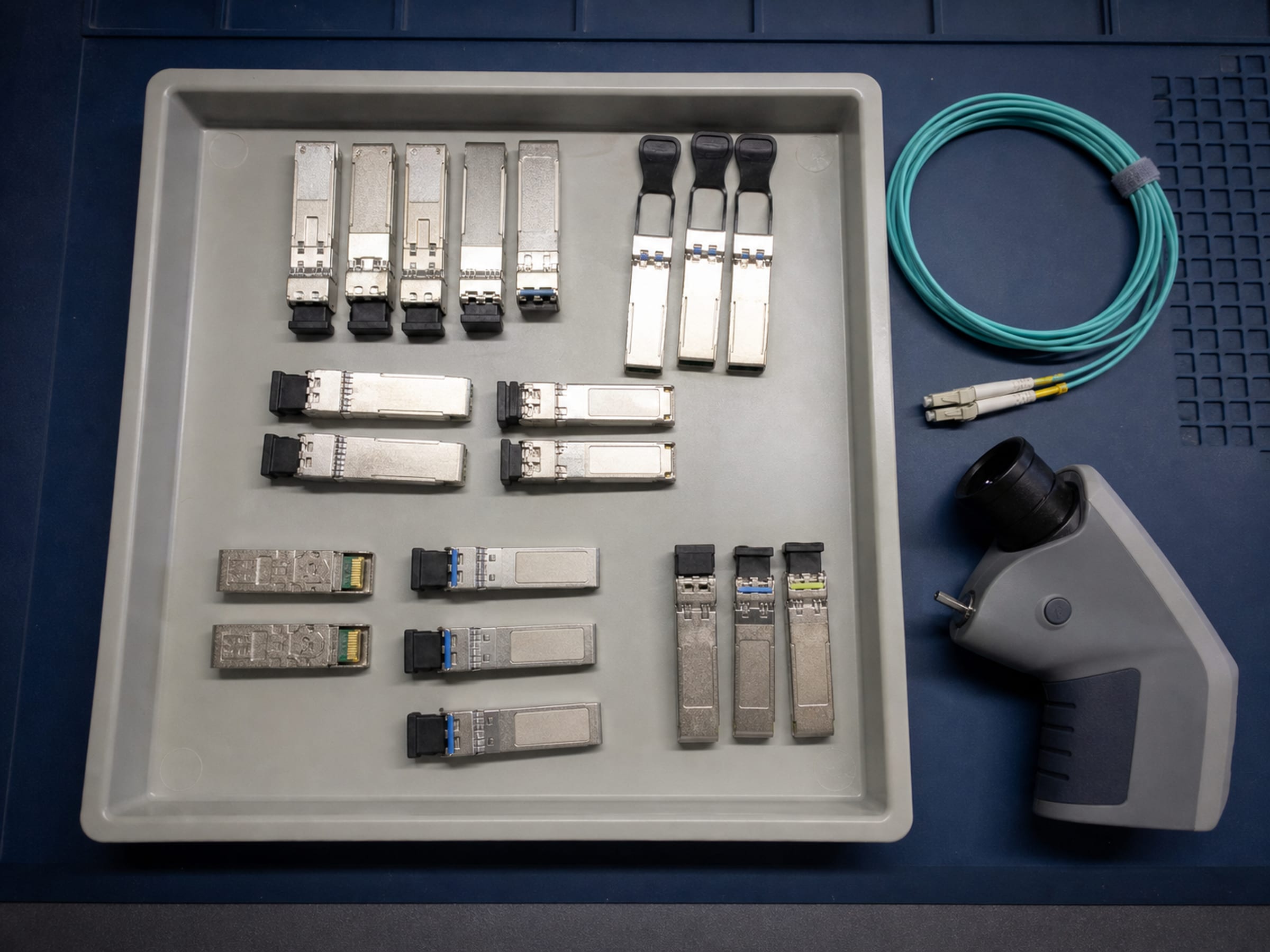
- Scope
- SFP, SFP+, SFP28, QSFP+ and QSFP28 optics, DAC and AOC
- Depth
- One of the largest priced inventories we carry
- Matched on
- Host platform coding, wavelength, reach and connector
- Stated plainly
- The OEM-support consideration, before you commit
Same module, different sticker, a tenth of the price
Optical modules are one of the few places in IT procurement where a genuinely equivalent part is available at a fraction of the branded price, and where the difference has nothing to do with quality. What the OEM sticker buys is a coding byte and a support position. Coded third-party optics from established makers are manufactured to the same MSA specifications, tested to the same parameters and programmed to be accepted by the platform you are plugging them into. The entire skill is in the matching: platform, speed, wavelength, reach, fiber type and connector, all of which have to agree at both ends of the link.
The six things that have to line up
Host platform first, because it decides the coding. A module coded for one vendor's switch may simply not be recognized by another's, and the same vendor sometimes needs different coding across product families. Give us the exact switch, router, NIC or storage controller model at each end of the link and the coding question stops being a risk.
Then form factor and speed — SFP for gigabit, SFP+ for 10, SFP28 for 25, QSFP+ for 40, QSFP28 for 100 — followed by reach and the fiber it runs on. Short-reach multimode over the wrong fiber grade is the classic distance failure; long-reach singlemode on a run that never left the rack is the classic waste. Both are avoided by measuring rather than assuming.
Connector type and duplex versus breakout finish it. A high-speed port broken out into multiple lower-speed links is a common and cost-effective pattern, and it needs the right cable assembly rather than an adapter improvised on site. Our cable length guide is built for exactly this measuring step.
The optics estate
AddOn and Axiom carry the depth here — coded modules and cable assemblies across the common speeds, reaches and host platforms.
Transceiver modules
SFP through QSFP28 in short, long and extended reach, coded to the host platform at both ends. We state wavelength, reach and fiber type per line so the module and the plant agree before anything ships.
Direct-attach and active optical cables
Passive DAC inside the rack, active optical where the distance or bend radius asks for it, and breakout assemblies where a high-speed port fans out. Measured to the rack layout rather than ordered in round numbers.
Fiber patch and structured plant
The patch cords, panels and cassettes between the module and the plant. Polarity, connector type and length are specified per run — the three details that most often turn an install into a second delivery.
Media converters where the plant is mixed
Where copper has to meet fiber — a long run to an outbuilding, a legacy segment, an industrial cabinet — media converters and their power are quoted with the rest of the link rather than as an afterthought.
Enough to quote optics without a second round trip
- Exact host platform at both ends — switch, router, NIC or controller model
- Speed and form factor required, or simply the port type if you are unsure
- Measured run length, and whether it stays inside a rack, crosses rows or leaves the building
- Fiber already installed: multimode grade or singlemode, and connector type
- Whether any links are breakout rather than one-to-one
- Spare ratio you want carried — most estates hold a small percentage per link type
The one thing worth knowing before you commit
Third-party optics are a commercial decision as well as a technical one. Some OEM support organizations will ask you to reproduce a fault using their own optics before they progress a case, and a few maintenance agreements address third-party components explicitly. This is rarely a practical obstacle and it is not a quality question, but it is a real consideration and we would rather raise it than let it surprise you during an incident.
Where a program's policy is to stay on OEM optics for supported platforms, we will quote those — including through our sister catalogs for Cisco, Aruba and Juniper platforms — and use third-party modules where the policy allows. A mixed estate is common and perfectly workable.
One catalog quirk worth knowing if you search yourself: a structured-cabling brand called Siemon surfaces on searches that look like they should return security-information tooling. It is a naming collision, not a mis-categorization.
Optics questions
Will a third-party transceiver work in our switch?
When it is coded for that specific platform, yes — coding is what the switch checks. Give us the exact model at both ends of the link and we match the module to it, along with wavelength, reach and connector, so the link comes up on first insertion rather than after a troubleshooting session.
Does using third-party optics void our support?
It does not void a warranty on the switch itself, but some OEM support organizations will ask you to reproduce a fault on their own optics before progressing a case, and some maintenance agreements mention third-party components. It is a commercial consideration rather than a technical one, and it is worth checking your specific agreement.
DAC or optics for a short link?
Inside the rack, passive direct-attach copper is cheaper, draws less power and adds less latency, and it is the right default for top-of-rack. Once the run crosses rows, exceeds the passive reach or has to bend more tightly than the cable allows, active optical or transceivers and fiber take over.
How do we work out cable lengths without a site visit?
Measure the path, not the straight line — up the rack, through management, across the tray and back down. Our cable length guide walks that calculation, and adding a small allowance is cheaper than a second delivery.
Should we hold spares?
Most estates carry a small percentage per link type, because an optic is a low-value part whose absence can hold a link down for days. We quote a spare ratio alongside the main count so it is a decision rather than an oversight.
Optics background and the cabling tools
The solutions atlas
Every solution, by technology area and by customer.
By technology
By customer
- TAA & NDAA-889 Compliance Screening
- CMMC & CUI Solutions
- Federal & DoD
- State, Local & Education
- Healthcare
- Enterprise
- Rapid Procurement & GPC Buys
- Multi-Vendor Integration Projects
- eProcurement & Custom Catalogs
- FISMA Modernization
- CJIS-Compliant Justice Cloud & Local AI
- Federal Storage Modernization
- Government ERP & Business Systems Infrastructure
- Managed Procurement
- Secure AV & Conferencing
- Fiber Network Infrastructure
- Satellite & Resilient Connectivity
- Wavelength & Optical Transport
- Decentralized Data Centers
- Data Center Design & Build
Send the platforms and the run lengths
Give us the host platform at each end and the measured distance. A Uniqcli specialist returns coded modules, DAC and patch cabling matched per link — wavelength, reach and connector stated per line, availability confirmed, screening performed before it goes out.