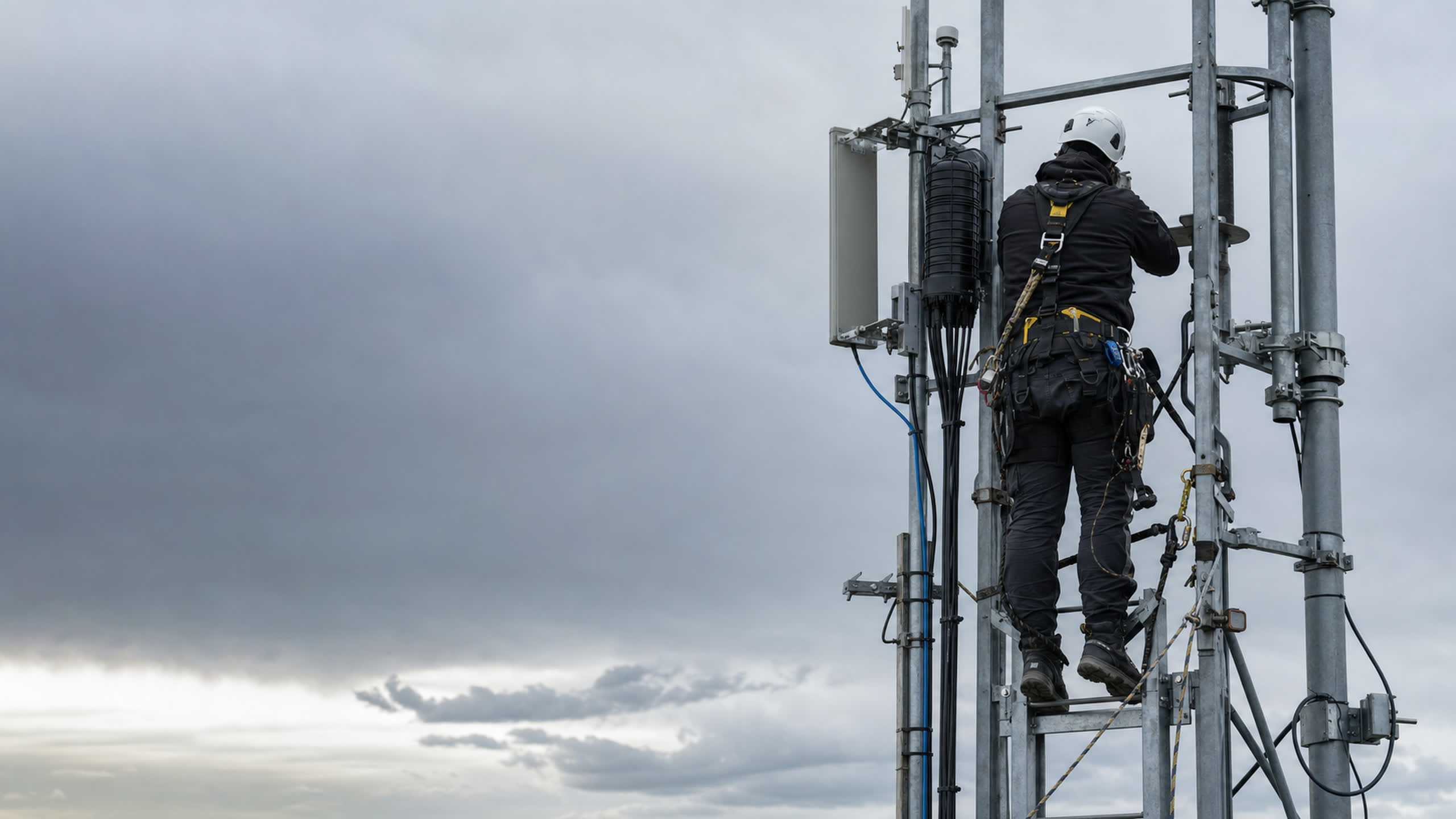
High-density Wi-Fi, outdoor and mesh coverage, and the switching, PoE and cabling backbone underneath — quoted line-by-line, staged configured, and delivered with the compliance paperwork your program requires.
Coverage complaints are almost never about the radios. They trace back to the layer nobody photographed: an access switch out of PoE budget, an uplink that can't carry a full building, cabling that never got certified. Uniqcli quotes the whole system — access points, WLAN controllers, access and aggregation switching, PoE headroom, structured cabling and outdoor bridges — as one compliant order, sourced through US distribution, screened for TAA and NDAA §889, and delivered configured instead of as a pallet of loose boxes.
What's inside
Choose where to start
Six practice areas, one quote path. Every topic below is orderable from the catalog today or scoped through a capability briefing.
One order for the radios and everything that feeds them.
Wireless projects fragment fast: the APs come from one vendor, the switches from another, the cabling from a third, and the PoE math from nobody. When a building comes up short on power budget or an uplink can't carry the floor, the finger-pointing starts. We consolidate the whole bill of materials — access points, controllers, access and aggregation switching, injectors, patch and outdoor gear — into one compliant order, with live stock and firm pricing on tens of thousands of lines.
When the requirement needs more than shipping — controller staging, switch config to your template, labeled per-building kits — our integration lane preps the plant so what arrives is ready to mount and patch, not a compatibility experiment on the ceiling.
▪TAA country-of-origin confirmed per lot; §889-covered equipment structurally excluded
▪PoE budget and uplink capacity checked against the AP count before any quote goes firm
▪Firm quotes before any commitment — no payment up front on quoted orders
▪GPC / P-Card and open-market POs accepted; priced to support the contract vehicle your program already holds
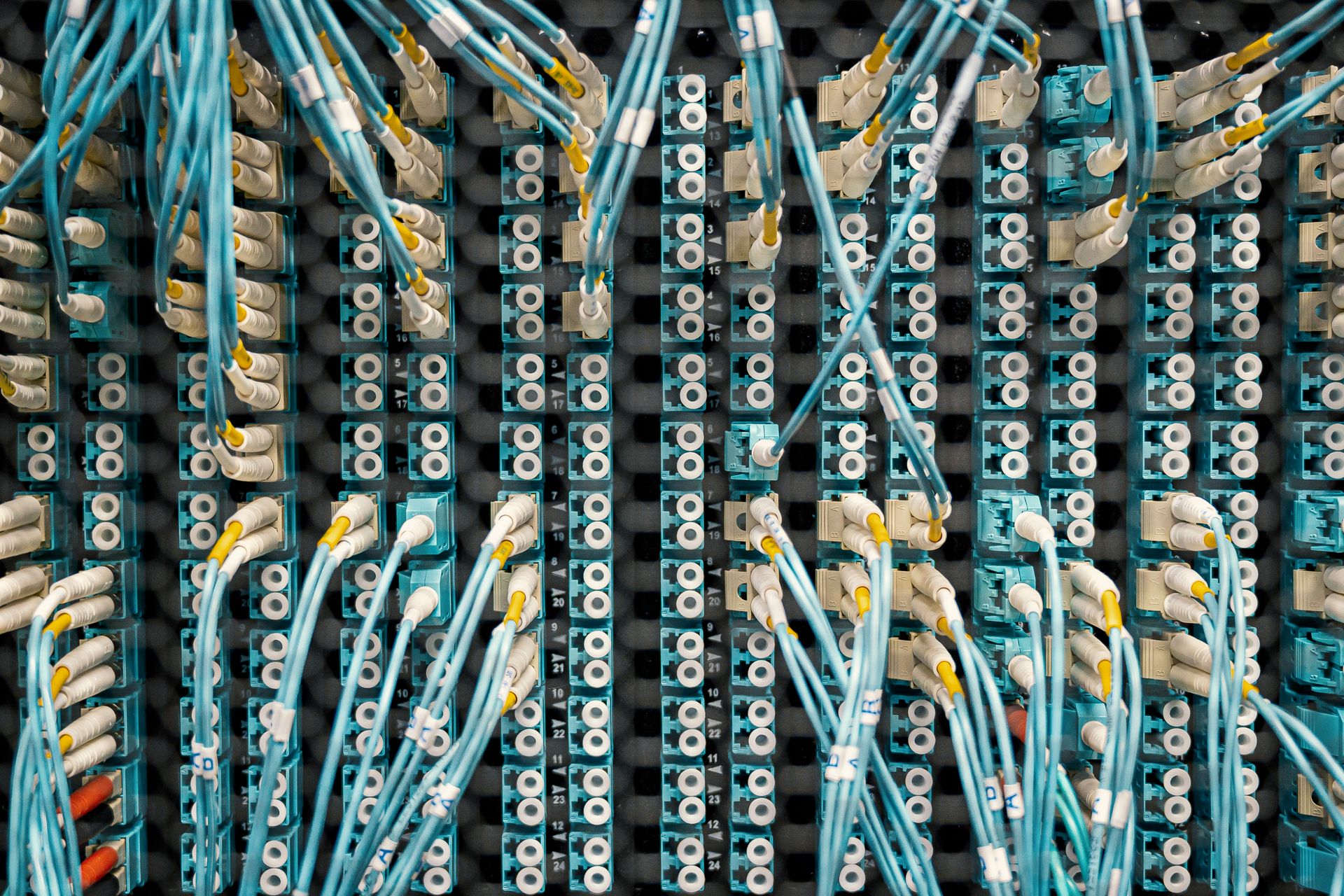
▪Rows of network switches and structured cabling in a campus distribution rack.
The practice areas
Wireless & campus connectivity, in depth
In this section
Campus Wi-Fi
Campus wireless lives or dies on density, not raw range. In a lecture hall, a residence floor or an open-plan office the problem is rarely a dead spot — it's hundreds of clients contending for the same channel. We design from a client-count and floor-plan basis: AP placement for cell overlap that supports fast roaming, band steering to keep capable devices on 5 GHz and 6 GHz, and channel plans that don't collide across a multi-building campus. Wi-Fi 6 (802.11ax) is the practical default for a refresh; Wi-Fi 6E adds the clean 6 GHz band where dense client counts justify it, and Wi-Fi 7 is worth speccing on new construction you won't touch again for years.
The controller decision shapes the whole order. Per-building or per-site controllers, a centralized controller cluster, or cloud-managed APs each carry different licensing, uplink and failover implications — and each changes how many switch ports and how much PoE budget you actually need. We quote the controller, the AP licensing term, and the switching to match as one stack, so nobody discovers at cutover that the access layer can't power a full floor of APs.
For K-12 districts, E-Rate eligibility and standardized per-building bills of materials matter as much as the radios: repeatable kits mean site 40 installs like site 3, and the paperwork supports the funding request. Higher-ed and enterprise campuses more often need guest/BYOD segmentation and roaming across large contiguous footprints — both are network-design questions we scope before the quote goes firm.
▪AP density designed from client count and floor plan, not coverage circles
▪Wi-Fi 6 / 6E / 7 chosen per refresh horizon and client mix
▪Controller model (per-site, centralized, cloud-managed) quoted with matching switch ports and PoE
▪E-Rate-eligible, repeatable per-building kits for K-12 districts
Resident Wi-Fi on a base is a housing-density problem wearing a coverage badge. Barracks, dormitories, billeting and privatized military housing pack many devices per room behind concrete-and-steel walls that Wi-Fi hates — so the design leans toward more, lower-power APs (often one per room or per pair of rooms) rather than a few hallway units trying to punch through block walls. We design from the building plan and the resident count, with per-room or per-suite segmentation so one resident's console or smart-TV traffic never becomes another's problem.
Morale, welfare and recreation networks — day rooms, fitness centers, dining, community spaces and outdoor gathering areas — are a separate coverage class with different density and durability needs, and they often extend outdoors where indoor APs stop. We quote the indoor resident plant and the MWR/common-area coverage as coordinated builds so both come off one bill of materials, with outdoor-rated hardware where the coverage crosses a threshold.
For base facilities and privatized housing operators, the practical constraints are wall construction, per-building repeatability and a clean handoff to whoever operates the network. We keep the per-building kit identical across the installation, document the substitutions where they occur, and clear every line through the same TAA and §889 screening as any federal order. We support the resident-network requirement; we don't claim any specific base program or affiliation.
▪Per-room / per-suite AP density for concrete-and-steel resident buildings
▪Resident-network segmentation so one unit's traffic stays isolated
▪MWR and common-area coverage quoted alongside the resident plant, outdoor-rated where it crosses outside
▪Repeatable per-building kits, TAA-confirmed and §889-screened, with a documented operator handoff
Stadiums, arenas and convention centers are the extreme end of the density curve: thousands of clients per acre, all active at once, in an RF environment full of steel and concrete. The design language changes here — tight cell sizes, directional and stadium-specific antennas aimed at seating bowls, aggressive channel reuse, and enough uplink capacity to carry the aggregate load off the edge. We quote the very-high-density AP and antenna hardware, the aggregation switching to backhaul it, and the cabling runs those cells demand, against a design built for the venue's geometry rather than a generic square-footage estimate.
Distributed antenna systems (DAS) and the wired backbone are the other half. Where cellular coverage matters as much as Wi-Fi — public safety, patron connectivity, wayfinding endpoints — DAS head-end and remote hardware coordinate with the Wi-Fi plant rather than competing for the same ceiling. We source the components and quote them alongside the switching so the two systems share a documented cabling and power plan.
Flightlines and hangars are a related high-density-outdoor case: very large open volumes, metal structures, aircraft that move, and coverage that has to reach flightline operations. Here the answer usually blends high-gain outdoor-rated APs, point-to-point bridges back to a facility, and — where Wi-Fi runs thin over the apron — private cellular or CBRS (see the Private 5G section). We scope which technology carries which zone before anything is quoted.
▪Very-high-density APs and directional/stadium antennas designed to venue geometry
▪Aggregation switching and cabling sized for aggregate bowl load, not average density
▪DAS head-end and remote hardware coordinated with the Wi-Fi plant on one plan
▪Flightline/hangar coverage blending outdoor APs, bridges and — where needed — private cellular
Warehouses defeat office Wi-Fi assumptions: high ceilings, tall steel racking that absorbs and reflects signal, and forklifts and scanners that need coverage in the aisles, not above them. We design for the racked reality — APs and antennas placed and aimed down the aisles, coverage validated at floor and rack-face height, and enough roaming continuity that a handheld scanner or an autonomous mover doesn't drop mid-aisle. Where racking layouts change seasonally, we flag that as a design assumption so the coverage plan can flex.
Yards and open ground are a bridging and mesh problem. Point-to-point and point-to-multipoint bridges carry a link across a yard, between buildings or out to a remote gate or scale house without trenching fiber; outdoor mesh fills coverage where running cable to every AP is impractical. Each approach trades throughput, latency and resilience differently — a PtP bridge is a fast, clean backhaul but a single link; mesh is self-healing but shares airtime — and we quote the outdoor-rated, weather- and temperature-hardened hardware with the mounting, surge protection and outdoor-rated cabling those installs actually require.
The unglamorous parts decide whether an outdoor build survives: enclosures rated for the environment, grounding and surge suppression on every outdoor run, and PoE that can still deliver budget at distance. We quote those with the radios rather than leaving them as a field surprise, and clear the whole bill through the same TAA and §889 screening as any order.
▪Warehouse APs and antennas aimed down aisles, coverage validated at floor and rack height
▪Point-to-point / point-to-multipoint bridges for yard and building-to-building links
▪Outdoor mesh where cabling every AP is impractical — throughput/resilience tradeoffs called out
▪Enclosures, grounding, surge suppression and outdoor-rated PoE cabling quoted with the radios
Every wireless design is really a wired design with radios on the end. The access switch has to power and carry each AP, the aggregation layer has to carry the buildings, and the cabling has to be rated and certified for the speeds the APs actually negotiate. We quote the whole backbone against the AP count: access switches with the right port count and PoE type, aggregation and core uplinks sized for real aggregate load, WLAN controllers and their licensing, and the structured cabling, patch panels and racks that make it permanent.
PoE budgeting is where wireless orders quietly fail. A high-density Wi-Fi 6E or Wi-Fi 7 AP with its radios lit can draw more than legacy PoE delivers — PoE (802.3af, ~15W) rarely suffices, PoE+ (802.3at, ~30W) covers most current APs, and PoE++ (802.3bt, up to ~60–90W) is what the hungriest multi-radio and outdoor units want. The trap is the switch's total power budget: thirty APs at 30W is 900W of PoE the switch has to source simultaneously, plus headroom. We check per-port class AND the switch's aggregate budget before the quote goes firm, so the access layer can actually power a full floor at once.
Cabling is the other silent failure. Cat5e will carry many APs but caps multi-gig; Cat6 and Cat6a give headroom for 2.5G/5G/10G uplinks and matter more as AP throughput climbs — and distance, bundling and certification all affect what a run really delivers. We quote patch, panels, racks and the outdoor-rated runs deliberately, and flag where an existing plant may need re-certification rather than assuming it's fine.
▪Access, aggregation and core switching sized to the AP count and real aggregate load
▪PoE type (af / at / bt) AND total switch power budget verified before the quote is firm
▪WLAN controllers and licensing quoted with the switching, not as an afterthought
▪Structured cabling, patch, panels and racks — with re-certification flagged where a plant may fall short
Some footprints are bigger than Wi-Fi wants to serve. Across a sprawling yard, a port, a flightline or a campus with long outdoor spans, private cellular can cover the same ground with far fewer radios and cleaner mobility than a field of outdoor APs. In the United States the practical entry point is CBRS — the shared 3.5 GHz band that lets an enterprise or agency stand up private LTE or 5G without holding licensed spectrum, coordinated through the SAS (Spectrum Access System) that governs the band.
Private 5G is a design decision, not a default. It shines where you need wide-area outdoor coverage, deterministic mobility for moving assets, or coverage in RF-hostile open space — and it carries real considerations: CBRS device and SAS coordination, the core/packet infrastructure to run it, SIM/credential management, and integration back into the wired network. We help scope which zones are better served by Wi-Fi and which by private cellular, and we source the CBRS radios, antennas and the switching that backhauls them.
This is a scoping-first practice area. Rather than push a technology, we map the coverage requirement to the honest answer — often Wi-Fi indoors and at density, private cellular for the wide outdoor spans — and quote the hardware for whichever carries each zone. Where the requirement is program-specific, we take it into a capability briefing before anything is priced.
▪CBRS (shared 3.5 GHz) private LTE/5G for large outdoor and RF-hostile footprints
▪SAS coordination, core/packet infrastructure and SIM/credential considerations scoped up front
▪Honest zone-by-zone split between Wi-Fi and private cellular — no technology push
▪CBRS radios, antennas and backhaul switching sourced and quoted together
From coverage requirement to connected, in four honest steps
1 · Survey
Send a floor plan, a site, or a coverage problem. We work from client counts, building construction and the density reality — not coverage circles — and confirm stock, country of origin and TAA status before anything is promised.
2 · Design & quote
A firm, line-item quote with the wired half checked: AP count, PoE budget, uplink capacity and cabling reconciled — priced for GPC, open-market PO, or to support the contract vehicle your program already holds.
3 · Stage & configure
Where the order needs it: controller and switch config to your template, per-building kits labeled per location, and outdoor hardware pre-fitted — so what ships is ready to mount and patch.
4 · Deploy & sustain
Chain-of-custody paperwork on delivery, then RMA, warranty and refresh support under the same accountable relationship.
▪How many access points does a barracks or dormitory need?
There is no per-square-foot rule that survives concrete-and-steel resident buildings — it comes down to construction and device density. As a planning starting point, dense resident housing often lands near one AP per room or per pair of rooms rather than a few hallway units trying to punch through block walls, because those walls attenuate signal hard. Send the building plan and the resident count and we design the count from there, then quote the switching and PoE to power it.
▪Wi-Fi 6E vs Wi-Fi 7 for a campus refresh?
For most refreshes, Wi-Fi 6 (802.11ax) is the practical default and Wi-Fi 6E is worth the step up where dense client counts justify the clean 6 GHz band. Wi-Fi 7 makes the most sense on new construction or a plant you won't touch again for years, since it needs 6 GHz spectrum and capable clients to show its advantage. The deciding factors are your refresh horizon, client mix and whether the switching and cabling can carry the higher throughput — we reconcile all three before quoting.
▪PoE vs PoE+ vs PoE++ — which do high-density APs need?
Legacy PoE (802.3af, ~15W) rarely powers a modern high-density AP with its radios lit; PoE+ (802.3at, ~30W) covers most current APs; PoE++ (802.3bt, up to ~60–90W) is what the hungriest multi-radio and some outdoor units want. The bigger trap is the switch's total power budget — thirty APs at 30W each is 900W the switch must source at once, plus headroom. We check both per-port class and the aggregate switch budget before a quote goes firm.
▪Do you support the contract vehicle our program already holds?
Yes. We price to support the contract vehicle your program already holds, and we also take GPC / P-Card and open-market purchase orders. We quote so the order clears your procurement path, with TAA country-of-origin confirmation and NDAA §889 screening on every line.
▪Indoor APs, outdoor mesh, or a point-to-point bridge for a yard?
It depends on distance, throughput and whether you can run cable. A point-to-point bridge is the clean choice for a fast backhaul across a yard or between buildings, but it's a single link; outdoor mesh is self-healing and fills coverage where cabling every AP is impractical, at the cost of shared airtime; indoor APs simply don't belong outdoors. We scope the yard, call out the tradeoffs, and quote the outdoor-rated hardware with the enclosures, grounding and surge protection those installs actually need.
▪When does private 5G / CBRS make more sense than Wi-Fi?
Private cellular over CBRS (the shared 3.5 GHz band) tends to win for wide outdoor footprints, deterministic mobility for moving assets, and RF-hostile open space — places where a field of outdoor APs gets expensive and messy. Wi-Fi still wins indoors and at high client density. We map the requirement zone by zone rather than pushing one technology, and take program-specific cases into a capability briefing before pricing.
The solutions atlas
Every solution, by technology area and by customer.
“What Uniqcli does for Wireless & Campus Connectivity”
Ready to scope a wireless build?
Send the requirement — a floor plan, a site, or a coverage complaint. A firm, compliance-checked quote comes back with the wired half reconciled, before anything is asked of you.