
Solutions
Data Center Network Fabric
Fabric cost lives in the optics and the cable runs at least as much as in the switches. We quote the leaf-spine build with its transceivers, direct-attach cables and patch fields measured against the rack layout, so the fabric arrives complete rather than in three deliveries and two change orders.
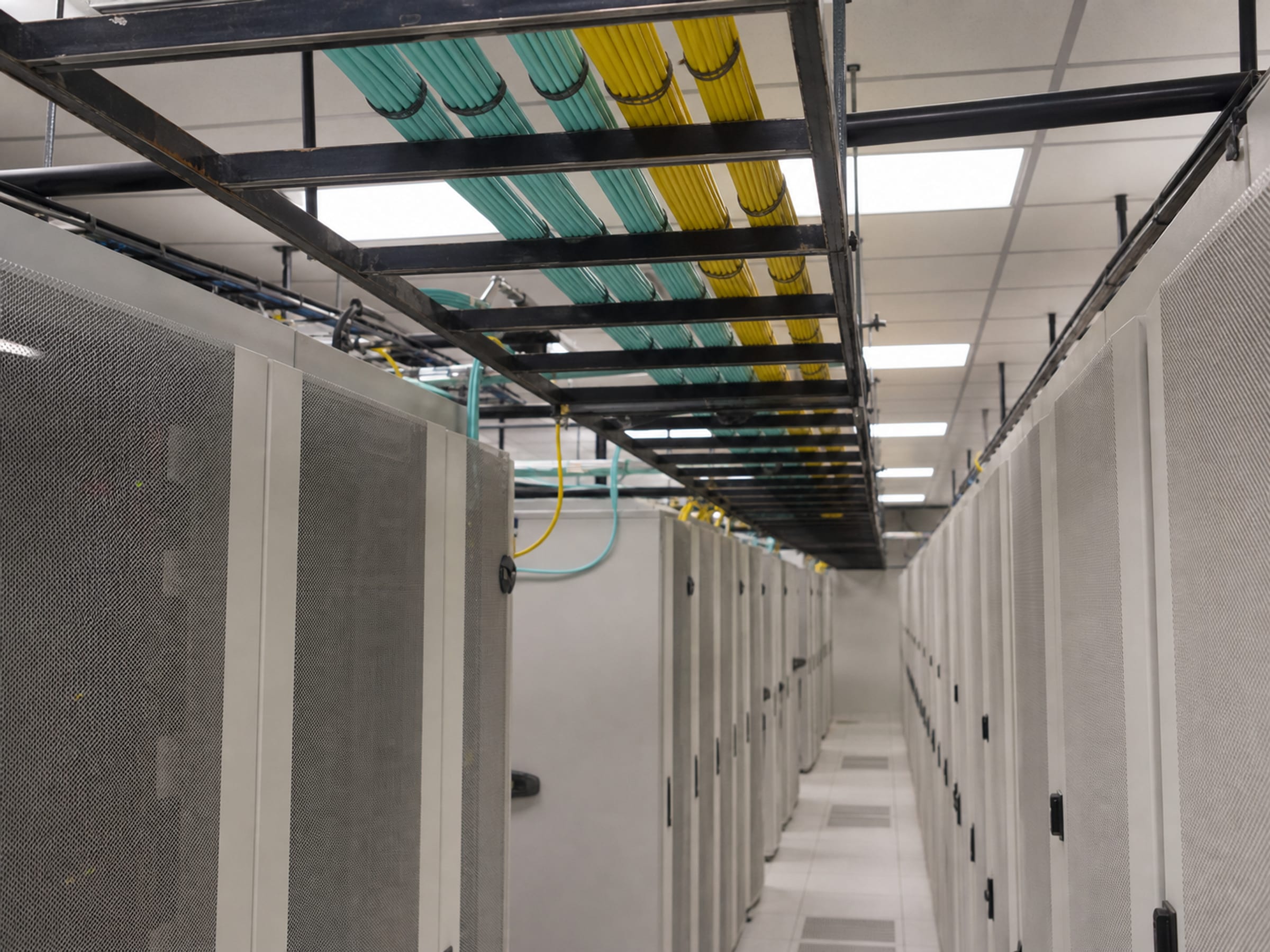
- Scope
- Leaf-spine fabric, top-of-rack, optics and structured patching
- Quoted
- Switching, transceivers, DAC and AOC, patch fields, rack hardware
- Deepest line
- Coded third-party optics — one of the largest priced sets we carry
- Boundary
- Fabric design and routing policy stay with your architects
Count the links before you count the switches
A leaf-spine fabric is described in switches and paid for in links. Every leaf-to-spine connection is two transceivers and a cable, every top-of-rack downlink is another, and a modest fabric can carry several hundred of them before anyone has racked a server. Get the media wrong — a passive direct-attach cable where the reach demanded optics, a short-reach module on a run that crosses the hall — and the fabric arrives as a pile of parts that will not light. We quote from the rack layout: which racks, what distance, which host platforms, and therefore exactly which module and cable at each end.
Where the money and the mistakes actually sit
Four decisions decide most of the bill of materials, and three of them are made before a switch is chosen.
Link count, not port count
Oversubscription ratio times rack count gives you the number of fabric links, and each link is two modules and a cable. This is the number that should be sized first, because it is the one that scales.
Media by distance
Inside the rack, direct-attach copper is cheaper, cooler and lower latency. Across rows, you are into optics and the correct fiber type. The boundary between them is a measured distance, not a preference.
Host platform coding
A transceiver has to be accepted by the platform at both ends. Coded third-party optics solve this at a fraction of the OEM line item, provided the coding is matched to the exact platform — which is the part we do rather than leave to you.
Patch field and rack hardware
Structured patching, cable management, rails and blanking are what keep a fabric maintainable at year three. Panduit and Legrand carry deep priced inventory across all of it.
Where the switches come from
Allied Telesis carries priced switching on the hub across aggregation and hardened lines. For the fabric platforms most data centers actually standardize on, Cisco sits in our sister catalogs, and Aruba and Juniper in our HPE sister catalog — all three quoted through the same RFQ rather than added to a hub cart. Send the platform your architects specified and it comes back priced alongside the optics and cabling.
The optics are the part where the hub is genuinely deep. AddOn and Axiom carry extensive priced inventory across transceivers and direct-attach cabling, coded for a wide range of host platforms — which is what makes an honest fabric quote possible rather than a switch quote with a note about optics to follow.
The complete fabric line set
Aggregation and top-of-rack switching
Allied Telesis priced rows on the hub, with Cisco, Aruba and Juniper platforms quoted through our sister catalogs on the same document. Sized to the link count and oversubscription ratio your design sets.
Transceivers and active optics
AddOn and Axiom coded modules across the common speeds and reaches, matched to the host platform at both ends of every link, with the fiber type and connector stated per line.
Direct-attach and patch fields
Passive and active DAC inside the rack, structured fiber patching across rows, and the cable management that keeps the whole thing serviceable. Measured to the rack layout rather than ordered in round numbers.
Fabric sourcing questions
How many transceivers does a fabric actually need?
Two per link, plus spares — and the link count is set by your leaf count, spine count and oversubscription ratio rather than by the number of switches. Send the rack layout and the target ratio and we produce the count with you rather than leaving it as an assumption on a quote.
Direct-attach copper or optics?
Distance decides it. Inside a rack, passive DAC is cheaper, draws less power and adds less latency. Once a link crosses rows or halls you are into optics and the correct fiber type. We quote from measured runs, because the failure mode of guessing is a delivery that will not light.
Will third-party optics work in our switches?
When coded for the specific host platform, they are widely deployed and we match module to platform, wavelength and reach per link. The consideration worth raising up front is commercial rather than technical: some OEM support organizations will ask you to reproduce a fault on their own optics.
Can you supply Cisco, Aruba or Juniper fabric switches?
Yes, through our sister catalogs rather than as a hub cart line. They are priced on the same quote as the optics, DAC and patch fields, so you still get one document and one screening pass rather than three suppliers and a coordination problem.
Fabric background and the racks it lands in
The solutions atlas
Every solution, by technology area and by customer.
By technology
By customer
- TAA & NDAA-889 Compliance Screening
- CMMC & CUI Solutions
- Federal & DoD
- State, Local & Education
- Healthcare
- Enterprise
- Rapid Procurement & GPC Buys
- Multi-Vendor Integration Projects
- eProcurement & Custom Catalogs
- FISMA Modernization
- CJIS-Compliant Justice Cloud & Local AI
- Federal Storage Modernization
- Government ERP & Business Systems Infrastructure
- Managed Procurement
- Secure AV & Conferencing
- Fiber Network Infrastructure
- Satellite & Resilient Connectivity
- Wavelength & Optical Transport
- Decentralized Data Centers
- Data Center Design & Build
Send the rack layout
Give us the rack count, the oversubscription target and the host platforms at each end. We return switching, transceivers, DAC and patch fields as one measured bill of materials — screened, availability-stated, and counted rather than estimated.