
Solutions
Network Racks & Enclosures
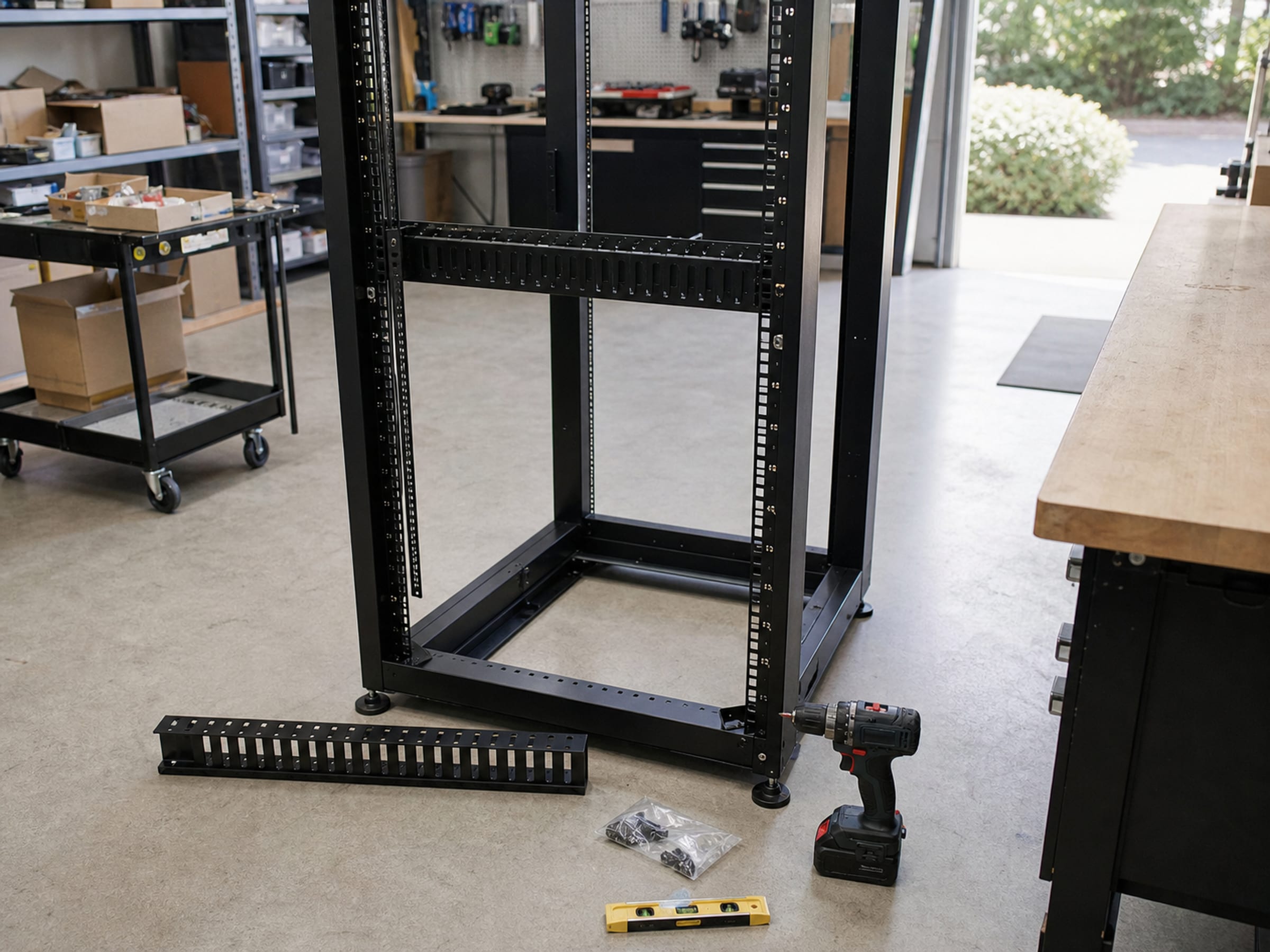
IDF closets, wall-mount cabinets and open two-post frames are chosen by the room they go in, not by the catalog. We spec the enclosure with its rails, cable management, PDU and airflow as one set, sized to the depth of the equipment and the space in front of the door.
- Scope
- IDF and MDF closets, wall-mount cabinets, two-post and four-post frames
- Quoted
- Enclosure, rails, cable management, PDU, airflow, blanking
- Distinct from
- Facility-scale hall builds — those are a data center engagement
Measure the room, then choose the rack
Enclosures are the most consistently mis-ordered category in network infrastructure, and always for the same reasons. The cabinet is deeper than the closet allows once the door swings. The equipment is deeper than the rails and the rear posts cannot be moved far enough back. Nobody counted rack units for the patch panels and the cable management, so the switch that should sit at the top has nowhere to go. The PDU was ordered with the wrong receptacle for the plugs it has to serve. All five are room questions, and all five are cheaper to answer before delivery than after.
The enclosure and everything mounted in it
Legrand, Panduit, Eaton and Vertiv carry deep priced inventory across racks, cabinets and the infrastructure that fills them.
Cabinets and open frames
Full-height cabinets, two-post and four-post open frames, and wall-mount enclosures for closets where floor space does not exist. Specified by usable depth and by what the door has to clear, not just by height.
Rails, shelves and mounting
Rail kits are model-specific, and the wrong one turns a delivery into a return. Shelves for equipment that has no rails, blanking panels for airflow, and the mounting hardware for everything else.
Cable management and patch fields
Horizontal and vertical management, patch panels, and the routing plan that keeps a rack serviceable three years in. Panduit and Legrand carry both the panels and the management that goes around them.
Power in the rack
PDUs sized to the load with the receptacle types the equipment actually has, plus the UPS behind them. Eaton, Vertiv and Schneider Electric are quoted with runtime rather than a default, and cord lengths are specified per rack.
Enough to spec a closet in one pass
- Room dimensions, including door swing and the clearance in front and behind
- The deepest piece of equipment going in, measured with its cable bend allowance
- Total rack units needed — equipment, patch panels, management and growth
- Power available: circuits, receptacle types and whether it is single or three-phase
- Cooling reality — conditioned closet, corridor air, or a room with no ventilation at all
- Physical security requirements: locking doors, side panels, keyed-alike sets
What stays yours to run
We specify and supply the enclosure and everything mounted in it. Floor loading, seismic bracing requirements, structural fixings into the building fabric and any permit or inspection those attract belong to your facilities engineer and the authority with jurisdiction. We will tell you the weight of what we are shipping; we will not tell you the floor can carry it.
Airflow is the other honest boundary. We quote blanking, management and rack-level power that support good airflow, but whether a closet with no ventilation can host the equipment you are putting in it is a mechanical question about that room. Where a build is facility-scale — containment, precision cooling, switchgear — it stops being an enclosure purchase and becomes a data center engagement.
Rack and enclosure questions
Wall-mount or floor-standing for an IDF closet?
Depth and access usually decide it. Wall-mount enclosures suit shallow equipment and closets with no floor space, but they limit what you can put in and how you service it. If the closet has to hold a UPS, deep switches or anything needing rear access, a floor-standing cabinet or open frame is the better purchase even where it is the bulkier one.
How many rack units should we allow?
More than the equipment list suggests. Patch panels, horizontal management between them, blanking for airflow and a growth allowance routinely add half again to a naive count. We work the elevation with you rather than sizing from the equipment alone.
Do you supply the PDU with the rack?
Yes, and it should be specified together — the PDU has to match the circuits available and the receptacle types on the equipment, not merely fit in the rack. We quote it with the UPS behind it and with cord lengths per rack rather than a default.
The solutions atlas
Every solution, by technology area and by customer.
By technology
By customer
- TAA & NDAA-889 Compliance Screening
- CMMC & CUI Solutions
- Federal & DoD
- State, Local & Education
- Healthcare
- Enterprise
- Rapid Procurement & GPC Buys
- Multi-Vendor Integration Projects
- eProcurement & Custom Catalogs
- FISMA Modernization
- CJIS-Compliant Justice Cloud & Local AI
- Federal Storage Modernization
- Government ERP & Business Systems Infrastructure
- Managed Procurement
- Secure AV & Conferencing
- Fiber Network Infrastructure
- Satellite & Resilient Connectivity
- Wavelength & Optical Transport
- Decentralized Data Centers
- Data Center Design & Build
Send the room and the equipment list
Give us the closet dimensions and what has to go in it. The quote comes back as the enclosure, rails, management, patch fields and rack power as one set — sized to the room, availability stated per line, screened before it goes out.