
Short answer
A rack unit (U or RU) is 1.75 inches (44.45 mm) of vertical mounting space in a 19-inch rack, so a 2U server occupies 3.5 inches and a 42U rack gives 73.5 inches of mountable height. The unit describes height only: width is set by the rack format and depth is a separate dimension you have to check against the chassis.
Key facts
- One rack unit is 1.75 inches (44.45 mm) of vertical mounting space, so 2U is 3.5 inches and 4U is 7 inches.
- A 42U rack gives 42 x 1.75 = 73.5 inches of mountable height and holds 42 one-U devices, or any mix of heights adding to 42 or less.
- EIA-310 specifies the rack unit, the vertical and horizontal hole spacing, the rack opening and the front-panel width.
- '19-inch' is the width between the mounting rails, not the outside of the cabinet. A 23-inch format also exists, mostly in telecom.
- U measures height only: chassis depth and cabinet depth — often quoted as 600, 800 or 1200 mm — are separate dimensions to check independently.
- A vertical PDU is 0U: it mounts in the rack's side channel and consumes no usable U, unlike a 1U or 2U horizontal PDU.
By Uniqcli Team
A rack unit — written as U or RU — is the standardized unit of height for equipment mounted in a 19-inch server rack. One rack unit equals exactly 1.75 inches (44.45 mm). A device described as "1U" occupies one of these increments; a "2U" server takes up two, or 3.5 inches of vertical rail space. The measurement is defined by the EIA-310 standard, which is why a 1U switch from one maker fits the same rails as a 1U server from another.
The U measurement standardizes only height and the mounting-hole pattern along the vertical rails — it says nothing about a device's width or depth. Equipment is built to a common 19-inch front-panel width so it spans the rack's threaded or square-hole rails, while depth varies widely by device. Understanding U sizing lets you count how many devices fit in a rack, budget for growth, and avoid the common mistake of buying capacity you can't actually power, cool, or physically fit.
How does rack unit (U) measurement work?
Rack height is measured in whole U increments up the vertical mounting rails, with 1U fixed at 1.75 inches. The rails carry a repeating hole pattern defined by EIA-310: within each U, the mounting holes are spaced 0.625, 0.625, and 0.5 inches apart, giving three holes per unit. That pattern is what makes gear interchangeable — a chassis built to occupy 2U lines up with the correct holes regardless of manufacturer. Rack heights are named for their usable U count: a full-height rack is commonly 42U, which yields 42 × 1.75 = 73.5 inches of mountable space, though the enclosure's outer frame stands taller.
Width is the second half of the standard. A "19-inch rack" refers to the distance across the front-panel mounting flanges; a wider 23-inch format also exists, mostly in telecom and carrier environments. Depth is a separate dimension the U value does not describe. Enclosures come in varying depths (often quoted in millimeters, such as 600, 800, or 1200 mm), and the device inside has its own chassis depth. A short 1U appliance and a deep 1U server both consume one U of height but place very different demands on rack depth and cable clearance.
What are the common rack unit sizes for servers, switches, and PDUs?
Network switches, routers, and thin appliances are usually 1U, prioritizing port density in minimal height. General-purpose servers most often come in 1U or 2U; 2U is popular because it allows more drive bays, larger heatsinks, full-height expansion cards, and better airflow. Storage arrays, GPU servers, and higher-capacity systems commonly run 3U or 4U, and blade or high-density chassis can occupy 6U to 10U or more while housing many compute nodes in a shared enclosure.
Power distribution units (PDUs) illustrate why U counting has an exception. Horizontal PDUs mount like any other device and consume 1U or 2U. Vertical PDUs, however, are described as "0U" because they mount in the rack's side channels — the zero-U space beside the rails — and therefore consume no usable U height at all. Accessories like cable managers, blanking panels, and shelf trays are also sold by U, and blanking panels matter for cooling: filling empty U slots prevents hot exhaust air from recirculating to equipment intakes.
When do you need to plan around rack units — full rack vs. half rack?
You plan in U whenever you are consolidating equipment, provisioning a colocation cabinet, or forecasting growth. A "full rack" typically means a complete enclosure — often 42U — while a "half rack" refers to roughly half that usable height (commonly around 18U to 24U), frequently sold as a share of a colocation cabinet with its own power and access. Counting the U footprint of every planned device, plus PDUs, patch panels, and cable management, tells you whether the workload fits in a half rack or needs a full one.
Leave deliberate headroom rather than filling every slot. Reserve U space for near-term expansion, keep some slots open for airflow and serviceability, and account for the top-of-rack switching and power gear that recurs in every cabinet. Planning by U count early prevents the expensive surprise of a device that has no home, or a rack that is height-full long before it is workload-full.
What should you consider when sizing and buying rack equipment?
Height in U is only the starting point. Confirm chassis depth against the enclosure's usable depth, remembering to leave clearance behind the device for power cables, network cabling, and cable-management arms. Check the rack's weight rating and how load is distributed — a rack full of dense storage or GPU nodes can approach structural and floor-loading limits well before it runs out of U space. Verify the mounting hole type as well: square-hole rails use cage nuts, round-hole rails may be threaded, and included rail kits must match.
Power and cooling frequently constrain a rack before height does. Total the power draw of planned equipment against PDU capacity and the circuit feeding the rack, and confirm the cooling design can remove the resulting heat. Follow hot-aisle/cold-aisle airflow direction, install blanking panels in unused U slots, and plan power redundancy (such as dual PDUs on separate circuits) if uptime requires it. Sizing that balances U count, depth, weight, power, and cooling together produces a rack that is dependable rather than merely full.
Key takeaways
- One rack unit (U) equals exactly 1.75 inches (44.45 mm) of vertical mounting height, standardized by EIA-310 so gear is interchangeable across makers.
- U measures height only — width (typically 19 inches) and depth are separate dimensions you must check independently.
- Typical sizes: switches and appliances 1U; servers 1U–2U; storage and GPU systems 3U–4U; blade chassis 6U and up.
- Vertical PDUs are "0U" — they mount in the rack's side channels and consume no usable U height, unlike 1U/2U horizontal PDUs.
- A full rack is often 42U (73.5 inches usable); a half rack is roughly 18U–24U, common in colocation.
- Power, cooling, chassis depth, and weight limits often fill a rack before U height does — size for all of them, not just U count.
Shop it at Uniqcli
Parts for this job
Full height, 42U
StarTech.com
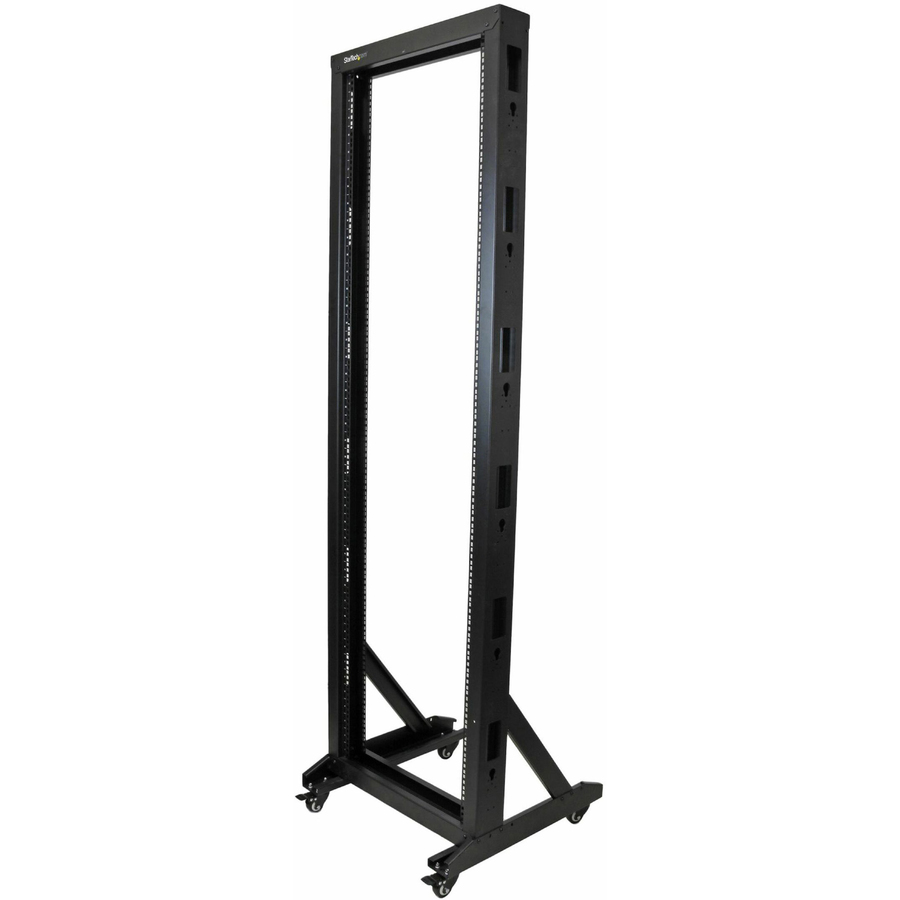
StarTech 2-Post 42U Mobile Open Frame Server Rack, Two Post 19in…
2POSTRACK42
A 42U two-post open-frame rack on casters rated to 663 lb, built to EIA/ECA-310 — the reference height most rack planning is written against.
Two-post frames suit switches and patch panels; deep servers on rails need a four-post frame.
$258.37In stock12U on a desk or floor
Eaton
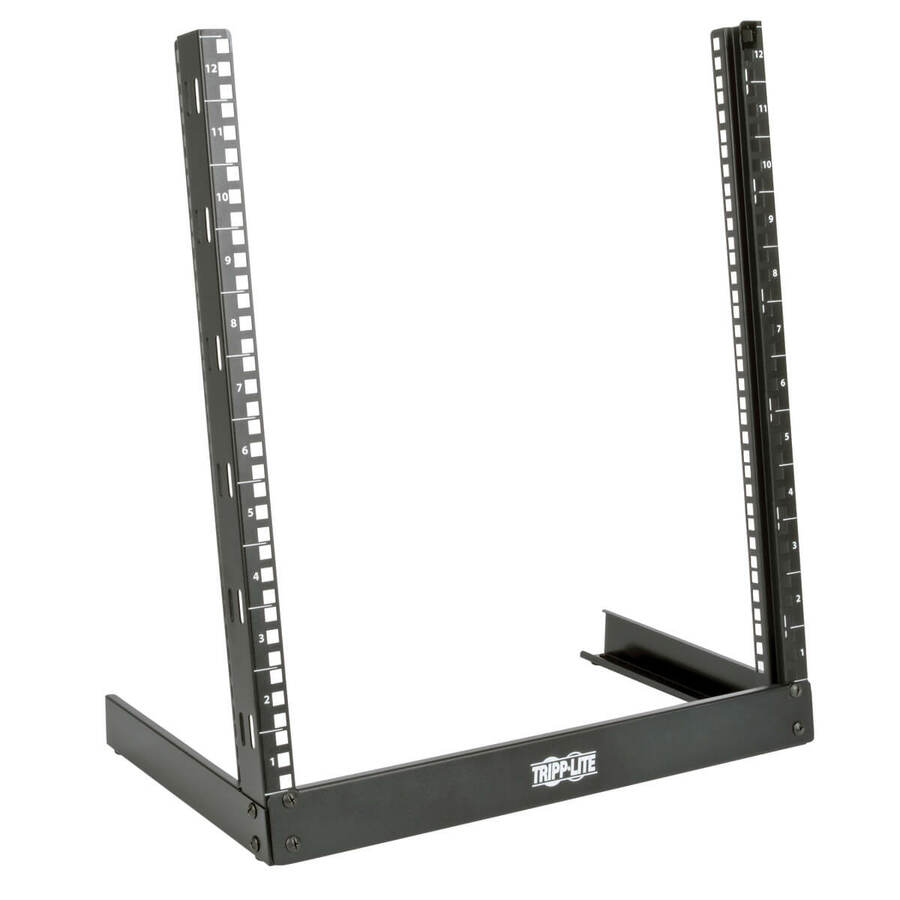
Eaton Tripp Lite Series SmartRack 12U Desktop 2-Post Open-Frame Rack
SR2POST12
A 12U two-post open-frame rack that stands on a floor or a bench, for a room whose whole stack is a switch, a patch panel and a small appliance.
$83.23In stock12U on a wall
StarTech.com
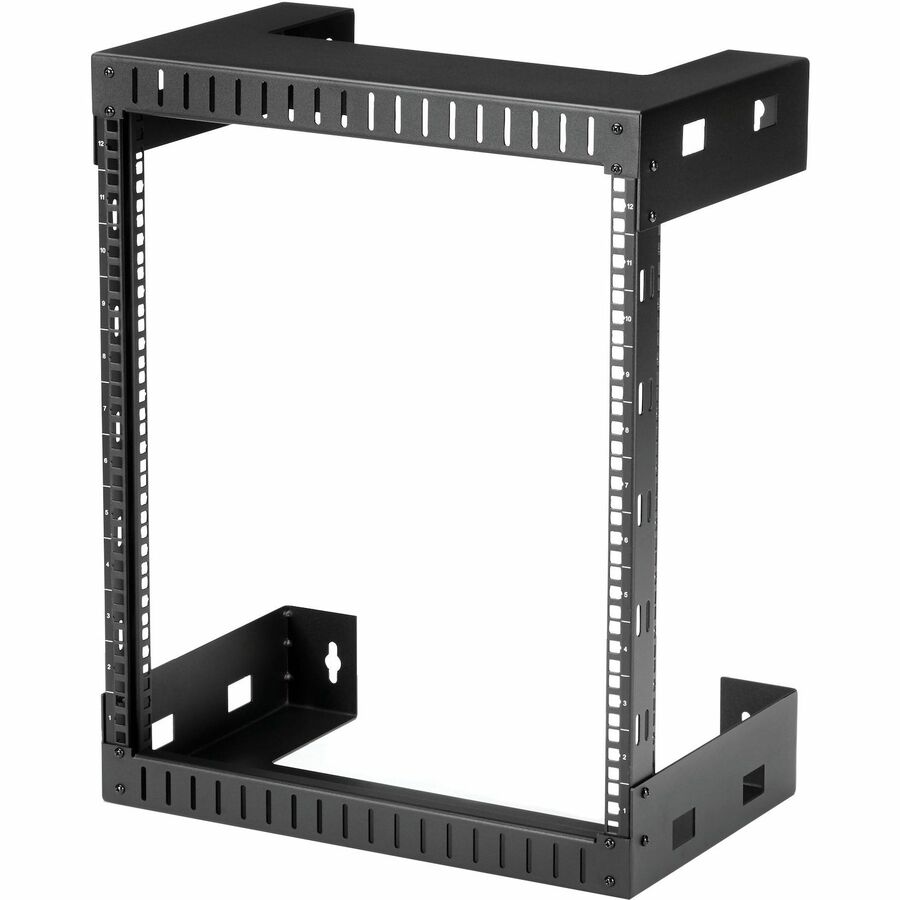
StarTech 2-Post 12U Heavy-Duty Wall-Mount Network Rack, 19" Open Frame…
RK12WALLO
A 12U wall-mounted open frame rated to 200 lb and built to EIA/ECA-310, for a closet where floor space is the constraint rather than U height.
$118.81In stockFrequently asked
- What does 1U, 2U, 3U, 4U mean?
- They are heights, counted in rack units of 1.75 inches each. 1U is 1.75 inches, 2U is 3.5 inches, 3U is 5.25 inches and 4U is 7 inches of vertical mounting space on the rails. The number tells you nothing about width or depth: a 1U appliance eight inches deep and a 1U server thirty inches deep both occupy one unit and make completely different demands on the cabinet. As a rough guide to what you will meet, switches and network appliances are usually 1U, general-purpose servers 1U or 2U, storage and GPU systems 3U or 4U, and blade chassis 6U and up.
- How many servers can fit in a 42U rack?
- Forty-two 1U servers in principle, or twenty-one 2U servers, because 42U is 73.5 inches of mountable height. In practice the answer is almost always lower, and height is rarely what runs out first: the circuit feeding the rack, the cooling available to it, the cabinet's weight rating and the depth needed for cable management and service access each cap the count before the rails do. Leave space for the PDUs that are not 0U, patch panels, cable managers and blanking panels as well, then size the power and cooling to the total draw rather than to the U count.
- How many inches is a rack unit?
- One rack unit (1U) is exactly 1.75 inches, or 44.45 millimeters. Multiply to get taller devices: a 2U device is 3.5 inches and a 4U device is 7 inches. A common 42U rack provides 42 × 1.75 = 73.5 inches of usable mounting height, though the outer frame is taller.
- Does a rack unit measure width or depth too?
- No. A rack unit measures only vertical height and the mounting-hole pattern along the rails. Width is set separately by the rack format — 19 inches is standard (23 inches exists in telecom). Depth is another independent dimension, so always confirm a device's chassis depth against your enclosure's usable depth plus cabling clearance.
- What is a 0U PDU?
- A 0U PDU is a vertical power distribution unit that mounts in the rack's side channels rather than across the mounting rails. Because it sits beside the equipment area, it consumes no usable U height — hence "0U." Horizontal PDUs, by contrast, mount like any device and take up 1U or 2U.
- How do I calculate how much rack space I need?
- Add up the U height of every device — servers, switches, storage, PDUs, patch panels, and cable managers — then compare the total to your rack's usable U (for example, 42U). Leave headroom for growth, airflow, and blanking panels, and separately confirm that depth, weight, power, and cooling capacity can support the load.
Sources
Keep reading