
Network & data center services
Structured Cabling Services
Structured cabling is the one layer of a building that is expensive to revisit, because revisiting it means opening the walls again.
- Quoted as a bill of materials
- Standards-aligned design guidance behind the counts
- Installation coordinated as part of the quoted project
Live prices from our catalog right now — a starting point, not the project price. Your quote is scoped to the site and includes the licensing and services the job needs.
Tell us the project — Structured cabling
Tell us where to reach you and a Uniqcli specialist follows up by email to scope the work with you — what has to be covered, how many sites or buildings, and what already exists — then comes back with a quoted bill of materials across the equipment, the software licensing and the deployment work.
Priced against your own site rather than a package tier, sourced through US distribution and screened line by line. We specify, supply, stage and integrate; internet access is scoped separately from the equipment on this page, and operating the network stays with your team or the provider you contract.
The first number is our real one, not an opening one.
Tell us the scope and we come back with the best price we can do on it.
- Supporting federal, state & local purchasers
- GPC & P-Card accepted
- TAA & NDAA-889 screening before every quote
At a glance
The plant, quoted as one document
We quote the plant as a bill of materials — cable, patch panels, keystones, racks, pathway and labeling — with standards-aligned design guidance behind the counts, and installation coordinated as part of the quoted project.
- Scope
- Cable · patch fields · keystones · racks · pathway
- Design order
- Counts, distances and pathways before part numbers
- Lines
- Panduit, Leviton, Tripp Lite, C2G and Black Box
- Boundary
- We supply and coordinate — the network stays yours to run
Overview
The counts and the pathways are the whole decision
Structured cabling gets treated as a commodity purchase right up until the first change order. The cable itself is rarely where a project overruns. It overruns on the drop count nobody re-counted after the furniture plan moved, on a pathway that is already at fill capacity, on patch panels ordered in a termination style that does not match the racks they are going into, and on the labeling scheme that was supposed to be somebody else's job.
Continue readingShow less
We work the plant the way it is actually built — outlets per work area, horizontal runs against the distances they have to cover, telecom room and rack elevation, pathway and support, then the patch field that ties it together — and quote the materials as one document. Panduit, Leviton, Tripp Lite, C2G and Black Box carry live-priced rows across most of that scope, so a structured cabling bill of materials comes back priced line by line rather than as a lump sum with the detail hidden inside it.
The bill of materials
What a structured cabling quote has to contain
A cabling quote listing only cable and outlets is missing roughly half of what the crew needs on day one, and the missing half is what gets bought twice at retail prices mid-install. These are the four groups we price together.
Horizontal cable, outlets and keystones
Cable category chosen per run rather than per building, in the jacket rating the pathway requires — plenum where the run crosses a plenum space, riser where it goes vertically between floors. Then the parts that have to agree with each other: keystone jacks in a style the faceplates accept, faceplates and surface-mount boxes in the count the furniture plan implies, and blanks for the positions that are reserved rather than populated.
Patch fields and cross-connects
Flat or angled panels, 110 punch-down or feed-through keystone, and port density measured against the rack units actually available in the closet. Patch cords are specified in the lengths and colors the scheme calls for rather than ordered in one length and coiled — a patch field that is legible two years later is worth more than one that was fast to install.
Racks, cabinets and cable management
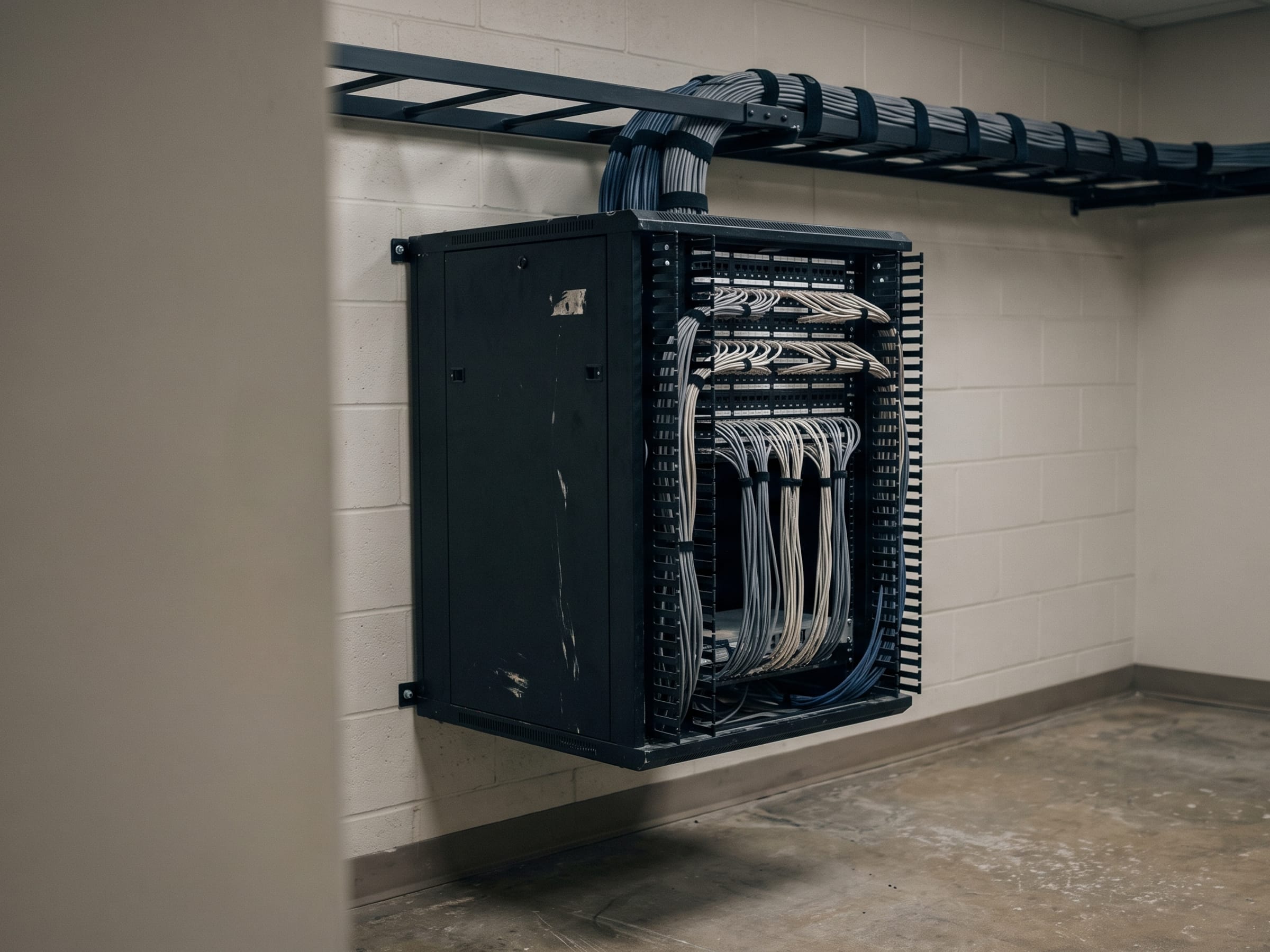
Two-post relay racks, four-post cabinets and wall-mount enclosures for closets that have no floor to give, sized on depth as well as height. Vertical and horizontal managers, blanking panels, grounding busbars and bonding hardware belong on the same order — they are the lines that get value-engineered out first and re-ordered first.
Pathway, support and labeling
J-hooks, ladder rack, cable tray, D-rings and the hardware that holds a bundle at the spacing the design assumes. Firestop sleeves and pathway devices are specified where the design calls for them; the penetration inspection and its sign-off stay with the licensed trades and the authority having jurisdiction. Label stock and the labeling scheme itself are quoted rather than assumed.
Design guidance
Standards-aligned counts before part numbers
The horizontal channel has a budget and everything else follows from it: 90 metres for the permanent link with the full channel capped at 100 metres once the patch cords at both ends are counted. The practical consequence is that the location of the telecom room decides the drop count more than the size of the floor plate does, and that a handful of runs at the far corner of a building are usually the reason a design needs a second closet or an intermediate distribution point. Working that out on a floor plan costs an hour. Working it out after the cable is pulled costs the pull.
Category choice is a per-run decision that gets made per building far too often. The application matters, but on most sites the deciding factor is the PoE class of whatever hangs off the drop and how many of those runs share a bundle: powered devices raise the temperature in the middle of a bundle, and a warmer cable carries more insertion loss over the same distance. The mitigations are all cheap on paper — smaller bundles, a higher category on the affected runs, shorter runs — and all expensive once the ceiling is closed. Worth knowing before the comparison is made on unit price alone: Cat6A generally costs more to install than to buy, because the larger diameter, the tighter bend radius and the extra pathway fill all show up in labor.
The remainder of the guidance is the unglamorous part that decides whether the plant is maintainable: pathway fill and support spacing, grounding and bonding designed in rather than added after the network starts logging errors, telecom room layout with room to work behind the rack, and a labeling and as-built convention chosen once and applied everywhere. None of it is expensive at design time and all of it is expensive as a retrofit.

Lines we quote
Where the parts come from
Availability is stated per line, and the quote says which lines are priced today and which are sourced through authorized US distribution. Naming a manufacturer describes the lines we quote, not a Uniqcli partnership, authorization or endorsement.
Panduit and Leviton
Copper and fiber connectivity, patch panels, jacks and faceplates, cable management and labeling systems — the parts of a plant that have to be specified as a family rather than assembled from whatever was cheapest that week. Both carry live-priced rows across the connectivity estate, which is what makes a per-line quote possible on a short timeline.
Tripp Lite, C2G and Black Box
Patch cords and cable assemblies in the lengths and colors a scheme actually calls for, racks and cable management, and media conversion or extension for the runs that exceed what copper will carry. Tripp Lite is an Eaton line. All three price across the assembly and rack estate rather than only at the headline part numbers.
Sourced on request
Bulk reels in a specific jacket rating, custom-length assemblies, pre-terminated trunks and the consumables a crew burns through are quoted through authorized US distribution rather than listed with a shelf price. Where a category has no priced rows we say so and quote it, instead of naming a line we cannot verify is available to you.
What's included
What's included in a structured cabling bill of materials
The whole bill of materials — the parts a crew needs on day one, not only the cable and the outlets.
- Horizontal cable in the category each run needs and the jacket rating the pathway requires — plenum where the run crosses a plenum space, riser where it goes vertically between floors
- Outlets and keystones specified as a family rather than assembled from whatever is cheapest that week
- Patch fields and cross-connects — flat or angled panels, punch-down or feed-through keystone — with port density measured against the rack units the closet actually has
- Racks, cabinets and wall-mount enclosures sized on depth as well as height, with the cable management that keeps the field legible
- Pathway and support — J-hooks, ladder rack, cable tray, D-rings and the hardware that holds a bundle at the spacing the design assumes
- Labeling, and the standards-aligned counts behind all of it: 90 metres for the permanent link and 100 metres for the full channel once the patch cords at both ends are counted
- Bulk reels in a specific jacket rating, custom-length assemblies, pre-terminated trunks and crew consumables, sourced through authorized US distribution with availability stated per line

How buying works
From a floor plan to a screened order
There is no shelf price on a cable plant, because the plant is a drawing before it is a parts list. What can move quickly is turning the drawing into a priced, screened bill of materials.
Send what you have — a floor plan, a drop schedule, a rack elevation or the bill of materials from the last site you built
A Uniqcli specialist works the counts with you: outlets per area, run distances, pathway capacity, closet and rack space
Cable, patch fields, racks, pathway and labeling come back as one bill of materials with availability stated per line
Where the project scope includes installation, it is coordinated against your site schedule rather than sold as hourly labor
TAA (FAR 52.225-5) and NDAA §889 screening is performed on every line before the quote goes out, with alternates for anything that does not clear
GPC / P-Card accepted up to your cardholder threshold; purchase orders otherwise, with the final total confirmed before you commit
Multi-site
Buying cabling nationally rather than site by site
Cabling labor is local and stays local — that part does not change with scale. What changes once an organization has more than a handful of sites is the materials. The same drop, specified five different ways by five different bidders, is how a portfolio ends up with five patch panel styles, five labeling conventions and a spares cupboard where nothing fits anything. Holding the bill of materials as a national standard is the cheapest form of standardization available, because it costs nothing to apply and it compounds at every site after the first.
The standard is worth the most on the parts nobody argues about: keystone style, patch cord lengths and colors, panel termination style, label stock, rack hardware. Once those are fixed, a branch refresh is a re-order rather than a re-design, a technician who worked one site can work the next one, and the spares held centrally are the spares the sites actually consume.
Materials ship to each site on the schedule the install calendar calls for, phased rather than dumped on a dock in week one, with the same screening applied per line at every site. For a rollout across many locations that phasing is usually what makes the project manageable — a site receives what its install plan calls for, in the order it calls for it.
Turn the drawing into a priced bill of materials
Send a floor plan, a drop schedule or the parts list from the last site you built, and the cabling, patch fields, racks and pathway come back as readable lines. If run lengths are still being worked out, the cable length guide gets patch-cord and horizontal counts close enough to budget against.
Limits
Where our line falls
We are a national supplier and integrator, not a local low-voltage or electrical contractor bidding hourly labor. We specify the plant, source it through authorized US distribution, quote it as a bill of materials, and coordinate installation as part of the projects whose scope includes it. Permits, inspections, firestop penetration sign-off and code compliance stay with the licensed trades performing the work and with the authority having jurisdiction. No supplier can sign those off on your behalf, and one that implies otherwise is selling you a problem to discover later.
We do not design your network, own its addressing or its security policy, or operate it after handover, and we make no uptime or response-time commitment on the plant or on anything riding it. Availability is stated per line rather than promised in general terms: a meaningful share of any catalog this size is backordered at any given moment, so a project that has to land on a date gets its long-lead lines identified during scoping rather than at the loading dock.
Related
The lanes either side of the cable plant
Cabling rarely arrives on its own. These are the adjacent scopes most often quoted on the same project.
Common questions
Structured cabling questions
Are you a structured cabling contractor?
We are a national supplier and integrator. We specify the plant, quote the materials as a bill of materials, and coordinate installation as part of the projects whose scope includes it; the trades performing the work on site are licensed for that jurisdiction and the permits and inspections stay with them. If you already have a cabling contractor you are happy with, the most common arrangement is the cleanest one: we supply the materials to your standard and they install, so responsibility for the parts and responsibility for the workmanship sit in obvious places.
Cat6 or Cat6A — how should we decide?
Per run, not per building. Start with what hangs off the drop and how hard it draws over PoE, then look at how many of those runs share a bundle and how long they are, because bundled powered runs get warm and a warm cable carries more loss over the same distance. The part that gets missed in a unit-price comparison is that Cat6A generally costs more to install than to buy — larger diameter, tighter bend radius, more pathway fill. We flag which runs genuinely need it rather than upgrading the whole floor to be safe.
Can you standardize cabling across multiple sites?
That is the main reason organizations buy cabling nationally rather than site by site. One bill of materials becomes the standard: the same keystone style, patch cord lengths and colors, panel termination style, rack hardware and label stock at every location. Materials are released per site against your install calendar, screened per line each time, so the fortieth branch is built from the same parts list as the first and the central spares actually fit.
Do you provide certified test results and as-built records?
Where the project scope includes installation, certified link test results per run, labeling and as-built documentation are part of the cabling deliverable — that is what makes the plant defensible for warranty and for the moves, adds and changes that follow. Where we are supplying materials only, testing belongs to whoever performs the install, and it is worth writing into their scope explicitly. An undocumented plant is not a problem in year one; it is a problem in year three when nobody can trace a run.
Do you quote bulk cable, custom assemblies and pre-terminated trunks?
Yes. Bulk reels in a specific jacket rating, custom-length assemblies and pre-terminated trunks are quoted through authorized US distribution rather than listed with a shelf price, because length, jacket, connector and count all change the part. Send the run schedule or the drawing and they come back on the same quote as the panels, racks and pathway.
Is cabling hardware TAA and §889 screened?
Yes, and passive hardware is precisely where this gets assumed rather than checked. Cable, panels, jacks, racks and pathway contain no electronics, which tempts people to treat origin as a non-question — but the test turns on where a part was manufactured or substantially transformed, not on whether it powers up, and a catalogued panel is frequently produced in more than one plant under one part number. We record manufacturer-stated country of origin per part number rather than per brand, check each maker with its parent and affiliates against the NDAA §889 covered-entity list, and put alternates beside anything that does not clear before you see a total. The determination on your award stays with your contracting officer; the diligence behind it is ours to run.
The solutions atlas
Every solution, by technology area and by customer.
By technology
By customer
- TAA & NDAA-889 Compliance Screening
- CMMC & CUI Solutions
- Federal & DoD
- State, Local & Education
- Healthcare
- Enterprise
- Rapid Procurement & GPC Buys
- Multi-Vendor Integration Projects
- eProcurement & Custom Catalogs
- FISMA Modernization
- CJIS-Compliant Justice Cloud & Local AI
- Federal Storage Modernization
- Government ERP & Business Systems Infrastructure
- Managed Procurement
- Secure AV & Conferencing
- Fiber Network Infrastructure
- Satellite & Resilient Connectivity
- Wavelength & Optical Transport
- Decentralized Data Centers
- Data Center Design & Build
Send the drawing, get the parts list
A floor plan, a drop schedule or a rack elevation is enough to start. One quote comes back with cable, patch fields, racks, pathway and labeling as readable lines, screened per line before it goes out.