
Network & data center services
Network Installation Services
Install day is decided weeks before install day. We stage the hardware with the configuration your team supplies, kit it per site, label it so it can be found on a loading dock, and release it against the rollout schedule — so the crew on site spends the window connecting equipment rather than assembling it.
- Scope
- Staging · configuration loading · kitting · per-site release
- Unit of work
- The site — one bill of materials, many delivery dates
- Cabling
- Scoped from a survey; ANSI/TIA-568 family and ANSI/BICSI N1-2019
- Boundary
- We load the configuration your network owner supplies
Tell us the project — Network installation
Tell us where to reach you and a Uniqcli specialist follows up by email to scope the work with you — what has to be covered, how many sites or buildings, and what already exists — then comes back with a quoted bill of materials across the equipment, the software licensing and the deployment work.
Priced against your own site rather than a package tier, sourced through US distribution and screened line by line. We specify, supply, stage and integrate; internet access is scoped separately from the equipment on this page, and operating the network stays with your team or the provider you contract.
The first number is our real one, not an opening one.
Tell us the scope and we come back with the best price we can do on it.
- Supporting federal, state & local purchasers
- GPC & P-Card accepted
- TAA & NDAA-889 screening before every quote
Live prices from our catalog right now — a starting point, not the project price. Your quote is scoped to the site and includes the licensing and services the job needs.
The work that decides install day happens before the truck leaves
A network installation goes wrong in predictable ways: boxes arrive in the wrong order, two of the four sites are missing the optics, somebody configures the fiftieth switch differently from the first, and the equipment window closes before the closet is finished.
Continue readingShow less
Almost none of that is field work. It is preparation, and it is far cheaper to do once, centrally, on a bench. Network installation services here mean the hardware is received into a build, configured to the standard your network owner sets, labeled at both ends, kitted per site with the small parts that get forgotten, recorded against its serial number and released on your schedule. Network deployment services across many locations are the same discipline with a calendar attached: one bill of materials, one kit definition per site type, and delivery dates that follow the rollout rather than the purchase order.
Deployment-ready, not merely delivered
Equipment leaves configured and identified rather than factory-default and anonymous, so what lands on a dock matches what the install plan expects.
Configuration loading and labeling
The configuration your network owner supplies is loaded and validated against your baseline, firmware brought to the level your standard requires, and the unit labeled the way the install plan refers to it.
Continue readingShow less
Because it happens once and centrally, the fiftieth unit matches the first, and the drift that comes from configuring gear one closet at a time never starts.
Per-site kitting
Each site gets its own carton set: the switches for that closet, the optics for both ends of every link, stacking cables, patch cords cut to a length somebody measured, rails, blanking panels and the mounting hardware that otherwise stops a job at four in the afternoon.
Continue readingShow less
Kits are built to a definition per site type, so branch fifty is packed like branch one.
Rack and enclosure build
Where a rack is part of the order it can be built, populated, cabled and dressed to your elevation before it ships, so the first time the system is assembled is not on install day.
Continue readingShow less
Enclosure, patch field, power distribution and cable management are quoted with it rather than left as an installer's surprise.
Asset records and manifests
Serial numbers, applied asset tags, loaded configuration and firmware level and the site each unit is destined for are captured as equipment moves through staging, not reconstructed afterwards.
Continue readingShow less
The receiving team reconciles against a manifest instead of cataloging boxes, and property accountability starts at delivery.
Send the site list, get a staged plan back
Go to the formSwitch installation, closet by closet
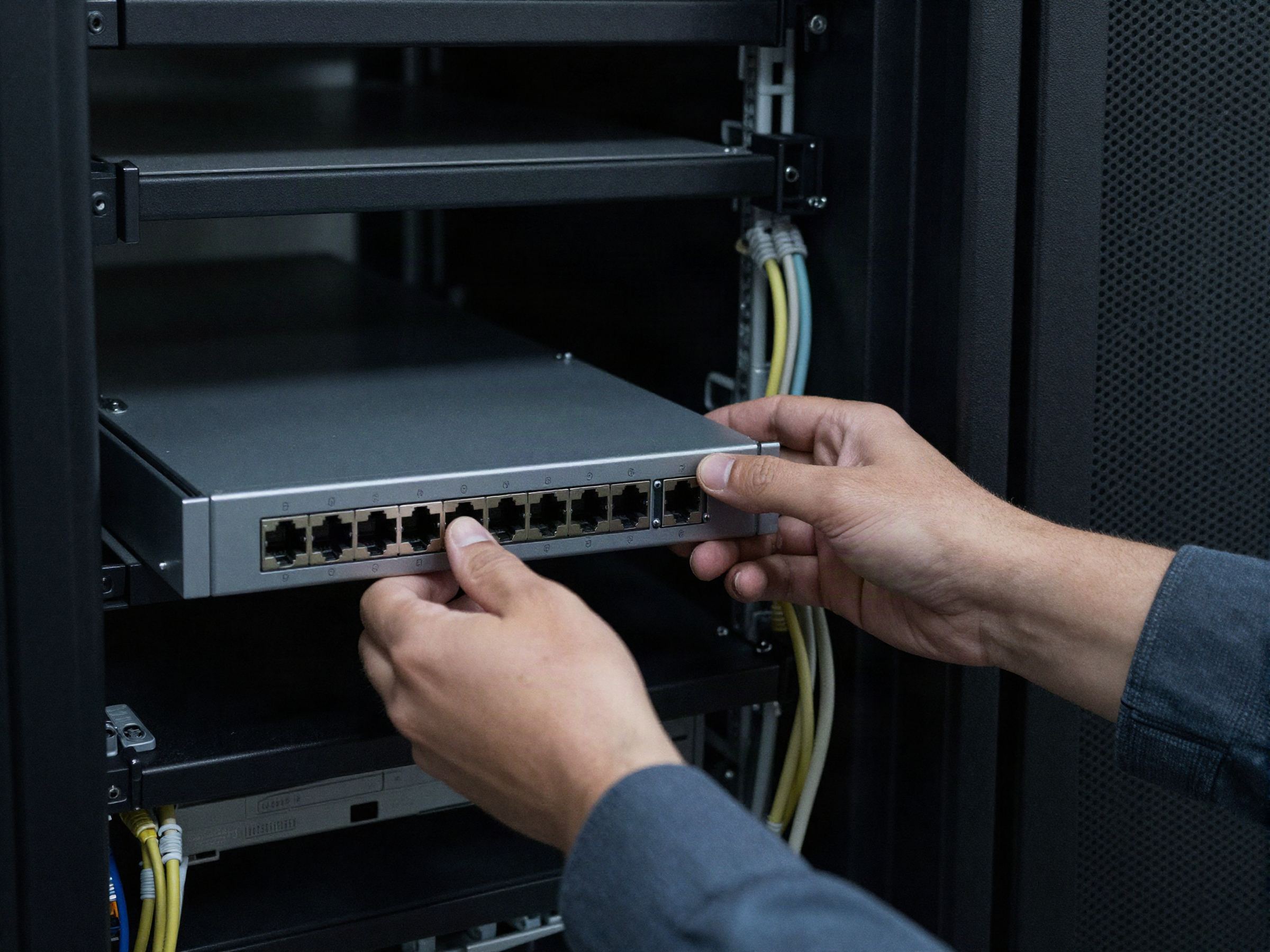
Switch installation is the part of a network rollout most often underestimated, because the switch itself is the easy half. What decides whether a closet is finished at the end of the window is everything around it: the uplink optic at both ends and whether it matches the platform, wavelength and distance; the stacking cable, which is model-specific and routinely forgotten; the rails for a chassis deeper than the one coming out; the patch cords at a length that lets the cable management close; and whether the power feeding the rack can carry the new draw once the powered devices come back up.
Continue readingShow less
We work switch installation from the closet list rather than the purchase order. Each closet gets its own line set — the switch or stack, the optics, the stacking and power cabling, the rack hardware and the patch field — staged and boxed together so the crew opens one carton per closet. Where a stack is replacing a stack, the configuration your team supplies is loaded and validated before it ships, so the cutover is a swap and a verification rather than an on-site build.
Old equipment is handled as its own decision rather than an assumption. Decommissioned switches can be quoted for lifecycle handling, returned to your own asset process, or left in place until the new path is proven — but the plan says which, before the crew arrives, because a closet with two generations of equipment and no plan for the older one is how a cutover window gets used up.
One bill of materials, many delivery dates
A rollout across dozens or hundreds of locations is a logistics problem wearing a networking costume. These three decisions make it repeatable.
Kit definitions per site type
Sites are rarely identical, but they usually fall into three or four types. Defining a kit per type — small branch, large branch, warehouse, hub — turns a rollout into a repeatable pack rather than a bespoke pick each time, and it makes the spares question answerable: you hold whole kits, not a pile of assorted parts.
Release against the schedule, not the order
Configured, kitted equipment is held and released to each site on its own date, so a location receives exactly what its install plan calls for in the order the plan calls for it.
Continue readingShow less
One procurement record covers the program; the delivery calendar belongs to the rollout, and it can move when a site slips.
The survey that sets the physical scope
What has to happen inside a building — cable pathway, closet condition, power, whether a rack fits through the door — is established by a site survey rather than assumed from a floor plan.
Continue readingShow less
The survey is what turns an equipment quote into a scope of work, and it is where the cable plant, if one is needed, gets defined.
What's included in a network installation
What staging produces, and what arrives on the dock because of it.
- The configuration your network owner supplies, loaded and validated against your baseline, with firmware brought to the level your standard requires
- Labeling the way the install plan reads, so a carton can be found on a loading dock
- Per-site kitting — the switches for that closet, the optics for both ends of every link, stacking cables, patch cords cut to a length somebody measured, rails and blanking panels
- Rack and enclosure build, populated, cabled and dressed to your elevation before it ships, where a rack is part of the order
- Asset records and manifests — serial numbers, applied asset tags, loaded configuration and firmware level, and the site each unit is destined for
From the closet list to a finished site
- Send the site list, the closet inventory and the configuration standard your network owner works to
- Kit definitions are agreed per site type, and the bill of materials is quoted with availability stated per line
- TAA (FAR 52.225-5) and NDAA §889 screening runs on every line before the quote goes out, with alternates where a line does not clear
- Equipment is received into staging, configured to the supplied standard, labeled, kitted and recorded against its serial
- Physical scope — pathway, closet work, rack build and any cable plant — is set from a survey rather than assumed
- Kits are released site by site against your schedule, with a manifest the receiving team can reconcile against
Where the cable plant fits in the job
A network installation that needs new cabling is really two scopes on one schedule, and they have different rules. Cable plant work is designed against the BICSI Telecommunications Distribution Methods Manual and installed to the ANSI/BICSI N1-2019 standard and the ANSI/TIA-568 family, with pathways and spaces following TIA-569, labeling and records following TIA-606 and bonding and grounding following TIA-607. Copper and fiber links are certified before handover, because a cable plant that has not been tested is an unknown wearing a label.
Continue readingShow less
The code side is the National Electrical Code — communications circuits under Article 800, power-limited signaling under Article 725, optical fiber under Article 770 — including separation from power conductors and the removal of accessible abandoned cable. Those are the practices the work follows. Jurisdiction-specific low-voltage licensing and permitting for a given site are confirmed during the survey for that project rather than assumed, so the scope reflects what the location actually requires rather than a generic assumption.
Where the cable plant already exists and only needs extending or re-terminating, that is usually the cheaper path and we will say so. Where it does not, it belongs in the design and in the quote, not in a conversation on install week.
Scope the rollout before the first site
Send the site list and the closet inventory and a specialist will work the kit definitions and the schedule with you. What comes back is one bill of materials, a kit per site type and a release calendar you can move when a site moves.
What we do not do on an installation
We do not author your configuration. The addressing plan, VLAN and routing policy, firewall rules and the security baseline are your network owner's or your integrator's; what we do is load the configuration they supply, validate it against the baseline they define, and label the result. Whether that configuration is right for your environment is a judgement that stays with the people who own the network.
Continue readingShow less
We do not operate the network once it is in service. There is no monitoring desk on our side, no availability or response-time commitment, and no ongoing administration of the equipment after handover. Support contracts and maintenance are quoted as their own lines where a manufacturer offers them, and the coverage they carry is the manufacturer's rather than ours.
We also do not assert code compliance on a building. Cabling practice follows the standards named above, and the licensing and permitting for a given site are confirmed at survey; the determination itself belongs to the authority having jurisdiction. Any dates on a rollout schedule depend on availability, and lines that are long-lead are identified early rather than discovered at the dock.
What usually travels with an installation
The design in front of it, the cabling under it and the standards that make a rollout repeatable.
Network installation questions
Are you a network installation company or a hardware reseller?
Both halves of that question describe part of it. We source hardware and software licensing through authorized US distribution, stage and configure it, kit it per site, build racks to your elevations and scope the physical and cabling work from a survey — the full cycle from bill of materials to a finished site. What we do not do is run the network afterwards; operations, monitoring and administration stay with your team or the provider you contract.
What does switch installation include?
The closet, not just the box. Each closet is staged as a set — the switch or stack with the configuration your team supplies already loaded and validated, the optics for both ends, stacking and power cabling, rails, blanking, patch cords cut to length and the patch field — labeled and boxed together. On site the work is the swap, the terminations and the verification rather than an assembly job under time pressure.
Can you handle a rollout across many locations?
That is the case staging is built for. Sites are grouped into types, a kit is defined per type, and one bill of materials covers the program while configured equipment is held and released site by site on its own date. A site that slips moves its delivery rather than the whole order, and each shipment arrives with a manifest the receiving team can reconcile against.
Do you supply the configuration for the equipment?
No — we load and validate the configuration your network owner or integrator supplies, and we will tell you plainly if what we are given is incomplete for the hardware in the order. Standardizing that configuration before a rollout starts is usually the single highest-value hour in the project, because everything staged after it inherits the standard.
Who is responsible for permits and low-voltage licensing?
Jurisdiction-specific low-voltage licensing and permitting for a given site are confirmed during the survey for that project rather than assumed, so the scope reflects what the location actually requires. Cabling work follows the ANSI/TIA-568 family and the ANSI/BICSI N1-2019 installation standard with NEC Articles 725, 770 and 800 on the code side; the compliance determination itself rests with the authority having jurisdiction.
How is an installation ordered and paid for?
Equipment, staging and the physical scope are quoted as separate readable lines against one bill of materials, with availability stated per line so long-lead items surface early. GPC / P-Card is accepted up to your cardholder threshold and purchase orders otherwise, with stock and the final total confirmed before you commit.
The solutions atlas
Every solution, by technology area and by customer.
By technology
By customer
- TAA & NDAA-889 Compliance Screening
- CMMC & CUI Solutions
- Federal & DoD
- State, Local & Education
- Healthcare
- Enterprise
- Rapid Procurement & GPC Buys
- Multi-Vendor Integration Projects
- eProcurement & Custom Catalogs
- FISMA Modernization
- CJIS-Compliant Justice Cloud & Local AI
- Federal Storage Modernization
- Government ERP & Business Systems Infrastructure
- Managed Procurement
- Secure AV & Conferencing
- Fiber Network Infrastructure
- Satellite & Resilient Connectivity
- Wavelength & Optical Transport
- Decentralized Data Centers
- Data Center Design & Build
Send the site list, get a staged plan back
One bill of materials, a kit definition per site type, and a release calendar that follows the rollout instead of the purchase order. Every line screened for TAA and NDAA §889 before the quote goes out.