
Solutions
Branch & Remote Office IT Standardization
Fifty sites should get one bill of materials. We hold the standard kit, build it repeatably and ship site by site, so every location comes up the same way and the twelfth deployment looks exactly like the first.
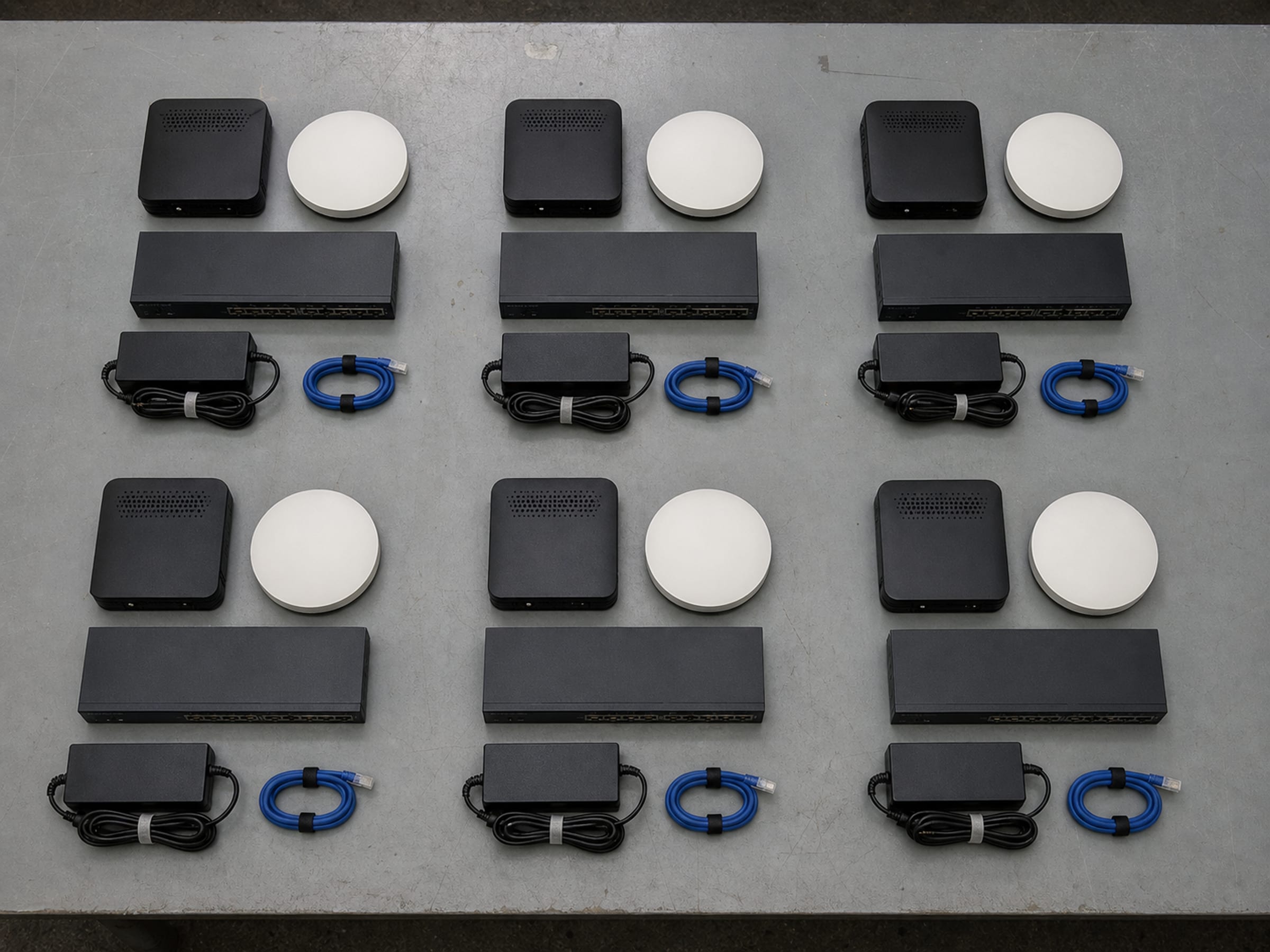
- Scope
- A held standard kit, built repeatably across a site estate
- What we quote
- Edge switching, Wi-Fi, firewall, failover, power, endpoints
- Boundary
- The network and its credentials stay yours to operate
Variance is the real cost of a multi-site estate
Nobody plans a divergent estate. It accumulates: site four got a different switch because the first one was out of stock, site nine has a firewall two generations behind because it was bought under a different budget year, and site seventeen has an access point somebody sourced locally in an emergency. Two years later every troubleshooting call starts with the question of what is actually installed, spares fit nothing, and a firmware program is thirty separate projects. Uniqcli holds the standard instead. One bill of materials, built the same way every time, staged and shipped site by site — so the estate that exists after the rollout is the estate that was designed, and the runbook written for the first site still describes the last one.
What a standard actually has to pin down
A useful standard fixes more than a model number. It fixes the port count and PoE budget at each site tier, the wireless density the space needs, whether the site has a failover path and what carrier it uses, the UPS runtime that a clean shutdown requires, and the small physical things that nobody documents until they go wrong — mount type, cable lengths, plug types and where the labels go.
Most estates need two or three tiers rather than one kit. A twelve-person satellite office and a hundred-person regional site do not share a switch, but they can absolutely share a design language: the same manufacturer, the same firmware train, the same configuration template, the same spares logic. That is what makes an estate supportable, and it is a cheaper form of standardization than pretending every site is identical.
Then there is the boring discipline that makes it hold: a kit that is reviewed on a schedule rather than whenever a line goes end of sale, with successor parts identified before the original disappears. A standard that quietly drifts because nobody re-ratified it is just variance with a document attached.
The four blocks most branch kits are built from
Allied Telesis, Netgear, Ubiquiti, Peplink, SonicWall, CyberPower and Lenovo cover the standard branch bill of materials from verified priced lines. Naming a manufacturer describes the market, not a Uniqcli partnership or endorsement.
Edge switching and wireless
Allied Telesis and Netgear across access switching, with Ubiquiti covering the smaller sites and the wireless estate. The specification that matters at branch scale is PoE budget rather than port count — access points, phones and cameras exhaust a switch's power budget long before they exhaust its ports.
Firewall and secure edge
SonicWall carries a deep priced line across the appliance sizes branch sites actually use. Standardizing the firewall across the estate is what makes a single policy and a single firmware train possible; buying whatever fit each budget year is what makes both impossible.
Cellular failover
Peplink carries a fully priced multi-WAN and cellular line for sites where a single circuit is the whole connectivity story. Failover is also the out-of-band path that lets a site be recovered remotely when the primary link is the thing that failed. The carrier plan is a contract you hold directly.
Site power and endpoints
CyberPower and Eaton rack and tower UPS units sized for a clean shutdown rather than a heroic runtime, alongside the Lenovo endpoints the site standard specifies. Power is the part of a branch kit most often left off the bill of materials and most often regretted.
From an agreed standard to the fiftieth site
- Standard agreed per site tier, with the successor part identified for each line
- Kit built to a controlled bill of materials — no verbal substitutions on the floor
- Imaging, firmware baseline and configuration staging run against your template
- Asset tag applied and serial recorded against the destination site
- Kits released to your phased rollout schedule rather than shipped all at once
- Standard re-ratified on a schedule, before a line goes end of sale rather than after
Standardization questions
Can you hold the kit and ship on demand?
Kits are built to a controlled bill of materials and released against your phased rollout schedule through our warehousing and staging lane, so sites receive complete kits on their own dates rather than a single bulk delivery somebody has to store. Stock and lead time on each line are confirmed before you commit.
What happens when a line in the standard goes end of sale?
We raise it before it bites and quote the successor, so the standard is re-ratified deliberately rather than broken by the first out-of-stock order. Our lifecycle checkers cover published end-of-sale and end-of-support notices for several major manufacturers, and the same discipline applies to lines they do not cover.
Do you configure the equipment to our template?
Imaging, firmware baseline and configuration staging run against the build sheet and template you provide, and every unit is logged as it moves through integration. What we do not do is author your configuration or hold credentials to the running estate.
Do you operate the branch network afterwards?
No. We source, build, stage and deliver. The running network — its policy, its monitoring, its credentials and its support — belongs to your team or the MSP you already work with. The program stays yours to run — the policy, the schedule, the decisions and the records. What a supplier puts behind it is the hardware, the licensing and the integration work that puts either into service.
The lanes and reading behind a kit
The solutions atlas
Every solution, by technology area and by customer.
By technology
By customer
- TAA & NDAA-889 Compliance Screening
- CMMC & CUI Solutions
- Federal & DoD
- State, Local & Education
- Healthcare
- Enterprise
- Rapid Procurement & GPC Buys
- Multi-Vendor Integration Projects
- eProcurement & Custom Catalogs
- FISMA Modernization
- CJIS-Compliant Justice Cloud & Local AI
- Federal Storage Modernization
- Government ERP & Business Systems Infrastructure
- Managed Procurement
- Secure AV & Conferencing
- Fiber Network Infrastructure
- Satellite & Resilient Connectivity
- Wavelength & Optical Transport
- Decentralized Data Centers
- Data Center Design & Build
Send one site and we will build the standard from it
A representative site list and the tiers you need. We come back with a per-tier bill of materials, staged and released to your rollout schedule.