
Network & data center services
Campus WiFi Solutions for Schools and Multi-Building Sites
A campus is not one wireless network. It is a set of buildings with different construction eras, different closet conditions and a backbone between them that decides what any of it can carry.
We scope the wireless building by building, quote the wired path that connects them, and phase the work against a budget cycle you can actually fund.
- Scope
- Per-building access points · PoE switching · backbone · licensing
- Design order
- Room-by-room capacity, then the wired path back
- Phasing
- Quoted per building so work can land in funded stages
- E-rate
- Informational context only — we make no program or funding claims
Tell us the project — Campus WiFi
Tell us where to reach you and a Uniqcli specialist follows up by email to scope the work with you — what has to be covered, how many sites or buildings, and what already exists — then comes back with a quoted bill of materials across the equipment, the software licensing and the deployment work.
Priced against your own site rather than a package tier, sourced through US distribution and screened line by line. We specify, supply, stage and integrate; internet access is scoped separately from the equipment on this page, and operating the network stays with your team or the provider you contract.
The first number is our real one, not an opening one.
Tell us the scope and we come back with the best price we can do on it.
- Supporting federal, state & local purchasers
- GPC & P-Card accepted
- TAA & NDAA-889 screening before every quote
Live prices from our catalog right now — a starting point, not the project price. Your quote is scoped to the site and includes the licensing and services the job needs.
Campus network design is a building-by-building exercise
The word campus hides how different the buildings usually are. A 1960s classroom block with plaster over lath, a 1990s library with a metal mezzanine and a new gymnasium with a 30-foot ceiling are three separate wireless problems that happen to share a budget line, and a design that averages across them will over-serve one and fail another.
Continue readingShow less
The order of work is the same everywhere: room by room, what has to be covered and how many devices will associate at once; then closet by closet, whether the switching can power and backhaul what the rooms need; then building to building, whether the fiber between them can carry the aggregate. Only after that does an access point model matter. This page is the quote-led lander for that work — if you want the broader engineering pillar covering outdoor links, point-to-point paths and campus-wide connectivity design, that lives on our wireless campus connectivity page.
The four spaces that set a campus design
Almost every campus has these four, and a plan that handles them honestly tends to handle the corridors and offices without further argument. Naming a manufacturer describes the lines we quote, not a Uniqcli partnership, authorization or endorsement.
Classrooms and one-device-per-student
A room with thirty or more devices associating within a few minutes of each other is a capacity design, not a coverage one, and testing windows concentrate that load further by putting every room on the same schedule.
Continue readingShow less
In-room access points are usually the answer rather than corridor coverage borrowed through a doorway, and the wall construction between rooms decides how much channel reuse is realistic.
Gymnasiums, halls and lecture theatres
High ceilings, hard reflective surfaces and crowd density at unpredictable intervals. Ceiling-mounted access points at 30 feet cover a floor differently to the same unit at 9 feet, and the assembly that fills the room twice a year is the load that decides the design.
Continue readingShow less
These spaces frequently justify directional antennas or a different mounting approach rather than more units of the same thing.
Libraries, labs and older blocks
The buildings where propagation surprises people. Metal shelving, dense stacks, older plaster and steel-framed partitions all absorb or reflect more than a modern interior wall, and older blocks are also where the closet is least likely to have the power budget or the uplink the new hardware needs.
Continue readingShow less
These are the areas worth surveying rather than modelling.
Outdoor spaces and the ground between buildings
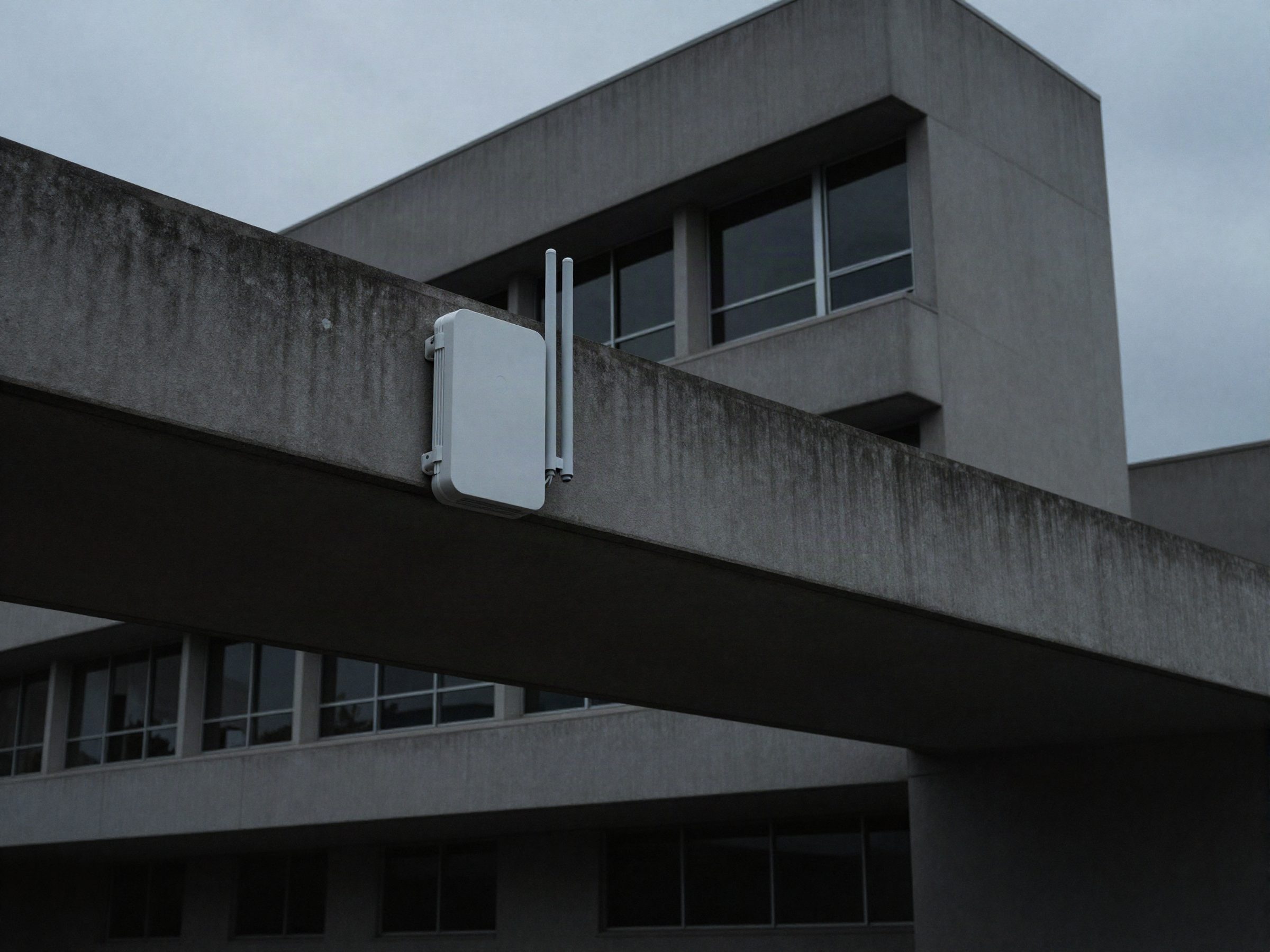
Courtyards, quadrangles, athletic fields and covered walkways need outdoor-rated hardware, its own power story and a path back to a closet. Between buildings the constraint is the backbone: fiber that predates the current traffic model becomes the ceiling on every wireless improvement inside.
Continue readingShow less
Where a trench is not viable, a surveyed point-to-point link is often what makes a building affordable to reach at all.
Scope the campus one building at a time
Go to the formWhere this page stops and the connectivity pillar starts
These two pages cover adjacent halves of the same site. This one is the quote-led lander for campus wireless: the per-building access point plan, the PoE switching and closet work beneath it, the controller or cloud licensing above it, and the phasing that lets the work land in funded stages. Send a building list and it comes back as a bill of materials.
Continue readingShow less
Our wireless campus connectivity page is the engineering pillar for the wider problem — outdoor coverage, point-to-point and building-to-building links, and the connectivity design that decides how a dispersed site is knitted together. If your question is about reaching a remote building rather than covering a classroom, start there and the two conversations meet in the middle.
Ubiquiti UniFi, EnGenius and Netgear carry priced rows in the hub catalog. Aruba and Cisco Meraki sit in our sister catalogs and are quoted on the same document as the switching, cabling and licensing. Software and subscriptions are sourced through authorized US distribution rather than held on a shelf, so what matters on a licence line is the access point count, the term and the renewal date.
The three layers of a campus wireless plan
Quoted per building so a multi-year program can be funded in stages rather than approved or abandoned as one number.
Access points, per room and per space
Indoor units sized to the device count each space actually carries, high-ceiling and directional options for halls and gymnasiums, and outdoor-rated hardware for the spaces between buildings.
Continue readingShow less
Mounting hardware and the drop to each position are quoted as their own lines rather than assumed.
Closet switching, power and uplinks
PoE budget calculated per closet against the actual power class of the units going in, uplinks sized for what the new access points can generate rather than what the old ones did, and rack, patch field and power hardware where the closet needs finishing rather than merely re-populating.
Cabling, backbone and licensing
New drops where a position has none, backbone fiber where the path between buildings is the constraint, and the controller or cloud licensing that manages the estate — with the term and renewal date written down.
Continue readingShow less
Cabling scope is set against a site survey rather than a catalog.
What's included in a campus WiFi plan
Everything below is quoted as its own readable line, and per building, so a stage can be costed without the rest.
- Access points sized to the device count each space actually carries, with high-ceiling and directional options for halls and gymnasiums
- Outdoor-rated hardware for courtyards, quadrangles, athletic fields and covered walkways, with its own power story and a path back to a closet
- A PoE budget calculated per closet against the actual power class of the units going in
- Uplinks sized for what the new access points can generate rather than what the old ones did, with the rack and closet hardware behind them
- New drops where a position has none, and backbone fiber where the path between buildings is the constraint
- Controller or cloud licensing with its term and renewal named, sourced through authorized US distribution rather than held on a shelf
- Line items with manufacturer part numbers, descriptions and pricing, structured per building so a business office or a consultant can work from it
From a building list to a phased, screened order
Campus work is rarely funded in one go, so the quote is built to be split along building lines rather than re-scoped every time a stage is approved.
- Send the building list with construction era, room counts and the device counts each space has to carry
- A Uniqcli specialist works the spaces with you and flags the buildings where a survey earns its cost before any hardware is chosen
- Access point, switching, cabling and licensing lines are sourced through authorized US distribution and priced per building
- The quote is structured in phases so a stage can be approved, ordered and installed without re-pricing the rest
- TAA (FAR 52.225-5) and NDAA §889 screening is performed on every line before the quote goes out, with alternates where a line does not clear
- GPC / P-Card accepted up to your cardholder threshold; purchase orders otherwise, with stock and final total confirmed before you commit
Summers, stages and the equipment list
School and campus work has a calendar problem more than a technical one. The installation window is short, it is usually shared with every other trade on site, and the approval that releases it often lands close to the window itself. That combination makes lead time the risk worth managing first: long-lead lines are identified early and named on the quote rather than discovered at the loading dock, and a phased structure means a building can proceed while another waits on funding.
Continue readingShow less
E-rate comes up in almost every one of these conversations, and it is worth being precise about what we are and are not saying. The federal E-rate program supports category one and category two services for eligible schools and libraries, and internal connections such as access points and the switching that supports them have historically fallen within category two. That is informational context, nothing more. We are not an E-rate consultant, we hold no service provider identification number, we do not file forms and we make no representation that any specific item will be funded or approved. Eligibility and funding decisions rest with USAC, the program rules in force at the time, and whoever advises you on them.
What we can do is produce an equipment list that is legible to whoever is filing: line items with manufacturer part numbers, descriptions and pricing, structured per building, so your consultant or business office can work from it rather than reconstruct it.
Send the building list, get a phased quote
A building list with room counts and device expectations is enough to start. One consolidated quote comes back per building — access points, closet switching, cabling and licensing as readable lines, structured so stages can be funded independently.
What a campus quote does not include
We do not operate the network after handover. Monitoring, SSID and policy administration, content filtering decisions, firmware approvals and the help desk behind them stay with your IT department or the provider you contract. We hold no credentials on your system after handover and offer no uptime, availability or response-time commitment.
Continue readingShow less
We are not an E-rate consultant or a service provider under that program, and nothing on this page should be read as advice about eligibility, filing or funding. The campus transport is a separate scope from this page with its own quote and its own approval path; the wireless design is sized against whatever that circuit actually delivers.
Wireless coverage is a design property that depends on positions, construction materials, interference and the devices actually in use, and it is verified by testing on the ground rather than asserted on a quote. On a campus with older buildings that is the single strongest argument for surveying the difficult blocks before the order rather than after the complaints.
The rest of the campus network
Wireless is one layer of a campus. These are the adjacent scopes most often quoted alongside it.
Campus WiFi and campus network design questions
How is this different from your wireless campus connectivity page?
This page is the quote-led lander for campus wireless coverage: the per-building access point plan, the closet switching beneath it, the licensing above it and the phasing that lets it be funded in stages. The wireless campus connectivity page is the engineering pillar for the wider site problem — outdoor coverage, point-to-point and building-to-building links, and how a dispersed campus is connected in the first place. Different starting question, same team, and the two scopes are routinely quoted together.
How do you plan coverage across buildings of different ages?
Separately, because averaging across them is what produces a design that over-serves one block and fails another. Each building is scoped on its own construction, room counts and device expectations, then the closet and backbone work behind it is sized to what those rooms need. Older blocks with plaster, steel framing or metal shelving are the ones we recommend surveying rather than modelling, and we will say which buildings those are before the order.
What does a classroom with a device per student actually need?
It needs a capacity design rather than a coverage one. Thirty or more clients associating in the same few minutes, with a testing schedule that puts every room under load simultaneously, is a different problem from covering the same floor area in an office. In practice that usually means an access point in the room rather than coverage borrowed from the corridor, with channel planning that accounts for how little the wall between two classrooms actually attenuates.
Is this equipment E-rate eligible?
Eligibility is determined by the program rules in force and by USAC, not by a supplier, and we make no representation about whether any specific item will be funded. As informational context, internal connections such as access points and supporting switching have historically fallen within category two for eligible schools and libraries. Uniqcli is not an E-rate consultant, holds no service provider identification number and does not file forms. What we provide is a clean, itemized equipment list your consultant or business office can work from.
Can the work be phased across summers or budget years?
Yes, and the quote is structured for it. Pricing is built per building so a stage can be approved, ordered and installed without re-pricing the rest of the program. The practical constraint is lead time rather than the paperwork: long-lead lines are identified and named on the quote early, because a short installation window shared with other trades leaves very little room to absorb a backordered part.
Do campus orders get TAA and §889 screened?
Yes, and on a campus that answer carries a timing caveat worth knowing. Campus work is normally phased across budget years, and a part number that cleared while building one was funded can be superseded, re-sourced from a different plant or rebadged by the time building four is. So each phase is screened as its own quote rather than inheriting the earlier one's result — manufacturer-stated country of origin recorded per line, each maker with its parent and affiliates checked against the NDAA §889 covered-entity list, alternates named for anything that does not clear. The determination on your award or your funding application stays with your contracting officer or your consultant.
The solutions atlas
Every solution, by technology area and by customer.
By technology
By customer
- TAA & NDAA-889 Compliance Screening
- CMMC & CUI Solutions
- Federal & DoD
- State, Local & Education
- Healthcare
- Enterprise
- Rapid Procurement & GPC Buys
- Multi-Vendor Integration Projects
- eProcurement & Custom Catalogs
- FISMA Modernization
- CJIS-Compliant Justice Cloud & Local AI
- Federal Storage Modernization
- Government ERP & Business Systems Infrastructure
- Managed Procurement
- Secure AV & Conferencing
- Fiber Network Infrastructure
- Satellite & Resilient Connectivity
- Wavelength & Optical Transport
- Decentralized Data Centers
- Data Center Design & Build
Scope the campus one building at a time
Send the building list with room counts and the device load each space carries. One consolidated quote comes back per building — access points, closet switching, cabling and licensing as readable lines, screened for TAA and §889 before it leaves.