
Solutions
Emergency Dispatch Center Technology
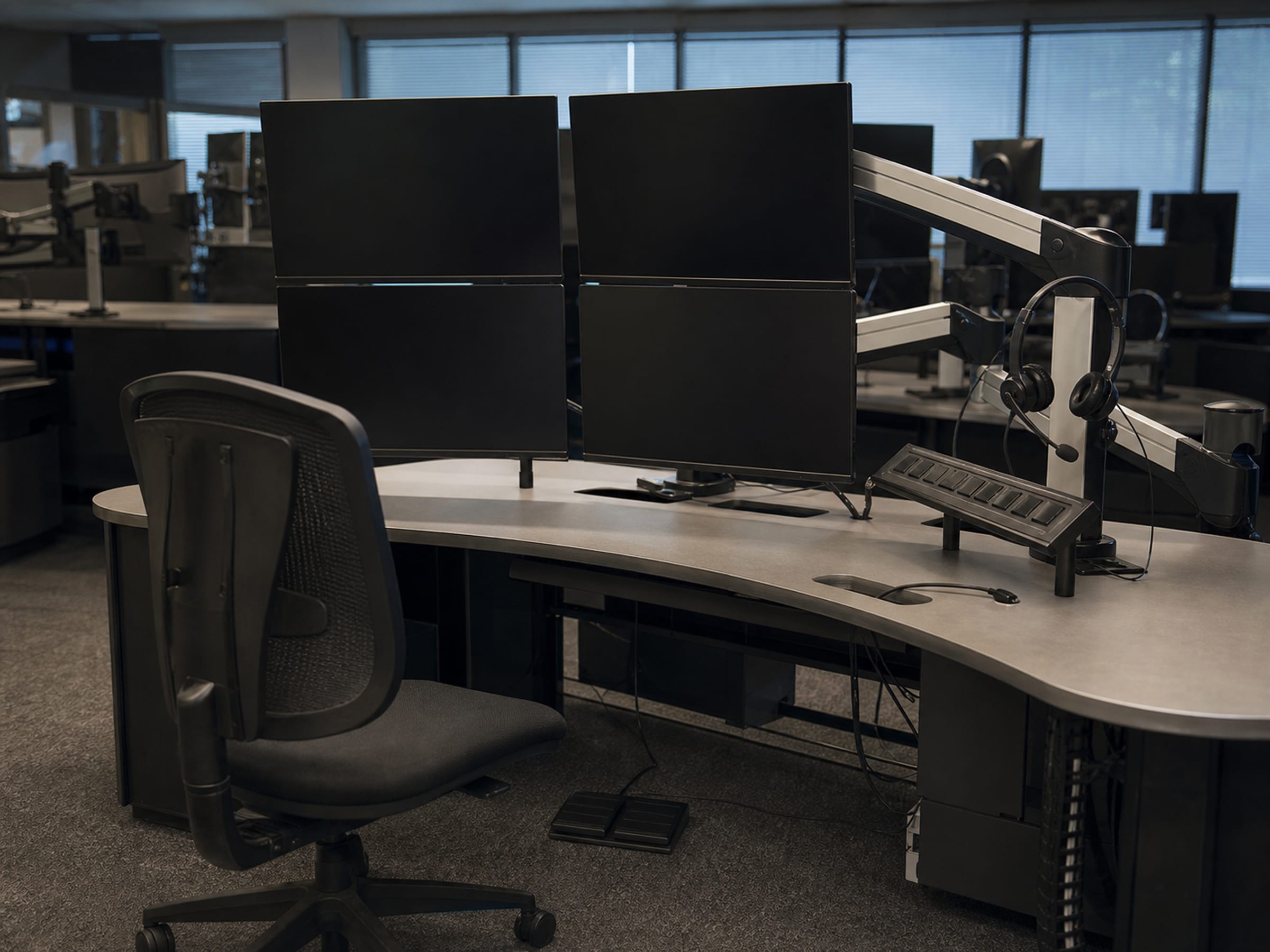
A dispatch floor runs continuously, and consumer-grade hardware does not survive that. We build the console hardware, multi-head displays, KVM, headsets and conditioned power for the duty cycle. The CAD platform and the operation are the agency's.
- Scope
- Console workstations, displays, KVM, headsets, conditioned power
- Design driver
- 24/7/365 duty cycle and a shift-change handover
- Software
- CAD and dispatch platforms are sourced on request
- Boundary
- We equip the floor; the agency operates it
The hardware never gets to power down
A public safety answering point runs every hour of every day, and the hardware on the floor is switched on for its entire service life. That single fact changes almost every specification decision. Fans and power supplies rated for an office duty cycle fail early. Monitors run at brightness levels office panels are not built for. Headsets are worn for twelve-hour shifts by people who cannot ask a caller to repeat themselves, and they are shared across shifts. Power interruptions are not an inconvenience but an outage in a service that has no acceptable downtime. We build dispatch positions to that duty cycle, quote them per console rather than per part, and stage identical builds so a position can be swapped rather than diagnosed at three in the morning.
A dispatch position, built as a unit
Quoted per console position with spares, so a failed unit is swapped rather than repaired in place. Naming a manufacturer describes the market, not a Uniqcli partnership or endorsement.
Console workstations
Continuous-duty workstations sized for the CAD, mapping, radio and records applications running side by side, with the graphics capability to drive four to six displays from one machine. Lenovo carries by far the deepest priced workstation and desktop line on our catalog. Built to one identical image across the floor, so any position can take any dispatcher.
Multi-head displays and mounts
Four to six panels per position on articulating arms, positioned so a dispatcher can see all of them without moving their chair. ViewSonic carries priced monitor rows on the hub across the sizes used on dispatch floors. Panel choice is driven by continuous-duty rating and by bezel width — thin bezels matter when six panels form one working surface.
KVM and console switching
Dispatchers commonly work across several isolated systems from one seat, which is what KVM switching exists for. Our catalog carries a deep priced line across KVM switchboxes, consoles and extenders. Specified against how many systems a position touches and whether the compute lives at the desk or in a machine room — extenders make the second option practical and much quieter on the floor.
Headsets and conditioned power
Jabra and EPOS both carry priced headset rows on our catalog, in the binaural and noise-canceling styles dispatch floors actually use — quoted with spares, because headsets are consumables on a 24-hour floor. Behind the position, Eaton carries a deep priced UPS and power line and Legrand carries very deep priced rows across power distribution and cable management.
What continuous duty actually changes
Three things break on a dispatch floor that never break in an office: anything with a fan, anything with a battery, and anything that is touched by four different people a day. Duty-cycle ratings on workstations and displays are not marketing distinctions here — a panel specified for eight-hour office use and run for twenty-four will fail inside the warranty period and take a position down with it. UPS batteries have a service life measured in years and need to be on a replacement schedule rather than a failure schedule. Headsets are consumables.
The second consequence is that spares strategy beats repair strategy. A failed dispatch position at 3 a.m. is not a support ticket, it is a capacity reduction on a service with no acceptable downtime. Building every position to one identical specification and holding a spare set of the failure-prone parts — headsets, power supplies, a complete workstation — turns a multi-hour diagnosis into a five-minute swap. We quote the spares with the build for exactly that reason.
The third is power. Everything on the floor sits behind conditioned, backed-up power sized to carry the whole position — workstations, displays, switching and the radio interfaces — long enough for a generator to take over or for an orderly failover. Sizing that against the workstation alone is a common and consequential error.
Equipping or refreshing a dispatch floor
- Send the position count, the applications each position runs and how many displays per seat
- We build one specification per position type and quote it as a unit, spares included
- Systems are imaged and staged identically so any position can take any dispatcher
- Power is sized against the whole position load, not the workstation alone
- Cutover is scheduled against your staffing, position by position, never floor-wide
- The outgoing equipment is removed with certified data sanitization where a refresh drives the buy
Dispatch center questions
Why not use standard office PCs for dispatch positions?
Because they are specified for a duty cycle they will never see on a dispatch floor. A machine that runs continuously for years, drives six displays and cannot be rebooted at will has different requirements for cooling, power supply and graphics than a desk PC that sleeps overnight. The cost difference is small compared to the cost of a position going down mid-shift.
Do you supply the CAD system?
No. Computer-aided dispatch and related platforms do not carry priced rows in our catalog. Where a project requires them, they are sourced on request through US distribution against the publisher's terms. We build and supply the hardware those platforms run on, quoted against the vendor's stated requirements.
How do you handle a refresh without taking the floor down?
Position by position, against your staffing schedule. New positions are staged and imaged identically off the floor first, then swapped one seat at a time during a shift the supervisor picks. That is slower than a floor-wide cutover and it is the only approach that does not create a coverage risk.
How many spares should a floor hold?
Enough that any single failure is a swap rather than a diagnosis: at minimum a complete spare position for the floor, plus a working stock of headsets and power supplies, which are the parts that actually fail. Larger centers carry more. We quote the spare set with the build because buying it separately later is how it ends up not being bought.
Dispatch background and the rooms it serves
The solutions atlas
Every solution, by technology area and by customer.
By technology
By customer
- TAA & NDAA-889 Compliance Screening
- CMMC & CUI Solutions
- Federal & DoD
- State, Local & Education
- Healthcare
- Enterprise
- Rapid Procurement & GPC Buys
- Multi-Vendor Integration Projects
- eProcurement & Custom Catalogs
- FISMA Modernization
- CJIS-Compliant Justice Cloud & Local AI
- Federal Storage Modernization
- Government ERP & Business Systems Infrastructure
- Managed Procurement
- Secure AV & Conferencing
- Fiber Network Infrastructure
- Satellite & Resilient Connectivity
- Wavelength & Optical Transport
- Decentralized Data Centers
- Data Center Design & Build
Quote it per position, spares included
Send the position count, the applications per seat and the display count. A Uniqcli specialist returns a per-console specification covering workstations, displays, KVM, headsets and conditioned power, staged identically and quoted with spares. TAA (FAR 52.225-5) and NDAA §889 screening performed on every line before the quote goes out.