
Solutions
Smart City Infrastructure
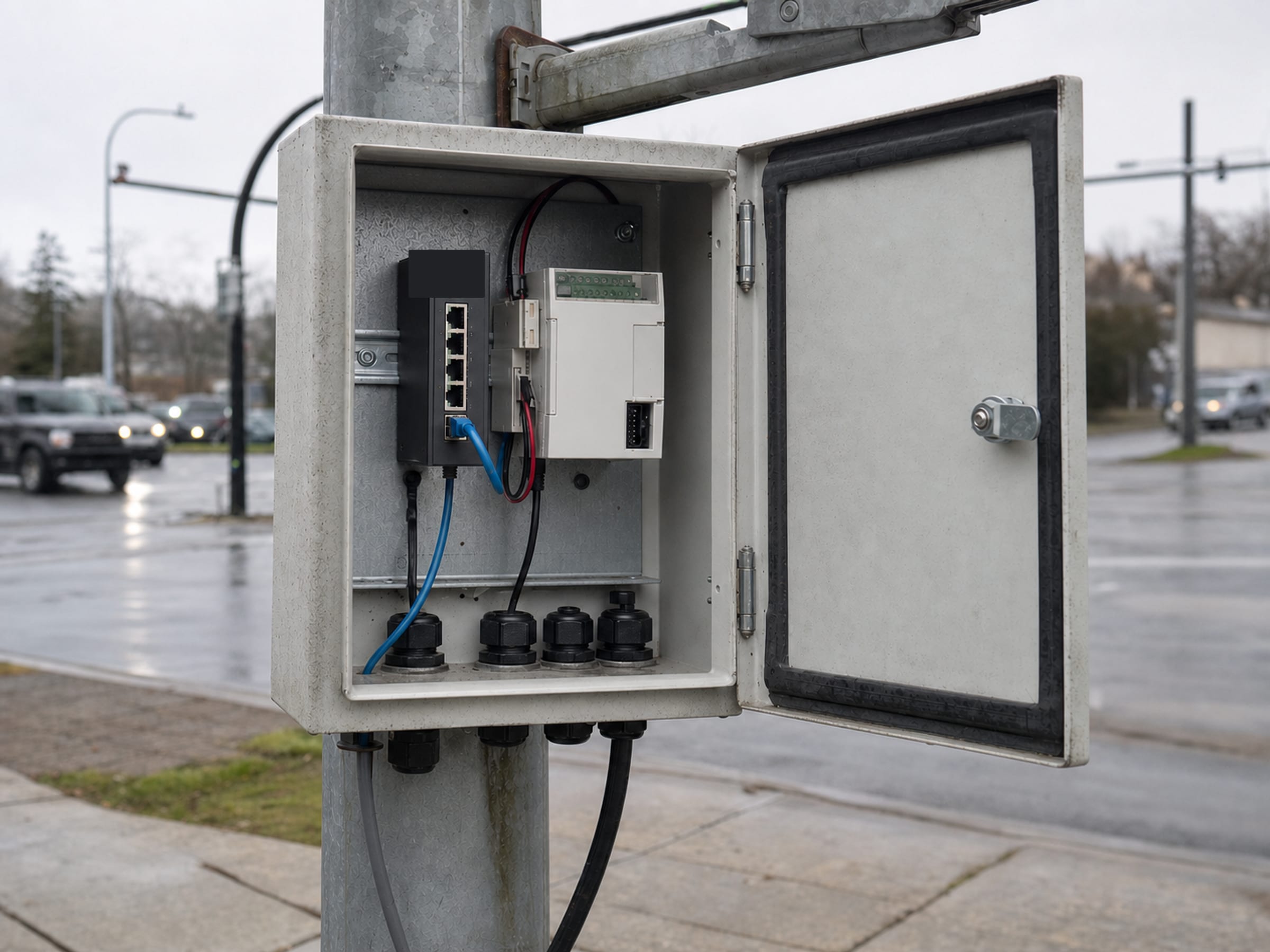
Municipal deployments live outdoors on poles and in cabinets. We spec the hardened switching, wireless backhaul, edge compute and power for that environment, and stage every cabinet identically before it goes out.
- Scope
- Hardened switching, wireless backhaul, edge compute, cabinet power
- Environment
- Outdoor cabinets and pole mounts, not a wiring closet
- Method
- Every cabinet built to one documented, repeatable configuration
- Boundary
- We supply and stage — the city operates the system
A hundred cabinets, and a truck roll costs more than the switch
Municipal technology deployments are unlike enterprise ones in a way that dominates every decision: the equipment lives outdoors in cabinets and on poles, spread across a city, and reaching any one of it requires a vehicle, a crew and sometimes a lane closure. That inverts the usual economics. Hardware cost stops mattering much and reliability, remote manageability and build consistency start mattering enormously, because a fifty-dollar saving on a component that forces one extra truck roll has already lost money. We specify for the environment, build every cabinet to one documented configuration, and stage and label them before they leave, so field crews install rather than assemble.
What the outdoors actually does to equipment
Temperature is the first constraint. A sealed roadside cabinet in direct summer sun runs far hotter inside than the air outside, and commercial equipment rated to a comfortable office ceiling will thermally throttle or shut down at exactly the times of year the city most wants it working. Industrial and extended-temperature ratings are not an upsell in this context; they are the difference between equipment that runs in August and equipment that does not.
Power and backhaul are the second and third. Cabinet power is frequently unconditioned, sometimes shared with street lighting, and subject to whatever the local grid does in a storm — so surge protection and a backup that carries the cabinet through a short outage are baseline rather than optional. Backhaul is usually a mix: fiber where it already exists, point-to-point wireless where a fiber run cannot be justified, and cellular where neither reaches. Most cities end up with all three, and designing for that mix from the start is much cheaper than retrofitting it.
The fourth is what the cabinet actually does. Where a deployment sends raw video or high-rate sensor data back to a central system, the backhaul cost dominates everything. Processing at the edge — filtering, aggregating, running inference locally and sending results rather than streams — changes that arithmetic substantially, at the cost of a more capable and more power-hungry device in the cabinet. That trade is worth calculating explicitly per deployment type rather than assuming either answer.
What goes in the cabinet
Specified for the environment and quoted per cabinet type, so a hundred sites are five repeatable builds. Naming a manufacturer describes the market, not a Uniqcli partnership or endorsement.
Wireless backhaul and point-to-point links
The links that reach sites fiber does not. Ubiquiti and EnGenius both carry priced outdoor wireless and bridging rows on our catalog. Specified against real path distances and line-of-sight rather than against datasheet range figures, and quoted with the mounting, grounding and surge protection the pole actually needs.
Cellular and bonded connectivity
Where neither fiber nor a wireless path reaches, or where a site needs a second path for resilience. Peplink carries priced routing and bonded-connectivity rows on our catalog. Sized against what the site actually sends — which is the number that determines whether a cellular plan is viable or ruinous over a hundred sites.
Hardened switching and cabinet networking
The switching inside the cabinet, powering whatever hangs off it, specified for the temperature range the cabinet actually reaches. Allied Telesis carries a deep priced switching line on our catalog. PoE budget is the number to check, since cameras, sensors and access points all draw from it and the last device added is the one that fails.
Edge compute and cabinet power
Processing at the site so backhaul carries results rather than raw streams. NVIDIA carries a very deep priced line across accelerator and edge-inference hardware on our catalog. Behind it, CyberPower carries priced UPS and surge rows for cabinet power — sized to carry a short outage and to survive what the local grid does in a storm.
Staging a hundred cabinets so field crews install rather than assemble
- Send the site list, the cabinet types, the available power and what backhaul exists at each location
- We reduce the deployment to a small number of repeatable cabinet builds rather than per-site improvisation
- Each build is assembled, configured, labeled and tested in staging before it ships
- Cabinets ship kitted per site with a documented as-built record for the city's own asset system
- Spares are quoted per build type, because a truck roll to diagnose costs more than a spare unit
- Refresh and expansion are priced with the initial deployment, since the second phase always comes
What stays with the city
We supply, stage and integrate the infrastructure. We do not operate municipal systems, do not monitor them and do not hold credentials to them after handover. Traffic management, utility operations, public safety and every policy decision about what is collected, who can see it and how long it is kept belong to the city and its departments. Those are governance questions with real public consequences, and a hardware supplier is the wrong party to be answering them.
Smart-city application platforms — the software that ingests sensor data and turns it into a municipal operations view — do not carry priced rows in our catalog. Where a deployment needs one, it is sourced on request through US distribution against the publisher's terms. Our contribution is the layer underneath: the cabinets, the links, the compute and the power, built consistently enough that the platform above them has something dependable to run on.
Municipal deployment questions
Does equipment in a roadside cabinet really need industrial temperature ratings?
Yes, more often than not. A sealed cabinet in direct sun runs substantially hotter inside than the ambient air, which puts commercially-rated equipment past its ceiling exactly during the summer months a city most wants the deployment working. Extended-temperature ratings cost more up front and cost far less than the truck rolls a thermal failure generates across a hundred sites.
Should we process data at the edge or send it back?
It depends almost entirely on what the site produces. Low-rate sensor telemetry is cheap to backhaul and there is little reason not to. Continuous video is expensive to backhaul at scale, and processing locally — sending results rather than streams — often pays for the more capable cabinet device within the first year. It is worth calculating explicitly per deployment type rather than adopting one answer across the whole program.
How do you keep a hundred sites consistent?
By reducing the deployment to a small number of documented cabinet builds and assembling, configuring, labeling and testing each one in staging before it ships. Field crews then install a known unit rather than assembling one on a pole. That is also what makes spares meaningful: a spare only helps if the failed unit is identical to it.
Do you operate the systems after installation?
No. We supply, stage, integrate and hand over, with an as-built record for the city's own asset system. Operation, monitoring, data governance and every policy decision remain with the city and its departments or whoever it contracts for that.
Municipal background and the network behind it
The solutions atlas
Every solution, by technology area and by customer.
By technology
By customer
- TAA & NDAA-889 Compliance Screening
- CMMC & CUI Solutions
- Federal & DoD
- State, Local & Education
- Healthcare
- Enterprise
- Rapid Procurement & GPC Buys
- Multi-Vendor Integration Projects
- eProcurement & Custom Catalogs
- FISMA Modernization
- CJIS-Compliant Justice Cloud & Local AI
- Federal Storage Modernization
- Government ERP & Business Systems Infrastructure
- Managed Procurement
- Secure AV & Conferencing
- Fiber Network Infrastructure
- Satellite & Resilient Connectivity
- Wavelength & Optical Transport
- Decentralized Data Centers
- Data Center Design & Build
Send the site list
Cabinet types, available power, existing backhaul and what each site is expected to do. We come back with a small set of repeatable cabinet builds, staged and labeled before shipment, with spares and the expansion path priced alongside. TAA (FAR 52.225-5) and NDAA §889 screening performed on every line before the quote goes out.