
Solutions
Mobile Command & Field Deployment Kits
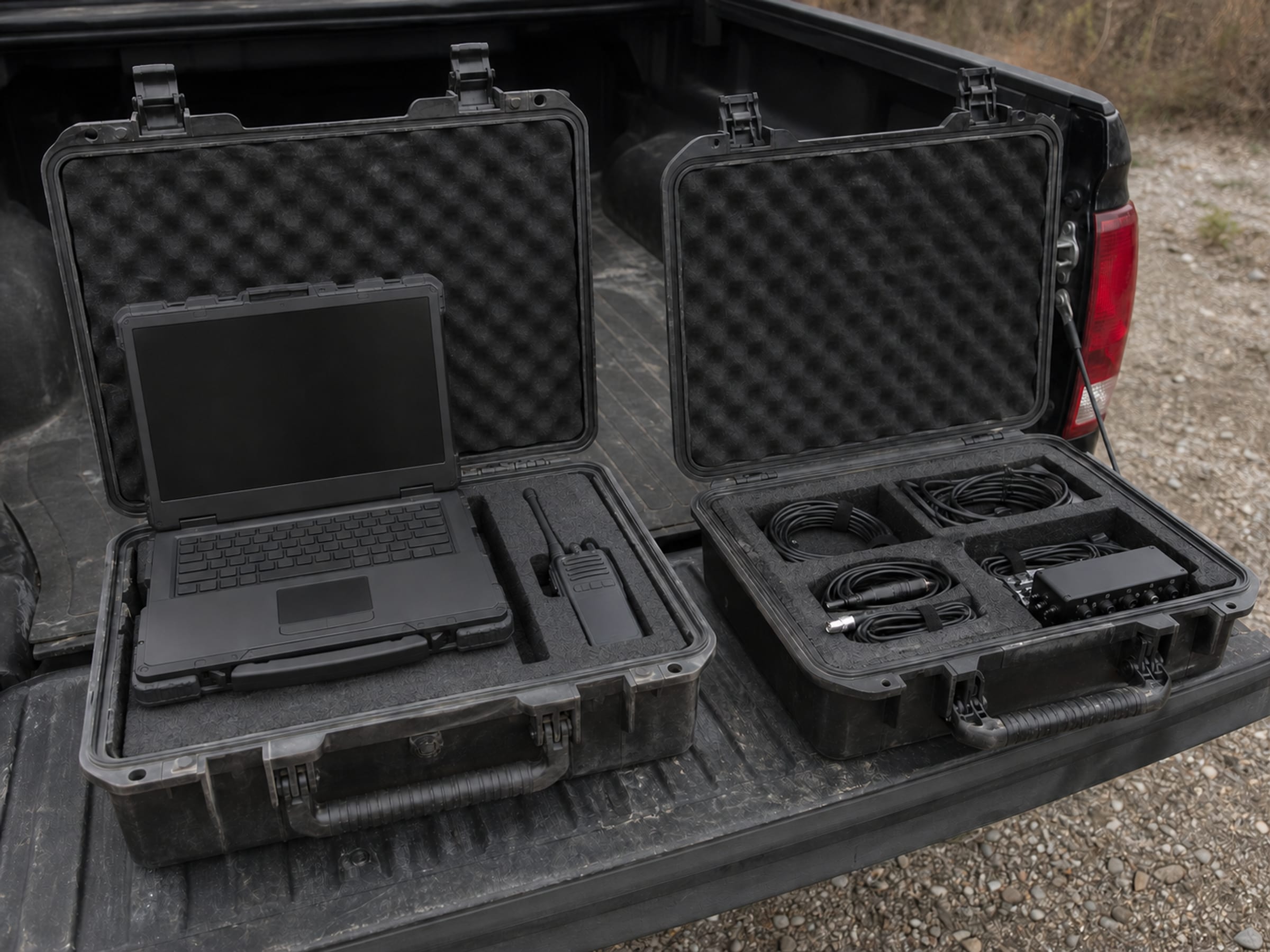
A deployable kit has to survive transport and come up without a network engineer. We build to a fixed packing list — rugged endpoints, cellular routing, a switch, portable power, cases — and ship it configured and labeled.
- Scope
- Rugged endpoints, cellular routing, switching, power, transit cases
- Method
- A fixed packing list, built identically every time
- Delivery
- Configured, labeled, tested and inventoried before it ships
- Boundary
- We build and supply kits; the agency deploys and operates them
It has to come up in a car park, in the rain, at 2 a.m.
A field kit is judged on a single question: can the person who opens it — who is not an engineer, who has not touched it since the last deployment, and who is standing somewhere unpleasant — get it working in a few minutes without calling anyone? Everything about how these kits are built follows from that. A fixed packing list rather than a shopping list. Identical builds so any kit behaves like any other kit. Labeling on every cable and port. Configuration done in staging and verified before it ships. And a written inventory in the case, so the person repacking it knows what is missing.
What is in a standard deployable kit
Kits are built to a fixed list rather than assembled per deployment. The list changes deliberately, between builds, not in the field.
- Rugged endpoints — a laptop or tablet specified for the environment rather than for the office
- A cellular or multi-path router providing the kit's own connectivity, pre-provisioned and tested
- A compact switch with enough ports for the kit plus whatever plugs into it on site
- Portable and backup power sized for the actual runtime the deployment expects
- Cabling, adapters and antennas, every one labeled at both ends
- A hard transit case with cut foam, so a missing item is visible before the lid closes
- A printed inventory and a one-page bring-up sheet, laminated, in the case
The components behind the packing list
Quoted per kit build, so ten kits are ten identical units rather than ten similar ones. Naming a manufacturer describes the market, not a Uniqcli partnership or endorsement.
Connectivity — cellular and multi-path
The kit's own path to the outside world, which is the component that most determines whether a deployment works. Peplink and CradlePoint both carry priced routing rows on our catalog, including multi-path and bonded configurations. Pre-provisioned and tested in staging, because a router that needs configuring in the field is a router that does not come up.
Switching and local network
A compact switch that gives the kit a local network and enough ports for whatever gets plugged in on site. Netgear carries a deep priced switching line on our catalog including the small unmanaged and smart-managed form factors that suit a case. Configured, labeled and tested with the rest of the kit rather than shipped in its own box.
Rugged endpoints and portable power
Ruggedised laptops and tablets specified for the environment they deploy into. Panasonic carries priced rugged mobile computing rows on our catalog and Lenovo carries the deepest priced endpoint line for the semi-rugged and standard tiers. CyberPower carries priced portable and backup power rows, sized against the runtime the deployment actually expects.
Why the staging work is most of the value
The components in a field kit are not exotic and are not where the difficulty is. The difficulty is that a kit assembled from a purchase order arrives as a pile of boxes, gets configured by whoever has time that week, and is subtly different from the kit built the following month. Two years later nobody knows which kit has which firmware, the spare cable does not fit, and the bring-up takes an hour instead of five minutes.
So the build is the deliverable. Endpoints imaged to your build; routers pre-provisioned against your carrier profiles and tested on a live connection; every cable labeled at both ends; the case foam cut so a missing component is visible at a glance; a printed inventory and a one-page bring-up sheet inside. Each kit is powered up and verified as a complete unit before it ships, and the build is documented so kit eleven, ordered next year, is identical to kit one.
Rugged specification is worth a word of caution: ruggedisation is a spectrum with real cost steps, and buying more than the deployment needs is common. A kit that lives in a vehicle and gets carried across a car park has different requirements from one that goes out in genuinely hostile conditions. We will ask what the deployment actually looks like before recommending a tier. Deeper rugged-compute capability sits with our electronics practice; this page is about kit composition.
Field kit questions
What makes a field kit different from buying the same equipment separately?
The staging. Identical builds, pre-provisioned connectivity, labeled cabling, cut foam, a printed inventory and a one-page bring-up sheet — plus a documented build so the kit ordered next year matches the ones you already have. Bought separately, the components are the same and the field experience is not remotely the same.
How rugged does the equipment actually need to be?
Less than most specifications assume, and occasionally more. Ruggedisation has real cost steps, and a kit that rides in a vehicle and gets carried across a car park does not need what a genuinely hostile-environment deployment needs. Tell us what the deployment looks like — transport, weather, handling, duration — and we will recommend a tier rather than defaulting to the most expensive one.
Can you build more kits later that match the ones we have?
That is the point of documenting the build. The packing list, the images, the configurations and the labeling scheme are recorded, so a later order produces identical units rather than similar ones. Where a component has gone end-of-life we will tell you what changed and propose the closest equivalent for your approval rather than substituting quietly.
Do you deploy the kits or operate them in the field?
No. We build, configure, test and supply them, with the documentation that lets your own people bring them up. Deployment, operation and everything that happens on site belong to the agency.
Field-kit background and the connectivity behind it
The solutions atlas
Every solution, by technology area and by customer.
By technology
By customer
- TAA & NDAA-889 Compliance Screening
- CMMC & CUI Solutions
- Federal & DoD
- State, Local & Education
- Healthcare
- Enterprise
- Rapid Procurement & GPC Buys
- Multi-Vendor Integration Projects
- eProcurement & Custom Catalogs
- FISMA Modernization
- CJIS-Compliant Justice Cloud & Local AI
- Federal Storage Modernization
- Government ERP & Business Systems Infrastructure
- Managed Procurement
- Secure AV & Conferencing
- Fiber Network Infrastructure
- Satellite & Resilient Connectivity
- Wavelength & Optical Transport
- Decentralized Data Centers
- Data Center Design & Build
Define the packing list once
Tell us what the deployment looks like — transport, environment, duration, how many kits and what has to work on arrival. A Uniqcli specialist returns a fixed packing list quoted as a repeatable build, configured, labeled and tested before it ships. TAA (FAR 52.225-5) and NDAA §889 screening performed on every line before the quote goes out.