
Solutions
Perimeter & Wide-Area Surveillance
Covering a fence line or a large site is a power-and-backhaul problem before it is a camera problem. We design and supply the pole, power, wireless link and recording capacity that make coverage continuous.
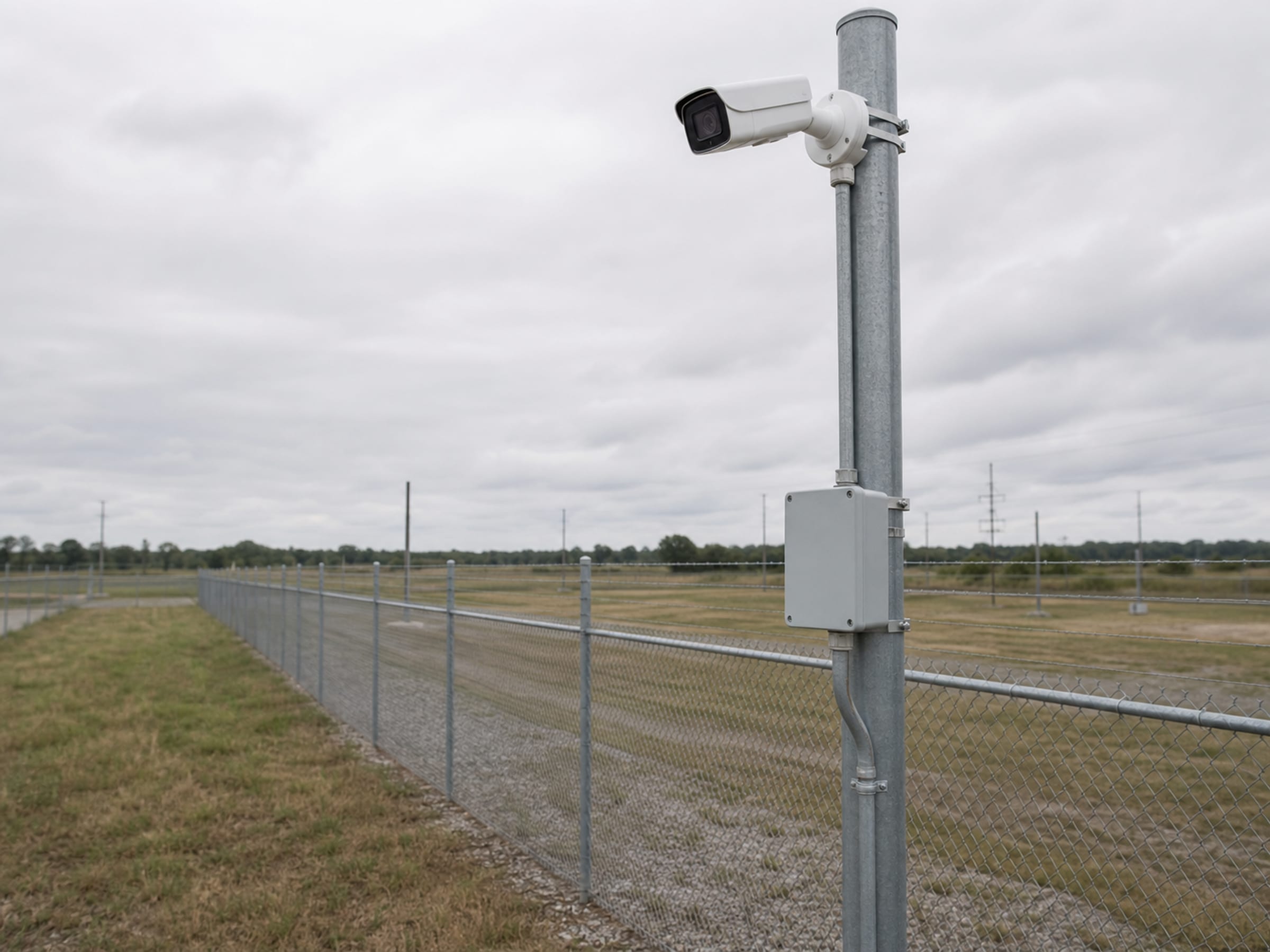
- Scope
- Pole power, wireless backhaul, hardened PoE, retention capacity
- Design order
- Power and backhaul first; the camera choice comes after
- Routing
- Cameras, radar and detection route to our physical-security storefront
- Boundary
- We supply infrastructure — no detection or security outcome claimed
The camera is the cheapest problem on the fence line
Perimeter projects get scoped as camera projects and fail as infrastructure projects. A fence line runs for a mile past the last building with power on it; the pole positions with the best sightlines are the ones furthest from a conduit; the wireless path that looked clear on a map crosses a stand of trees that will be in leaf by June; and the retention requirement, once someone writes it down, needs several times the storage that was budgeted. None of that is about the camera. We design the layer underneath — the power to each pole, the backhaul path, the hardened switching and the recording capacity — and route the camera, radar and detection hardware itself to our physical-security storefront so the whole package is quoted together.
Power, path, capacity — then optics
Power comes first because it is the constraint that cannot be worked around cheaply. Every pole position either has power or needs a trench, and trenching cost per foot across a large site will exceed the entire equipment budget faster than most planners expect. That reality is what drives the real design decisions: fewer poles with better optics, wireless links instead of buried fiber, and honest arithmetic about which positions are worth what they cost to energize.
The path is second. Wireless backhaul makes remote positions economically viable, but it needs genuine line of sight surveyed on the ground, at the season of worst foliage, with the fresnel clearance the link actually requires — not a map line. Where several positions chain back to one aggregation point, the capacity of the link nearest the head end is what limits the whole branch, so it is sized against the total downstream load rather than against the position it directly serves.
Capacity is third, and it is arithmetic: camera count multiplied by bitrate multiplied by the retention period, plus headroom for the positions that get added in phase two. Perimeter deployments run continuously and often at higher frame rates than building cameras, so the per-camera storage figure is usually higher than an interior estimate would suggest. Only after those three are settled does the optics decision — resolution, focal length, thermal or visible — become answerable, because it is constrained by what the pole can be given.
The infrastructure under the coverage
Quoted as one package with the camera and detection lines routed through our physical-security storefront. Naming a manufacturer describes the market, not a Uniqcli partnership or endorsement.
Wireless backhaul to remote positions
Point-to-point and point-to-multipoint links that make positions viable without a trench. Ubiquiti and EnGenius both carry priced outdoor wireless rows on our catalog. Specified against a real ground survey at worst-case foliage, with the aggregation link sized for the whole downstream branch.
Hardened PoE switching and pole hardware
Switching that survives an outdoor enclosure's real temperature range and delivers the PoE budget the positions actually draw, plus the mounts, grounding and surge protection. Allied Telesis carries a deep priced switching line on our catalog. The PoE budget after everything is connected is the number that matters.
Recording and retention capacity
Storage sized against continuous recording at the frame rates perimeter deployments actually run. Nexsan carries a deep priced array line on our catalog and Western Digital carries priced surveillance-class drive rows. Sized with headroom for phase two, since perimeter programs almost always grow.
Cameras, radar and detection
Camera hardware, thermal imaging, radar and detection systems are our physical-security storefront's inventory rather than hub catalog rows, and several of those categories are sourced on request rather than stocked. Those lines are routed there and quoted as part of the same package rather than described here as shelf items.
What we do not claim
No equipment package produces security, detection reliability or an intrusion outcome, and we do not write it as though it does. Coverage is a design property — it depends on pole positions, sightlines, lighting, weather and what the site is actually trying to detect — and it is verified by testing on the ground rather than asserted on a quote. Where a requirement is asking for a detection performance figure, that is a question for the detection vendor's own documented specifications, not for a supplier's marketing.
Monitoring, response, alarm handling and the security program around all three belong to the site's own security organization or whoever it contracts. We supply and integrate the infrastructure and hand it over with documentation. We do not operate a monitoring center, do not respond to alarms and do not hold credentials to the system after handover.
Perimeter infrastructure questions
Why does perimeter coverage cost so much more per camera than interior coverage?
Because the camera is a small fraction of the per-position cost outdoors. Each position needs power that frequently is not there, a backhaul path that may require a wireless link and a survey, a hardened enclosure, mounting, grounding and surge protection, and it records continuously into storage sized for a longer retention period. Interior cameras inherit all of that from the building.
Can wireless backhaul replace trenching fiber?
Often, and it is usually the decision that makes a large-site project affordable. It requires genuine line of sight, surveyed on the ground rather than on a map, at the season of worst foliage, with adequate clearance for the link. Where those conditions hold, wireless links are dramatically cheaper than trenching. Where they do not, it is better to find out during design than during commissioning.
How much storage does continuous perimeter recording need?
More than an interior estimate suggests, because perimeter cameras typically record continuously rather than on motion and often at higher frame rates. The arithmetic is camera count multiplied by bitrate multiplied by retention days, plus headroom for phase two. Send those numbers and the retention requirement and we will size it and show the working.
Do you supply the cameras and detection systems too?
Those lines route to our physical-security storefront rather than to the hub catalog, and several detection categories — radar, thermal, dedicated analytics hardware — are sourced on request rather than stocked. They are quoted as part of the same package. What is described on this page is the infrastructure layer we supply directly.
Perimeter background and the power and path to it
The solutions atlas
Every solution, by technology area and by customer.
By technology
By customer
- TAA & NDAA-889 Compliance Screening
- CMMC & CUI Solutions
- Federal & DoD
- State, Local & Education
- Healthcare
- Enterprise
- Rapid Procurement & GPC Buys
- Multi-Vendor Integration Projects
- eProcurement & Custom Catalogs
- FISMA Modernization
- CJIS-Compliant Justice Cloud & Local AI
- Federal Storage Modernization
- Government ERP & Business Systems Infrastructure
- Managed Procurement
- Secure AV & Conferencing
- Fiber Network Infrastructure
- Satellite & Resilient Connectivity
- Wavelength & Optical Transport
- Decentralized Data Centers
- Data Center Design & Build
Start with the site map, not the camera list
Send the perimeter length, the candidate pole positions, where power already reaches and your retention requirement in days. A Uniqcli specialist returns an infrastructure design and quote, with camera and detection lines routed through our physical-security storefront. TAA (FAR 52.225-5) and NDAA §889 screening performed on every line before the quote goes out.