
Solutions
Asset Tagging & Inventory Hardware
Tagging is cheapest at the point of receipt. We asset-tag and record serials during staging, and supply the scanners, printers and label stock that keep the register accurate long after the rollout is finished.
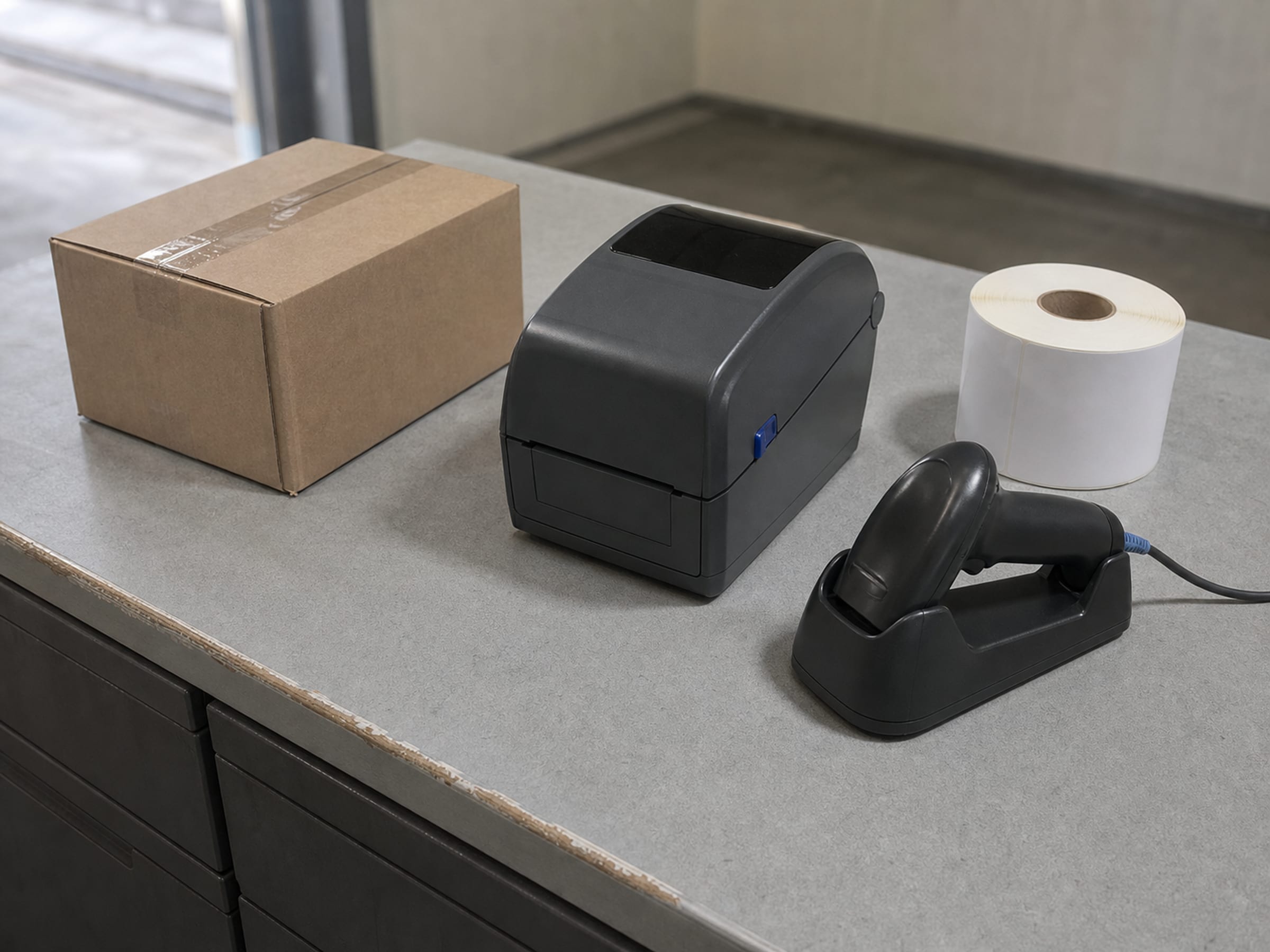
- Scope
- Tagging at integration time, plus the scanning estate afterwards
- What we quote
- Scanners, mobile computers, label printers, label stock
- Handover
- Serialized inventory manifest, loadable into your asset system
- Boundary
- The ITAM platform and the register itself stay yours
Every hour you wait to tag something makes tagging it more expensive
An asset that arrives untagged gets tagged eventually — on a dock, in a corridor, or during an audit two years later when somebody is crawling under a desk with a clipboard and a torch. The cost curve is brutal and entirely avoidable, because the cheapest possible moment to apply a tag and read a serial is while the unit is already open, already powered, and already being configured. Uniqcli tags at that moment. Asset tags, serial numbers and configuration records are captured at integration time and handed over as a structured inventory, so property accountability begins at delivery rather than after a week of clipboard work on site. What keeps the register accurate afterwards is a scanning estate that works — and that is the hardware half of this page.
Three decisions that determine whether a tag survives
Label material first. A paper label on a laptop lid lasts about as long as the first cleaning cycle. Polyester and polyimide stocks survive heat, solvents and handling; tamper-evident stocks leave a visible void when lifted, which matters where the tag is doing accountability work rather than just convenience. The stock, the adhesive and the printing method have to be chosen together — thermal transfer with the right ribbon, not direct thermal, wherever the label has to last years.
Symbology second. A linear barcode is fine when the only payload is an asset number. A 2D code holds the serial, the site and the build reference in the same footprint, which matters on small devices where there is barely room for a label at all — and it scans reliably at angles that defeat a linear scanner.
Reader class third. A corded scanner at a receiving bench, a cordless one for a stockroom, and a rugged mobile computer for someone walking a floor or a warehouse aisle are genuinely different purchases with genuinely different failure modes. Buying one class for all three roles is the most common way a scanning estate quietly stops being used.
The scanning and labeling estate
Verified priced lines across the three hardware roles this work needs, with availability stated per line. Naming a manufacturer describes the market, not a Uniqcli partnership or endorsement.
Scanners and mobile computers
Zebra and Honeywell carry the deepest priced lines we hold across corded, cordless and rugged mobile computers, with Socket Mobile covering the compact and pocket end for field and healthcare use. Specified by where the device actually lives — a bench, a stockroom aisle or a technician's belt.
Label and receipt printers
Desktop, industrial and mobile printers from Zebra and Honeywell, chosen by duty cycle and by whether the print method has to be thermal transfer for durability. A printer bought for volume it will never see is wasted; one bought a class too small becomes the bottleneck in every rollout.
Label stock, ribbon and media
The consumable is where asset-tagging programs actually fail — the wrong stock peels, the wrong ribbon fades, and a replacement bought on price does not match the original. Quoted against the printer and the environment, and re-orderable against the same specification later.
What is recorded before a unit ships
- Asset tag applied to your numbering scheme and placement standard
- Serial read from the unit rather than transcribed from a carton
- Loaded image and firmware level recorded against that serial
- Rack position or destination site noted where the rollout is phased
- Structured manifest handed over for loading into your asset-management system
- Third-party hardware you already own received into the same build and recorded the same way
The lanes this work runs through
Asset tagging questions
Can you apply our existing asset tags and numbering scheme?
Yes. Tags are applied to your scheme and your placement standard at integration time, and the manifest comes back in a structure your asset system can ingest. Where you supply pre-printed tags we apply those; where you want them printed to your specification we quote the stock and the printing as part of the build.
Do you supply the asset-management platform?
No. ITAM and inventory platforms are not lines we hold, and we would rather say so than imply a shelf that does not exist. Where a platform is in scope we treat it as a sourcing request through US distribution. The register, its accuracy and the process around it stay yours to run.
What about equipment we already own?
Third-party hardware you have already purchased can be received into the same build, so a rollout can combine units we sourced with units drop-shipped from elsewhere and still produce one manifest. Nobody ends up cataloging boxes on your dock.
Which label stock should we standardize on?
It depends on the environment more than the device. Polyester with thermal-transfer printing is the common answer for IT assets that have to survive handling and cleaning; tamper-evident stock is worth it where the tag carries accountability weight. Tell us where the assets live and we will quote the stock and ribbon together rather than separately.
The solutions atlas
Every solution, by technology area and by customer.
By technology
By customer
- TAA & NDAA-889 Compliance Screening
- CMMC & CUI Solutions
- Federal & DoD
- State, Local & Education
- Healthcare
- Enterprise
- Rapid Procurement & GPC Buys
- Multi-Vendor Integration Projects
- eProcurement & Custom Catalogs
- FISMA Modernization
- CJIS-Compliant Justice Cloud & Local AI
- Federal Storage Modernization
- Government ERP & Business Systems Infrastructure
- Managed Procurement
- Secure AV & Conferencing
- Fiber Network Infrastructure
- Satellite & Resilient Connectivity
- Wavelength & Optical Transport
- Decentralized Data Centers
- Data Center Design & Build
Tag it once, at the right moment
Send the rollout scope and your tagging standard. We quote the scanning estate and fold the tagging and serial capture into the integration build.