
Cybersecurity
Ransomware Protection & Recovery
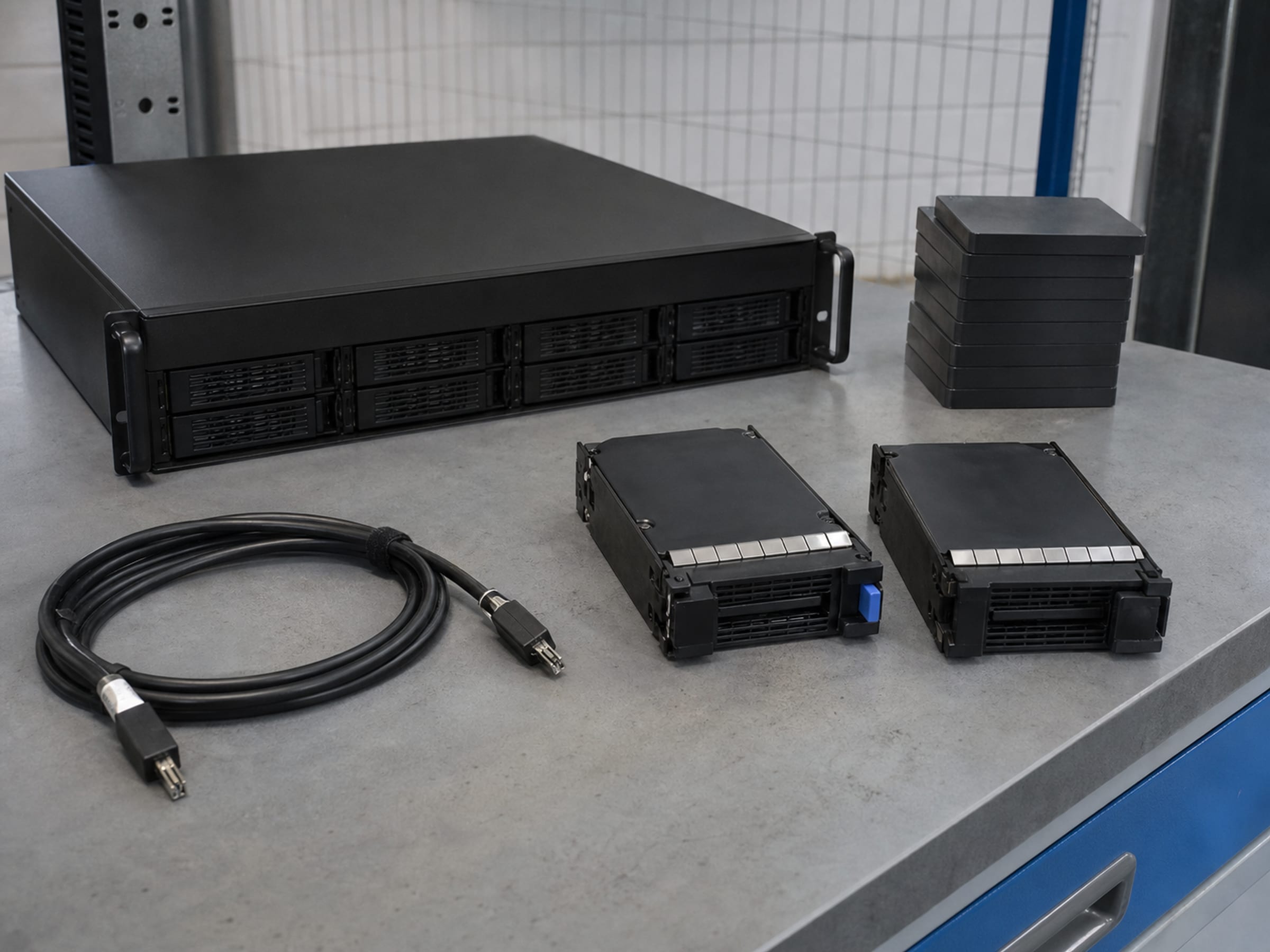
Recovery is a hardware problem as much as a software one. We quote the backup license, the immutable target it writes to and the restore capacity that makes your RTO believable — then rack and configure the target before handover.
- Category
- Backup software, immutable targets and the capacity to restore at speed
- What we quote
- Licensing per socket or per workload, plus the appliance behind it
- Sizing
- Against restore time, not just the size of the protected estate
- Boundary
- We build the capability; the runbook and the restore drills are yours
Everyone has backups; the question is how fast they come back
The uncomfortable arithmetic of a ransomware event is that recovery time is governed by read throughput and the restore path, not by how diligently the backups ran. An estate that backed up faithfully to a deduplicating target over a saturated link can take a week to come back — and the recovery-time objective in the continuity plan will say four hours. That gap is a hardware decision made years earlier. We quote recovery as an infrastructure package rather than a software line: the backup license, the immutable target that a compromised backup administrator cannot erase, and enough restore capacity and network path to make the stated objective arithmetically possible. The target is racked, configured and retention-locked before handover, so the first restore drill is not also the first time anyone logs into it.
What actually determines whether you recover
Each of these is a purchase and a design choice, and they are usually made by different people.
Immutability
A retention lock the backup administrator's own credentials cannot lift. Without it, backups are just another target an attacker with domain access will encrypt or delete first.
Restore throughput
Recovery time is read speed divided by data volume, plus the network between them. Sizing the target for backup windows alone is the most common reason an RTO is missed.
Isolation
A copy that cannot be reached from the production credential domain. Whether that is an appliance with its own authentication, a separate network, or offline media is a design decision.
Rehearsal
A restore that has never been tested is a hypothesis. The drill is yours to run, but the capacity to run it without disturbing production is something we can size and quote.
Backup licensing and the targets underneath
Priced lines from the hub catalog. Licensing models differ sharply between these vendors — per socket, per workload, per front-end terabyte — so the comparison is only fair once it is normalized against your estate. Naming a manufacturer describes the market, not a Uniqcli partnership or endorsement.
Veeam
Broad priced coverage across the licensing families, quoted per workload or per socket depending on the edition and the estate. The most common pairing we see with a dedicated immutable target.
Cohesity
The deepest priced line in this cluster — platform and software licensing where the design consolidates backup, archive and recovery onto one system rather than assembling three.
Veritas, Arcserve, Acronis and Barracuda
Four further estates with priced rows across software and appliance lines. The first two appear where an incumbent platform is being extended and are quoted against the existing anniversary; the second two suit smaller and departmental designs where one vendor covering backup and recovery beats best-of-breed at every layer.
Object First, racked before handover
A purpose-built immutable target designed for Veeam environments — not a general-purpose array — sized against restore throughput as well as capacity. Delivered with the retention lock set against your backup software, firmware baselined and rack integration done, so the first job it receives is a real one.
What no purchase delivers
There is no product that prevents a ransomware event, and any vendor claim in that direction should be read as marketing. What infrastructure can do is make the outcome survivable: shorten the restore, keep one copy beyond the attacker's reach, and make the recovery path known before it is needed.
The runbook, the decision authority during an incident, the communications plan and the restore drills are your program. We supply and configure the capability behind them. We do not operate the platform after handover. The console, the policy, the tuning and the response process stay with your team or the MSP you have chosen; what we supply is the license, the hardware it runs on and the integration work that puts both into service.
Recovery infrastructure questions
What is the 3-2-1 rule, and does it still hold?
Three copies of the data, on two different media, with one off-site. It still holds, and most programs now add a fourth condition — one copy immutable or offline — because the original rule assumed an attacker could not authenticate to the backup system. That fourth condition is the one that changes the hardware bill.
How do you size a backup target?
From both ends. Capacity comes from the protected estate, the retention schedule and the change rate; throughput comes from the recovery-time objective, because restore speed is what the objective is actually measuring. Sizing for the backup window alone is the most common reason a stated RTO turns out to be unachievable.
Do you carry immutable backup appliances?
Yes. Object First is a purpose-built immutable target for Veeam environments, and Cohesity, Veritas and Nexsan all carry priced rows where the design calls for a platform or array with retention-lock capability. We size the target against restore throughput, not just capacity.
Can you configure the target before it ships?
Yes. Rack integration, firmware baselining, retention-lock configuration against your backup software and cabling can all be scoped on the order, so the appliance arrives ready to receive its first job rather than factory-default.
Do you provide incident response?
No. We are not an incident-response firm and we do not staff a response team. What we supply is the infrastructure that makes recovery possible, delivered configured — the response itself belongs to your organization and whichever specialist firm you retain for it.
The solutions atlas
Every solution, by technology area and by customer.
By technology
By customer
- TAA & NDAA-889 Compliance Screening
- CMMC & CUI Solutions
- Federal & DoD
- State, Local & Education
- Healthcare
- Enterprise
- Rapid Procurement & GPC Buys
- Multi-Vendor Integration Projects
- eProcurement & Custom Catalogs
- FISMA Modernization
- CJIS-Compliant Justice Cloud & Local AI
- Federal Storage Modernization
- Government ERP & Business Systems Infrastructure
- Managed Procurement
- Secure AV & Conferencing
- Fiber Network Infrastructure
- Satellite & Resilient Connectivity
- Wavelength & Optical Transport
- Decentralized Data Centers
- Data Center Design & Build
Cost a recovery you can actually meet
Send the protected estate size, the retention schedule and the recovery-time objective you are held to. We return one quote covering the backup license, the immutable target sized against restore throughput, and the staging work.