
Solutions
Hyperconverged Infrastructure (HCI)
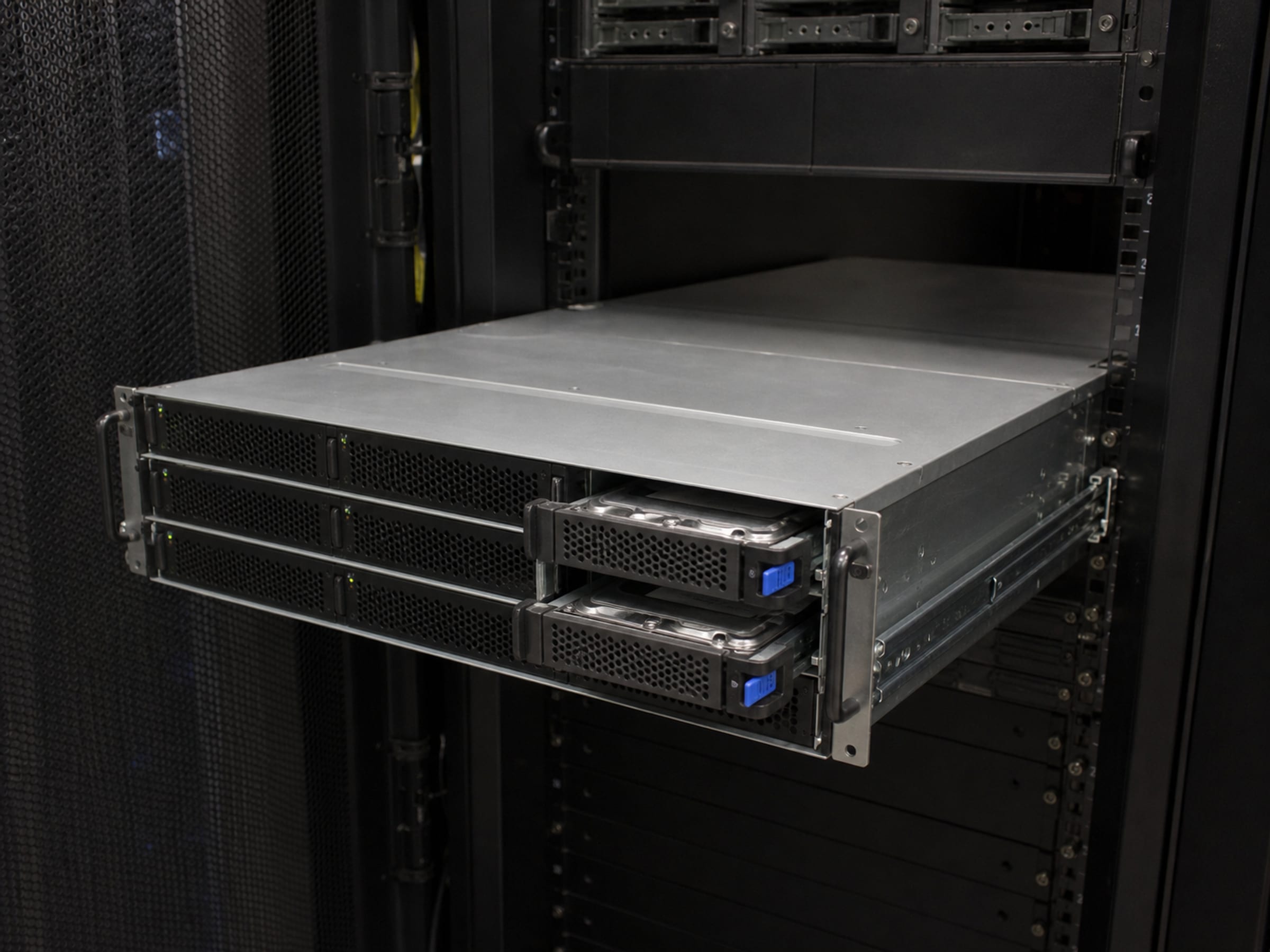
We quote HCI as the node hardware it really is — drives, memory, NICs and chassis sized per cluster — and rack, cable and burn it in before your platform team turns it on.
- Unit of sale
- The node, and what populates it
- Sized on
- Usable capacity after replication, not raw
- Delivery
- Racked, cabled and burned in before handover
- Boundary
- The cluster is operated by your platform team
Hyperconverged is a software idea sold as a hardware purchase
The pitch for HCI is consolidation: compute, storage and the virtualization layer collapse into identical nodes you add one at a time. The procurement reality is a bill of materials made of drives, memory, network cards and chassis, where the choices that matter are made at the component level. How many drives per node, at what endurance rating. How much memory before the cluster is memory-bound. Whether the NIC count matches what a replicating cluster actually pushes across the fabric. Uniqcli quotes that layer explicitly, line by line, then racks, cables and burns in the cluster so your platform team receives working hardware rather than pallets.
Three numbers that get quoted wrong
Usable capacity is the first. Hyperconverged clusters replicate, so raw drive capacity and the capacity a workload sees are different figures — and the gap depends on the replication factor and reserve you configure. We quote against usable, state the assumption on the document, and let you argue with it.
Failure-domain headroom is the second. A cluster sized so that it exactly fits its workload has no room to lose a node, which means the first hardware failure becomes an outage rather than an inconvenience. Node count is a resilience decision before it is a capacity one.
Network is the third, and the one most often left at defaults. Consolidating storage onto the same fabric as everything else changes the traffic profile completely — east-west replication traffic is constant, not bursty. NIC count, port speed and the switching underneath belong in the same quote as the nodes.
Node hardware, priced at the component level
Nutanix appears on this catalog as HCI hardware — storage nodes, SSDs, memory, network cards and GPUs. We name it in that register and no other. Naming a manufacturer describes the market, not a Uniqcli partnership or endorsement.
Storage nodes and drives
Nutanix storage nodes and SSDs are the deepest priced HCI hardware line we carry. Quoted per node with the drive endurance class stated, because a write-heavy cluster on read-optimized drives is a warranty conversation waiting to happen.
Memory and platform
Micron and Kingston memory populated to the density the cluster needs, on Lenovo server platforms where the node is a general-purpose server rather than an appliance. Memory is quoted as its own line, never folded into a platform price.
Fabric and interfaces
Network interface cards, transceivers and the leaf switching a replicating cluster consumes. Quoted with the node bill of materials rather than after it, because the fabric is what makes a cluster behave like one.
What we hand over, and what we do not
We deliver the cluster racked, cabled to your rack elevation, powered, labeled and burned in — meaning it has been powered on, checked and confirmed as functioning hardware before your team touches it. Where you want it built to a specific rack map, that map is the deliverable we work to.
We do not install the platform software, configure the cluster, migrate workloads onto it or operate it afterwards. We source and integrate the technology; the platform, the tenancy and the day-to-day operation stay with you or with the provider you have chosen. Platform licensing is quoted alongside the hardware where distribution carries it; where it does not, we say so.
HCI procurement questions
Do you sell HCI as an appliance or as components?
As node hardware quoted at the component level — drives, memory, network cards and chassis — because that is where the decisions and the cost sit. It arrives racked, cabled and burned in, which is the appliance experience without pretending the components do not matter.
How do you size usable capacity?
Against the replication factor and reserve you plan to run, not against raw drive totals. The assumption is written on the quote. If you do not have those numbers yet, we quote a stated scenario you can correct rather than a silent one you cannot.
Can you quote the platform licensing too?
Where US distribution carries it, yes, and it goes on the same document as the hardware. Some platform subscriptions are sold only through vendor-specific programs; when that is the case we say so rather than issue a quote that cannot be filled.
Who turns the cluster on?
Your platform team, or the integrator you engage. We hand over hardware that has been racked, cabled, powered and verified. Cluster creation, configuration and workload migration are outside what we sell.
The solutions atlas
Every solution, by technology area and by customer.
By technology
By customer
- TAA & NDAA-889 Compliance Screening
- CMMC & CUI Solutions
- Federal & DoD
- State, Local & Education
- Healthcare
- Enterprise
- Rapid Procurement & GPC Buys
- Multi-Vendor Integration Projects
- eProcurement & Custom Catalogs
- FISMA Modernization
- CJIS-Compliant Justice Cloud & Local AI
- Federal Storage Modernization
- Government ERP & Business Systems Infrastructure
- Managed Procurement
- Secure AV & Conferencing
- Fiber Network Infrastructure
- Satellite & Resilient Connectivity
- Wavelength & Optical Transport
- Decentralized Data Centers
- Data Center Design & Build
Send the workload and the resilience target
We return a node bill of materials with usable capacity, failure-domain headroom and fabric all stated, plus a rack-and-burn-in plan.