
Solutions
Disaster Recovery Site Buildout
A DR site is a second bill of materials that has to match the first closely enough to fail over. We build it as a mirrored package — racks, power, compute, replication target and network.
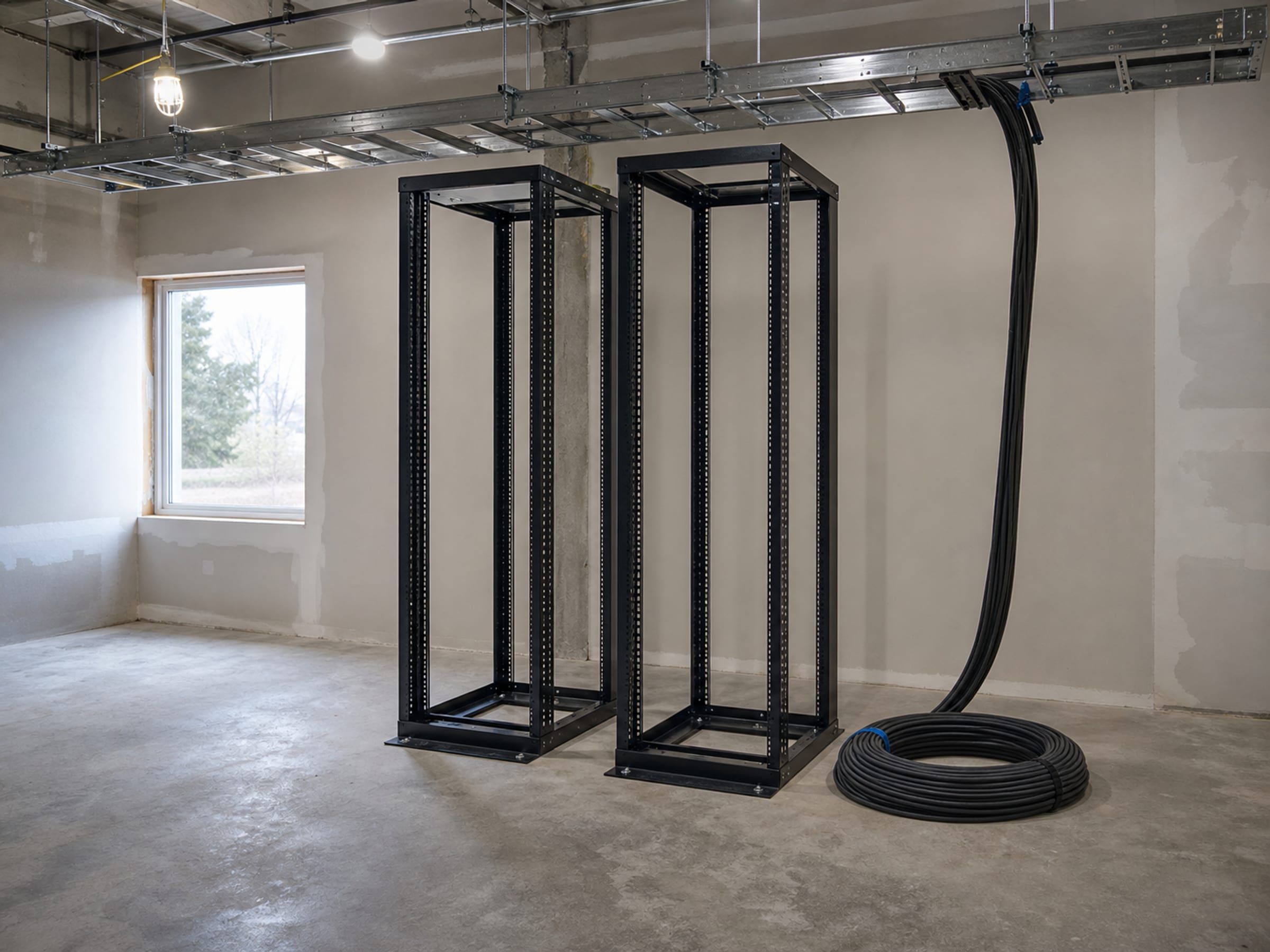
- Quoted as
- A mirrored bill of materials against the primary
- Includes
- Racks, power, compute, replication target, network
- Delivery
- Racked, cabled, labeled and burned in
- Boundary
- We never operate the site or perform the failover
The second site only works if it resembles the first in the ways that matter
A DR site is procured as a cost-reduction exercise and tested as an exact-match exercise, and the gap between those two framings is where failover tests fail. Smaller hosts are usually fine; a different processor generation may not be. Less capacity is usually fine; a different network topology rarely is. Uniqcli quotes the DR site as a mirrored bill of materials against the primary — racks and power, compute and storage, the replication target, and the network that has to behave the same way — with the deliberate differences called out on the document rather than discovered during a test.
What has to match, and what can be smaller
Architecture has to match. If the primary runs a particular hypervisor version, network topology or storage protocol, the DR site does too — those are the things a failover actually depends on. Substituting them to save money produces a site that looks like insurance and behaves like a science experiment.
Capacity usually does not have to match. Most DR designs accept degraded performance during an incident, which means fewer hosts, less memory and a smaller storage tier are legitimate savings — provided the reduction is a decision written down rather than an accident. We put the intended ratio on the quote.
The replication target is the one line that should never be under-specified. It has to ingest at the rate the primary generates change, hold the retention your recovery-point objective implies, and be reachable over the circuit you actually have. That last constraint is the one most often left out of the sizing.
The mirrored package, layer by layer
Every layer verified as a priced line on this catalog. Naming a manufacturer describes the market, not a Uniqcli partnership or endorsement.
Compute and storage
Lenovo server platforms and Nexsan arrays sized to the degraded-performance ratio you agree to, with memory quoted per host so the DR estate is not silently thinner than the design assumed.
Replication targets
Cohesity and Object First appliances, sized to ingest at the change rate the primary produces and hold the retention your recovery-point objective implies.
Backup and replication licensing
Veeam licensing quoted per the unit your program uses and aligned to your existing renewal date. Licensing and subscriptions are quoted and sourced through US distribution rather than held on a shelf, so stock language does not apply to them.
Power and racking
Eaton and Vertiv UPS, batteries and PDUs with the racking and containment around them — a DR site's power path is as real as the primary's, and it is usually the layer that gets forgotten.
We build the site; we never run it
Uniqcli supplies, racks, cables, labels and burns in the equipment for a DR site. We do not operate that site, do not host it, do not monitor it, and do not perform or participate in a failover. There is no Uniqcli recovery service behind any of this, and there is no facility of ours involved.
Recovery-time and recovery-point objectives are commitments your organization makes to itself and to whoever it answers to. We size hardware against the numbers you give us and state the assumptions plainly; the plan, the testing and the decision to invoke it stay entirely inside your program.
- Racked, cabled and labeled to your DR-site elevation
- Burned in and verified as working hardware before handover
- Deliberate differences from the primary written on the quote
- Country of origin recorded per line; NDAA §889 screening before the quote
- No failover, monitoring or site operation performed by us
DR buildout questions
Can the DR site be smaller than production?
Usually yes on capacity, and rarely on architecture. Fewer hosts and less storage are legitimate savings if degraded performance during an incident is acceptable and the ratio is written down. Different topology, different storage protocol or a different platform version is where failover tests start failing.
How do you size the replication target?
From the change rate the primary produces, the retention your recovery-point objective implies, and the bandwidth of the circuit between the sites. That third input is the one most often omitted, and it is frequently the binding constraint.
Do you operate the DR site or run the failover?
No. We supply, rack, cable, label and burn in the hardware. Operation, monitoring, testing and any decision to fail over belong entirely to your organization or to the provider you contract for that purpose.
Can you quote the primary and DR sites together?
Yes, and it is the better way to do it — the mirrored bill of materials is easier to build and to review when both halves are on one document, with the intended differences called out explicitly.
The solutions atlas
Every solution, by technology area and by customer.
By technology
By customer
- TAA & NDAA-889 Compliance Screening
- CMMC & CUI Solutions
- Federal & DoD
- State, Local & Education
- Healthcare
- Enterprise
- Rapid Procurement & GPC Buys
- Multi-Vendor Integration Projects
- eProcurement & Custom Catalogs
- FISMA Modernization
- CJIS-Compliant Justice Cloud & Local AI
- Federal Storage Modernization
- Government ERP & Business Systems Infrastructure
- Managed Procurement
- Secure AV & Conferencing
- Fiber Network Infrastructure
- Satellite & Resilient Connectivity
- Wavelength & Optical Transport
- Decentralized Data Centers
- Data Center Design & Build
Send the primary site's bill of materials
We return a mirrored DR package with the deliberate differences called out, the replication target sized, and the racking plan attached.