
Solutions
Digital Signage Systems
Signage rarely fails on the screen. It fails on the boring layer underneath — the mount, the cable run, the player, and whether the panel was rated for the hours it is actually being asked to run. We quote and stage that layer as one set, per location.
- Scope
- Commercial displays, players, mounts, cabling and enclosures
- Rated on
- Duty hours, orientation and environment — not consumer specifications
- Boundary
- The CMS and the content operation stay yours
A consumer television on a lobby wall is a warranty claim waiting to happen
The single most common signage mistake is buying a consumer television because the price per inch looks better. Commercial panels differ in the ways that matter for this use: rated duty hours for continuous or near-continuous operation, higher sustained brightness for daylit spaces, portrait orientation support without voiding anything, commercial connectors and control, and a warranty written for the way the panel will actually be used. The second most common mistake is budgeting for panels and then discovering that mounts, players, power and network drops were never on the requisition.
What decides the specification
Duty hours first. A wayfinding screen in a twenty-four-hour facility, a menu board that runs twelve hours a day and a meeting-room panel that wakes on booking are three different ratings. Buying the highest rating everywhere wastes money; buying the lowest everywhere produces a replacement cycle you did not plan for.
Then brightness and environment. A screen behind glass in direct sun needs far more brightness than a corridor panel, and a high-brightness window display is a different product class again. Orientation matters too — a panel mounted portrait must be rated for it.
The player is the third decision, and the one most often deferred. Some panels run signage internally, which is cheaper and fine at small scale; a separate player is more capable, easier to standardize and easier to replace. That choice interacts with the CMS your team has chosen, which is why we ask before quoting rather than assuming.
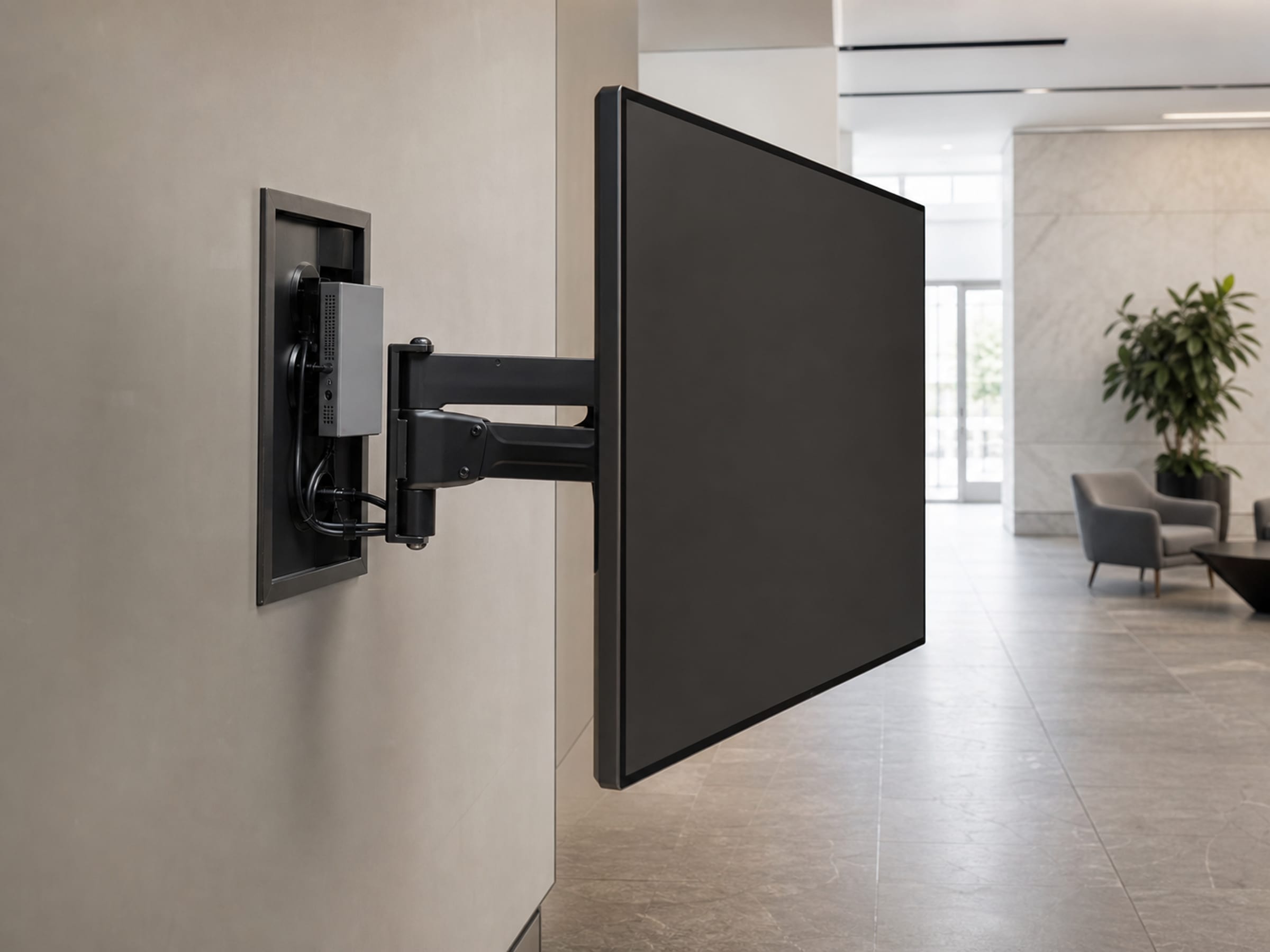
Then the physical layer: mount type for the wall construction, recessed enclosure or surface mount, cable routing that hides the run, a power outlet behind the screen rather than a visible cable, and a network drop or the honest admission that this location will run wireless.
The whole installation, per location
Samsung, LG, Sharp, BenQ, ViewSonic and Legrand carry priced rows across displays, mounts and AV infrastructure.
Commercial displays
Samsung, LG, Sharp and BenQ across the commercial signage lines, quoted by duty rating, brightness and orientation rather than by diagonal alone. ViewSonic covers the smaller and interactive end of the estate.
Players and media appliances
Where the CMS calls for an external player rather than the panel's internal one, it is quoted with the display and standardized across the estate so a failure is a swap.
Mounts, enclosures and protection
Legrand carries very deep priced inventory across AV mounting and infrastructure. Fixed, tilting and recessed mounts, plus protective enclosures where a screen is in a public or outdoor-adjacent space.
Cabling, extension and power
The run from the player to the panel, extenders where the distance exceeds what a direct cable will carry, and the outlet behind the screen. Quoted per location so the installer arrives with everything.
Enough to quote a site without a walk-through
- Location list with screen size and orientation per location
- Hours of operation for each — continuous, business hours, or wake-on-demand
- Lighting conditions, especially anything behind glass or in direct sun
- Wall construction at each mount point, and whether recessing is possible
- CMS or player platform already chosen, if there is one
- Power and network availability at each location, honestly stated
Signage questions
Can we use consumer televisions to save money?
You can, and many organizations do once. Consumer panels are not rated for the duty hours, sustained brightness or orientation most signage demands, and the warranty is generally written for domestic use. Where the screen runs a few hours a day in a dim room the gap is small; in a lobby running sixteen hours it is a replacement cycle.
Do we need a separate media player?
It depends on your CMS and your scale. Panels with capable internal players are cheaper and perfectly adequate for small estates. External players are easier to standardize, easier to swap and generally more capable, which matters once you are managing dozens of locations. We ask which CMS you have chosen before quoting either.
Who manages the content?
You do. We source and integrate the hardware — displays, players, mounts, cabling and the network side — and can stage devices before delivery. The CMS subscription, the content design and the scheduling operation belong to your team or your agency.
Can screens be installed as well as supplied?
Installation and low-voltage work is a capability-level service we quote alongside the hardware, covering mounting, cable routing and the network drop. What we will not do is imply we run a national field-service organization — the scope and the schedule are agreed per project.
Signage background and the displays behind it
The solutions atlas
Every solution, by technology area and by customer.
By technology
By customer
- TAA & NDAA-889 Compliance Screening
- CMMC & CUI Solutions
- Federal & DoD
- State, Local & Education
- Healthcare
- Enterprise
- Rapid Procurement & GPC Buys
- Multi-Vendor Integration Projects
- eProcurement & Custom Catalogs
- FISMA Modernization
- CJIS-Compliant Justice Cloud & Local AI
- Federal Storage Modernization
- Government ERP & Business Systems Infrastructure
- Managed Procurement
- Secure AV & Conferencing
- Fiber Network Infrastructure
- Satellite & Resilient Connectivity
- Wavelength & Optical Transport
- Decentralized Data Centers
- Data Center Design & Build
Send the location list
Give us the screens, the hours they run and the walls they hang on. A Uniqcli specialist returns displays, players, mounts and cabling per location — rated to real duty hours, screened, and availability stated per line.