
Solutions
Video Wall Systems
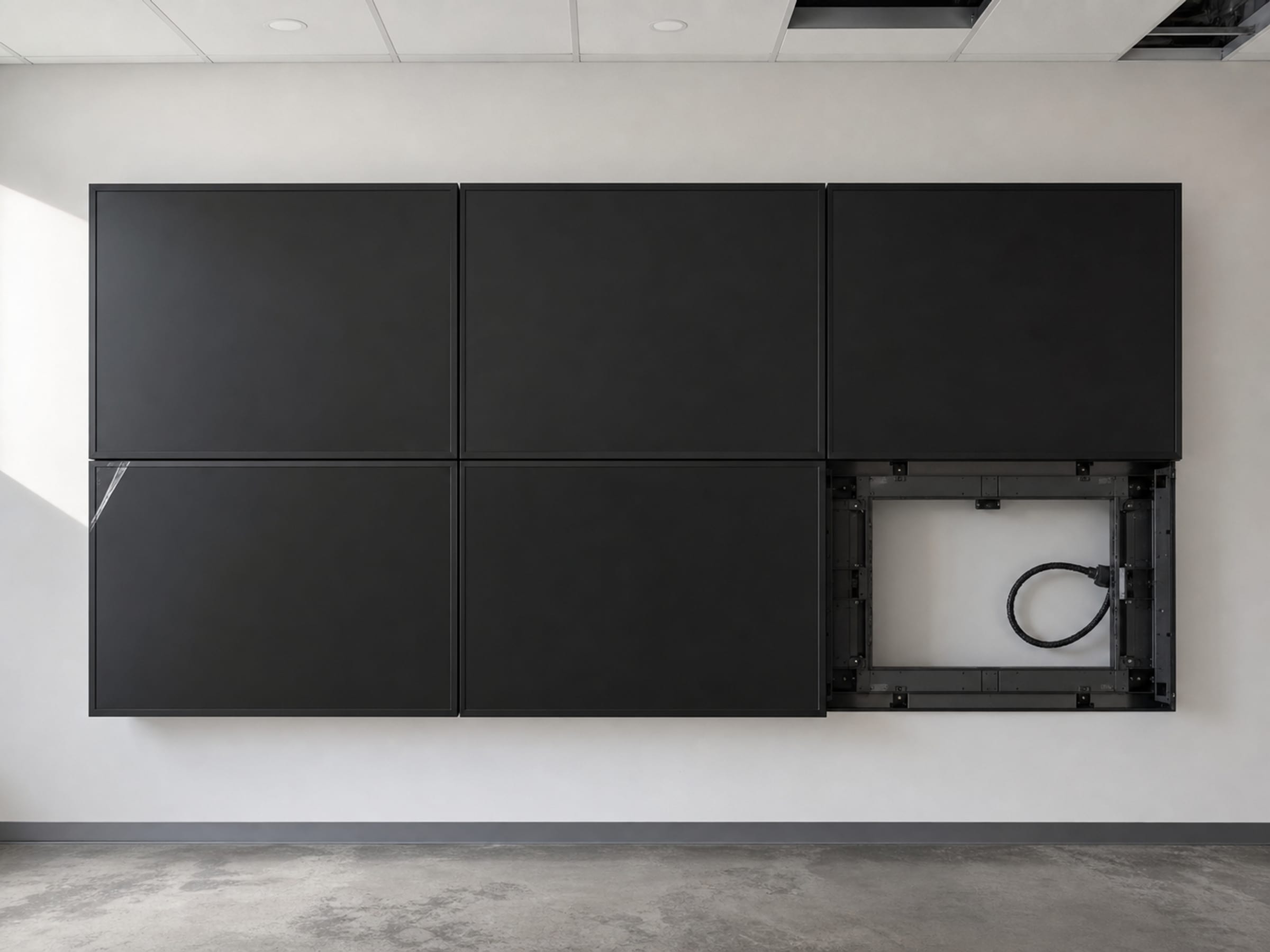
A control-room wall is a structural purchase as much as a display one. We quote the panels, the mounting system, the processing and the power together, sized to the viewing distance rather than to the wall — because pixel pitch is decided by where people stand, not by how much space there is.
- Scope
- Control room, operations center and lobby video walls
- Sized by
- Viewing distance and content type — not by available wall area
- Quoted
- Panels, mounting system, processing, control and power
- Boundary
- Structural fixing and the operation of the room stay yours
Pixel pitch is a function of where people stand
The first number in a video wall specification is not the size of the wall. It is the distance between the nearest operator and the display, because that distance sets the pixel pitch at which individual pixels stop being visible. Specify a pitch that is too coarse and the wall looks crude from the console; specify one far finer than the room needs and the budget triples for a difference nobody in the room can see. Every other decision — LED versus tiled LCD, processing, mounting depth, power and heat — follows from that measurement and from what the wall is actually displaying.
Five decisions, in the order they should be made
Made in this order, a wall specification converges. Made in any other order, it is re-done.
Viewing distance and pitch
Measure from the nearest sustained viewing position, not from the back of the room. This sets pixel pitch for LED, or panel size and count for a tiled LCD wall.
LED or tiled LCD
Fine-pitch LED gives a seamless image and suits continuous-duty rooms; tiled LCD is cheaper per area and carries bezels. Content and duty hours decide it more than budget does.
Processing and sources
How many sources, at what resolution, arranged in what layouts, switched by whom. The processor and control surface are specified from that answer rather than from the panel vendor's default.
Mounting, service access and power
Front-serviceable mounting, the depth it needs, the structure it fixes to, and the dedicated circuits and heat load behind a wall that runs continuously.
What stays yours to run
Structural fixing is the boundary we hold most firmly. A fine-pitch LED wall is heavy, it hangs off a mounting system that transfers that load into the building, and whether a given wall can carry it is a question for your structural engineer and the authority with jurisdiction. We state the weight and the mounting system's requirements; we do not certify the wall.
Heat and power are the adjacent one. A wall running continuously puts a sustained load into a room that may have been cooled for people rather than for equipment. We quote the dedicated circuits and the equipment's own draw and heat figures so your mechanical and electrical engineers have real numbers to work from.
And the operation is yours. What appears on the wall, who switches it, how it integrates with your systems, and the day-two support of that workflow belong to your operations team or your AV integrator. We source, stage and integrate the equipment.
The wall and everything behind it
Absen, Leyard, Samsung, LG, Crestron and Legrand carry priced rows across panels, control and mounting infrastructure.
LED and LCD panels
Absen and Leyard across fine-pitch LED; Samsung, LG and Sharp across commercial and tiled LCD. Quoted by pitch and duty rating against your measured viewing distance.
Processing and control
Crestron and Harman carry priced control, processing and distribution lines. The source count and layout requirement drive this specification rather than the panel choice.
Mounting, structure and power
Legrand carries deep priced inventory across AV mounting and infrastructure. Front-service mounting systems, alignment hardware, cable management and the rack and power behind the wall.
Video wall questions
What pixel pitch do we need?
It follows from the nearest sustained viewing distance and from the content — dense text and mapping demand a finer pitch than dashboards or video. Send the room dimensions and where operators actually sit, and we work the pitch with you rather than quoting a default and hoping.
LED or tiled LCD?
Fine-pitch LED gives a seamless image with no bezels and suits rooms running continuously, at a higher cost per square meter. Tiled LCD is materially cheaper for large areas and perfectly good where bezels are acceptable and duty is lower. Content type and operating hours usually decide it.
Can you handle the mounting and installation?
We quote the mounting system and the installation work as a capability-level service alongside the hardware. What we do not do is certify that a wall or structure can carry the load — that is a structural engineering judgement, and we will give your engineer the weights and fixing requirements to make it.
How much power and cooling does a wall need?
More than most rooms were designed for, and it should be raised early. We state the equipment's own draw and heat output and quote the dedicated circuits and rack power, so your mechanical and electrical engineers are working from real figures rather than a rule of thumb.
Video-wall background and the rooms they live in
The solutions atlas
Every solution, by technology area and by customer.
By technology
By customer
- TAA & NDAA-889 Compliance Screening
- CMMC & CUI Solutions
- Federal & DoD
- State, Local & Education
- Healthcare
- Enterprise
- Rapid Procurement & GPC Buys
- Multi-Vendor Integration Projects
- eProcurement & Custom Catalogs
- FISMA Modernization
- CJIS-Compliant Justice Cloud & Local AI
- Federal Storage Modernization
- Government ERP & Business Systems Infrastructure
- Managed Procurement
- Secure AV & Conferencing
- Fiber Network Infrastructure
- Satellite & Resilient Connectivity
- Wavelength & Optical Transport
- Decentralized Data Centers
- Data Center Design & Build
Send the room, not the wall size
Give us the room dimensions, where operators sit and what the wall has to display. We return panels, mounting, processing and power sized to that — with weights and heat figures for your engineers, and screening performed before it goes out.