
Short answer
LC, SC, ST, FC and MPO are the fiber connector families an enterprise network uses, and each has an IEC 61754 interface standard — Part 20 for LC, Part 4 for SC, Part 7 for MPO. LC is the small-form-factor connector on duplex SFP and SFP+ transceivers, SC is the older push-pull square connector still common on carrier handoffs, and MPO carries a row of fibers in one ferrule.
Key facts
- IEC 61754-20 defines the type LC connector family, IEC 61754-4 the type SC family, and IEC 61754-7 the type MPO family.
- A standard MPO12 houses 12 fibers in a single row on 250 µm centerlines, numbered one to twelve from left to right.
- Parallel-optic links using 8 fibers are properly called MPO12/8; the center four of the twelve positions are filled with a stub.
- MPO was originally specified in 12- and 24-fiber configurations, with 16- and 32-fiber versions added later.
- In North America TIA-604-5, also called FOCIS-5, is the standard supporting physical compatibility between MPO connectors.
- UPC and APC polish types must never be mated to each other, and MPO polarity must follow one method across the whole channel.
By Uniqcli Team
Fiber optic connectors are defined family by family in the IEC 61754 series. Part 20 is the type LC connector family, Part 4 is the type SC family, and Part 7 is the type MPO family. Each part fixes the interface dimensions, which is what lets a cord from one manufacturer mate with an adapter from another.
In an enterprise network the choice is usually made for you by the equipment. LC is the interface on duplex SFP, SFP+ and SFP28 transceivers, so it is what nearly every switch-facing patch cord terminates in. SC survives on older equipment, on many service-provider handoffs and on single-fiber applications. ST and FC turn up on legacy plant and test equipment. And MPO carries a whole row of fibers in one rectangular ferrule for parallel optics on 40, 100 and 400 Gigabit ports.
The practical work is therefore matching three things: the connector on the equipment, the connector on the panel, and the fiber type behind both. A connector says nothing about whether the fiber is single-mode or multimode — that is a separate decision and a separate color code.
The duplex families: LC, SC, ST and FC
LC is the small-form-factor connector defined by IEC 61754-20. It latches like an RJ-45 plug, and because it is small a duplex LC pair fits where a single older connector used to, which is why it became the transceiver interface and why an equipment room is mostly LC-to-LC cords.
SC, defined by IEC 61754-4, is a square-bodied push-pull connector. It is easy to work with in a crowded enclosure because it needs no latch release, and it remains common on carrier handoffs, on media converters and on older switch plant. An SC-to-LC cord is the ordinary bridge between an existing SC panel and current LC optics.
ST is a bayonet connector — push and twist — that dominated early multimode plant and is still found in industrial and campus installations. FC is a threaded connector, once standard in test and metrology because the screw coupling holds alignment under vibration. Neither is something to specify for new work, but both are things to identify correctly when extending or repairing an existing run.
MPO: one ferrule, many fibers
MPO, defined by IEC 61754-7, is a multi-fiber connector: instead of one fiber in a round ferrule, it holds a row of fibers in a rectangular one. CommScope describes the standard MPO12 as housing 12 fibers in a single row on 250 µm centerlines, numbered one to twelve from left to right. In North America TIA-604-5, also known as FOCIS-5, is the standard that supports physical compatibility between MPO connectors.
MPO exists because parallel optics need multiple fibers per link. A 40 or 100 Gigabit transceiver that transmits on four lanes needs eight fibers — four transmit, four receive — and CommScope notes that such applications are more precisely called MPO12/8, because the connector holds 12 positions and the application uses 8. The center four positions are typically filled with a fiber stub to keep dust out.
MPO was originally specified in 12- and 24-fiber versions, with 16- and 32-fiber versions added later. The practical pattern in a data center is an MPO trunk between panels, broken out at each end into duplex LC for the equipment — which is why an MPO-to-4×LC harness is one of the most common assemblies in the rack.
Polish, polarity and the mistakes that cost a link
Polish type is the first thing to match. UPC (ultra physical contact) is the blue-bodied default for most multimode and much single-mode work; APC (angled physical contact) is green-bodied and uses an angled endface to send back-reflections into the cladding, which matters on single-mode links carrying analog or long-haul services. UPC and APC do not mate: joining them damages the endfaces and produces a link that either fails or degrades quietly.
Polarity is the second, and it is where MPO installations go wrong. Because an MPO carries a row of fibers, the trunk, the adapters and the breakout harnesses must all follow the same polarity method end to end. Mixing methods across a channel produces transmit-to-transmit pairs at one end, and the fault looks like a dead link rather than a wiring error.
The third is cleanliness. A fiber endface is a contact interface, and a single particle on a ferrule is enough to raise insertion loss past the link budget or to pit both endfaces when they are mated. Inspect and clean before every mating; it is the cheapest step in the whole installation and the one most often skipped.
Key takeaways
- IEC 61754 defines the connector interfaces family by family: Part 20 is LC, Part 4 is SC, Part 7 is MPO.
- LC is the small-form-factor connector on duplex SFP, SFP+ and SFP28 transceivers, so most switch-facing cords are LC-to-LC.
- SC is a push-pull square-bodied connector still common on carrier handoffs and older plant; ST and FC are legacy families to identify rather than specify.
- An MPO12 holds 12 fibers in one row on 250 µm centerlines; TIA-604-5 (FOCIS-5) is the North American compatibility standard.
- Parallel optics that use 8 of those 12 positions are properly called MPO12/8; the center four positions are stubbed.
- UPC and APC polish types do not mate, and MPO polarity must follow one method end to end or the link comes up dead.
Shop it at Uniqcli
Parts for this job
LC to LC
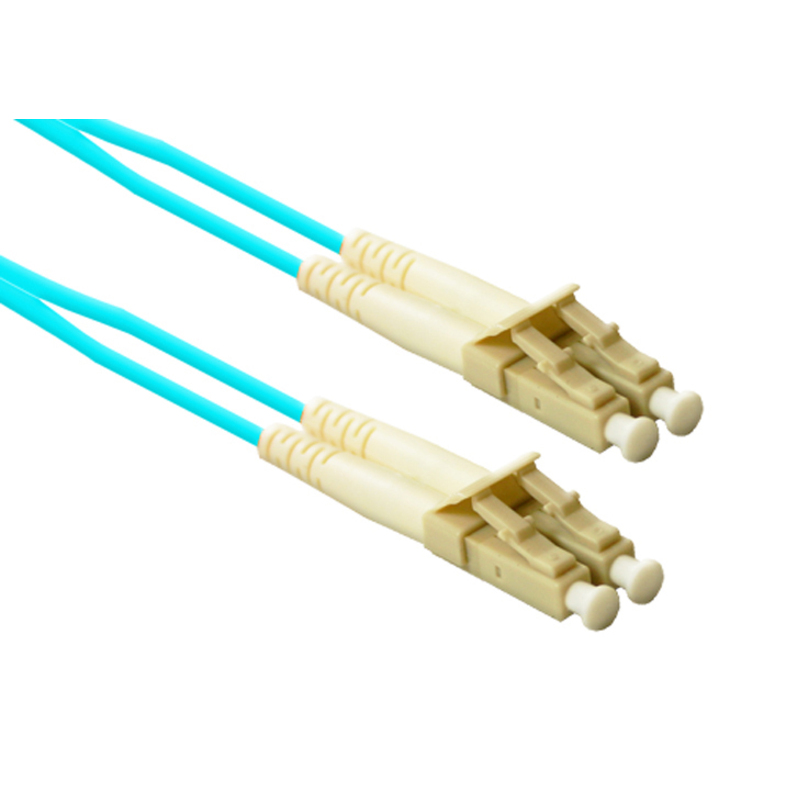
NSI Industries
ENET 2M LC/LC Duplex Multimode 50/125 10Gb OM4 or Better Aqua Laser…
LC2-OM4-2M-ENC
A 2 m duplex LC multimode OM4 patch cord — the ordinary switch-to-patch-panel cord for duplex SFP+ and SFP28 optics.
$33.47In stockSC to LC
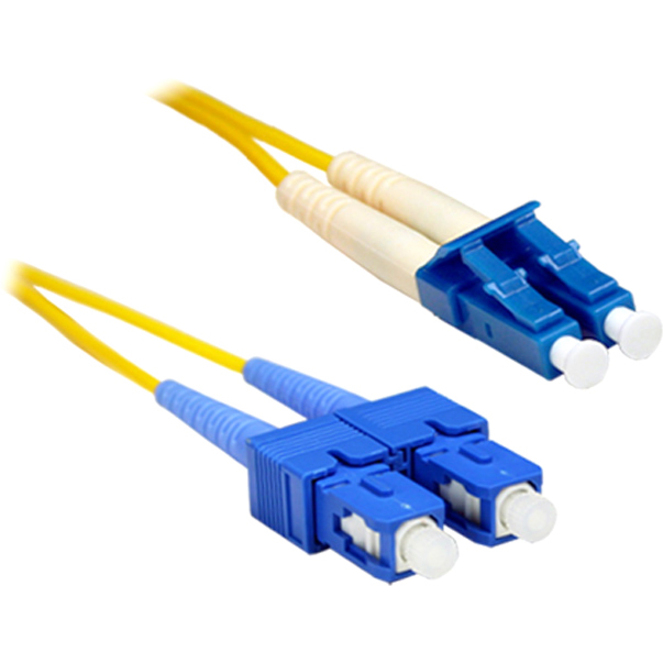
NSI Industries
ENET 3M SC/LC Duplex Single-mode 9/125 OS1 or Better Yellow Fiber Patch…
SCLC-SM-3M-ENC
A 3 m duplex single-mode cord with SC on one end and LC on the other, for joining an existing SC panel or carrier handoff to current LC optics.
$31.36In stockMPO to LC breakout
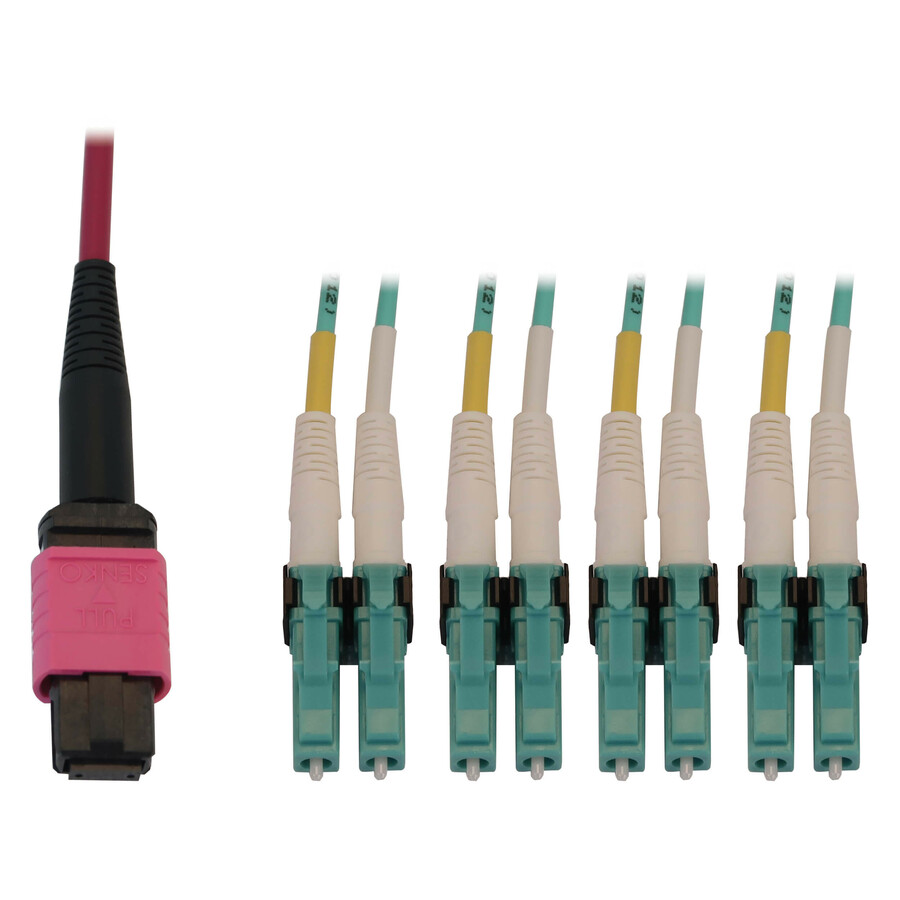
Eaton
Eaton Tripp Lite Series 40/100G Multimode 50/125 OM4 Fiber Optic Cable…
N845X-01M-8L-MG
A 1 m harness taking one 12-fiber MTP/MPO connector to four duplex LC pairs, the usual way a parallel trunk feeds duplex equipment ports.
Polarity method must match the trunk and adapters it is used with, end to end.
$209.54In stockST to ST
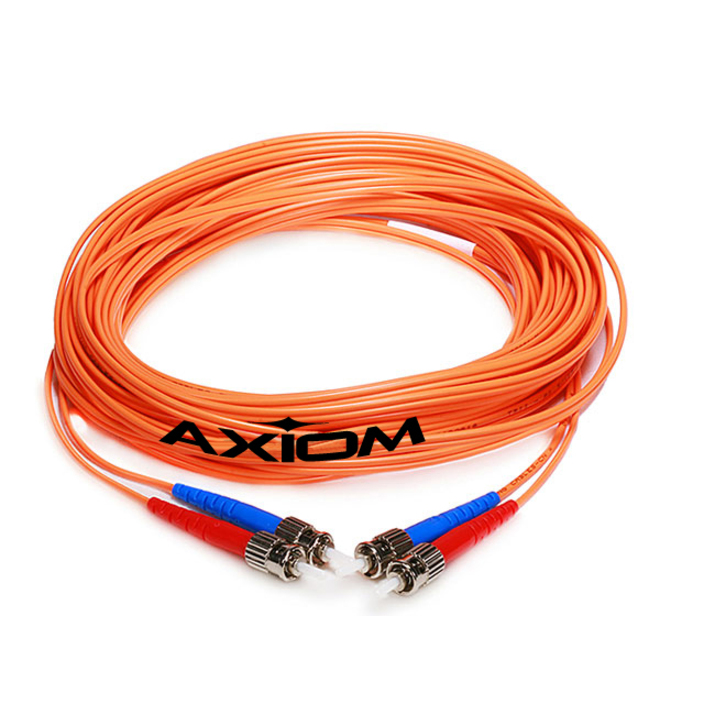
Axiom Memory Solutions
Axiom ST/ST Multimode Duplex OM1 62.5/125 Fiber Optic Cable 3m
STSTMD6O-3M-AX
A 3 m duplex ST multimode OM1 cord, for extending or repairing legacy plant where the existing panel is bayonet ST rather than LC.
$17.35In stockFrequently asked
- What is the difference between MPO and MTP?
- MTP is a registered trademark of US Conec for its own line of MPO-style connectors. Both are built to the type MPO connector interface defined in IEC 61754-7, so an MTP connector mates with an MPO adapter and with MPO connectors from other manufacturers. Treat MTP as a brand of MPO, and match polarity method and fiber count rather than the name printed on the boot.
- Which fiber connector is used on SFP transceivers?
- Duplex LC. A duplex SFP, SFP+ or SFP28 module has two LC ports, one transmit and one receive, which is why LC-to-LC is the most common cord in an equipment room. Higher-lane modules such as QSFP typically use an MPO instead, because parallel optics need a row of fibers rather than a pair.
- Can I connect an LC cable to an SC port?
- Not directly — the interfaces are different families and do not mate. Use a hybrid SC-to-LC patch cord, or an SC-to-LC adapter in the panel. Whichever you choose, the fiber type and the polish type must still match on both sides: single-mode to single-mode, multimode to multimode, and UPC to UPC or APC to APC.
- What is the difference between UPC and APC connectors?
- The endface geometry. UPC is polished flat with a slight dome and is normally blue-bodied; APC is polished at an angle and is normally green-bodied, so back-reflections are directed into the cladding rather than back down the fiber. APC is used where return loss matters, typically on single-mode links carrying analog or long-haul services. The two must never be mated to each other.
Sources
- 1.IEC 61754-20 — Fibre optic connector interfaces, Part 20: type LC connector familywebstore.iec.ch
- 2.IEC 61754-4 — Fibre optic connector interfaces, Part 4: type SC connector familywebstore.iec.ch
- 3.IEC 61754-7 — Fibre optic connector interfaces, Part 7: type MPO connector familywebstore.iec.ch
- 4.CommScope — MPO8 and MPO12/8 explainedcommscope.com
Keep reading