
Short answer
Core size separates single-mode from multimode fiber, and reach follows from it: single-mode has an 8-10 µm core carrying one light path on 1310 and 1550 nm lasers, for links measured in kilometres; multimode has a 50 µm core (62.5 µm on OM1) lit by 850 nm VCSELs, for links inside a building. They do not interchange: both ends need the same fiber and matching optics.
Key facts
- Single-mode fiber has a core of 8-10 µm, usually written 9/125, and runs at 1310 nm and 1550 nm.
- Multimode is 50/125 µm on OM2 through OM5 and 62.5/125 µm on OM1; short-reach optics light it at 850 nm.
- Cisco's 10GBASE-SR datasheet gives 300 m on OM3 (2000 MHz·km) and 400 m on OM4 (4700 MHz·km).
- Multimode's ceiling is modal dispersion. Single-mode has no modal limit, which is why it stretches to 10 km and beyond.
- OM1 and OM2 are legacy grades; OM3, OM4 and OM5 use the enhanced 50 µm glass that VCSEL-based links need.
The single-mode versus multimode question almost always surfaces during a physical build-out, when someone has to commit money to a cable plant that will sit in the walls, trays, and conduit for a decade or more. It gets framed as a fiber-type decision, but the real drivers are the distance every link must cover and where the cost lands — in the glass or in the optics that light it. The fiber itself is the cheap, long-lived part; the transceivers plugged into each end are what you replace as speeds climb from 10G to 100G to 400G and beyond.
Two facts drive most of the decision. First, reach: single-mode has no modal-dispersion ceiling and stretches from hundreds of meters to tens of kilometers, while multimode is capped by modal dispersion and gives you a few hundred meters at 10G shrinking to roughly 100 m at 100G. Second, a cost inversion: single-mode cable is typically cheaper per meter but its transceivers cost more, whereas multimode uses inexpensive 850 nm VCSEL optics on pricier cable. So a data center lighting thousands of short links weighs optics savings differently than a campus running fiber between buildings, where multimode simply cannot reach.
At a glance
Side by side
| Factor | Single-mode fiber | Multimode fiber |
|---|---|---|
| Core diameter | ~9 µm (8–10 µm) — one light path | 50 µm (OM2–OM5) or 62.5 µm (OM1) — many paths |
| Light source & wavelength | Lasers at 1310 nm and 1550 nm | 850 nm VCSELs; legacy 1300 nm sources |
| Reach at 10G | 10 km (LR), 40 km (ER), ~80 km (ZR) | OM3 ~300 m, OM4/OM5 ~400 m (SR) |
| Reach at 100G | 500 m (DR), 2 km (FR), 10 km (LR4) | OM3 ~70 m, OM4 ~100 m (SR4) |
| Distance-limiting factor | Attenuation & chromatic dispersion; no modal limit | Modal dispersion (differential mode delay) |
| Cable grade & jacket | OS2, yellow, ~0.3–0.4 dB/km | OM3/OM4 aqua, OM5 lime green; ~3 dB/km at 850 nm |
| Cost inversion | Cheaper cable, pricier optics + tighter alignment | Cheaper short-reach optics, higher cost-per-meter cable |
| Typical role | Long-haul, campus, DCI, future-proof backbone | In-row and short in-rack data-center links |
Choose Single-mode fiber when
- Runs exceed a few hundred meters — campus backbones, building-to-building, metro, long-haul, or data-center interconnect
- You want one cable plant to outlast many optics generations, since OS2 has no modal reach ceiling as speeds climb to 100G/400G and past
- Links must reach 500 m to 10 km or more at high speed, or use coherent (ZR) optics
- Fiber runs outside-plant or in hard-to-access conduit where re-pulling later is expensive
Choose Multimode fiber when
- Links are dense and short inside a data center — top-of-rack to end-of-row, within the ~100–400 m modal budget
- The optics budget dominates and you are lighting many parallel links where cheaper SR/VCSEL modules add up
- OM3/OM4 cabling is already installed and the reach comfortably fits the target speed
- Structured cabling stays inside a single building or floor, well under the modal-dispersion limit
Bottom line
Measure the link — inside a building, multimode; between buildings or past 550 metres, single-mode. If any link must reach beyond a few hundred meters, or you want a cable plant that survives multiple speed upgrades without re-pulling, single-mode is the safe call despite pricier optics. For dense, short data-center links where inexpensive 850 nm optics multiplied across thousands of ports drive the budget, multimode can still be the cheaper build today. Many facilities run both: single-mode for backbone and interconnect, multimode for short in-row hops.
Products for this decision
Single-mode patching
AddOn
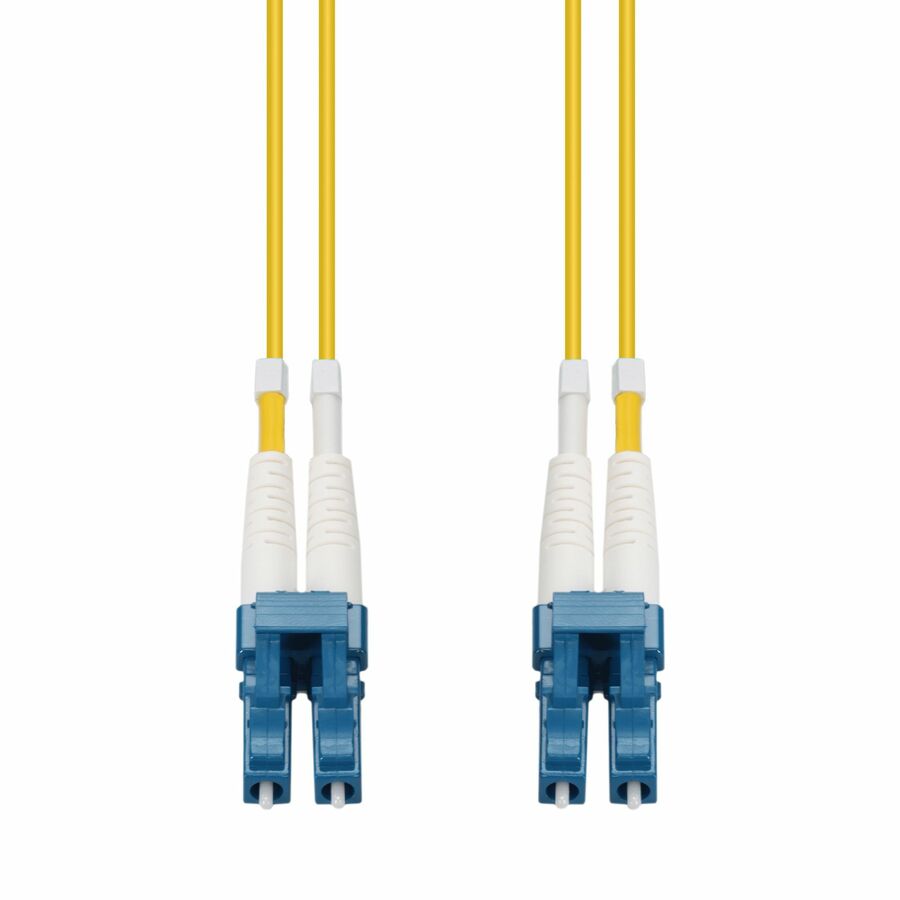
AddOn 3m LC to LC Yellow OS2 Duplex OFNR (Riser-Rated) SMF…
ADD-LC-LC-3M9SMF
A 3 m duplex OS2 LC-to-LC riser-rated jumper on 9/125 glass — the cord for a backbone, interconnect or campus link terminated in a rack.
$17.48In stockMultimode patching
Ubiquiti
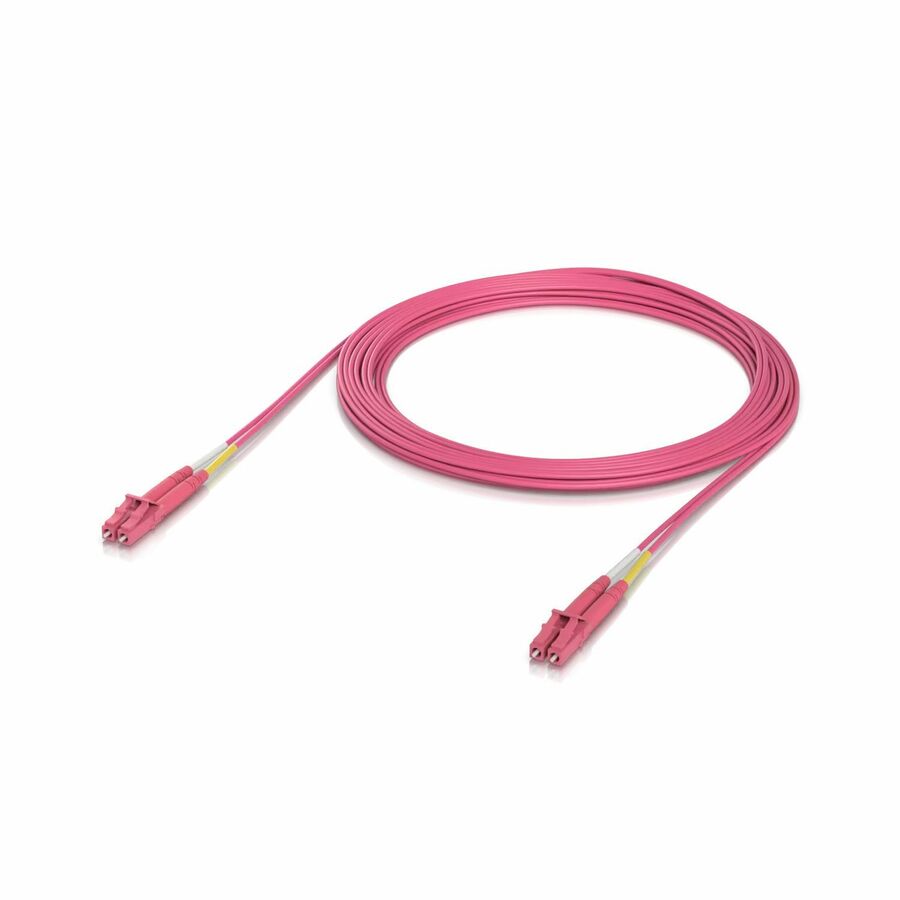
Ubiquiti OM4 Duplex LC UPC Fiber Patch Cable - 16.40 ft
UACC-OFC-M2-LULU-5M
A 5 m duplex OM4 LC/UPC jumper on 50/125 glass, LSZH-jacketed, for short in-row hops between switches and servers.
$10.66In stockLong-reach conversion
Axiom Memory Solutions
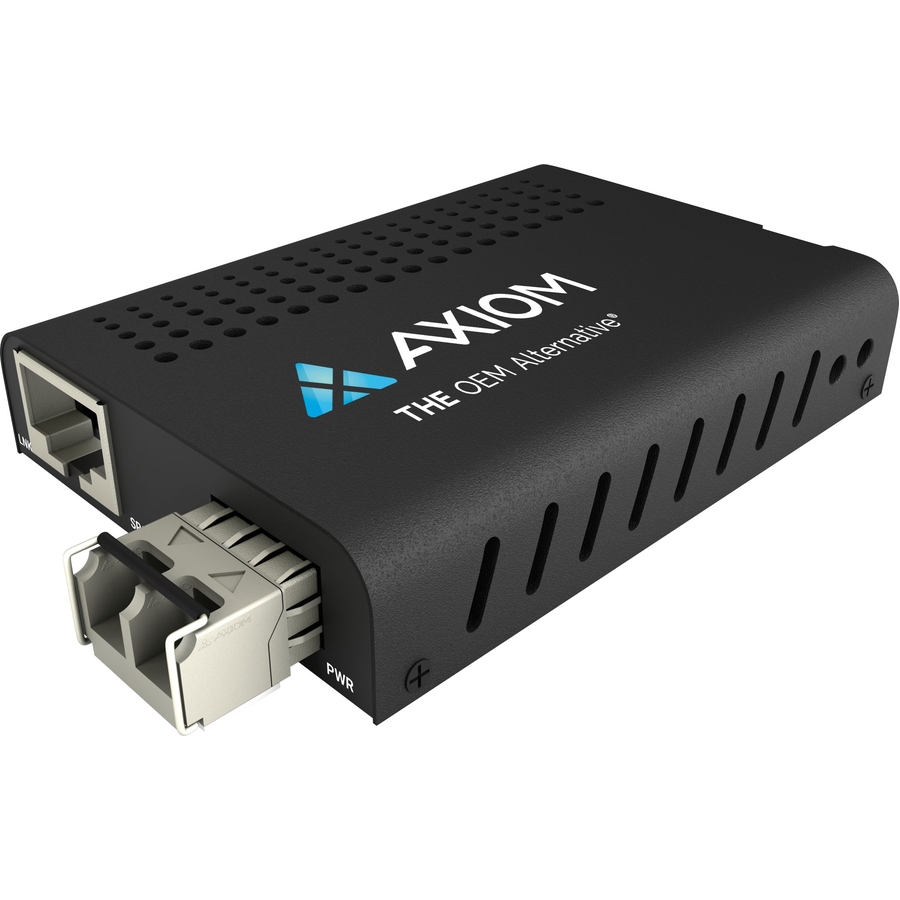
Axiom Mini 10Gbs RJ45 to 10GBASE-LR Media Converter
MC10-S3L20-AX
A 10GBASE-LR media converter that takes 10G copper to single-mode LC at 1310 nm for a 20 km reach — the long side of the decision.
$1,100.27In stockShort-reach conversion
Axiom Memory Solutions
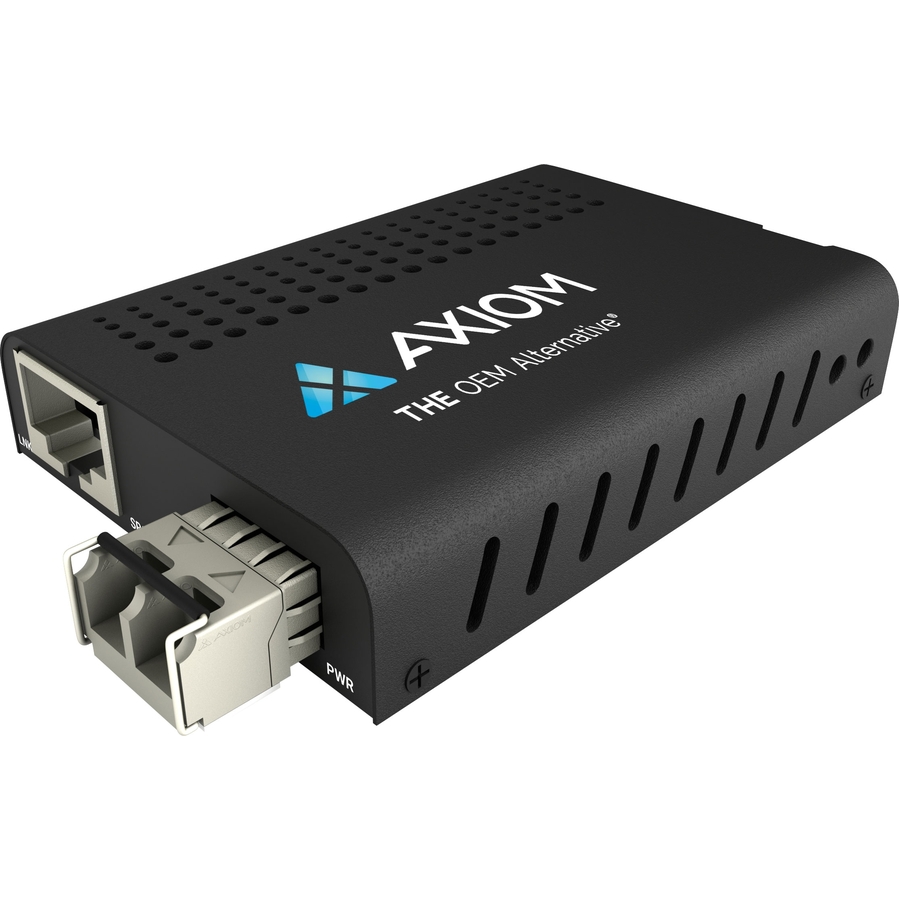
Axiom Mini 10Gbs RJ45 to 10GBASE-SR Media Converter
MC10-M8L04-AX
The multimode counterpart: 10GBASE-SR on 850 nm optics over 50 µm fiber, for the in-building distances multimode was designed around.
$987.87In stockShop it at Uniqcli
FAQ
Common questions
- Is single-mode always the more future-proof choice?
- Single-mode has no modal-dispersion reach ceiling and carries every speed OS2 realistically faces for the foreseeable future, so it is the safer long-term cable plant. But for dense sub-100 m links, multimode with SR optics can still be cheaper overall today. Which is 'better' depends on your distances and how many links you are lighting.
- Can I mix single-mode and multimode on the same link?
- No. Both ends of a given link must use the same fiber type, and the transceiver must match the fiber — a single-mode module on OS2, a multimode module on OM-x. The core sizes and light sources differ, so mixing them causes severe loss or no link at all. You can run both fiber types in the same cabinet or cable plant, just not on the same pair end to end.
- Do I need OM5, or is OM4 enough?
- OM4 covers the large majority of short-reach needs. OM5's real advantage is short-wavelength WDM (SWDM), which carries several wavelengths on one pair; without SWDM optics, OM5's reach at a single wavelength is essentially the same as OM4. Only pay the OM5 premium if you specifically plan to deploy SWDM transceivers.
- Why do single-mode transceivers cost more if the cable is cheaper?
- The ~9 µm single-mode core demands precise laser alignment and narrower-linewidth sources than the inexpensive 850 nm VCSELs used on multimode, so the optics cost more even though OS2 cable is often cheaper per meter. That inversion — cheap cable, expensive optics versus pricier cable, cheap optics — is the heart of the decision.
- What are the differences between single mode and multimode fiber?
- Core size, light source and reach. Single-mode carries one light path through an 8-10 µm core using 1310 nm and 1550 nm lasers, and has no modal-dispersion limit, so it runs kilometres. Multimode carries many paths through a 50 µm core (62.5 µm on OM1) lit by cheap 850 nm VCSELs, and modal dispersion caps it at a few hundred metres. Single-mode cable is usually cheaper per metre and its optics are dearer; multimode inverts that.
- Can you mix multimode and singlemode fiber?
- Not on the same link. Both ends must be the same fiber type and the transceivers must match it, because a 9 µm core and a 50 µm core do not couple light usefully — you get heavy loss or no link at all. The two types coexist happily in the same building and even the same enclosure; the rule applies end to end on one pair.
- Is OM3 fiber single mode or multimode?
- Multimode. Every OM designation — OM1 through OM5 — is a multimode grade; OM3, OM4 and OM5 all use enhanced 50 µm glass, and OM3 carries 10 Gigabit Ethernet to about 300 m. Single-mode grades are labelled OS1 and OS2 instead.
- How do I know if my fiber is single mode or multimode?
- Read the jacket print first: the cable legend usually states the fiber type and the core/cladding size, such as 9/125 for single-mode or 50/125 for multimode. Jacket colour is a useful second clue — OS2 is conventionally yellow, OM3 and OM4 aqua, OM5 lime green — but colour is a convention, not a standard, so trust the printed legend over the sheath.
Sources
- 1.The Fiber Optic Association — fiber optic cable reference (core sizes and wavelengths)thefoa.org
- 2.ITU-T G.652 — Characteristics of a single-mode optical fibre and cableitu.int
- 3.Proterial Cable America — what OS1, OS2, OM1, OM2, OM3 and OM4 meanusa.proterial.com
- 4.Cisco — 10GBASE-SR SFP+ transceiver datasheet (300 m on OM3, 400 m on OM4)cisco.com
- 5.IEEE P802.3bm — 40 Gb/s and 100 Gb/s fiber optic task forceieee802.org