
Short answer
OM3 and OM4 are the same 50/125 um laser-optimised multimode glass and take the same 850 nm optics — the difference is modal bandwidth. OM3 is 2000 MHz-km and carries 10GBASE-SR to 300 m; OM4 is 4700 MHz-km and carries it to 400 m. They are fully intermateable, but a channel performs to its weakest segment, so any OM3 in the path rates the whole run as OM3.
Key facts
- OM3 is specified at 2000 MHz-km effective modal bandwidth at 850 nm; OM4 at 4700 MHz-km.
- 10GBASE-SR is specified to 300 m on OM3; IEEE's 802.3 maintenance submission adding OM4 to clause 52 set that reach at 400 m.
- Both are 50/125 um laser-optimised multimode and take the same 850 nm VCSEL optics — upgrading the grade never means new transceivers.
- OM4 is defined by TIA in TIA-492AAAD and by IEC as A1a.3 in IEC 60793-2-10 ed.4.
- OM4 was specified for the parallel-optics standards 40GBASE-SR4 and 100GBASE-SR10 in IEEE 802.3 clause 86.
- TIA-598 assigns aqua to both grades, so jacket colour never identifies the grade — read the legend printed along the cable.
OM3 and OM4 are both laser-optimized 50/125 µm multimode fibers built for 850 nm VCSEL transceivers, and they are fully intermateable: same core geometry, same connectors, same optics. The difference is bandwidth. OM3 is specified at 2000 MHz·km effective modal bandwidth at 850 nm, while OM4 raises that to 4700 MHz·km. That tighter control of modal dispersion translates directly into reach: 10GBASE-SR runs 300 m on OM3 versus 400 m on OM4, 40GBASE-SR4 (IEEE 802.3ba) runs 100 m versus 150 m, and 100GBASE-SR4 (IEEE 802.3bm) runs 70 m versus 100 m. Nothing else about the link changes — the transceivers, patch panels, and polarity schemes are identical — so the decision reduces to how much distance and upgrade headroom your cable plant needs over its service life.
The cost question has largely settled itself. OM4 carried a meaningful premium when TIA-492AAAD standardized it in 2009, but the delta on bulk cable and patch cords has narrowed to the point where cable price is rarely the deciding factor — termination labor, pathways, and the transceivers at each end dominate total installed link cost. That is why OM4 is the default grade for new structured cabling, while OM3 survives mainly as an extension of installed plant. One practical wrinkle is color: TIA-598 assigns aqua jackets to both grades, so many vendors ship OM4 in Erika violet to keep the grades distinguishable at the patch panel — a convention, not a requirement, which means the printed legend on the jacket, not the color, is the only reliable way to identify what you are holding.
At a glance
Side by side
| Factor | OM3 | OM4 |
|---|---|---|
| Fiber geometry | 50/125 µm laser-optimized multimode | Same 50/125 µm — fully intermateable with OM3 |
| Effective modal bandwidth at 850 nm | 2000 MHz·km | 4700 MHz·km |
| 10GBASE-SR reach | 300 m | 400 m |
| 25GBASE-SR reach (IEEE 802.3by) | 70 m | 100 m |
| 40GBASE-SR4 reach (IEEE 802.3ba) | 100 m | 150 m |
| 100GBASE-SR4 reach (IEEE 802.3bm) | 70 m | 100 m |
| Jacket color | Aqua (TIA-598) | Aqua per TIA-598; Erika violet is a common vendor convention |
| Connectors and optics | LC / MPO, standard 850 nm VCSEL transceivers | Identical — no transceiver or connector change |
| Cable cost | Slightly cheaper per meter | Modest premium that keeps narrowing; labor and optics dominate link cost |
Choose OM3 when
- You are extending or patching an existing OM3 plant and want one grade throughout — any OM3 segment derates the whole channel to OM3 limits anyway
- Every run is 10G at 300 m or less — in-rack, in-row, or short riser links with no 40G/100G parallel-optics roadmap
- The cabling will be replaced or the space decommissioned before a speed upgrade, so OM4 headroom would never be used
- You are buying pre-terminated assemblies in bulk where the OM3 line is meaningfully cheaper and your reach margins are generous
- A single-grade plant simplifies spares, labeling, and audits — and your installed base is OM3
Choose OM4 when
- You are pulling new structured cabling of any kind — the cable-cost delta is small and the bandwidth headroom outlasts a switch refresh cycle
- 10G runs fall in the 300–400 m band where OM3 is out of spec and OM4 still carries the link
- 40GBASE-SR4 or 100GBASE-SR4 parallel optics are on the roadmap and you need the 150 m / 100 m reach those standards allow on OM4
- You want loss-budget margin for extra mated pairs — cassettes, cross-connects, and dense patch fields consume budget that OM3 links barely meet
- Backbone or riser runs approach OM3's limits today, so OM4 avoids a recable when line rates climb
- You plan 25GBASE-SR to servers, where OM4's 100 m reach covers row distances that OM3's 70 m cannot
Bottom line
For new structured cabling, buy OM4. The cable premium over OM3 is small against termination labor and transceiver cost, and the extra modal bandwidth buys real headroom: 400 m at 10G, 150 m for 40GBASE-SR4, and 100 m for 100GBASE-SR4 — margins that keep a cable plant useful through one or two switch refreshes. OM3 remains the right call when you are extending an existing OM3 plant, when every run sits comfortably inside OM3 limits and the plant will be retired before a speed upgrade, or when a single-grade installed base simplifies operations. Whichever you choose, label it — an aqua jacket alone does not tell you which grade you are holding.
Products for this decision
Patch cord
AddOn
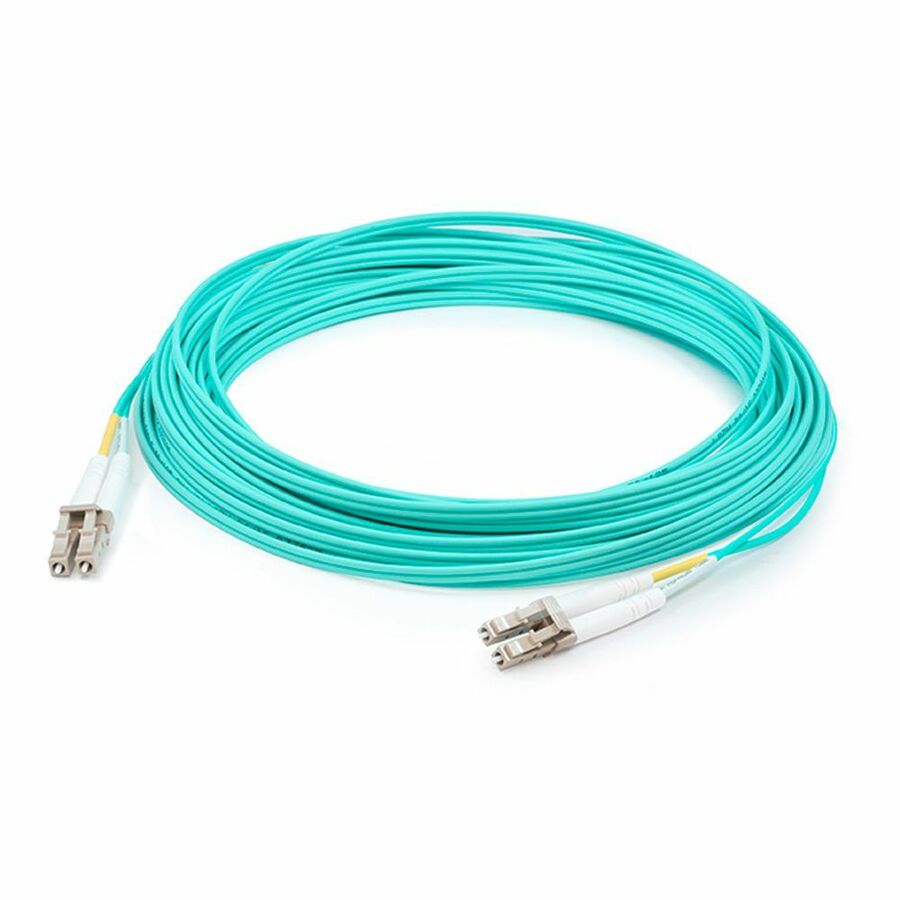
AddOn 1m LC to LC Aqua OM4 Duplex Uniboot OFNR (Riser-Rated) MMF…
ADD-LC-LC-UB1M5OM4
A 1 m LC-to-LC OM4 duplex uniboot cord in riser-rated jacket — the short in-rack hop between a transceiver and a patch field.
$14.35Back-orderedParallel optics
AddOn
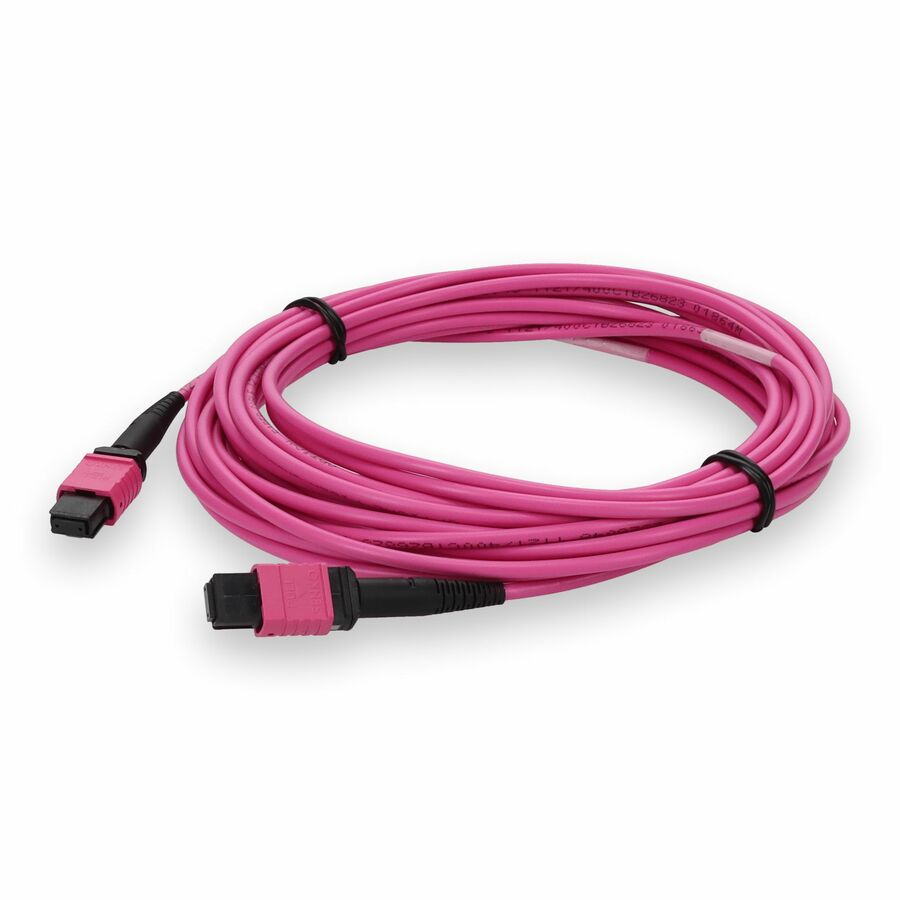
AddOn 10m MPO/UPC to MPO/UPC Magenta (Erika Violet) OM4 OFNR…
ADD-MPOMPO-10M5OM4-MA
A 10 m 12-strand MPO-to-MPO OM4 trunk, the cable 40GBASE-SR4 and 100GBASE-SR4 run on — and in the Erika violet jacket many vendors use to keep OM4 apart from OM3.
Violet is a convention, not a standard; confirm the grade from the legend printed on the jacket.
$58.42In stockLong backbone run
AddOn
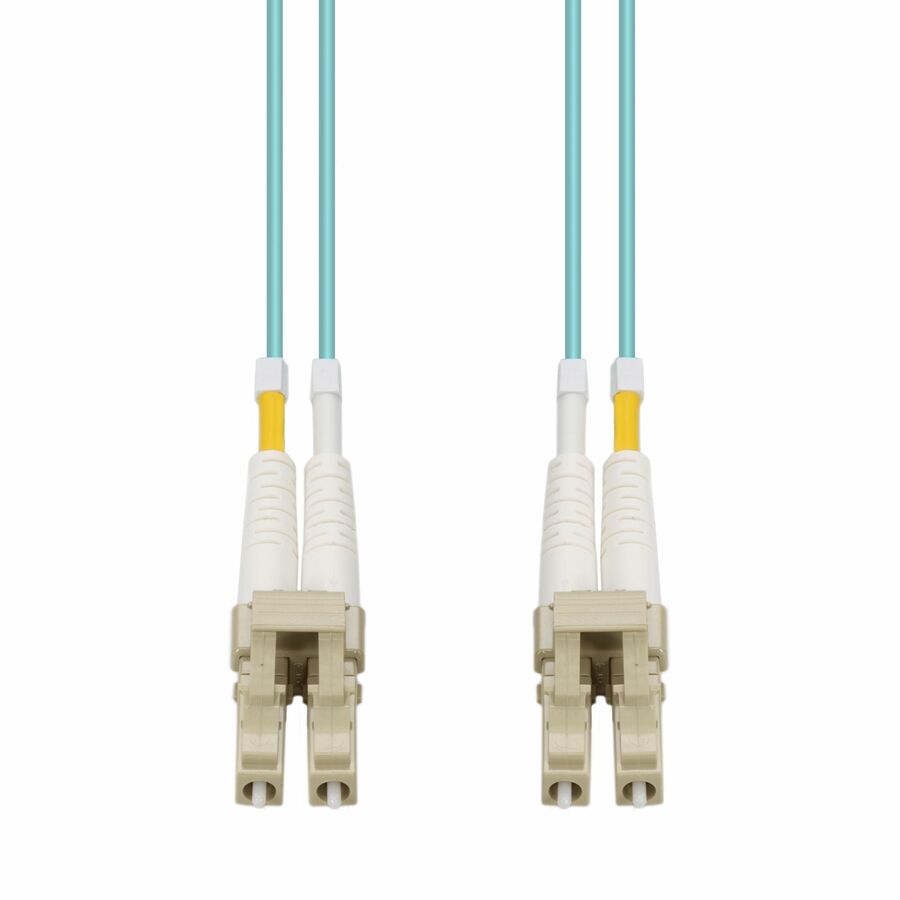
AddOn 300m LC to LC Aqua OM4 Duplex Armored OFNR (Riser-Rated) MMF…
ADD-LC-LC-300M5OM4A
A 300 m armoured OM4 duplex run — the length at which OM3 reaches its specified 10GBASE-SR limit and OM4 still has margin left.
$1,069.50Back-orderedFAQ
Common questions
- Can I mix OM3 and OM4 fiber in the same link?
- Yes — OM3 and OM4 are both 50/125 µm laser-optimized fibers and are fully intermateable, with the same connectors and transceivers. But the channel performs to its weakest segment: any OM3 in the path means the whole run must be engineered to OM3 bandwidth and reach limits. Mixed channels also complicate audits, since aqua jackets do not distinguish the grades. If you must mix, document every segment and rate the entire channel as OM3.
- Do OM3 and OM4 use different transceivers?
- No. Both grades are designed around 850 nm VCSEL optics, so the same SR, SR4, and BiDi transceivers work on either fiber — there is no such thing as an OM4-specific transceiver. What changes is supported reach: 10GBASE-SR is specified to 300 m on OM3 and 400 m on OM4, and 100GBASE-SR4 to 70 m versus 100 m under IEEE 802.3bm. Upgrading fiber grade never requires new optics; it only extends how far the optics you have can go.
- What color is OM4 fiber — aqua or violet?
- Officially, both. TIA-598 assigns aqua jackets to both OM3 and OM4, so plenty of compliant OM4 ships in aqua. Erika violet emerged as a vendor convention — first in Europe, now common in North America — specifically to make OM4 distinguishable from OM3 at the patch panel. Because violet is a convention rather than a requirement, never identify grade by color alone: check the legend printed along the cable jacket, which states the actual fiber type.
- Is OM4 worth the extra cost over OM3?
- For new installs, almost always. The price gap on bulk cable and patch cords has narrowed since OM4 was standardized in 2009, and cable is a minor share of installed link cost next to termination labor and transceivers. In exchange you get 100 m of additional 10G reach, 50 m more for 40GBASE-SR4, and headroom for 25G and 100G upgrades without recabling. OM3 only wins when you are matching an existing plant or every run is short-lived and well inside OM3 limits.
- What is OM1, OM2, OM3, and OM4?
- They are TIA and ISO grades of multimode fibre, ordered by modal bandwidth. OM1 is 62.5/125 um and OM2 is 50/125 um, both designed around LED sources and both legacy for Ethernet above 1 Gigabit. OM3 and OM4 are 50/125 um laser-optimised fibres built for 850 nm VCSELs, specified at 2000 and 4700 MHz-km effective modal bandwidth respectively. OM5 adds short-wavelength WDM on the same geometry.
- Is OM3 and OM4 compatible?
- Yes. Both are 50/125 um laser-optimised multimode with the same connectors and the same 850 nm optics, so they are fully intermateable and no transceiver changes. The catch is that a channel performs to its weakest segment: put any OM3 in the path and the whole run has to be engineered to OM3's bandwidth and reach limits, and the aqua jacket will not tell you afterwards which segment is which.
- Is OM4 backward compatible with OM3?
- Yes, in both directions — the fibres are the same geometry and take the same transceivers, so an OM4 patch cord works on an OM3 plant and the reverse is also true. What does not carry over is the reach: an OM4 cord in an OM3 channel does not extend that channel past OM3's specified 300 m for 10GBASE-SR, because the limit belongs to the whole link and not to any one cable in it.