




Ryzen AI Halo vs DGX Spark: 128 GB and 192 GB Compared
Compare Halo 128 GB and 192 GB with DGX Spark 128 GB by model capacity, software support and deployment needs.
By Uniqcli Team · · 6 min read
Key takeaways
- Halo 128 GB uses Ryzen AI Max+ 395; Halo 192 GB uses Ryzen AI Max+ PRO 495. Compare the complete system and operating system, not just the Halo name.
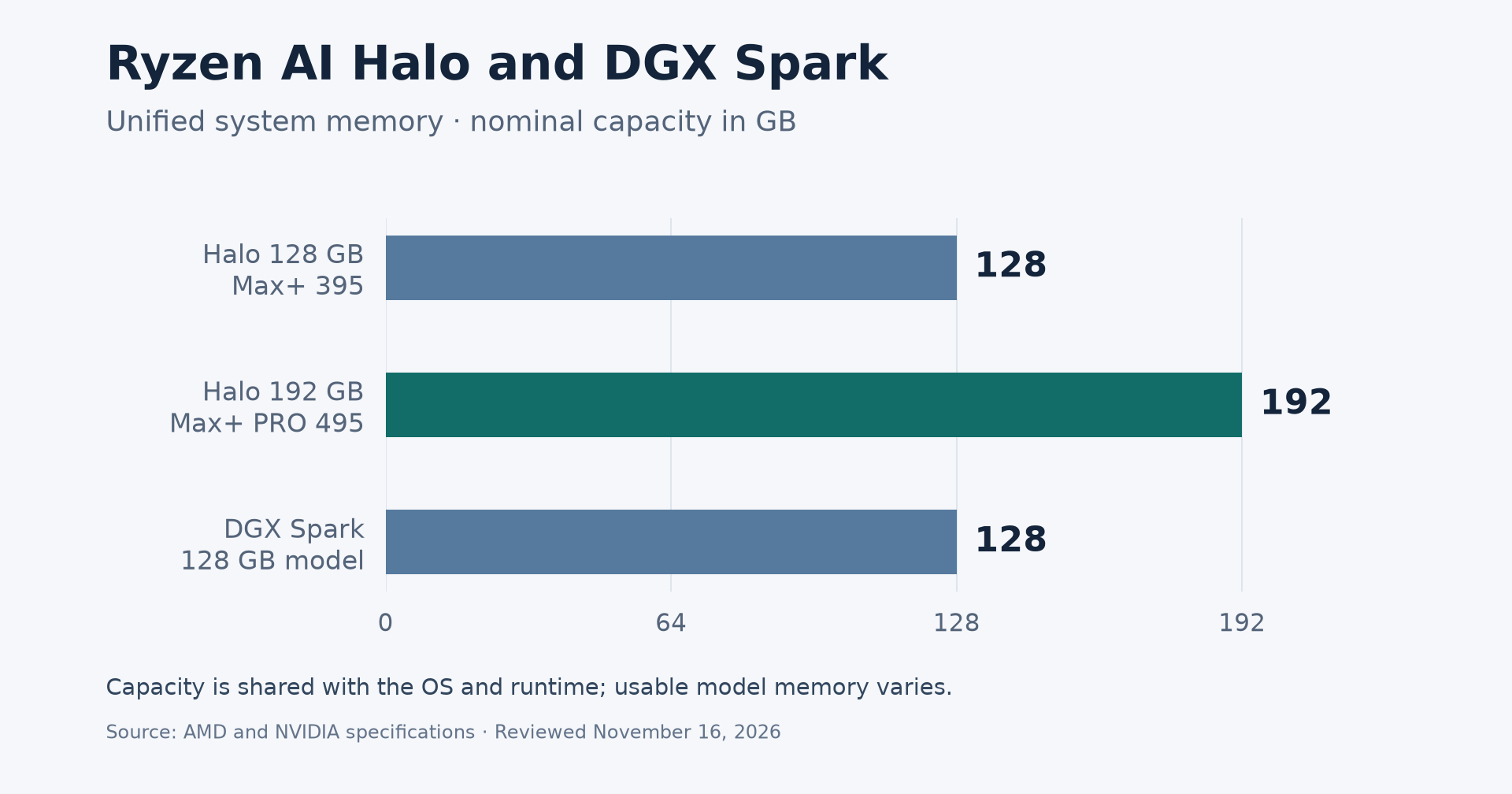
- The 192 GB Halo has 50% more nominal memory than DGX Spark 128 GB. Both list 273 GB/s memory bandwidth; neither figure predicts application speed.
- Halo offers Linux and Windows configurations. DGX Spark uses an Arm CPU and DGX OS. Verify your dependencies and chosen GPU runtime before buying.
- Unified memory must also hold the operating system, runtime and context cache. A model's parameter count alone does not establish fit.
On this page
Evaluate Ryzen AI Halo when your application needs an x86 platform, a supported Windows configuration or more memory in one desktop. Evaluate DGX Spark when your workflow depends on CUDA and NVIDIA's Linux software stack. Test whether your actual model runs with enough context and acceptable response time.
There are now three distinct machines to compare: the 128 GB Halo with Ryzen AI Max+ 395, the 192 GB Halo with Ryzen AI Max+ PRO 495, and DGX Spark with 128 GB. AMD's larger Halo changes the capacity comparison, but does not establish a universal performance winner.
First, separate Ryzen AI Halo from Strix Halo
Strix Halo is the platform codename commonly associated with Ryzen AI Max 300-series processors, including the Max+ 395, and systems built around them. Searches for DGX Spark vs Strix Halo can therefore lead to comparisons involving different desktops, vendors and memory configurations.
Ryzen AI Halo Developer Platform is AMD's named desktop product, with its own chassis, software image and supported configurations. A result measured on another Ryzen AI Max desktop is not automatically a result for Halo.
The three configurations in this comparison
- Halo 128 GB
- Ryzen AI Max+ 395; 16 cores / 32 threads; Radeon 8060S; 128 GB LPDDR5x; 256 GB/s; 2 TB SSD; Linux or Windows 11 configuration.
- Halo 192 GB
- Ryzen AI Max+ PRO 495; 16 cores / 32 threads; Radeon 8065S; 192 GB LPDDR5x; 273 GB/s; 2 TB SSD; Linux or Windows 11 configuration.
- DGX Spark 128 GB
- GB10 Grace Blackwell; 20-core Arm CPU; Blackwell GPU; 128 GB LPDDR5x; 273 GB/s; NVIDIA 4 TB configuration; DGX OS.
Manufacturer specifications reviewed November 16, 2026. These are unified system-memory capacities and rated bandwidth figures, not measured application results.
Ryzen AI Halo 192 GB vs DGX Spark 128 GB
The clearest difference is 64 GB of additional nominal memory in one Halo system. AMD introduced the Max+ PRO 495 version in October 2026 and describes support for allocating up to 160 GB to GPU memory. That allocation is part of the shared 192 GB capacity; it is not another 160 GB added to the system.
For a model that exceeds the practical budget of a 128 GB system, extra capacity can change whether local execution is possible. As an arithmetic illustration, 300 billion parameters at an ideal four bits per weight occupy 150 GB before quantization metadata, context cache and runtime overhead. That figure already exceeds 128 GB, but it does not prove that the checkpoint will run inside a 160 GB GPU allocation. The remaining demands still need to fit.
DGX Spark's 128 GB is also shared between CPU, GPU and other system users. NVIDIA documents that available-memory reporting can vary with reclaimable OS memory. Its display reservation consumes additional capacity, with settings depending on firmware. Treat usable memory as a measured workload budget rather than subtracting one universal allowance from the label.
The 192 GB Halo and Spark both list 273 GB/s bandwidth. Equal rated bandwidth does not mean equal token generation: architecture, kernels, quantization and memory traffic differ. Choose the larger Halo when a validated workload benefits from its extra local capacity. Choose Spark when the required CUDA implementation, tools or deployment path make it the better fit.
ROCm, CUDA and the operating system
Halo combines an x86 CPU with Radeon graphics. AMD provides developer tools and playbooks for workflows including PyTorch with ROCm, local model serving and image generation. Its Windows and Linux software inventories differ. Confirm the specific driver, framework version, model format and GPU backend supported by the selected OS.
Spark combines an Arm CPU with a Blackwell GPU and ships with Ubuntu-based DGX OS. Its documented environment includes CUDA, container tooling and access to NVIDIA's development ecosystem. This can suit teams whose applications already depend on NVIDIA libraries, provided their containers, native extensions and other dependencies support Arm and the target GPU.
Start with a working installation recipe for the actual application. A supported framework does not establish that every extension or quantization format works.
Capacity is different from speed
The 128 GB Halo lists 256 GB/s bandwidth; the 192 GB model lists 273 GB/s. The larger model therefore adds 50% nominal capacity while rated bandwidth increases by about 6.6%. Those are specification differences, not a measured inference improvement.
Avoid ranking AMD's NPU TOPS, GPU FP16 throughput and NVIDIA's sparse FP4 petaflop figure as though they measure the same operation. They involve different processing units, precisions and assumptions. A useful comparison measures prompt processing, time to first token and sustained generation separately, with the same workload and an acceptable output-quality target.
When a Spark cluster changes the choice
Two 128 GB Sparks offer 256 GB across two machines and can use a direct ConnectX link. A distributed runtime must divide the model and communicate between nodes; the second machine does not enlarge an ordinary application's local address space.
NVIDIA documents manual four-node rings as well as switched layouts, and announced eight-node support in October 2026. Guided NVIDIA Sync setup and larger manual deployments have different limits. For a single-desktop buying decision, compare the 192 GB Halo against a complete Spark cluster only when the proposed model has a tested distributed recipe. Include networking, setup and maintenance in that comparison.
Compare the exact systems you will order
The shortlist contains different OS configurations: 192 GB Halo Linux, 128 GB Halo Windows, and Spark with DGX OS. Match the software image, storage and support requirements before comparing complete offers.
Compare Halo and DGX Spark configurations
Advanced Micro Devices
AMD Ryzen AI Halo Max+ PRO 495 Developer Platform
$9,124.99In stockAdvanced Micro Devices
AMD Ryzen AI Halo Max+ 395 Developer Platform
$4,999.99In stockNVIDIA
NVIDIA DGX Spark 128GB 4TB GB10 Grace Blackwell AI Desktop
$7,792.83In stock
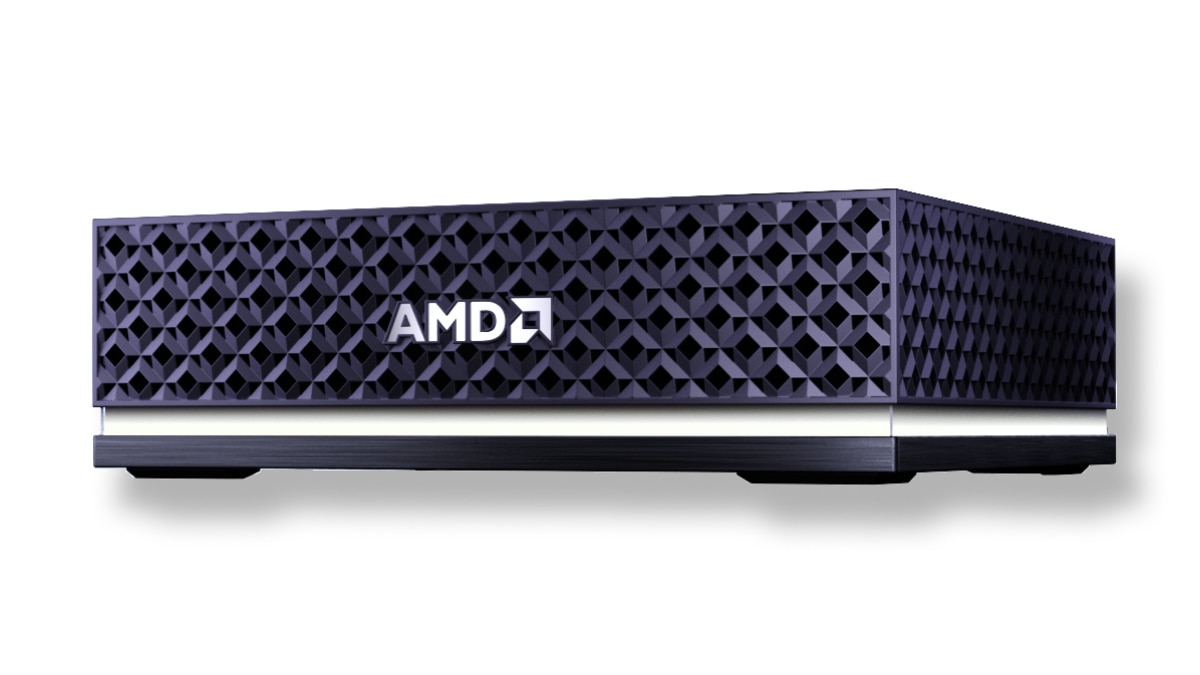
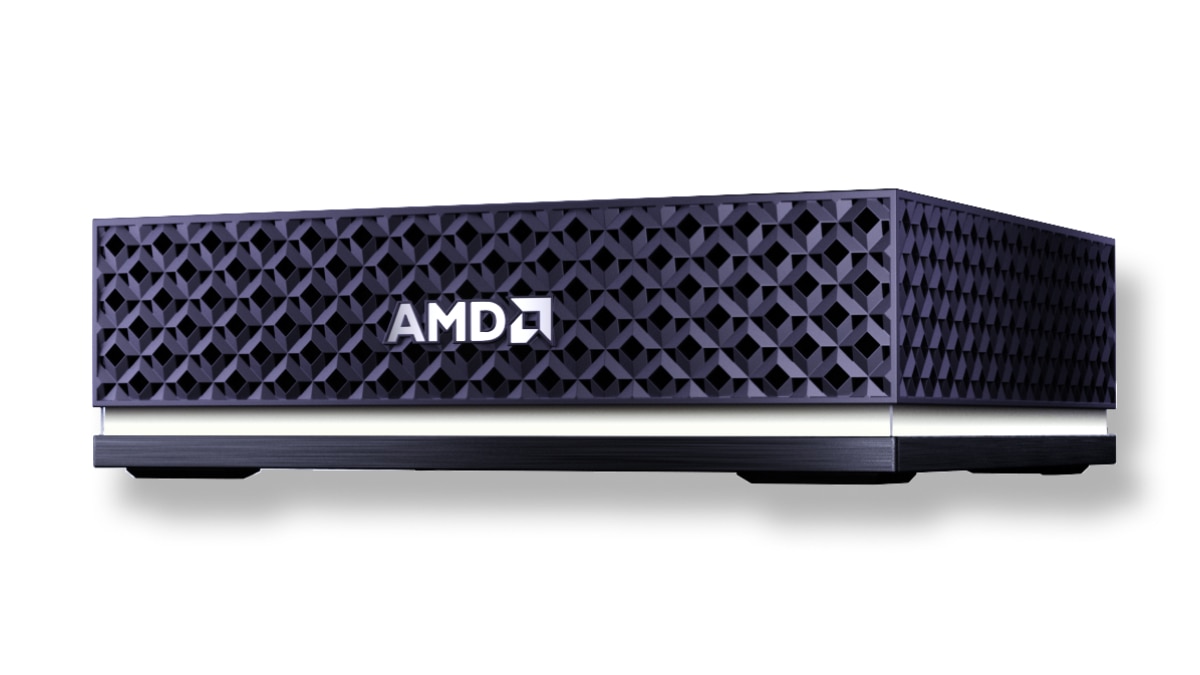
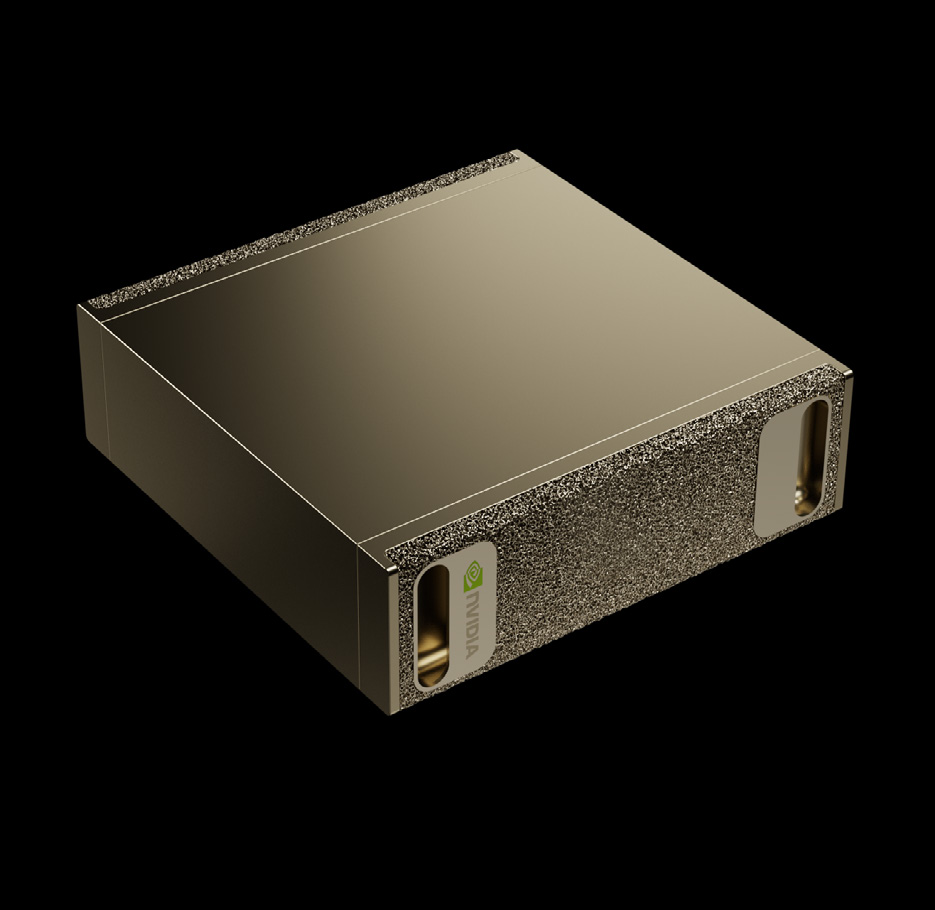
192 GB Halo Linux, 128 GB Halo Windows and DGX Spark 128 GB. Cards resolve current catalog information; confirm configuration and delivery terms in the quote.
Run a deployment test before choosing
- Record the exact checkpoint, quantization, runtime, driver and operating system.
- Use representative prompts, expected context length and the busiest planned concurrency.
- Measure peak memory, time to first token, generation rate and output quality after warmup.
- Check installation, restart behavior and sustained operation with the applications that will share the machine.
- Compare the complete configuration, support requirements and any cluster networking against the team's budget.
Continue the hardware comparison
Compare configurations for your model
Send the model, required OS, context length and concurrency target to scope hardware, software and deployment support together.
FAQ
Is Ryzen AI Halo 192 GB faster than DGX Spark?
Its extra capacity can help a workload fit on one system, but capacity does not establish speed. Compare the same model, output quality, context and concurrency using supported runtimes on both machines.
Does DGX Spark run Windows like Halo?
The DGX Spark configuration discussed here uses DGX OS, a Linux distribution. AMD lists Windows and Linux Halo configurations. Select the required OS explicitly and verify the application's GPU support on it.
Is this a DGX Spark vs Strix Halo comparison?
It compares DGX Spark with AMD's named Halo developer platforms. Other Strix Halo desktops can have different cooling, memory, software and commercial terms, so their results and specifications need separate verification.
Sources
- 1.AMD Ryzen AI Halo with Max+ 395 specificationsamd.com
- 2.AMD Ryzen AI Halo with Max+ PRO 495 specificationsamd.com
- 3.AMD 192 GB Halo announcementamd.com— Launch and GPU memory allocation.
- 4.AMD Ryzen AI Halo user guidedeveloper.amd.com— Operating systems and development software.
- 5.NVIDIA DGX Spark hardware guidedocs.nvidia.com
- 6.NVIDIA DGX Spark memory reporting guidancedocs.nvidia.com
- 7.NVIDIA Spark optimization guidedocs.nvidia.com— Arm architecture and display reservation.
- 8.NVIDIA DGX OS documentationdocs.nvidia.com
- 9.NVIDIA DGX Spark software documentationdocs.nvidia.com
- 10.NVIDIA cluster cabling playbookbuild.nvidia.com— Direct links, manual rings and switched layouts.
- 11.NVIDIA eight-node Spark announcementdeveloper.nvidia.com— Scale-out and guided setup timing.
Manufacturer information reviewed November 16, 2026. This guide compares published capabilities; it does not report Uniqcli benchmark testing. Confirm the exact configuration and software support before ordering.