
Short answer
The main difference between RJ45 and RJ11 is size: RJ45 is the common name for the eight-position, eight-conductor jack ANSI/TIA-568 specifies for four-pair Ethernet cabling, while RJ11 is the narrower six-position telephone jack. They do not interchange — an RJ45 plug is too wide for an RJ11 jack, and an RJ11 plug seats loosely in an RJ45 jack and can deform its contacts.
Key facts
- RJ45 is the everyday name for the eight-position, eight-conductor interface ANSI/TIA-568 defines for four-pair balanced twisted-pair cabling.
- That interface carries four twisted pairs, and ANSI/TIA-568 defines T568A and T568B as its two straight-through wiring schemes.
- RJ11 names an analogue telephone jack, and it is not the eight-position, eight-conductor interface the cabling standard defines for data.
- Only the eight-position interface carries Power over Ethernet, which IEEE 802.3bt specifies across all four pairs.
- Ethernet on the eight-position jack is engineered to a 100 m twisted-pair channel; an analogue phone line has no such data limit.
These two connectors get confused because they belong to the same mechanical family and photograph identically. Both are modular plugs with a plastic latch; both terminate onto flat or twisted conductors; both appear on wall plates in the same buildings. The difference is width and position count, and it is decisive in a way no adapter fixes.
RJ45 is the everyday name for the eight-position, eight-conductor modular interface that ANSI/TIA-568 specifies for four-pair balanced twisted-pair cabling — the Ethernet jack. RJ11 is the narrower six-position modular jack used for analogue telephone service, normally wired with two or four of its six positions. Eight positions is wider than six, so an RJ45 plug will not enter an RJ11 jack at all.
The dangerous direction is the other one. An RJ11 plug will physically slide into an RJ45 jack, sit off-centre, and load the outer contacts of that jack in a way they were not designed for. Sometimes it simply does not connect; sometimes it deforms the outer contacts so the jack stops working reliably with a real Ethernet plug afterwards. That is why a phone cord in a network port is a fault worth looking for, not a harmless mistake.
At a glance
Side by side
| Factor | RJ45 | RJ11 |
|---|---|---|
| Positions and conductors | Eight positions, eight conductors | Six positions, commonly two or four conductors |
| Everyday use | Ethernet over four-pair balanced twisted-pair cabling | Analogue telephone, fax and legacy modem lines |
| Governing cabling standard | ANSI/TIA-568 for the four-pair interface | Telephone wiring practice, not the four-pair data standard |
| Physical width | Wider — the eight-position body | Narrower — the six-position body |
| Pairs carried | Four twisted pairs | One or two pairs |
| Fits the other jack? | No — too wide for a six-position jack | It enters, but seats off-centre and can deform outer contacts |
| Wiring schemes | T568A or T568B pin-pair assignments | USOC-style telephone pairing |
| Typical termination | 110 punch-down keystone jack, patch panel or field plug | Telephone jack or six-position modular plug |
| Carries Power over Ethernet | Yes, on conformant cabling and hardware | No |
Specify RJ45 when
- The outlet serves data — computers, access points, cameras, printers, controllers
- The device needs Power over Ethernet on the same cable as its data
- The run is part of a structured cabling plant terminated to a category rating
- You want one outlet type across the building so patching is never a guess
Specify RJ11 when
- The outlet serves an analogue telephone line, a fax machine or an alarm dialler
- You are repairing or extending an existing telephone plant that stays analogue
- A device ships with a six-position modular lead and no network interface
- The position is documented as voice and has to stay visually distinct from data outlets
Bottom line
Treat them as two different outlets that must never be confused on a label. RJ45 is the eight-position interface the cabling standard defines for four-pair data, and it is the only one of the two that carries Ethernet or Power over Ethernet. RJ11 is the six-position telephone jack, and its only remaining jobs are analogue lines, fax and alarm diallers. Because an RJ11 plug fits loosely into an RJ45 jack and can deform its outer contacts, colour-code and label voice and data outlets differently, and when a port stops working reliably after someone has been at the desk, inspect the jack before you replace the switch. Where an analogue line has to ride the structured cabling plant, do it at the patch field with a purpose-made adapter rather than by plugging one connector into the other.
Products for this decision
The data jack
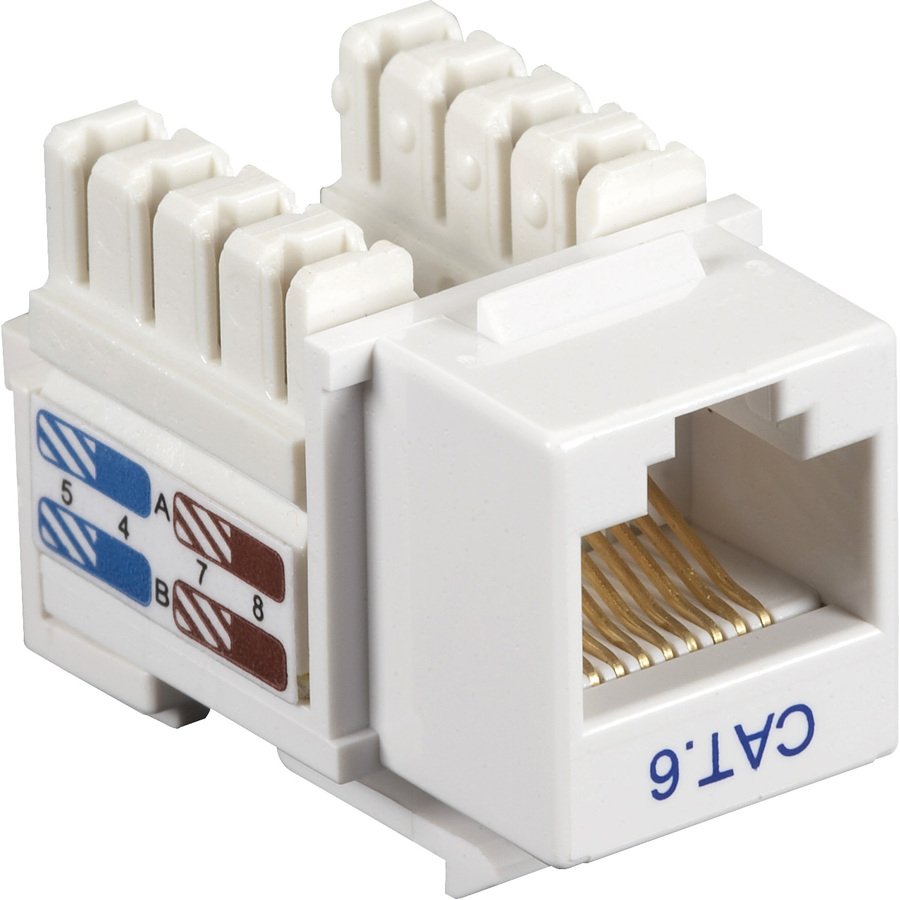
Black Box
Black Box CAT6 Keystone Jack
CAT6J-WH
An unshielded Cat6 eight-position keystone jack, the part that goes in a wall plate or panel wherever the outlet is meant to carry Ethernet.
$2.84In stockThe telephone jack
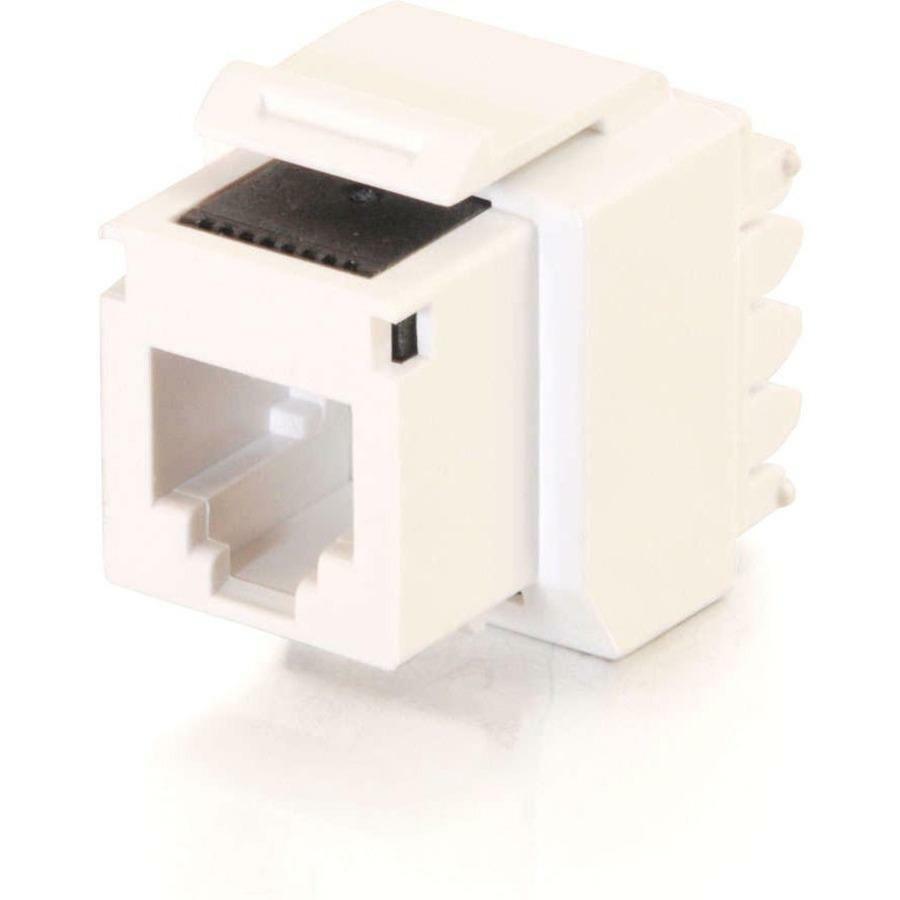
Legrand
C2G Cat3 RJ11/RJ12 Keystone Jack
03801
A Cat3 six-position keystone jack for an analogue telephone or fax position, so a voice outlet is physically and visually distinct from a data one.
$4.86In stockTests both
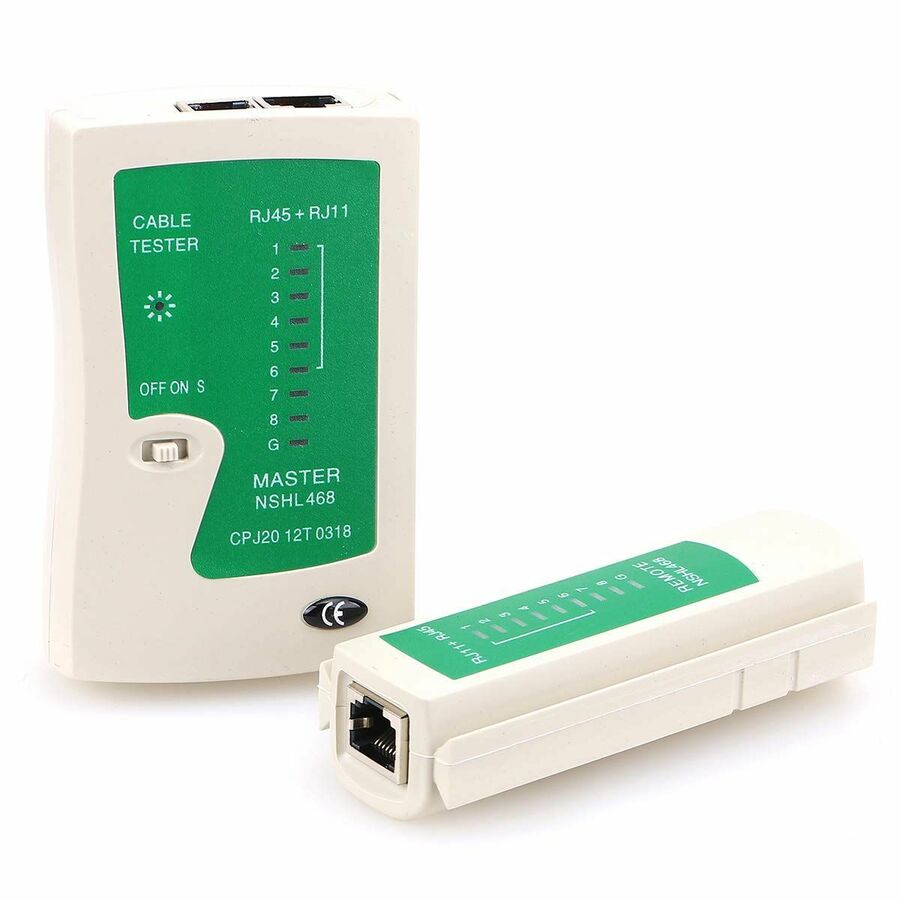
4XEM
4XEM RJ45/RJ11 Network Cable Tester Cable configuration Network Tester
4XRJ45TESTER
A cable tester that reads pin configuration on eight-position and six-position leads, useful when tracing an outlet nobody labelled.
$24.61In stockTerminates both
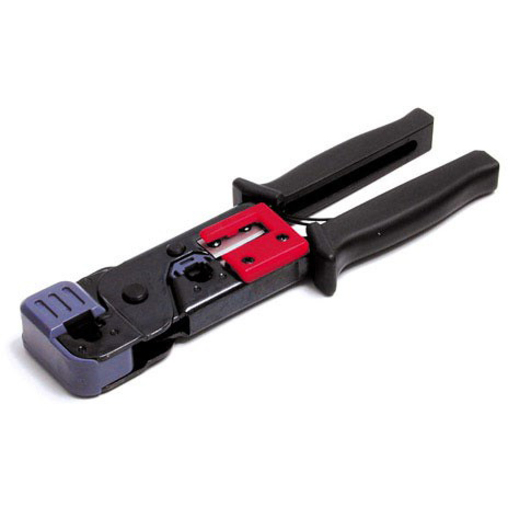
StarTech.com
StarTech RJ45 RJ11 Crimp Tool with Cable Stripper, RJ45+RJ11 Strip…
RJ4511TOOL
A crimp tool with a cable stripper that handles both eight-position and six-position modular plugs, for field terminations and repairs.
$36.76In stockFAQ
Common questions
- Can I plug an RJ11 cable into an RJ45 port?
- It will fit, and you should not do it. The six-position plug is narrower than the eight-position jack, so it seats off-centre and presses on contacts it was never meant to touch. At best nothing connects; at worst the outer contacts of the jack are bent out of position and the port becomes unreliable with a proper Ethernet plug afterwards.
- Are RJ45 and 8P8C the same thing?
- In everyday use, yes. Eight-position, eight-conductor is the accurate description of the connector, and RJ45 is the name the industry uses for it — including in vendor documentation for four-pair Ethernet cabling. The cabling standards describe the eight-position interface; the shorthand has simply stuck.
- Why does my phone jack have fewer wires than my network jack?
- Because it needs fewer. An analogue telephone line uses one pair, so a six-position jack is normally wired with two conductors, sometimes four for a second line. Ethernet on the eight-position jack uses all four pairs — eight conductors — which is also what makes Power over Ethernet possible on the same cable.
- Can I use an Ethernet cable for a phone line?
- Physically the pairs are fine, but the connectors are not interchangeable, so it is done at the outlet rather than at the cord. The usual approach is to terminate the run onto a six-position jack for the voice position, or to adapt at the patch field, rather than forcing a six-position plug into an eight-position jack.
Sources
- 1.Panduit TR103 — Patch Cord Wiring Guide (eight-position, eight-conductor interface)panduit.com
- 2.TIA — standards development (the ANSI-accredited body behind TIA-568)tiaonline.org
- 3.IEEE 802.3-2022 — IEEE Standard for Ethernetstandards.ieee.org
- 4.IEEE 802.3bt-2018 — Power over Ethernet over 4 pairsstandards.ieee.org