
Business connectivity
Managed WiFi as a Service
Wireless bought as an outcome rather than a parts list: we design against the building, source the equipment, coordinate the turn-up and stay the point of contact afterwards.
- Designed, deployed and supported as one service
- Density planned against your building
- One quote and one point of contact
One quote, one number to call, whatever the property is.
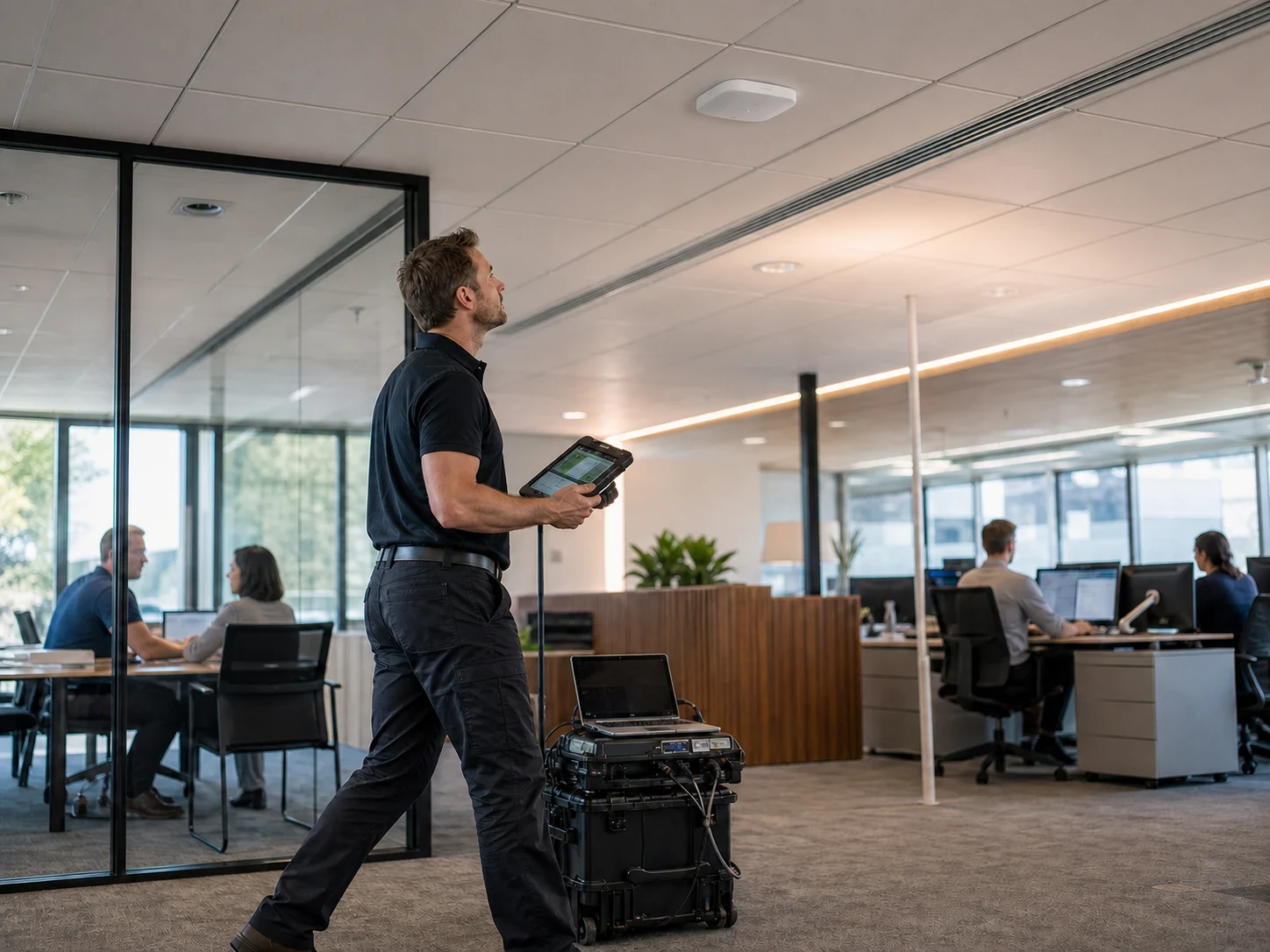
- Unit of scope
- The building — floor plans and device counts, not a floor number
- What we deliver
- Design, equipment, deployment coordination, ongoing support
- Sourcing
- Equipment through our distribution network; circuits through carrier relationships
- Accountability
- One quote and one point of contact from design through turn-up
Get a quote
Managed WiFi & campus wireless
Tell us where to reach you and a Uniqcli specialist follows up by email to scope the locations with you, then comes back with a written quote. Serviceability and the final figure are confirmed per location.
The first number is our real one, not an opening one.
Tell us the scope and we come back with the best price we can do on it.
- Supporting federal, state & local purchasers
- GPC & P-Card accepted
- TAA & NDAA-889 screening before every quote
Live prices from our catalog right now — a starting point, not the project price. Your quote is scoped to the site and includes the licensing and services the job needs.
Wireless is judged in the one room where it fails
Nobody rates a wireless network by its average. They rate it by the conference room where the video call drops, the far end of the third floor, the lobby at check-in, the evening when everyone is home at once.
Continue readingShow less
That gap between the average and the worst room is almost always a design gap rather than an equipment gap — access points placed by floor plan symmetry instead of by what the building is made of and how many devices are actually in each space. Scoped per square footage and device count rather than per room, because coverage in these buildings is set by the structure and the client mix rather than by a unit count. What we sell here is the whole outcome rather than the boxes: the design against your building, the equipment quoted against that design, the deployment coordinated to your schedule, and one accountable relationship afterwards. Assess, design, procure, support: we scope the requirement with you, design against it, source the circuits and equipment, and stay the single point of contact through turn-up and afterwards.
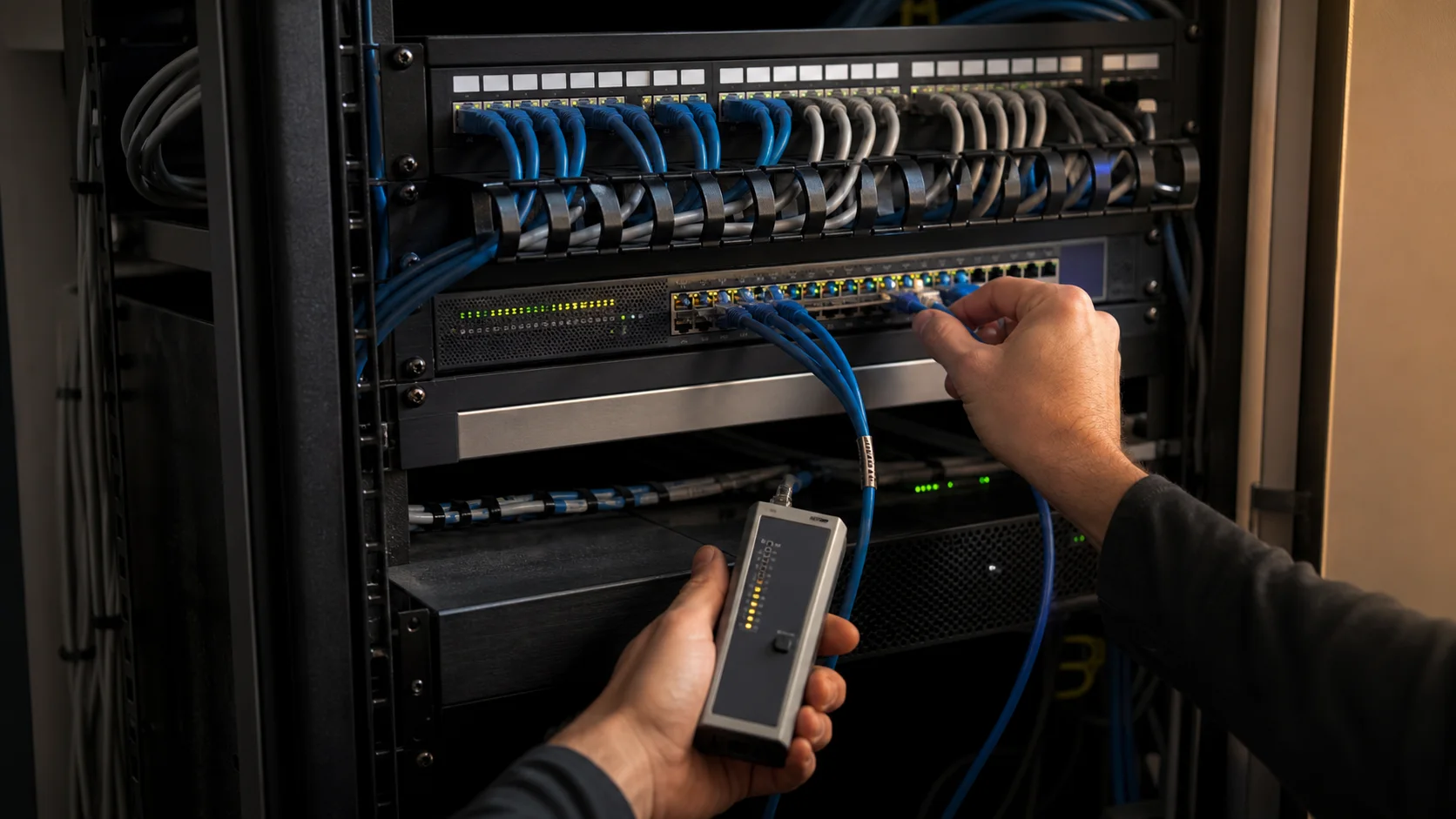
What managed WiFi covers when it is bought as a service
Four deliverables, and only the second one arrives in a box. The order matters — every expensive wireless disappointment we are asked to fix started at the first one and was discovered at the fourth.
A design against the building you have
Density planning starts with what is in the space: construction materials, ceiling heights, room boundaries, and how many devices sit in each area at the worst moment rather than the average one.
Continue readingShow less
Concrete, plaster with metal lath, brick demising walls, glass curtain walls and cold rooms all behave differently, and an older building is not a harder building — it is a different one. The output is placement, mounting, channel and capacity decisions you can hold us to, not a symmetrical grid of dots on a floor plan.
Equipment quoted against that design
Access points are the visible part; the switching, the PoE budget, the uplinks and the cabling behind them are what decide whether the design survives contact with the building.
Continue readingShow less
Enterprise-grade access points, controllers and switching are quoted through our distribution network against the design, rather than listed with a shelf price. TAA (FAR 52.225-5) and NDAA §889 screening is performed on every hardware line, before the quote goes out.
Segmentation decided before install, not after
How many SSIDs, and what sits behind each one, is a design decision that is painful to retrofit. Guest traffic separated from operations, building systems and printers off the network people use, staff devices where policy can reach them, and a guest path that does not become an accidental route into anything else.
Continue readingShow less
We scope the segmentation with you, and the network is built to it on the first pass.
One point of contact through turn-up and after
A wireless project touches a survey, a cabling crew, a switch order, an equipment lead time, a building engineer, an install window and a validation pass.
Continue readingShow less
Assess, design, procure, support: we scope the requirement with you, design against it, source the circuits and equipment, and stay the single point of contact through turn-up and afterwards. Service commitments are backed by the underlying carrier's published service terms, which are provided with your quote rather than summarized here.
Scope managed WiFi for your property
Go to the formWireless designed for the building it lives in
A residence hall, a hotel, an assisted-living community, an elementary school and an office floor all fail differently, so they are scoped differently. Pick the one that describes your property.
Hotels & resorts
Per-room coverage that holds up at full occupancy, plus conference space, lobby and outdoor areas — the amenity guests judge the property on.
Apartments & MDU
Property-wide WiFi as a resident amenity: private coverage in every unit, plus clubhouse, gym, garage and the connectivity behind it all.
Student housing
Five-plus devices per resident, a move-in surge every semester, and lounges and study spaces that fill on the same evenings.
Senior living
Residents, staff and telehealth on one network, with onboarding simple enough to do once and roaming that follows a resident between buildings.
Schools & districts
Classroom density for 1:1 device programs, testing-day concurrency, and content-filtering-ready designs across every building.
Offices & enterprise
Roaming that survives the walk to a conference room, SSID and VLAN segmentation, guest access, and rooms full of all-day video calls.
2 moreShow less
Warehouse & industrial
Racking that moves, scanners and vehicles that roam, and coverage designed for the RF reality of a tall building full of steel.
Need a survey, an install or a network build?
Site surveys, heat mapping, cabling and the deployment stack itself are our deployment team's lane — that is where the platform, licensing and installation detail lives.
What we'll ask at quote
There is no coverage calculator on this page, because a number produced without knowing what the walls are made of is a guess with a decimal point. These are the questions that turn into a real design — most owners and facilities managers can answer them without research.
- The addresses, and what each building is: square footage, floor count, and roughly when it was built or last renovated
- Floor plans if you have them, in any form — a PDF, a leasing brochure or a marked-up print is more useful than a description
- Construction: concrete floors, plaster or drywall interior walls, brick or block demising walls, glass exteriors, and anything unusual like cold rooms or shielded spaces
- How many devices are in the space at the worst moment, not the average one — and what they are, because tablets, handhelds, TVs and building systems behave differently
- Which separate networks you need: staff, guest, building systems, point of sale, and anything a policy or an insurer already dictates
- What is installed today — access points, switching, cabling and how old it is — and whether this is a refresh, an expansion or a new build
- Whether the internet circuits behind the wireless are in scope too, and who supports the network the day after turn-up
Coverage and capacity are two different problems
The question we are asked first is almost always how many access points a building needs, and it is the wrong first question because it has two different right answers. Coverage asks whether a usable signal reaches everywhere it has to. Capacity asks whether the space can carry every device that will be in it at once, doing what those devices actually do. A warehouse aisle is a coverage problem. A ballroom with four hundred phones in it is a capacity problem. The same square footage in a school at testing time and in a storage mezzanine need completely different designs, which is why the honest answer to how many access points comes after the walk-through rather than before it.
Continue readingShow less
The second thing that decides the outcome is entirely wired. Access points need cable to the right places, switch ports with enough PoE budget to power what is plugged into them, and uplinks that do not turn into the bottleneck the wireless was supposed to remove. A building with cabling from a previous decade often needs cable pulled before it needs anything wireless at all, and finding that out during scoping is an ordinary line on a quote — finding it out on install day is a change order and a delay. We look at the wired side while we are looking at the wireless one.
The third is what happens after everyone goes home on turn-up day. A network that was correct at handover drifts: rooms change use, tenants move, device counts grow, firmware ages, and the one access point somebody unplugged to power a Christmas display never goes back. Assess, design, procure, support: we scope the requirement with you, design against it, source the circuits and equipment, and stay the single point of contact through turn-up and afterwards. Service commitments are backed by the underlying carrier's published service terms, which are provided with your quote rather than summarized here.
What gets scoped on the same conversation
Wireless is rarely bought alone. These are the lanes most often quoted alongside it for the same property — including the circuits underneath and the cameras and door access on top.
Managed WiFi questions
What does managed actually mean here — do you run our network?
It means the outcome is ours to deliver rather than yours to assemble: the design, the equipment, the deployment coordination and one accountable relationship afterwards, on a single quote. Assess, design, procure, support: we scope the requirement with you, design against it, source the circuits and equipment, and stay the single point of contact through turn-up and afterwards. What it does not mean is a watch desk staring at your dashboards around the clock — where you want that layer, it is scoped explicitly rather than implied, and the platform and licensing detail behind it lives with our deployment team.
How do you deliver this — do you own a network?
No, and we will not describe it that way. Circuits are provisioned through our carrier network relationships and quoted per location; equipment is sourced through our distribution network. Naming a service type describes what we quote, not a partnership with any provider. Coverage is nationwide and confirmed per location at quote — what is deliverable to a specific address depends on which carriers reach that building, so we check it per site rather than publishing a map.
Which access points do you use?
We do not lead with a brand, because the honest answer depends on the building, what you already own, how you want it managed and what the licensing looks like over the term. Enterprise-grade access points, controllers and switching are quoted through our distribution network against the design, rather than listed with a shelf price. TAA (FAR 52.225-5) and NDAA §889 screening is performed on every hardware line, before the quote goes out.
Why is there no price on this page?
Because a building is not a multiplication. Scoped per square footage and device count rather than per room, because coverage in these buildings is set by the structure and the client mix rather than by a unit count. Starting rates are published on the lanes where a room or a residential unit is the honest unit of scope — hotels, apartments, student housing and senior living — and they are stated there rather than generalized here. Everything outside the starting rates above is sized rather than priced on a web page: the figure that binds is a written quote against your own addresses, terms and equipment list.
How fast can you get a quote back?
How quickly a quote comes back depends on how many addresses have to be checked and which carriers serve them; a single site is usually straightforward, and a multi-site scope moves at the pace of the slowest address. We tell you where each location stands rather than holding the whole quote for the last one.
Can you quote the internet circuits and the cameras on the same order?
Yes, and for most properties it is the better way to buy: the wireless, the circuit behind it, the cabling and the physical-security equipment all land on one design, one schedule and one point of contact instead of three vendors pointing at each other. If you only want the wireless, that is a complete scope on its own — we will not pad it.
Send the property, get a design and a number
An address, a rough square footage and what the building is used for is enough to start. We come back with a design approach, an equipment list and a written quote — deployment coordination included, and the circuits or security equipment on the same order if you want them there.
Continue readingShow less
Everything outside the starting rates above is sized rather than priced on a web page: the figure that binds is a written quote against your own addresses, terms and equipment list.
The solutions atlas
Every solution, by technology area and by customer.
By technology
By customer
- TAA & NDAA-889 Compliance Screening
- CMMC & CUI Solutions
- Federal & DoD
- State, Local & Education
- Healthcare
- Enterprise
- Rapid Procurement & GPC Buys
- Multi-Vendor Integration Projects
- eProcurement & Custom Catalogs
- FISMA Modernization
- CJIS-Compliant Justice Cloud & Local AI
- Federal Storage Modernization
- Government ERP & Business Systems Infrastructure
- Managed Procurement
- Secure AV & Conferencing
- Fiber Network Infrastructure
- Satellite & Resilient Connectivity
- Wavelength & Optical Transport
- Decentralized Data Centers
- Data Center Design & Build
Scope managed WiFi for your property
Tell us what the building is and how it is used. You get a design approach, an equipment list and a written quote against that scope — with one point of contact from the walk-through through turn-up. Service commitments are backed by the underlying carrier's published service terms, which are provided with your quote rather than summarized here.