
Business connectivity
Senior Living Community WiFi
Residents, staff and telehealth visits share one community network, and each of them needs something different from it.
We design for coverage that follows a resident between buildings and onboarding they only have to do once — starting at $100 per room for high-density deployments.
- Unit of scope
- The resident apartment or room, plus common and clinical areas
- Starting rate
- High-density deployments start per unit; quoted per community
- Also in scope
- Dining, activity and therapy rooms, corridors, outdoor paths, staff areas
- Boundary
- We supply and support the network; clinical and care programs stay yours
Get a quote
Senior living WiFi
Tell us where to reach you and a Uniqcli specialist follows up by email to scope the locations with you, then comes back with a written quote. Serviceability and the final figure are confirmed per location.
The first number is our real one, not an opening one.
Tell us the scope and we come back with the best price we can do on it.
- Supporting federal, state & local purchasers
- GPC & P-Card accepted
- TAA & NDAA-889 screening before every quote
Three different networks living in the same buildings
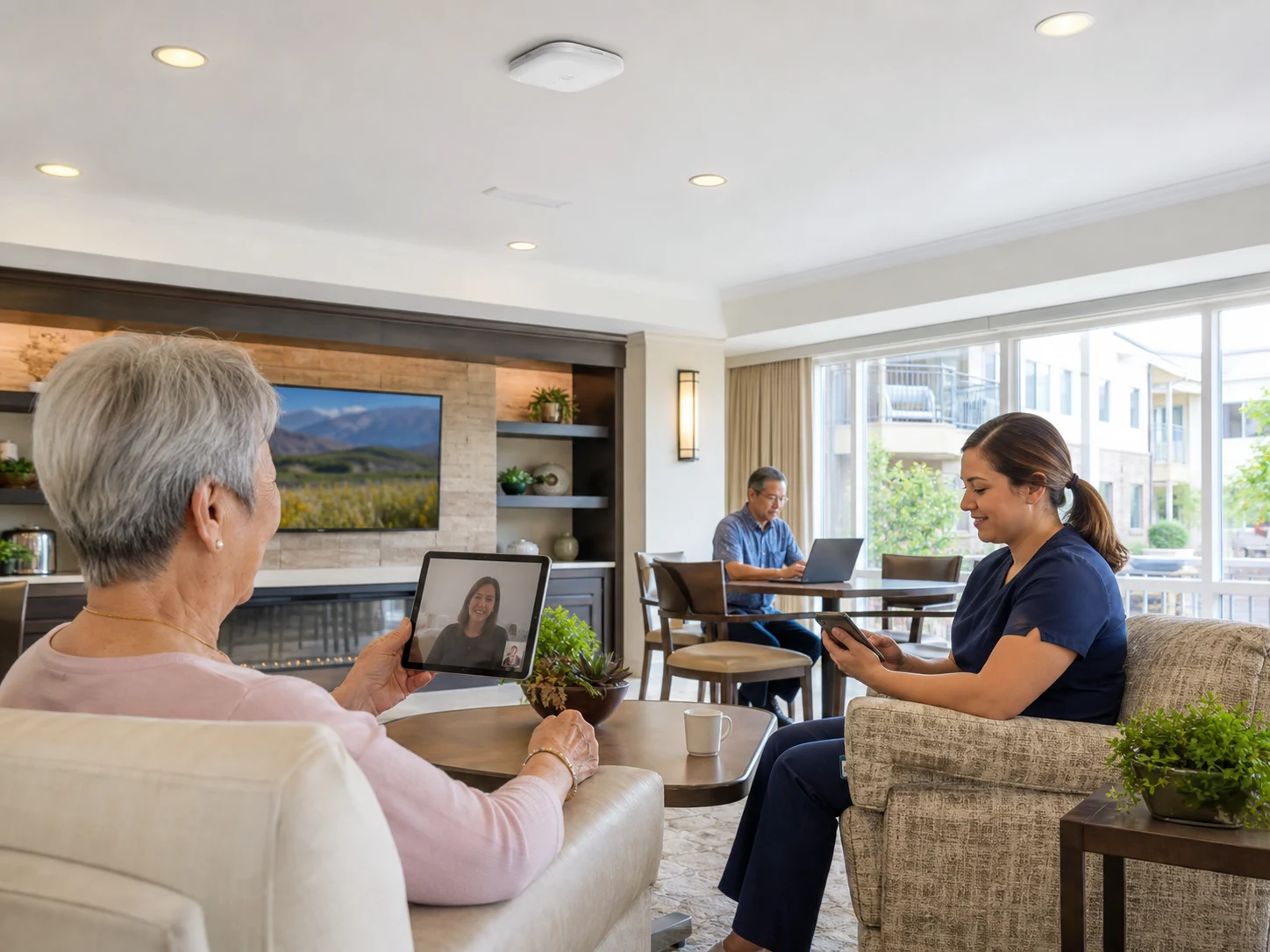
A senior living community runs three demands across one set of buildings, and they pull in different directions. Residents want their own devices to work in their own apartment, for video calls with family that do not freeze halfway through, and they want to set it up once and never think about it again.
Continue readingShow less
Staff need devices and systems that work while they move, in corridors and back rooms that a resident-focused design tends to treat as leftover space. And an increasing share of care now arrives over a video call — a telehealth visit, a remote consult, a monitoring device — which turns a convenience network into part of how the community operates. We quote high-density deployments from $100 per room, designed against all three at once rather than one at a time. Everything outside the starting rates above is sized rather than priced on a web page: the figure that binds is a written quote against your own addresses, terms and equipment list.
What a community network has to hold together
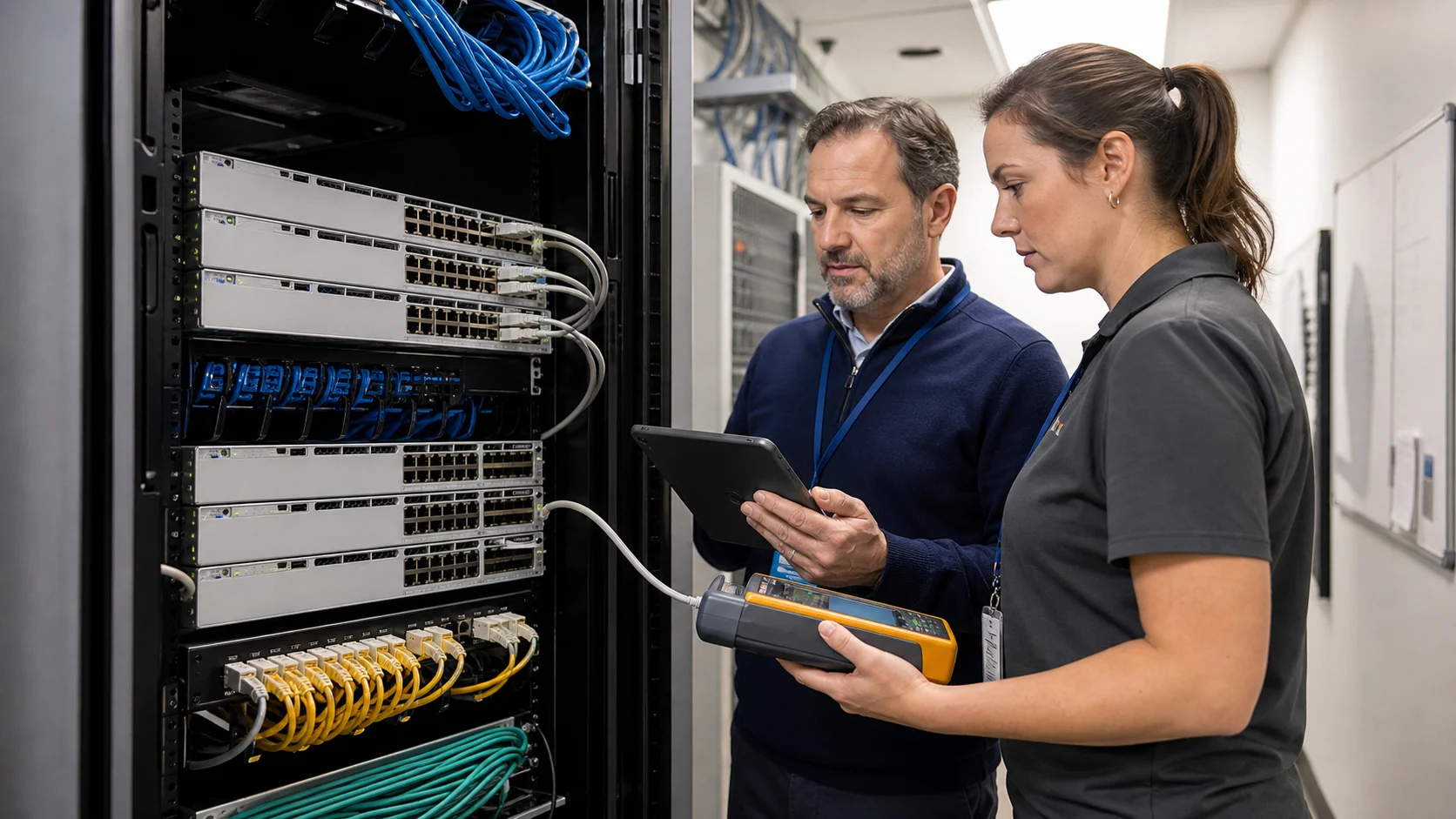
Four requirements, and the hardest one is that they share the same walls. Assess, design, procure, support: we scope the requirement with you, design against it, source the circuits and equipment, and stay the single point of contact through turn-up and afterwards.
Coverage in the apartment, at the chair, on the path
Residents use their devices where they sit, which is often the corner of an apartment furthest from anything, and in the lounges, dining rooms and courtyards where they spend the day.
Continue readingShow less
Senior living construction is frequently block and plaster with fire-rated corridors, so coverage into the unit is a design problem rather than an assumption. High-density work starts at $100 per room, and independent living, assisted living and memory care buildings are scoped separately because they are built and used differently.
Onboarding a resident does once
The best onboarding for this population is one that happens with help, at move-in, and then never needs repeating: devices that reconnect on their own, credentials that do not expire on a schedule nobody remembers, and no page to accept every time somebody walks past the dining room.
Continue readingShow less
Where families set up a tablet on a visit, that should work without a staff member being the technical support of last resort. We design for that outcome and we say plainly where it takes staff involvement.
Staff, clinical systems and separation
Staff devices, nurse call and wander-management systems, therapy equipment, point of sale in the bistro and administrative computers all live on the same infrastructure and should not live on the same network as guests.
Continue readingShow less
We design the segmentation your operations and your own compliance obligations call for and document what sits where; the clinical program, the policies and the compliance decisions stay yours.
Telehealth-ready, without a promise we cannot make
Designing for telehealth means capacity and coverage where visits actually happen — the apartment, the clinic room, the therapy suite — and a network that does not fall over because the dining room is streaming at the same hour.
Continue readingShow less
Service commitments are backed by the underlying carrier's published service terms, which are provided with your quote rather than summarized here. Enterprise-grade access points, controllers and switching are quoted through our distribution network against the design, rather than listed with a shelf price.
Quote WiFi for your community
Go to the formWhat we'll ask at quote
Enough to design across the whole community rather than one building at a time. A walk-through confirms the construction, which in these buildings is usually the deciding factor.
- Unit count by care level — independent living, assisted living, memory care, skilled nursing — and how many buildings each occupies
- Construction and vintage: block or concrete walls, fire-rated corridors, and whether buildings were added in phases
- Common areas to cover: dining rooms, activity and therapy spaces, chapel, salon, bistro, lobbies, corridors and outdoor walking paths
- How residents and their families expect to get online, and how much help staff can realistically provide at move-in
- Staff and clinical systems on the network today — nurse call, wander management, therapy equipment, point of sale, administrative computers
- Whether telehealth visits happen in apartments, in a dedicated room, or both, and what equipment those visits use
- What is installed now, the age of the cabling and switching, and how buildings are connected to each other today
- The internet circuits behind the community, and who a resident or a staff member calls when something does not work
Roaming, simplicity and the buildings in between
The requirement that most often gets missed in these communities is movement. A resident goes from an apartment to the dining room to an activity room to a courtyard, sometimes across a connecting corridor into a different building, and expects a video call with a grandchild to keep going the whole way. Staff do the same thing all day with a device in hand. Designing for that means the corridors, the connectors and the outdoor paths are part of the coverage plan rather than the gaps between it, and it means the handoff between access points is engineered rather than left to whatever the devices decide.
Continue readingShow less
The second is that simplicity is a technical requirement here, not a nicety. Every extra step in getting online converts directly into staff time and resident frustration, and a network that needs periodic re-authentication will generate a support call every time it asks. The design goal is a device that was set up once at move-in and keeps working — through a firmware update, a new building, a family visit and a device the resident was given for their birthday. Where a step is genuinely unavoidable, it should be one a staff member can complete in a minute at the resident's chair.
The third is that these communities grow in phases, and the network usually shows it. A campus assembled over three decades typically has three generations of cabling, buildings connected by whatever was convenient at the time, and equipment rooms that were once closets. That history is not a problem to hide from a quote — it is the main thing that decides sequence and cost, so we would rather find it during scoping and phase the work honestly than discover it on an install day in an occupied building.
What communities usually scope alongside the network
Connectivity, resident safety equipment and the systems staff rely on tend to arrive on the same capital plan.
Senior living WiFi questions
What does the per-unit starting rate include?
High-density deployments start at $100 per room, which is a starting point for the resident-unit design rather than a community total — dining and activity spaces, corridors, outdoor paths, staff areas, the wired work behind the access points and any cabling a building needs are scoped on top. Everything outside the starting rates above is sized rather than priced on a web page: the figure that binds is a written quote against your own addresses, terms and equipment list.
Can the network handle telehealth visits reliably?
We design for it: capacity and coverage planned where visits actually take place, segmentation that keeps clinical traffic away from the guest network, and validation of those spaces before handover. What we will not do is publish an uptime or quality figure as our own guarantee. Service commitments are backed by the underlying carrier's published service terms, which are provided with your quote rather than summarized here.
How simple is it for a resident to get online?
The target is once, with help, at move-in — after that the device reconnects on its own anywhere in the community, including when a resident moves to a different building or care level. Repeated login pages and expiring credentials are a design choice we avoid precisely because they convert into staff time every single day.
Do you handle our clinical systems and our compliance program?
We design and quote the network those systems run on, including the segmentation your operations and your obligations call for, and we document what sits where so your own compliance work has something accurate to reference. The clinical systems themselves, the policies around them and the compliance decisions stay with your organization and the providers you contract for them.
How do you deliver this — do you own a network?
No. Circuits are provisioned through our carrier network relationships and quoted per location; equipment is sourced through our distribution network. Naming a service type describes what we quote, not a partnership with any provider. Coverage is nationwide and confirmed per location at quote — what is deliverable to a specific address depends on which carriers reach that building, so we check it per site rather than publishing a map.
How fast can you get a quote back?
How quickly a quote comes back depends on how many addresses have to be checked and which carriers serve them; a single site is usually straightforward, and a multi-site scope moves at the pace of the slowest address. We tell you where each location stands rather than holding the whole quote for the last one.
Send the community, get one design across every building
Unit counts by care level, the buildings and the construction are enough to start. We come back with a design approach, an equipment list and a written quote — phased sensibly if the community grew over time.
Continue readingShow less
TAA (FAR 52.225-5) and NDAA §889 screening is performed on every hardware line, before the quote goes out.
The solutions atlas
Every solution, by technology area and by customer.
By technology
By customer
- TAA & NDAA-889 Compliance Screening
- CMMC & CUI Solutions
- Federal & DoD
- State, Local & Education
- Healthcare
- Enterprise
- Rapid Procurement & GPC Buys
- Multi-Vendor Integration Projects
- eProcurement & Custom Catalogs
- FISMA Modernization
- CJIS-Compliant Justice Cloud & Local AI
- Federal Storage Modernization
- Government ERP & Business Systems Infrastructure
- Managed Procurement
- Secure AV & Conferencing
- Fiber Network Infrastructure
- Satellite & Resilient Connectivity
- Wavelength & Optical Transport
- Decentralized Data Centers
- Data Center Design & Build
Quote WiFi for your community
Send the unit counts, the buildings and how residents and staff use them. You get a design approach, an equipment list and a written quote covering residents, staff and the spaces in between. Everything outside the starting rates above is sized rather than priced on a web page: the figure that binds is a written quote against your own addresses, terms and equipment list.