
InsightsThe editorial shelf
Buyer guidance that outlasts the news cycle.
Procurement strategy, compliance explainers, refresh planning and buying guides — written for the people who sign the requisitions. Breaking price and market news lives in the Newsroom →
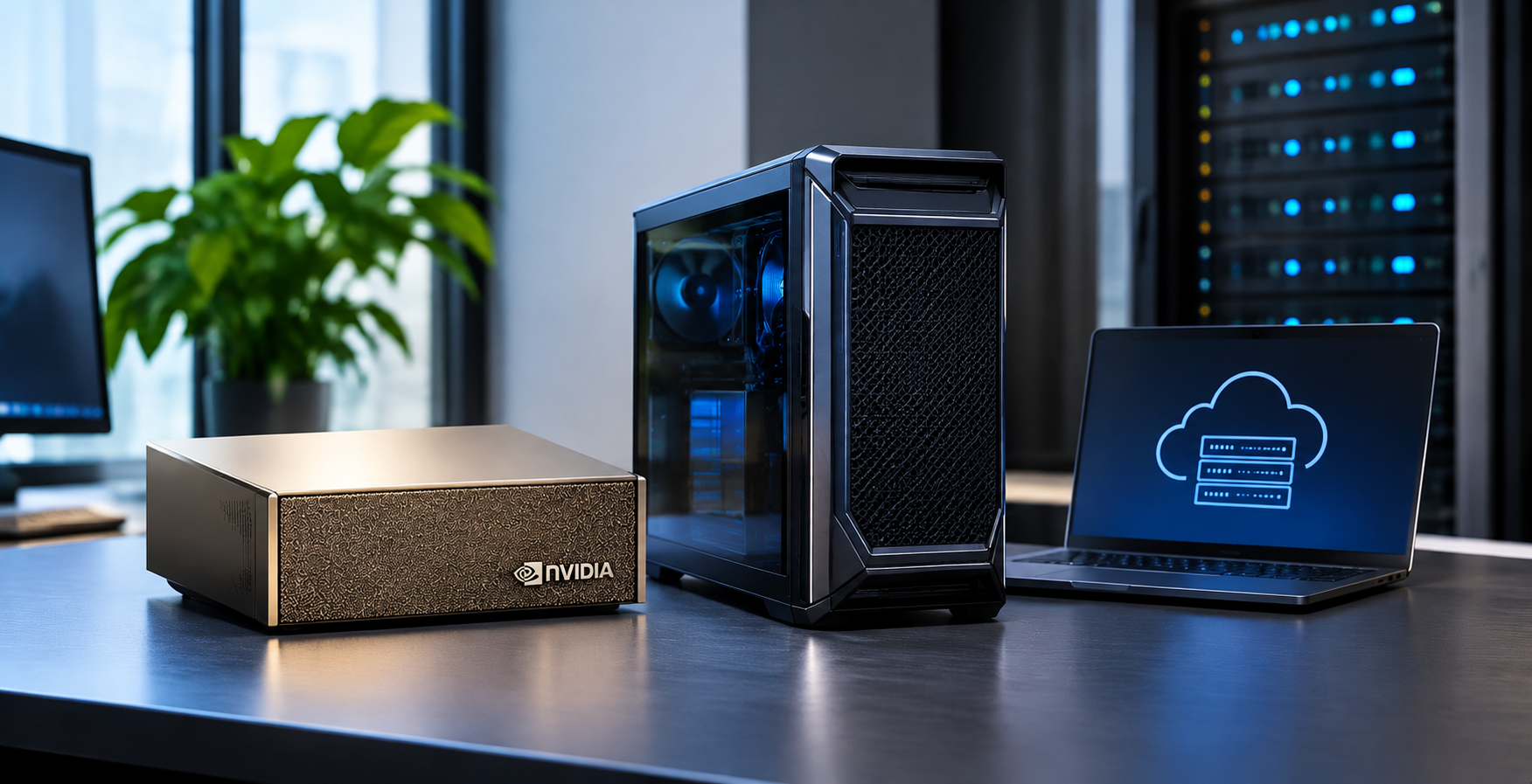
Buying Guides
What 16-, 32-, and 36-node DGX Spark clusters actually prove
What do large DGX Spark clusters really demonstrate? Explore a 16-system GB10 build, reported performance, and what smaller teams should consider before buying.
· 6 min read
Buying Guides
Connecting 2–4 DGX Spark Systems: Cables, Setup and Network Checks
Planning a DGX Spark cluster? Learn how to choose a two-, three- or four-system layout, check cable and switch compatibility, and test the network before deployment.
· 10 min read
Buying Guides
16GB or 32GB RAM for business laptops? A role-based guide
Use measured workloads to decide between 16GB and 32GB business laptops, then account for upgrade options and expected service life.
· 3 min read
Buying Guides
Extract Invoice and Technical PDF Data Locally on DGX Spark
Learn how to extract invoice and technical PDF data locally on NVIDIA DGX Spark. Explore OCR, structured output, source verification and accuracy testing for a proposed document-processing workflow.
· 10 min read
Buying Guides
Run a Local Coding Assistant on DGX Spark
Learn how to connect OpenCode to local AI inference on NVIDIA DGX Spark, test real coding tasks and evaluate code quality, security, memory use and developer review time before scaling.
· 9 min read
Buying Guides
Fine-Tune an 8B Model on DGX Spark and Evaluate the Results
Learn how to plan a LoRA fine-tuning experiment for an 8B model on NVIDIA DGX Spark. Prepare training and evaluation datasets, document resource requirements, compare results against the base model, and verify that the saved adapter can be reloaded.
· 12 min read
Buying Guides
DGX Spark 64GB vs. 128GB: Which Should You Buy?
Compare DGX Spark 64GB and 128GB configurations by model memory, context length and concurrent requests. Use workload tests and current OEM quotes to choose the right system.
· 10 min read
Buying Guides
Build a Local Document Assistant on DGX Spark for Engineering Manuals and SOPs
Build a local AI document assistant on NVIDIA DGX Spark to search engineering manuals and SOPs. Learn how to handle scanned PDFs, verify source citations, manage revisions and test answer accuracy before deployment.
· 13 min read
Buying Guides
When Does a Second DGX Spark Actually Help?
A second DGX Spark can solve a capacity problem, reduce request queues or separate competing workloads. Learn when another system is worth buying.
· 11 min read
Compliance
Encrypted USB handoff: prove access and recovery ownership
Before issuing a drive, verify the permitted host, ordinary unlock, recovery boundary and data handoff. Record who can recover access without putting the secret in the ticket.
· 6 min read
Procurement Guidance
Audio chain acceptance: prove the input, recording and playback
A repeatable handoff for a microphone, interface, computer and app, including separate checks for monitoring, saved files and output channels.
· 6 min read
Procurement Guidance
Rack power planning: an electrical handoff worksheet
Connect the IT equipment list to the facilities review with one record for load assumptions, power supplies, cords, outlets, upstream feeds and acceptance evidence.
· 5 min read
Procurement Guidance
External video input acceptance: prove the camera-to-application path
A camera preview does not approve a meeting or recording setup. Check the source, capture device, USB connection, selected application and audio together, then save a repeatable handoff.
· 5 min read
Buying Guides
Repair return acceptance: check the computer before handoff
Close a repair with evidence of the original symptom, changed parts, device identity, work configuration and the employee's actual workflow.
· 6 min read
Buying Guides
Fiber link acceptance: a port-to-port ordering worksheet
Record the exact optics, cabling path, polarity and test evidence before ordering a fiber link or accepting an installed one.
· 6 min read
Procurement Guidance
From reference architecture to as-built: the configuration handoff
Reconcile the OEM design, supplier quote and installed system. Record changes, support evidence, site dependencies and acceptance results before closing the deployment.
· 6 min read
Procurement Guidance
Wide-format media acceptance: approve the finished print
Before approving a wide-format print job, record the exact printer, ink, material, production settings and viewing conditions. Check a finished sample before releasing the job or approving any material substitutions.
· 6 min read
Procurement Guidance
PC VR fleet readiness: check the runtime before buying the headset
A deployment record for application, headset, runtime, operating system and support ownership—with a dated Windows Mixed Reality example and a complete pilot handoff.
· 6 min read
Procurement Guidance
E-paper signage acceptance: test the update, not just the image
A site pilot for static digital signs: prove readable content, controlled refreshes, update ownership and a workable charging routine before expanding the installation.
· 5 min read
Compliance
BYOD offboarding: separate work access from personal data
Plan the identity, app-data and device-management steps separately. Use a bounded record to show what was requested, what completed and what remains unresolved on an employee-owned device.
· 5 min read
Compliance
Microsoft 365 backup restore test: prove the recovered work
Use a small, approved mailbox and file sample to test recovery. Record the restore point, destination, permissions, elapsed time and owner signoff instead of stopping at a completed job.
· 5 min read
Procurement Guidance
Small-office NAS acceptance: prove access, backup and restore
Turn a NAS proposal into a testable file-service requirement. Record the workload, user permissions, client path and recovery evidence before accepting the installation.
· 5 min read
Buying Guides
Compact GPU workstation fit: check the card, cable and enclosure
Create a purchase record for the exact GPU, chassis, slot and power path, then accept the assembled system against its supported configuration and workload.
· 6 min read
Procurement Guidance
LTO upgrade acceptance: prove media compatibility and restore access
Inventory the tapes you must retain, verify the complete drive path and prove a restore before retiring the hardware that can read your archive.
· 6 min read
Procurement Guidance
Field mobile printer acceptance: prove the ticket and the recovery
Test the complete route from mobile application to printed record, including reconnects, media changes, controlled reprints and charging handoff.
· 6 min read
Procurement Guidance
Thermal label acceptance: qualify the media, print and barcode
Use one traceable worksheet to approve the printer, media, ribbon, settings and finished label for its actual working conditions.
· 6 min read
Buying Guides
Label printer costs: calculate cost per accepted label
Compare printers using the same artwork, media, batch size and acceptance rule. Include setup waste, rejects, maintenance and labor without counting the same expense twice.
· 6 min read
Procurement Guidance
Barcode scanner acceptance: prove the scan in the application
Approve the complete path from printed code to saved transaction. Record the scanner, host mode, data format, application behavior and recovery steps before ordering a fleet.
· 6 min read
Procurement Guidance
Branch Office Outage Drill: Prove the Recovery Path Before You Need It
Turn a branch continuity plan into a bounded exercise with a dependency map, business task, restoration evidence and a clear decision about what must improve.
· 5 min read
Procurement Guidance
Rugged Laptop Field Acceptance: A Requirements and Evidence Worksheet
Approve a rugged laptop against the work, environment and accessories your team actually uses, with a field pilot record that makes open questions visible.
· 5 min read
Buying Guides
Business Mini PC Acceptance Test: Approve the Installed Desk
Turn a promising mini PC into an approved office configuration with a repeatable test for the installed desk, management state and replacement path.
· 5 min read
Buying Guides
Digital signage hardware readiness: a site handoff checklist
Plan each screen as an installed service: viewing conditions, approved mounting, player and CMS support, network access, recovery behavior and a person responsible for keeping content current.
· 5 min read
Procurement Guidance
Small-business network refresh: the inventory-to-BOM handoff
Turn a site inventory into an equipment list an installer can accept: port assignments, power assumptions, complete uplinks, named owners and a controlled substitution record.
· 5 min read
Buying Guides
Ollama vs llama.cpp vs vLLM on DGX Spark: How to Test User Capacity
Compare Ollama, llama.cpp and vLLM on NVIDIA DGX Spark using realistic AI workloads. Learn how to test concurrent requests, response times, throughput and answer quality to evaluate user capacity.
· 12 min read
Buying Guides
AI Customer Service That Actually Resolves Cases
A buyer's guide to the less glamorous work behind a useful AI support agent: trusted answers, permissioned actions, human handoffs and a scorecard that counts the whole case.
· 13 min read
Procurement Guidance
AI Vendor Risk Assessment: What to Check Before You Buy
A practical evidence review for AI software, embedded copilots and agents. Map what each supplier can see and do, test the claims that matter, and put change and exit terms in the agreement.
· 14 min read
Buying Guides
All-in-One PCs for Business: A Buying Guide for IT Teams
An all-in-one clears desk space, but the best fleet choice depends on the display, ports, service plan and daily work. Use this guide to write a specification that will survive the rollout.
· 14 min read
Buying Guides
Cloud Physical Security: What Should Move and What Should Stay Local?
The useful question is not whether cameras can connect to the cloud. It is where video is recorded, what still works during an outage, and who carries the cost and risk of each choice.
· 14 min read
Sector Guides
What AI-Assisted Prior Authorization Really Costs per Case
A cheaper model call does not settle the cost of a prior authorization workflow. Count retrieval, retries, staff review and failed handoffs, then test whether the process produces complete submissions.
· 15 min read
Industry Trends
Responsible AI Adoption: A Board-Ready Pilot Scorecard
Turn an AI pilot into a decision the board can defend. Define the task, baseline, owner, review point, cost and stop rule before the organization scales it.
· 16 min read
Buying Guides
How to Connect Two or Four DGX Sparks
Connect two Sparks with one supported cable, or wire four through a 200 GbE switch for NVIDIA Sync. The four-node manual ring is a separate path.
· 9 min read
Buying Guides
DGX Spark vs. DGX Station: Which One Fits Your Work?
A real research example shows when one Spark is enough, when a Spark cluster helps, and when a team needs the memory and shared capacity of DGX Station.
· 7 min read
Buying Guides
DGX Station GB300 or GB300 NVL72? Deskside vs. Rack Scale
Both carry the GB300 name. One can sit beside a research team; the other needs a data-center project. Use the actual workload and site plan to decide where to start.
· 6 min read
Buying Guides
NVIDIA DGX Station: What Research Teams Can Run Locally
See how research teams use DGX Station for protein search, weather forecasts and model development, then check memory, power and the exact system before buying.
· 6 min read
Buying Guides
42U Server Rack Cabinets vs. 4-Post Racks: How to Buy for an IT Room
Choose a server rack around the equipment, room, and delivery plan. Compare 42U cabinets with open 4-post racks and prepare a complete quote request.
· 10 min read
Buying Guides
Cisco and Aruba Switches: Choosing PoE, Fiber, and 24 or 48 Ports
Choose Cisco or HPE Aruba Networking switches around the devices, uplinks, operating model, and complete purchase cost your deployment requires.
· 10 min read
Buying Guides
Rugged Tablets for Field Teams: How to Choose the Right Model and Request a Quote
Choose rugged tablets around the work your team actually does. Compare operating systems, screen sizes, connectivity and accessories, then build a quote-ready model list.
· 10 min read
Buying Guides
TAA Monitors for Agencies: Compare Dell Pro Options and Build a Better Bulk Quote
Build a clearer agency monitor purchase: verify origin for the exact SKU, compare 22- to 32-inch options, match your BOM and request a complete bulk quote.
· 10 min read
Buying Guides
TAA Network Switches: A Practical Government Procurement Guide
A practical guide to requesting TAA network switch quotes, documenting country of origin, matching a bill of materials, and preparing an agency purchase.
· 10 min read
Buying Guides
Wall Mount Network Racks: Comparing Middle Atlantic and StarTech Options
Plan a wall rack around maintenance access, equipment depth, and the installation site. Compare Middle Atlantic and StarTech options by exact model.
· 10 min read
Buying Guides
NVIDIA H200 vs B200 vs B300 for Government AI Infrastructure
Choosing between NVIDIA H200, B200 and B300 is not a contest to buy the newest accelerator. It is a decision about the mission workload, the supported server platform, the network and storage data path, the facility envelope, the deployment date and the evidence an agency will need to accept the system. H200 remains a capable Hopper-generation option with mature server designs. B200 moves into the Blackwell generation and a different power-and-cooling class. B300, also called Blackwell Ultra at the GPU generation level, increases memory and arrives in several system forms—including HGX B300 servers and the much denser GB300 NVL72 rack.
· 7 min read
Buying Guides
Is NVIDIA H300 Real? H200, B300 and GB300 Explained
As of August 25, 2026, NVIDIA does not list a current product named “NVIDIA H300” in its official AI Enterprise support matrix or current data-center platform documentation. The search term usually reflects a mix-up between H200, the Hopper-generation GPU, and B300, the Blackwell Ultra GPU. It can also be a mistaken shorthand for GB300, the Grace Blackwell Ultra superchip and rack-scale systems built around it.
· 6 min read
Buying Guides
NVIDIA H200 Price: What a Government Buyer Actually Needs to Budget
There is no durable, universally valid “NVIDIA H200 price.” An agency does not deploy a bare headline price; it deploys a configured server or appliance with CPUs, memory, local storage, NICs, fabric, rack power, cooling, software, integration, support and a data path. Availability, warranty, OEM configuration, delivery location and acquisition path can change the quote materially.
· 6 min read
Buying Guides
NVIDIA B200 Server Specifications: What Belongs in the Requirement
A B200 GPU specification is not a B200 server specification. Government buyers need the full supported system: GPU platform, CPU and memory, storage, network interfaces, chassis, power, cooling, firmware, software, warranty and acceptance criteria. The same Blackwell B200 generation can appear in a DGX appliance and in multiple OEM HGX server designs whose facility and integration details differ.
· 6 min read
Buying Guides
NVIDIA B200 vs B300: Which Platform Fits the Mission and Facility?
NVIDIA B300 is newer than B200, but “newer” does not answer a government deployment decision. B200 may offer a better-aligned OEM design, delivery window, software baseline and air- or liquid-cooling path. B300 offers Blackwell Ultra capabilities and more memory at the GPU generation, but its value depends on the exact server or rack form, model workload and facility readiness.
· 6 min read
Buying Guides
What Sovereign AI Means for Government Infrastructure
Sovereign AI is the ability of an organization or jurisdiction to govern the data, models, computing infrastructure, identities, operations and supply chain on which an AI capability depends. It does not automatically mean “everything on premises,” “only domestic hardware” or “no commercial software.” It means that the mission owner has defined which decisions and dependencies must remain under its control—and can produce evidence that the architecture enforces those boundaries.
· 6 min read
Buying Guides
Air-Gapped AI Infrastructure for Government Missions
Air-gapped AI is an AI environment whose security boundary prevents routine network connectivity to external systems. That can support classified, disconnected, tactical, laboratory or critical-infrastructure missions, but unplugging an internet cable is not the design. Models, packages, security updates, datasets, licenses, logs and replacement parts still cross the boundary through controlled processes.
· 6 min read
Buying Guides
AI Server Rack Bill of Materials: From GPU Nodes to Acceptance Test
An AI server rack is not a stack of GPU servers. It is an integrated system whose compute, fabric, storage, management, power, cooling, cabling, firmware and support must work together at the destination site. A complete bill of materials makes those dependencies visible before award. A rack elevation, port map, power schedule and acceptance plan turn the BOM into something engineers can install and a receiving team can verify.
· 6 min read
Buying Guides
InfiniBand vs Spectrum-X Ethernet for Government AI Infrastructure
InfiniBand and NVIDIA Spectrum-X Ethernet can both support high-performance GPU clusters. The right choice depends on workload communication, scale, topology, existing skills, operational tooling, security boundaries and the validated end-to-end design. Port speed is not enough. An AI fabric must deliver predictable collective communication while storage, management and tenant traffic operate around it.
· 6 min read
Buying Guides
Storage Architecture for Government AI: Feed the GPUs Without Losing Control
AI storage cannot be sized by capacity alone. Training reads large datasets repeatedly and writes checkpoints. Fine-tuning mixes base models, curated datasets and derived artifacts. Retrieval-augmented generation creates metadata-heavy indexes. Inference needs model-load speed, predictable retrieval and durable logs. Government environments add data classification, records, retention, provenance, backup and disconnected-operation requirements.
· 6 min read
Procurement Guidance
How to Buy GPU Infrastructure Through Federal Contract Vehicles
Federal contract vehicles can shorten acquisition lead time, but a vehicle does not turn an incomplete GPU requirement into a deployable system. The buyer still needs a complete scope, competition strategy, exact contract-holder path, configuration-specific products and services, funding, delivery plan and acceptance criteria.
· 6 min read
Procurement Guidance
How to Write a GPU Server RFQ Without Creating an Unusable Quote
A good GPU server request for quotation makes responsive offers comparable and the delivered system testable. It describes the workload, buying unit, salient performance and interfaces, site constraints, software/support, delivery and acceptance. A weak RFQ says “NVIDIA B300 server or equivalent” and leaves sources to guess whether the government needs a GPU, an eight-GPU server, a liquid-cooled rack or a cluster.
· 6 min read
Compliance
TAA, NDAA Section 889 and AI Server Supply-Chain Screening
“TAA compliant server” is not a permanent badge that can be inferred from a product title. Trade-agreement treatment depends on the acquisition, clauses, thresholds and country-of-origin analysis. Section 889 addresses certain covered telecommunications and video-surveillance equipment or services and representations at the entity/use level. An AI rack adds servers, switches, storage, management, cameras/sensors, PDUs, software and integrator services—so screening must follow the exact configuration and supplier path.
· 6 min read
Procurement Guidance
How to Evaluate an AI Infrastructure Integrator for Government
An AI infrastructure integrator should deliver a working, documented and supportable system—not a collection of individually valid boxes. The evaluation should test how the integrator turns a workload into compute, fabric, storage, power, cooling, security, supply-chain evidence, factory acceptance and site operations. The strongest answer is an artifact and a method: sizing worksheet, rack elevation, cable matrix, as-built BOM, test report and escalation map.
· 6 min read
Compliance
CMMC vs FedRAMP vs NIST 800-171: Which Evidence Applies
CMMC is a Department of Defense contracting and assessment program. NIST SP 800-171 is a set of security requirements for protecting CUI in nonfederal systems. FedRAMP is a government-wide assessment and certification program for cloud services used by federal agencies. They can overlap in one architecture, but none is a universal substitute for the others.
· 10 min read
Compliance
Section 889 Surveillance BOM: A Component-Level Checklist
Section 889 compliance screening cannot stop at the logo on a camera. A defensible review follows the system through cameras, recorders, radios, management software, cloud services, and the entities that provide them—then preserves the manufacturer and supplier evidence behind the decision.
· 11 min read
Buying Guides
AI PC Procurement Checklist: What an NPU Changes
An AI PC adds a neural processing unit, or NPU, to the familiar CPU-and-GPU platform, but the NPU alone is not a business case. Buy around named applications and measured workflows. Confirm that the software can use the accelerator, that the complete system has enough memory and storage, and that security, privacy, deployment, warranty, and dock behavior meet the fleet standard.
· 10 min read
Buying Guides
Wi-Fi 7 Access Point Checklist: The BOM Beyond the AP
A Wi-Fi 7 access point is only one line in a working wireless design. Before ordering, validate the regulatory mode, client mix, channel plan, mounting, multigig switch ports, power per AP, total PoE budget, cabling, controller or cloud support, licenses, subscriptions, optics, spares, and installation labor. The exact AP model and enabled radio configuration—not the Wi-Fi 7 label—determine the supporting bill of materials.
· 11 min read
Buying Guides
10GbE Switch Upgrade Guide: When the Workload Justifies It
A 10GbE switch upgrade is justified where measured traffic, transfer windows, convergence, or growth exceeds the practical capacity of the existing path. That does not mean replacing every 1GbE port. A sound design places 10GbE at the bottleneck—server, storage, workstation, wireless access, or uplink—then verifies media, NICs, optics, switch fabric, buffers, software, power, cooling, and the rest of the service path.
· 11 min read
Procurement Guidance
The September Surge: FY2026's Closing Weeks
Federal fiscal year 2026 closes September 30, and the heaviest obligation weeks of the year start now. This year they land on a memory market that is still repricing every quarter — here is what that does to a year-end IT order, and how to protect one.
· 9 min read
Procurement Guidance
SSD Price Increase 2026: Enterprise Buying Signals to Watch
TrendForce forecast NAND Flash contract prices up 70–75% quarter over quarter in Q2 2026 and described tight supply as producers favored higher-value demand. That is a serious sourcing signal, but it is not a universal enterprise SSD price. Buyers must recheck the exact drive, endurance, firmware qualification, allocation, and quote.
· 10 min read
Procurement Guidance
Windows 10 ESU Year 2: The October 2026 Decision
The Windows 10 end-of-life project reaches its next commercial deadline when ESU Year 1 ends October 13, 2026. Organizations keeping eligible Windows 10 22H2 devices after that date need Year 2 coverage or an approved alternative. Microsoft says ESU pricing doubles each consecutive year and that an organization entering in Year 2 must also acquire Year 1, so delay does not erase the earlier-year cost.
· 10 min read
Procurement Guidance
UPS Battery Replacement: Build the Cycle Before Runtime Fades
An Eaton UPS battery replacement plan should combine the exact model's guidance with chemistry, installation age, temperature, discharge history, measured runtime, health data, and maintenance risk—not wait for a red light. Eaton recommends proactive sealed-battery replacement between three and five years. APC publishes a typical three-to-five-year lifecycle for VRLA cartridges and eight-to-ten years for lithium-ion. Real conditions can shorten either interval.
· 11 min read
Buying Guides
SAS vs SATA Server Drives: What the Interface Actually Buys You
Every SAS-versus-SATA explainer stops at 12Gb/s versus 6Gb/s. That number decides almost nothing. Paths, queue depth, error-recovery timing, workload ratings and the controller you already own decide the rest.
· 9 min read
Buying Guides
Server Memory Compatibility: DDR4 Wind-Down and Population Rules
Server memory is compatible only when the complete platform supports the module and the finished population. Matching "DDR4," capacity, and pin count is not enough. The CPU generation, system board, firmware, DIMM type, speed, rank, data width, capacity, voltage, error-correction design, slot order, and the modules already installed all affect whether a server boots—and whether it runs with full bandwidth after it does.
· 10 min read
Buying Guides
NVMe Form Factors and the PCIe Lane Budget Behind the Bays
U.2, U.3, M.2, E1.S and E3.S are not interchangeable shapes for the same drive — they are different service models with different thermal and lane consequences. And a chassis full of NVMe bays asks for more PCIe lanes than most people count.
· 9 min read
Buying Guides
Server NIC, Transceiver and DAC Compatibility: What Actually Fits
Speed is the easy part of a network card order. Whether the link comes up depends on what the switch reads out of the module's EEPROM, how many PCIe lanes the slot is really wired for, and whether the bracket in the box fits the riser.
· 9 min read
Buying Guides
Server CPU Sizing: Cores, Clock Speed and the Licensing Bill
Core count and clock speed are the easy half of the decision. The half that sets the five-year cost is how many cores your hypervisor, operating system and database charge you for — including the cores a licensing floor bills you for whether you bought them or not.
· 9 min read
Buying Guides
iDRAC, iLO and XCC Licensing: What Each Tier Actually Unlocks
Every enterprise server ships with an out-of-band controller. The one capability that makes it worth having — remote console with virtual media — is licensed per server, bound to that chassis, and re-bought at every refresh.
· 8 min read
Compliance
CMMC Phase II Is Suspended: What Contractors Still Owe
CMMC Phase 2 (Phase II) was suspended on July 13, 2026, but the Department did not suspend the cybersecurity clauses already in contracts, Phase I self-assessments, SPRS reporting, or the obligation to give the government accurate representations. Treat the pause as time to improve evidence and scope—not permission to stop.
· 10 min read
Compliance
CMMC Hardware Requirements: What the Controls Really Require
CMMC compliance does not begin with a product certificate or universal hardware list. CMMC assesses how an organization protects information within a defined system boundary. Hardware matters when it implements a requirement—such as segmentation, multifactor authentication, encryption, logging, recovery, or physical protection—but the evidence must show the exact device is configured, operated, and maintained as part of the system.
· 10 min read
Compliance
CMMC MFA: Where Hardware Security Keys Fit
A FIPS security key is not a standalone CMMC requirement, and CMMC does not mandate one authenticator brand. At Level 2, the current NIST SP 800-171 Revision 2 baseline requires MFA for local and network access to privileged accounts and for network access to non-privileged accounts, plus replay-resistant authentication for network access. PIV, CAC, FIDO2, and other cryptographic authenticators can fit—but only when the complete identity system, fallback path, enrollment, recovery, and evidence meet the requirement.
· 10 min read
Industry Trends
EdTech Hardware Trends 2026: What Actually Changed for District IT
Not AI, VR or the metaverse. The changes that will actually move a district IT budget this year are two operating-system end-of-support dates, a ten-year update clock on Chromebooks, memory contract pricing, and a funding cliff that state edtech leaders have already measured.
· 10 min read
Sector Guides
Classroom Technology Statistics: What the Federal Data Actually Shows
Every figure below carries its agency, its survey instrument and its collection year — because two different federal instruments are in play, and the current headline sits on top of detail that is five years older than the fleet you are benchmarking.
· 11 min read
Buying Guides
Personalized Learning Technology: The Infrastructure Underneath It
Adaptive and personalized learning platforms make specific assumptions about devices, bandwidth, identity and offline behavior. Those assumptions are procurement decisions, and they are usually discovered after the software contract is signed.
· 9 min read
Buying Guides
Smart Classroom Design: The District IT Checklist
A room-level build checklist for the person who has to make the room work — wall structure and mount rating, power and data before the panel ships, closet PoE budget, audio coverage, and the cable inventory that always gets forgotten.
· 10 min read
Buying Guides
Classroom AV Planning: Specifying a Single Room End to End
For districts refreshing rooms one at a time: the point-to-point signal chain from source to display, the geometry that decides display size and projector throw, and the commissioning checklist that proves the room actually works.
· 11 min read
Buying Guides
Network Readiness for 1:1: Sizing a District Network Before the Devices Land
A district buys four thousand devices and discovers the access layer, PoE budget, uplinks and circuit cannot carry them. The sizing exercise that prevents it, done before the purchase order rather than after.
· 11 min read
Procurement Guidance
K-12 Device Lifecycle: Building a Refresh Budget That Survives the Board
A multi-year refresh budget is a schedule, not a number. How to stagger cohorts, anchor each one to a vendor-published support date, and fund spares and disposition as recurring lines rather than surprises.
· 11 min read
Procurement Guidance
Student Device Damage: Planning Spares, Repairs and Protection
Year two of a 1:1 program is an operations problem. How to derive your own damage rate instead of borrowing someone else's, size a spares pool from it, choose between in-house and depot repair, and pick protection that shortens rather than lengthens the queue.
· 10 min read
Buying Guides
Choosing a Student Device Platform: The Decisions That Actually Drive It
A criteria-first framework for district IT: what the assessment platform supports, what CTE and assistive software require, what your management stack already runs, how repair is staffed, and how long each platform stays supported.
· 12 min read
Buying Guides
Classroom Display Sizing: Getting Viewing Distance Right Before You Buy
The most expensive specification mistake in classroom AV is a 65-inch panel in a room whose back row is thirty feet away. Here is the geometry, the arithmetic and the point at which a projector is the honest answer.
· 13 min read
Buying Guides
Hybrid Instruction Hardware: Equipping a Room for Both Audiences
What a room actually needs to serve in-person and remote students at once — camera placement, the microphone problem that is the real failure point, the teacher-station versus room-system line, and the prerequisites that are not hardware.
· 13 min read
Procurement Guidance
The Summer Refresh Window: Sequencing a District IT Procurement
Every district shares one procurement constraint: the work has to land between the last day of one school year and the first of the next. Here is the schedule backed out from the first instructional day, and where lead times actually bite.
· 14 min read
Procurement Guidance
How Long Is an IT Price Quote Valid?
The quote validity period is the window stated on the document, often as an expiration date or number of days. But “valid” may mean only that the buyer can accept or order during that window. Price through shipment, allocation, freight, tax, substitutions, and supplier acceptance can follow different terms.
· 10 min read
Procurement Guidance
When Keeping the Old Servers Costs More Than Replacing Them
Every year past a server's support window quietly adds a rising renewal fee, a growing failure risk, and a wattage bill the spec sheet never mentioned. Here is the finance-side case for retiring compute on a schedule instead of running it until it breaks.
· 10 min read
Buying Guides
Turning a Rack Power Fleet From Blind to Observable
Most rack and closet outages start as a blind spot, not a failure — a circuit nobody was watching, a battery nobody polled, an outlet nobody could reach remotely. Here is the upgrade path from a basic power strip to a fleet you can meter, alert on, and reboot from anywhere.
· 10 min read
Buying Guides
The Hardware Behind a Backup Ransomware Can't Encrypt
Attackers delete or encrypt backups before they ever trigger the ransom note. Here is the storage hardware — immutable, air-gapped, and separate from what you restore into — built to survive that step.
· 8 min read
Industry Trends
Your EDR Is Only as Strong as the Silicon Under It
Behavior-based EDR and XDR read telemetry from an operating system that assumes its own boot chain is honest — an assumption detection software is rarely built to verify. TPM 2.0, secure boot, and hardware-based manageability are the prerequisites that let that assumption hold, and most Windows 11 refresh purchases are already paying for them.
· 9 min read
Buying Guides
Specifying an IP Camera System That Won't Choke Your Network
Camera count is the easy number on an RFP. Getting resolution, PoE power budget, switch uplinks, and NVR throughput right is what decides whether the system still works after installation.
· 10 min read
Buying Guides
Building a Meeting Room BOM for Hybrid Work
A meeting room retrofit is a parts list before it's a project: video bar or modular camera, display size, and microphone coverage all follow from room depth and seating, not the platform you pick. This guide works through the hardware, in the order it actually gets specified.
· 10 min read
Compliance
Section 889 in 2026: The Loophole Just Closed and the List Keeps Growing
The FCC's June 2026 vote didn't create new restrictions — it deleted the loophole that let integrators keep selling legacy Hikvision and Dahua stock. Here is what actually changed, and why a SAM.gov checkbox no longer covers you.
· 7 min read
Procurement Guidance
Delivering IT Hardware to Military Installations
Base and controlled-site deliveries hinge on details a spec sheet never shows — gate access, escorts, a certificate of insurance, curbside-only freight. Here is what to disclose before you accept an order, so the shipment clears the gate instead of stalling at it.
· 7 min read
Buying Guides
The Windows 10 End of Life Refresh Playbook
End of support means no more security updates. Here is how to sequence a fleet refresh — audit first, cost the ESU bridge honestly, and time the buy against 2026 hardware pricing.
· 7 min read
Buying Guides
High-Density GPU Rack Power and Liquid Cooling: A Facility Readiness Guide
Modern AI systems span very different facility classes. NVIDIA's DGX B200 documentation lists a maximum input power of 14.3 kW for one 10U appliance. A rack of multiple servers plus switches and storage can move far higher. NVIDIA's GB300 NVL72 reference architecture states that a complete liquid-cooled rack can reach 142 kW. “GPU rack” therefore is not a sufficient planning unit.
· 6 min read
Compliance
NIST 800-171 Checklist for Hardware Buyers
Most NIST 800-171 gap assessments come back with findings that trace to a switch, a server, or an endpoint — not a policy document. Here is what to check before the assessor does.
· 6 min read
Procurement Guidance
IT Asset Disposition: A Buyer's Guide to Retiring Hardware
Retiring hardware is a procurement decision with its own requirements, not a courtesy the refresh vendor throws in. Here's what to actually specify.
· 6 min read
Procurement Guidance
How to Evaluate an IT Hardware Vendor Quote
Unit price is the number every buyer compares first — and the least useful one for predicting whether the hardware actually ships on schedule. The line items that matter are further down the page.
· 6 min read
Buying Guides
AV-over-IP Classroom Design Requirements: What to Specify Before the RFQ
AV-over-IP turns cabling into a network design problem. The specification questions answered before the RFQ are the ones that keep a rollout from getting redesigned mid-install.
· 5 min read
Procurement Guidance
Chain of Custody Documentation for Federal Hardware Delivery
Program offices rarely think about custody paperwork until an auditor or an incident forces the question. By then, the gap in the record is already permanent.
· 7 min read
Compliance
CJIS Security Policy Network Requirements Checklist
Dispatch centers and records units pass CJIS audits on paperwork more often than on the network itself — here's where the technical controls actually live.
· 6 min read
Sector Guides
Power and Cooling Requirements for Clinical AI Deployments
GPU inference clusters draw and dissipate more per rack unit than anything a hospital data closet was built for. Here's what has to change before the hardware shows up.
· 7 min read
Compliance
Cyber Insurance Requirements: What Insurers Now Demand Before They Write a Policy
Underwriters stopped taking IT security posture on faith. Here is what the questionnaire actually checks, and the hardware and software that gets an organization to "yes."
· 6 min read
Sector Guides
What Is Covered Under E-Rate Funding? A District Guide
Category One and Category Two aren't the same discount, and conflating them is how E-Rate budgets fall apart before the school year starts.
· 7 min read
Sector Guides
Election Infrastructure Network Security Checklist: What County IT Teams Should Close First
Certification deadlines compress a year's worth of hardening work into a few weeks. Here is the order county IT teams actually close it in.
· 7 min read
Compliance
FedRAMP 20x: What Changes in a Cloud Evidence Package
FedRAMP 20x moves cloud-security evidence toward machine-readable rules, persistent validation, Security Decision Records, and Key Security Indicators. It does not remove an agency’s responsibility to define its use case, assess customer-controlled components, authorize the complete agency system, or verify that the purchased service and integrations match the certified offering.
· 10 min read
Buying Guides
GPU Server Total Cost of Ownership: What a First Cluster Really Costs
The accelerator invoice is the smallest line item in a GPU buildout. Power, cooling, rack density, and network fabric decide what your first cluster actually costs to stand up and run.
· 7 min read
Sector Guides
University Data Center Sizing for Research Computing: A Two-Workload Framework
Admin systems and research clusters age on different clocks and draw power on different curves. A refresh sized around one starves the other.
· 7 min read
Compliance
HIPAA Security Rule Network Requirements: What Your Infrastructure Must Do
The Security Rule's technical safeguards do not stop at your EHR. Access control, audit controls, and transmission security reach into the switches, firewalls, and wireless that carry protected health information.
· 7 min read
Sector Guides
Hospital Access Control Network Security: Where Physical Meets Cyber
A compromised badge reader is a network endpoint, not just a door lock — hospitals already know how to segment clinical IoT, and access control deserves the same discipline.
· 6 min read
Sector Guides
IoMT Device Network Segmentation for Hospitals: A Clinical-Safe Model
Every infusion pump, telemetry monitor, and smart bed on the network is an endpoint biomedical engineering bought, not IT. Segmentation has to protect the network without adding a single click to a nurse's workflow.
· 7 min read
Sector Guides
K-12 School Access Control Requirements: What Districts Need Now
A decade of state school-safety mandates has moved access control from door locks to an integrated system of record. Here's what a compliant campus actually requires today.
· 6 min read
Sector Guides
Municipal Wi-Fi Upgrade Project Delays: Sequencing Around Budget Cycles, Easements, and Legacy Cable Plant
Access points and controllers are rarely the bottleneck. The calendar, the right-of-way office, and the cable plant underneath the ceiling tiles are.
· 7 min read
Buying Guides
The Firewall Vendor Consolidation Checklist: What to Verify Before You Collapse Three Platforms Into One
Merging branch, data-center, and cloud firewalls under one vendor sounds simple on a slide. The rule-base, licensing, and support questions that decide whether it actually works are not.
· 7 min read
Buying Guides
1:1 Device Program Total Cost of Ownership: The K-12 Lifecycle Math Districts Skip
The purchase order is the smallest line item in a 1:1 program's real cost. The bigger numbers show up eighteen months later, in the repair queue and the redeployment cart.
· 7 min read
Sector Guides
OT/IT Network Segmentation for Utilities: A Practical Starting Architecture
Full IT/OT convergence takes years and a change-management program most utilities don't have budget for yet. This is the segmentation architecture that gets measurably safer in one cycle.
· 7 min read
Sector Guides
OT Network Segmentation for Manufacturing: A Minimum-Viable Starting Point
You don't need a green-field rebuild to get the plant floor out of a flat, unmanaged IT/OT network. A staged segmentation plan protects the line while it keeps running.
· 6 min read
Sector Guides
Satcom Ground Segment Sustainment Planning: What Happens After Cutover
A ground terminal that ships and cuts over on schedule is the easy part. Keeping it in service for the next decade is where most programs lose the thread.
· 6 min read
Sector Guides
Cybersecurity Priorities for a Small School District Budget
Ransomware doesn't wait for a bigger IT budget. Here's the sequence that gets the most protection out of the first dollars a small district has to spend.
· 6 min read
Sector Guides
Rail Transit Wayside Network Modernization: Scoping Signaling, Comms, and Security Together
A multi-year wayside upgrade is really three infrastructure programs sharing one physical plant. Scoping them separately is the most common way agencies pay for the same right-of-way twice.
· 7 min read
Buying Guides
Video Surveillance Storage Sizing for Government Agencies
Camera counts make for an easy budget line. Retention requirements are what actually determine whether that number holds up under review.
· 7 min read
Procurement Guidance
Windows 10 ESU: Budgeting the Bridge Before the Refresh
Extended Security Updates buy time, not a solution — and the pricing is built to make waiting the expensive option.
· 6 min read
Buying Guides
Workstation on Wheels Lifecycle Management: The Refresh Model Nobody Budgets For
A WOW cart takes hallway collisions, constant docking, and twelve-hour shifts that a desktop never sees, yet most fleets still budget it on a desktop refresh clock. That mismatch is where the money leaks.
· 6 min read
Sector Guides
Zero Trust Architecture for K-12 School Districts: A Right-Sized Model
Districts don't have a federal SOC or a dedicated identity team, but they still hold student records, staff credentials, and a network that touches thousands of devices a day. Here's a version of zero trust that a three-person IT department can actually run.
· 7 min read
Buying Guides
Cat6 vs Cat6A: The Real Cost of a Cabling Refresh, Line by Line
The spec sheet says 10 Gb to 100 meters. The invoice says conduit fill, bend radius and PoE thermal margin. How the Cat6 vs Cat6A choice actually prices out.
· 7 min read
Buying Guides
NVMe vs SATA SSD in a Server Refresh: When the Premium Pays
The spec gap is textbook. The refresh decision is not: queue depths, U.2/U.3 backplanes, endurance classes and mixed-tier designs decide when the NVMe premium pays.
· 7 min read
Buying Guides
Tower Server vs Rack Server: Which Fits a Branch or Small Site?
No server closet, a workspace within earshot, and a growth plan: making the tower vs rack call for branch sites — and when a short-depth rack beats both.
· 7 min read
Buying Guides
Line-Interactive vs Online UPS for Network Closets and Edge Racks
Transfer time, generator compatibility, runtime sizing, and battery lifecycle cost — the four inputs that decide UPS topology for network closets and edge racks.
· 7 min read
Buying Guides
Wi-Fi 6E vs Wi-Fi 7: The Upgrade-Timing Math for Network Buyers
Both standards use the same 6 GHz spectrum. The real decision is client readiness, MLO maturity, PoE budgets and switch ports — here is the upgrade-timing math.
· 7 min read
Procurement Guidance
The 2026 IT Price Increases: Order-Timing After the August Round
Nearly every major OEM raised list prices in 2026 and the heaviest cluster landed in August. That round is over; the order-timing method that beat it still works for the next one.
· 11 min read
Compliance
FIPS 140-2 Goes Historical: What New Purchases Need
CMVP accepted FIPS 140-2 modules for new federal systems only through September 21, 2026; from September 22 the remaining certificates sit on the CMVP Historical List. That is not a recall: NIST says agencies may continue using those modules in existing systems, while new-system purchases must specify modules with active FIPS 140-3 validations.
· 10 min read
Procurement Guidance
The SEWP VI Transition: A Buyer's Guide to Ordering in the Gap
NASA has named roughly 2,115 SEWP VI awardees and anticipates a November 1, 2026 go-live, with SEWP V extended to bridge the gap. Here is what agency buyers should do about the overlap and a restructured catalog.
· 6 min read
Compliance
CMMC Phase 1 in 2026: Assessment Readiness and C3PAO Capacity
Phase 1 is in force and Phases 2 to 4 are suspended pending DoD's Reform Task Force. Halfway through 2026, the binding constraint for a Level 2 contractor is still getting a C3PAO assessment scheduled.
· 6 min read
Procurement Guidance
Blue UAS and NDAA-Compliant Drones: A Buyer’s Check
Blue UAS status and “NDAA compliant” are not interchangeable. The Blue List is a current government record of vetted unmanned systems and components; federal and Defense purchases can also implicate the American Security Drone Act, FAR prohibitions, Defense-specific statutes, the FCC Covered List, agency policy, grant terms, and the exact solicitation. Verify the complete configuration and evidence on the award date.
· 10 min read
Compliance
What "TAA Compliant" Actually Means (and What to Demand)
TAA is not a checkbox — it's a three-layer test of threshold, country, and substantial transformation. Here's what the government now audits, and the documentation buyers should demand.
· 6 min read
Procurement Guidance
DoDIN APL Changes: How to Verify Products After the Shift
The DoDIN Approved Products List was formally sunset on September 30, 2025. That did not erase every product record, security requirement, or interoperability obligation. It changed where buyers must look and made a clean evidence trail more important than a familiar APL badge.
· 10 min read
Procurement Guidance
Federal IT Spending in FY2026: SAM.gov, Acquisition Thresholds and Q4 Timing
FPDS folded into SAM.gov, the micro-purchase threshold jumped to $15,000, and two shutdowns compressed FY2026. Here is how to read the market now.
· 6 min read
Free Guide · Compliance
TAA Compliance Checklist for Federal IT Buyers
A practical, line-by-line checklist for confirming Trade Agreements Act compliance before hardware ever reaches a contracting officer's desk.