
Fine-Tune an 8B Model on DGX Spark and Evaluate the Results
Learn how to plan a LoRA fine-tuning experiment for an 8B model on NVIDIA DGX Spark. Prepare training and evaluation datasets, document resource requirements, compare results against the base model, and verify that the saved adapter can be reloaded.
By Uniqcli Team · · 12 min read · Updated
Key takeaways
- Before fine-tuning an 8B model on DGX Spark, test whether better prompting or retrieval can solve the task without additional training.
- Build separate training, validation and test datasets before training. Group related examples together to prevent data leakage and preserve an untouched final test set.
- Record the model revision, LoRA settings, dataset versions, software environment and training costs so each experiment can be reproduced and compared fairly.
- Evaluate the fine-tuned adapter against the prompted base model using task accuracy, precision, recall, macro-F1 and checks for unsupported explanations or other regressions.
- Verify that the LoRA adapter can be saved, reloaded and evaluated independently before considering deployment. Lower training loss alone does not establish better real-world performance.
On this page
Fine-tuning an AI model can help it perform a specific task more consistently, but training does not automatically produce better results. Before adapting an 8B model on NVIDIA DGX Spark, it is important to establish what needs improvement, how that improvement will be measured and whether fine-tuning is the right approach.
Consider a support team that wants an AI model to classify incoming technical tickets into categories such as networking, storage, model runtime or needs review. The model must not only select the appropriate category but also provide a short explanation supported by the information in the ticket. This creates a practical task with outcomes that can be evaluated.
This guide outlines a proposed LoRA fine-tuning experiment using Llama 3.1 8B on a single 128 GB NVIDIA DGX Spark. It covers dataset preparation, training configuration, resource tracking, evaluation against the base model and verification that the resulting adapter can be saved and reloaded.
The objective is to determine whether the adapted model provides a meaningful improvement over simpler alternatives, including better prompting or retrieval. Uniqcli has not independently performed this experiment or verified a performance improvement. The workflow is intended to help teams plan a reproducible evaluation before committing additional time or infrastructure resources.
First Decide What Needs to Change
Before fine-tuning an 8B model on NVIDIA DGX Spark, identify the specific behavior you want to improve. A successful experiment should answer a practical question: does adapting the model produce better results for a defined task than using the original model with clear instructions?
For example, an IT support team might want to classify incoming tickets into four categories: networking, storage, model runtime and needs review. Each response should include the selected category, a short explanation and supporting evidence from the ticket. This gives reviewers a consistent way to assess whether the model is making reliable decisions.
Start by testing the base model. Provide clear instructions, a consistent output format and a few representative examples. Record where it succeeds and fails. If the model already meets the team's accuracy and reliability requirements, additional training may not be necessary.
Next, consider whether the problem is missing knowledge rather than inconsistent behavior. Tasks involving frequently changing information, such as firmware versions, compatibility lists or current troubleshooting instructions, may benefit from retrieval-augmented generation (RAG). Retrieval supplies relevant documents at inference time without requiring the model to learn every updated fact through training.
If the base model continues to struggle with a repeatable task, Low-Rank Adaptation (LoRA) may be worth evaluating. LoRA keeps the original model weights frozen while training a smaller set of additional parameters. These learned parameters form an adapter that can be loaded alongside the base model, reducing the number of trainable parameters compared with full-model fine-tuning.
The adapter's rank, scaling and target layers influence how many parameters are trained and how the model is adapted. QLoRA is a related approach that uses a quantized base model during adaptation, but its memory requirements, training configuration and results should be evaluated separately rather than assumed to match standard LoRA.
Define success before training begins. For ticket classification, establish the correct category for each example, what qualifies as a supported explanation and when the model should select needs review instead of guessing. Include measurable targets for classification quality, invalid responses and unsupported claims.
The purpose of this first step is to determine whether fine-tuning addresses a genuine limitation. A more complex training workflow is only worthwhile if it delivers an improvement that simpler approaches cannot achieve at an acceptable cost.
Build the Evaluation Set Before the Training Set
A fine-tuning experiment is only as reliable as the data used to evaluate it. Before preparing training examples for Llama 3.1 8B on DGX Spark, establish a separate evaluation dataset that can reveal whether the adapted model actually performs better on unfamiliar tickets.
Start with representative, approved examples. For an IT support classification task, use synthetic tickets or real tickets that have been authorized for this purpose and stripped of identifying or confidential information. Include examples involving networking, storage, model runtime issues and situations where the correct response is needs review.
Create a labeling guide that defines each category and explains how to handle ambiguous requests. For example, a ticket mentioning both network connectivity and storage access should have a documented rule for selecting its primary category. Ask a second reviewer to examine difficult examples so that the expected answers are consistent.
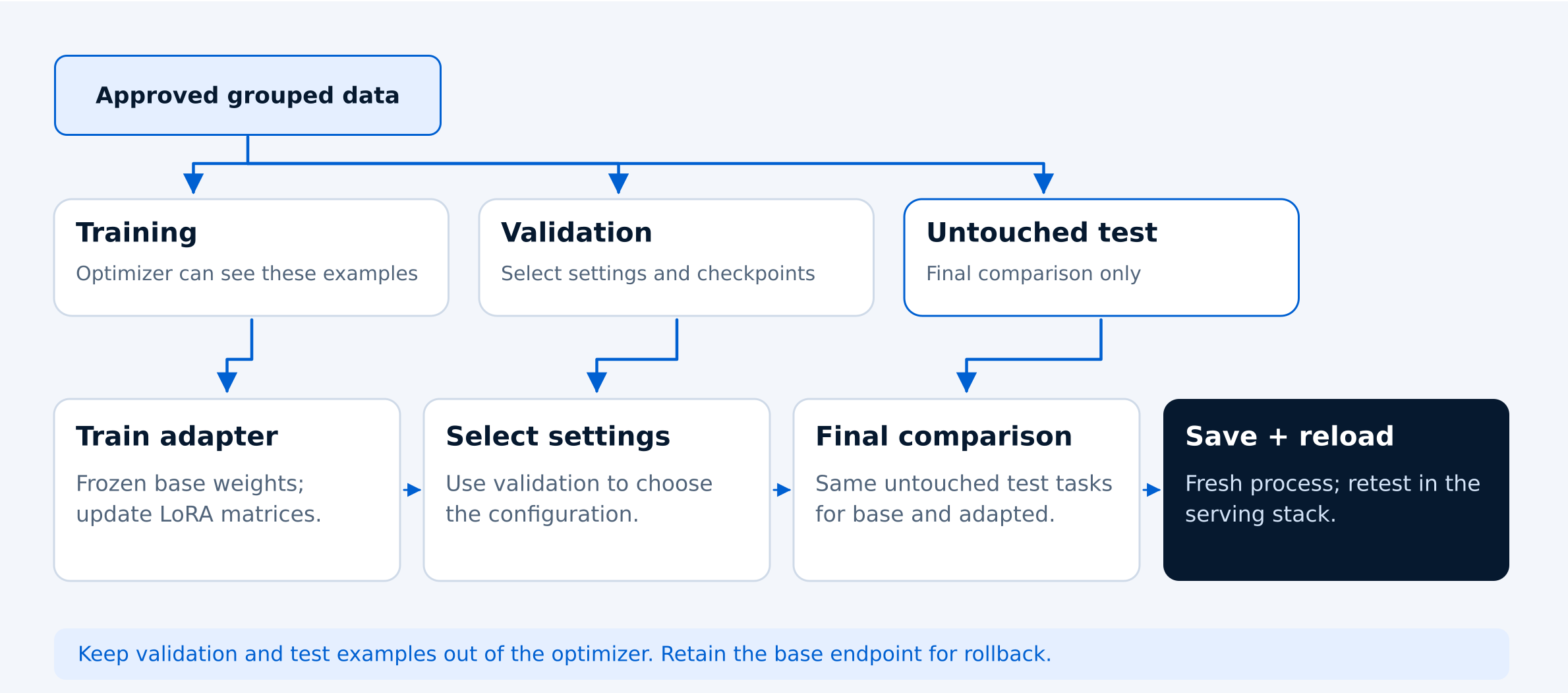
Prevent data leakage before splitting the dataset. Group related records by incident, including original tickets, follow-up messages and rewritten resolutions. Keep each group within a single dataset partition. Otherwise, nearly identical examples may appear in both training and testing, making the adapted model look more accurate than it really is.
Divide the approved examples into three separate datasets:
Training set: Examples used to update the LoRA adapter's trainable parameters.
Validation set: Examples used to compare training settings, monitor performance and select a checkpoint.
Test set: Previously unseen examples reserved for the final evaluation after the configuration has been selected.
Do not repeatedly adjust the model based on its final test results. If the test set influences training decisions, it no longer provides an independent assessment of generalization.
Include difficult examples rather than relying only on straightforward tickets. Test incomplete descriptions, misleading keywords, overlapping categories and requests outside the supported scope. These cases help reveal whether the model recognizes uncertainty or produces confident but unsupported classifications.
Maintain a separate evaluation set for general instruction following, output formatting and unsupported claims. A model that becomes better at ticket classification but worse at following basic instructions may not be suitable for deployment.
Plan how results will be reported before training. Measure performance for each ticket category, not just overall accuracy. Where enough examples are available, also examine results by product family or issue type. This prevents strong performance in common categories from hiding failures in smaller but important groups.
Finally, record dataset versions, partition sizes, labeling rules and file hashes. These details make it possible to reproduce the evaluation and determine whether later improvements come from the adapter, revised data or changes to the testing process. The goal is to create a trustworthy baseline. A carefully designed evaluation set provides stronger evidence of fine-tuning value than a lower training loss or a handful of successful demonstrations.
Record the Recipe and Check the Training Script
A reproducible fine-tuning experiment requires more than recording the model name and training loss. Before running LoRA fine-tuning on NVIDIA DGX Spark, document the software environment, training configuration and any changes made to the example script.
NVIDIA provides an 8B LoRA training example in its PyTorch fine-tuning playbook. The documented starting environment includes a 128 GB DGX Spark and NVIDIA's PyTorch 25.11 container. This is a useful reference for planning an experiment, but it should not be treated as a complete, validated training pipeline for your own dataset.
Verify model access and licensing first. Llama 3.1 8B weights may require accepting applicable license terms and obtaining access through the model provider. Confirm that the intended training and deployment use complies with those terms before downloading the model.
For each experiment, record the following configuration details:
- Software environment: Repository commit, container image digest, installed package versions and relevant driver information.
- Model: Exact base-model revision, tokenizer version and model-loading configuration.
- Dataset: Training and validation file hashes, preprocessing rules and example counts.
- LoRA configuration: Adapter rank, scaling, target layers and trainable parameter count.
- Training settings: Learning rate, optimizer, precision, batch size, gradient accumulation, sequence length and random seed.
- Prompt format: The exact instructions, input structure and expected response format used during training and evaluation.
Keep the prompt format consistent when comparing the base model and adapted model. If the formatting changes, investigate its effect separately rather than attributing every difference to fine-tuning.
Check the training script before starting a full run. In the NVIDIA 8B script version inspected for this guide on October 20, 2026, the README describes an --output_dir option that is not implemented in the script. Periodic checkpoint saving is disabled, and the script does not include an explicit final adapter-saving call.
The inspected script also performs a short training phase for compilation warm-up before the main training phase without restoring the initial adapter weights. This means the warm-up can contribute to the adapter's training exposure. Record both phases when documenting the number of examples processed, elapsed time and resource consumption.
These observations apply to the inspected version and should be verified against the exact repository commit used for your experiment. A newer script revision may behave differently.
Implement and test adapter saving before committing to a longer run. Confirm that the modified workflow can save the adapter weights and configuration, reload them in a fresh process and generate responses using the intended base model. Do not assume that a successful training run automatically produces a reusable adapter.
Use the example dataset initially to confirm that the software environment and training process operate correctly. For the support-ticket experiment, additional work is required to integrate an approved dataset loader, validation procedure, final adapter export and reload verification.
Preserve the original script alongside any modifications, and document why each change was made. This makes it easier to reproduce results, investigate failures and distinguish training improvements from changes in the underlying software.
The objective is to establish a controlled training recipe before spending significant time or resources. A documented configuration and verified saving process are essential for determining whether the resulting adapter is useful beyond the initial experiment.
Start With a Small Training Experiment
Once the dataset, evaluation criteria and training script are ready, begin with a small, controlled LoRA fine-tuning experiment on NVIDIA DGX Spark. The goal is not to maximize training time or run as many configurations as possible. It is to determine whether adapting Llama 3.1 8B produces a measurable improvement for the selected task.
Set an experiment budget before training. Define limits for the number of runs, preparation time, training duration and manual review. Include time spent troubleshooting failed runs and evaluating results. This provides a more realistic picture of the effort required than GPU training time alone.
Start with one documented LoRA configuration. Record the adapter rank, target layers, scaling factor and number of trainable parameters. Keep the dataset and evaluation procedure consistent while establishing a baseline. When testing alternative settings, change one factor at a time so differences are easier to investigate.
Check sequence length and data truncation. Support tickets can vary considerably in length. Inspect examples that exceed the configured sequence limit and determine whether truncation removes information needed to classify the issue. If important details are lost, adjust the dataset preparation or sequence-length configuration before interpreting the training results.
For every experiment, maintain a training record covering five areas:
- Adapter configuration: LoRA rank, target layers, scaling settings and trainable parameter count.
- Training configuration: Data type, optimizer, learning rate, batch size, gradient accumulation and maximum sequence length.
- Dataset processing: Training and validation partition hashes, examples processed and percentage of truncated examples.
- Resource usage: Peak observed memory consumption, saved checkpoint size and wall energy where measurement equipment is available.
- Time required: Environment setup, compilation or warm-up, training, evaluation and adapter export recorded separately.
Compare the Adapter With Useful Alternatives
After fine-tuning Llama 3.1 8B on DGX Spark, evaluate whether the LoRA adapter actually improves the selected task. Compare the adapted model with the prompted base model using the same untouched test dataset, output format, generation settings and scoring rules. If the task depends on external information, also test the base model with retrieved evidence to determine whether retrieval offers a simpler solution.
Measure more than overall accuracy. For ticket classification, report precision, recall and macro-F1 for each category. Precision measures how often a predicted category is correct, while recall measures how many relevant tickets the model identifies. Macro-F1 gives equal weight to each category, helping reveal weaknesses that overall accuracy might hide.
Review errors alongside these scores. Check whether the adapter produces unsupported explanations, invalid response formats or confident classifications when a ticket should be marked needs review. Include the number of examples tested in each category, since small datasets can make minor score differences appear more significant than they are.
Decide whether the improvement justifies the cost. Use acceptance criteria established before the final test, such as better performance in the weakest category, fewer manual corrections and no increase in unsupported explanations. Consider training effort, inference requirements and ongoing maintenance when comparing alternatives.
Document the results, including successful cases, regressions and any limitations. The goal is to establish whether LoRA provides a meaningful improvement over simpler approaches, not merely whether training loss decreased. This article describes a proposed evaluation workflow and does not claim that Uniqcli has achieved measured improvements.
Save and Reload the Adapter
After evaluating the fine-tuned model, verify that the LoRA adapter can be saved and reused outside the original training session. A successful training run is not enough if the resulting adapter cannot be loaded reliably for future testing or deployment.
Save the adapter weights and configuration along with the exact base-model revision, tokenizer details and training settings. Reload the adapter in a fresh process and repeat a set of representative test questions. Confirm that the saved version produces valid outputs and meets the same evaluation requirements.
If deployment requires merging the adapter with the base model or converting it to another format, test that version separately. Keep the original base-model configuration available for rollback if the adapted model introduces errors or unexpected behavior.
Retain approved checkpoints, evaluation results and configuration records for reproducibility. Verify that the required files have been archived before removing temporary datasets or unused checkpoints according to the organization's retention policy.
Planning an 8B fine-tuning project on DGX Spark? When discussing hardware requirements with Uniqcli, share the base model, training method, sequence length, dataset size, experiment budget and expected storage needs. These details can help assess the infrastructure required for training, evaluation and adapter storage.
Use this checklist before accepting the results of an 8B LoRA fine-tuning experiment on DGX Spark. Confirm that the training process is reproducible, the evaluation is reliable and the saved adapter works as expected.
- Define the task and measurable success criteria before training.
- Test the prompted base model and consider retrieval as an alternative.
- Prepare approved, labeled data with sensitive information removed.
- Separate training, validation and untouched test datasets without leakage.
- Record the model revision, software versions and LoRA settings.
- Verify the training script, checkpoint saving and adapter export.
- Track training time, memory usage, dataset size and failed runs.
- Compare accuracy, precision, recall and macro-F1 against the baseline.
- Review unsupported explanations, invalid outputs and other regressions.
- Reload the saved adapter in a fresh process and confirm rollback readiness.
Frequently asked questions
Can NVIDIA DGX Spark fine-tune an 8B AI model?
Yes. NVIDIA provides an 8B LoRA fine-tuning example for the 128 GB DGX Spark. LoRA updates a smaller set of adapter parameters rather than retraining every model weight. Actual memory use, training time and compatibility depend on the model, sequence length, software environment and training configuration.
What is the difference between LoRA and QLoRA fine-tuning?
LoRA trains a small set of additional parameters while keeping the base model weights frozen. QLoRA also uses a quantized base model to reduce memory requirements during adaptation. Both approaches require configuration and evaluation, and their performance should not be assumed to be identical.
How much training data is needed to fine-tune an 8B model?
There is no universal minimum dataset size. Requirements depend on task complexity, example quality and the model's existing capabilities. Start with representative, consistently labeled examples and separate training, validation and test sets. Evaluate performance on unseen data before deciding whether more examples are needed.
How do you know whether LoRA fine-tuning improved a model?
Compare the fine-tuned adapter with the prompted base model using the same untouched test dataset. Measure task accuracy, precision, recall and macro-F1, then review unsupported explanations, invalid outputs and other regressions. Lower training loss alone does not prove better performance on new examples.
Can a LoRA adapter be saved and reused after training?
Yes. A LoRA adapter can be saved separately from its base model and reloaded for later inference or evaluation. Preserve the adapter weights, configuration and compatible base-model revision. Test the saved adapter in a fresh process before relying on it for deployment.
Plan the Right Infrastructure for AI Fine-Tuning
Evaluating LoRA fine-tuning on NVIDIA DGX Spark? Share your model size, dataset requirements, training goals and storage needs with Uniqcli. Our team can help you assess suitable AI hardware and infrastructure options for your project.
Sources
- 1.NVIDIA — DGX Spark PyTorch Fine-Tuning Playbookgithub.com
- 2.NVIDIA — Llama 8B LoRA Fine-Tuning Scriptraw.githubusercontent.com
- 3.Hugging Face — LoRA Conceptual Guidehuggingface.co
- 4.Hugging Face — PEFT Documentationhuggingface.co
- 5.Hugging Face — Transformers Documentationhuggingface.co