
Solutions
GPU Compute Infrastructure
A GPU node is bought as a system, not as a card. Uniqcli quotes and integrates the whole rack — accelerators, host platform, memory and local NVMe, the power density the row has to carry, the cooling headroom it assumes, and the fabric that ties nodes together — screened, staged and delivered racked.
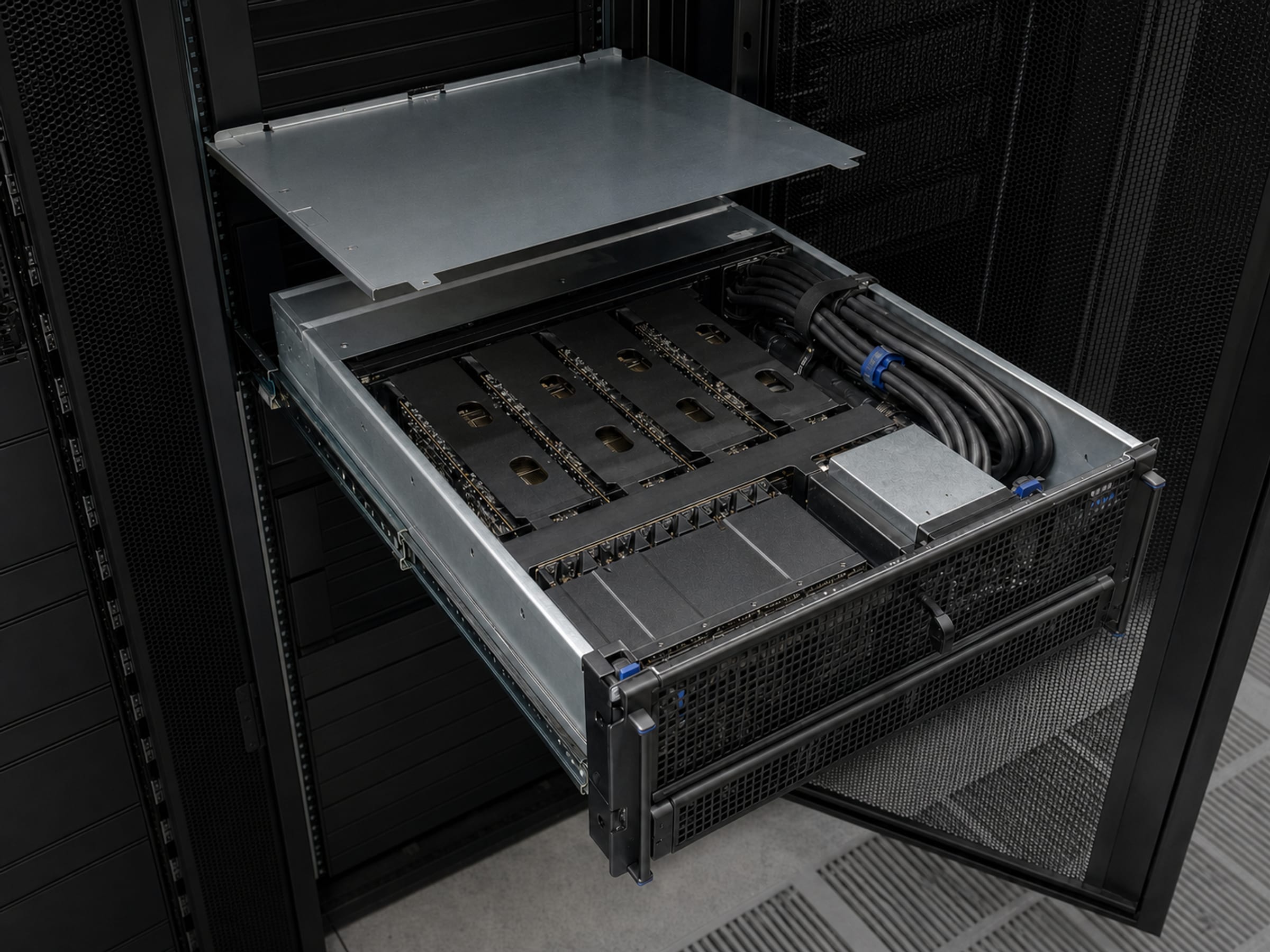
- Category
- Accelerated compute — training, inference and visualization nodes
- We quote
- Accelerators, hosts, memory, NVMe, fabric, rack power and cooling
- Delivered
- Racked, cabled and burned in against a published layout
- Boundary
- We supply and integrate the hardware; the models and the workload stay yours
The card is the cheapest decision on the page
Most GPU purchases fail somewhere other than the accelerator. The host has the wrong number of PCIe lanes, or the wrong CPU-to-GPU ratio for the job. The rack was sized for 6 kW and the node draws 10. The chilled-water loop or the rear-door heat exchanger was never in the budget. The nodes arrive, and then someone discovers the fabric between them is the actual bottleneck. Uniqcli quotes the whole system as one bill of materials — accelerators, host platform, system memory, local NVMe, the network adapters and optics, the PDUs and power path, and the rack and containment they sit in — screened line by line for TAA and NDAA §889 before the quote leaves. We build, integrate and stage that rack; your program runs the workload on it.
What actually has to be specified
Start at the accelerator, because it fixes almost everything downstream: form factor decides which chassis is eligible, memory capacity per board decides whether a model fits without sharding, and the board's power envelope multiplied by density decides the circuit. From there the host has to be matched rather than assumed — PCIe generation and lane count, CPU cores per accelerator for data loading and preprocessing, and enough system memory that the host never becomes the thing the GPUs wait on.
The rack is the second half of the specification. High-density accelerated nodes routinely land between 8 kW and 40 kW per rack, which changes the PDU, the branch circuit, the receptacle type and often the containment strategy. Air-cooled deployments need real intake temperature and airflow headroom; direct-liquid designs need the manifold, the quick-disconnects and a facility loop that already exists. We quote the power and cooling line items alongside the compute rather than after it, and we say plainly when a requirement needs facility work we do not perform.
The third piece is the fabric. A single node is a server; a cluster is a network problem. Adapter choice, switch port speed, optics or direct-attach copper, and the physical cable runs between racks all get quoted as a matched set with the layout they have to reach — because a fabric specified after the racks are placed is a fabric that gets re-bought.
The lines that make up a GPU rack
Each card is a real line on a real quote, sourced through US distribution and screened for TAA and NDAA §889 before it reaches you. Naming a manufacturer describes the market, not a Uniqcli partnership or endorsement.
Accelerators
NVIDIA data-center and professional accelerator lines, quoted to the model footprint and the chassis that will hold them. A portion of the board catalog is priced in the storefront; allocation-constrained parts are quoted with an honest lead time rather than a fictional one.
Host platforms
Lenovo rack and tower hosts, with PCIe topology, CPU-to-accelerator ratio and system memory matched to the job rather than to a configurator default. AMD platform options are quoted where the workload favors core count and memory bandwidth over clock.
Memory and local NVMe
Registered ECC DIMMs from Micron and Kingston sized so preprocessing never starves the accelerators, plus the local NVMe scratch tier that holds a working dataset next to the GPUs instead of across the network.
Rack power and containment
Metered and switched PDUs, power cords and receptacle types matched to the real per-rack draw, with rack, rail and containment hardware quoted in the same bill of materials so nothing is discovered on install day.
From requirement to a rack that powers on
- Send the workload shape — model sizes, concurrency, training or inference, and the rack power you actually have
- We return one consolidated bill of materials: accelerators, hosts, memory, storage, fabric, power and rack
- TAA (FAR 52.225-5) and NDAA §889 screening runs per line before the quote goes out
- Nodes are built, firmware-leveled, imaged and burned in before they ship
- Racked, cabled and labeled to a published elevation, with the cable schedule delivered as a document
- Lifecycle and refresh planning quoted alongside, so the second wave is not a fresh archaeology project
What stays yours to run
We do not train, tune, host or operate models, and we do not run a data center. The scheduler, the container images, the dataset governance, the model weights and the decision about what the system is allowed to do all stay inside your program — as they should, because they are the parts an auditor and a mission owner will ask you about.
What we own is the supply chain and the integration: sourcing through US distribution, per-line origin and covered-entity screening, the build and burn-in, the physical deployment, and the licensing and support entitlements quoted alongside the metal. If a requirement needs electrical or mechanical work on the facility, we say so and quote around it rather than through it.
Related infrastructure and background
GPU infrastructure questions
Can you quote accelerators on their own?
Yes — a single board is a valid line item, and plenty of buyers are adding capacity to hosts they already own. We will ask what chassis and power supply it is going into, because the wrong pairing is the most common way a GPU purchase gets returned.
What lead times should we plan for?
It depends entirely on the part. Some accelerator and host lines are in distribution stock and ship in days; allocation-constrained data-center boards can run considerably longer. We quote the lead time distribution actually reports rather than an optimistic placeholder, and we flag it before you commit.
Do you handle liquid cooling?
We quote and integrate the equipment side — chassis, manifolds, quick-disconnects and rack hardware specified by the platform vendor. We do not design, install or operate facility water systems; that work belongs to your mechanical contractor, and we coordinate the equipment specification with them.
Is this hardware TAA and §889 screened?
Every line on every order is screened before the quote goes out: manufacturer-stated country of origin recorded per line, and the maker with its parent and affiliates checked against the §889 covered-entity list. Lines that do not survive the check are flagged with alternates rather than quietly quoted.
Can you deliver a rack that is ready to run?
We build, firmware-level, image and burn in the nodes, then rack, cable and label them against a published elevation before delivery. Powering it on in your facility, connecting it to your network, and operating what runs on it stays with your team.
The solutions atlas
Every solution, by technology area and by customer.
By technology
By customer
- TAA & NDAA-889 Compliance Screening
- CMMC & CUI Solutions
- Federal & DoD
- State, Local & Education
- Healthcare
- Enterprise
- Rapid Procurement & GPC Buys
- Multi-Vendor Integration Projects
- eProcurement & Custom Catalogs
- FISMA Modernization
- CJIS-Compliant Justice Cloud & Local AI
- Federal Storage Modernization
- Government ERP & Business Systems Infrastructure
- Managed Procurement
- Secure AV & Conferencing
- Fiber Network Infrastructure
- Satellite & Resilient Connectivity
- Wavelength & Optical Transport
- Decentralized Data Centers
- Data Center Design & Build
Send us the workload, not just the part number
Tell us the model sizes, the concurrency and the rack power you have. We will come back with one screened bill of materials for the whole node — accelerators, host, memory, fabric and power.