
Solutions
AI Cluster Networking
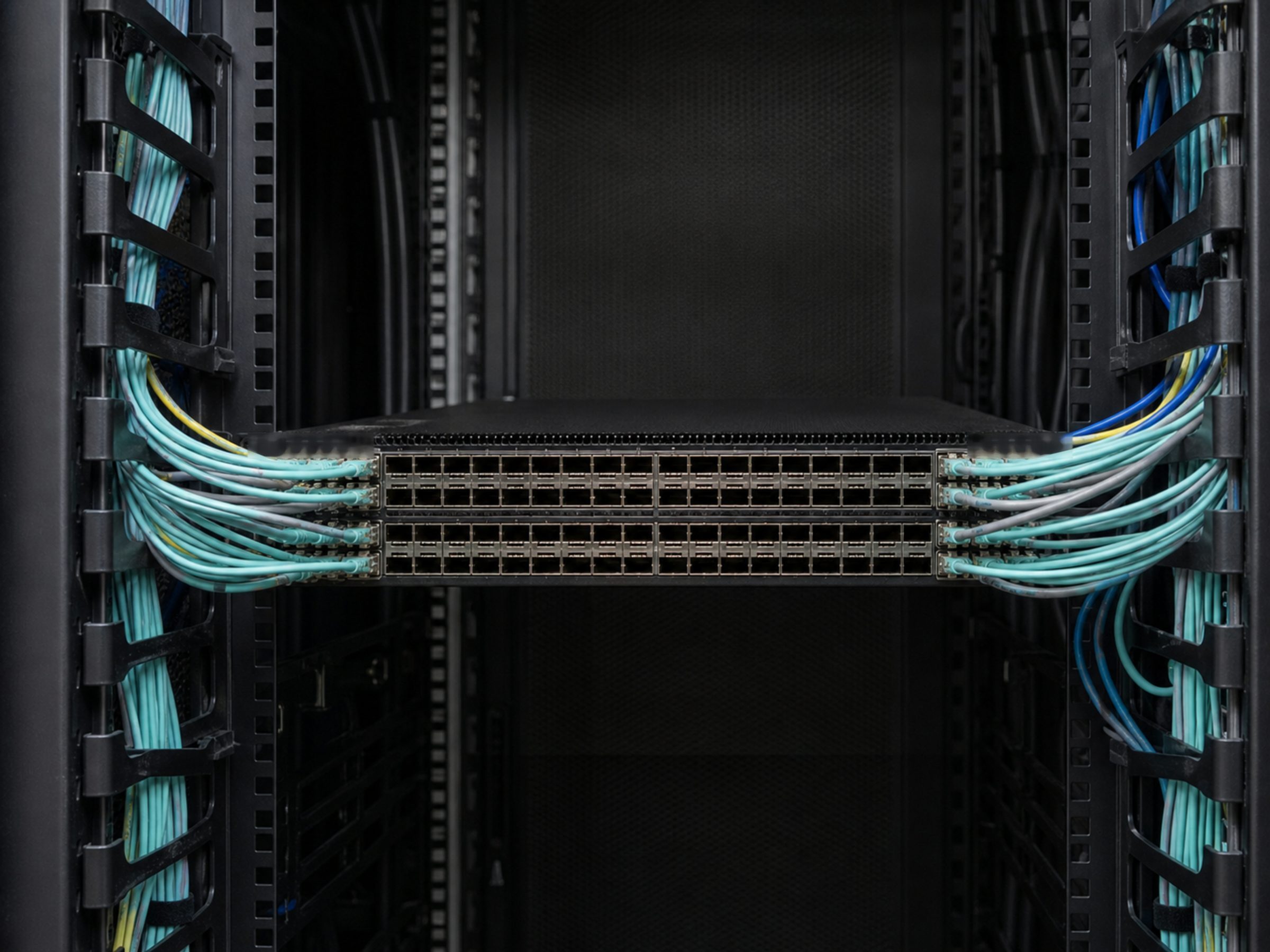
East-west traffic between accelerators sets the fabric specification. Uniqcli quotes switching, adapters, transceivers and direct-attach runs as one matched set against the rack layout they physically have to reach.
- Category
- High-throughput east-west fabric for accelerated clusters
- We quote
- Switching, adapters, transceivers, DAC and structured runs
- Matched to
- The rack elevation and the physical distances in your room
- Boundary
- We supply and stage the fabric; routing policy and operation stay yours
The traffic that matters runs sideways
Enterprise networks are designed around north-south traffic: users reaching services, services reaching the internet. An accelerated cluster inverts that. The dominant flow is east-west — accelerators exchanging gradients, parameters and activations with each other, in bursts, synchronously, where the slowest link sets the pace for every node in the collective. That changes what a switch is being bought for, changes the port speed and the oversubscription ratio you can tolerate, and makes the physical distance between racks a design input rather than an afterthought. We quote the fabric as a matched set: adapters, switches, optics, and the exact cable runs the elevation demands.
Four lines that have to agree with each other
An adapter, a transceiver, a switch port and a cable that disagree about speed, reach or connector type are four separate returns. We quote them together. Naming a manufacturer describes the market, not a Uniqcli partnership or endorsement.
Switching
Data-center switching quoted to the port speed, radix and oversubscription ratio the topology needs, including Allied Telesis lines for management, out-of-band and edge aggregation alongside the high-throughput spine.
Host adapters
Network interface cards and high-throughput adapter lines — including NVIDIA's accelerator-adjacent networking products — matched to the host's PCIe generation and lane budget, because an adapter starved of lanes is a slow adapter no matter what the box says.
Optics and transceivers
Transceivers and media converters quoted per link by speed, reach and fiber type, with third-party optics available where a platform accepts them and vendor-coded parts where it does not. Compatibility is confirmed against the switch and adapter before the quote goes out.
DAC and structured runs
Direct-attach copper for in-rack and adjacent-rack links, plus the fiber trunks, patch panels and cable management for anything longer. Quoted by measured run length against the elevation, not by an estimate that turns into a second order.
Three inputs turn a wish into a bill of materials
The first is the collective pattern: how many nodes participate in a synchronized exchange, and how large those exchanges are. That sets the per-node bandwidth requirement, and therefore the port speed and the adapter class. It is also the input that decides whether a conventional Ethernet fabric is entirely adequate — for many inference and loosely coupled workloads it is, and saying so saves real money.
The second is the physical plant: rack positions, distances, pathway capacity and what is already installed. Direct-attach copper is cheap, low-latency and strictly limited in reach; active optical and fiber trunks solve distance but cost more per link and add transceivers to the bill. The elevation decides which is which, so we ask for it rather than assume a standard row.
The third is management and out-of-band. Every cluster needs a second, quieter network for console access, IPMI and switch management, and it is the piece most often left off the first quote and discovered during commissioning. We include it by default.
Fabric background and adjacent builds
Cluster fabric questions
Do we need a specialized fabric, or is Ethernet enough?
It depends on how tightly coupled the workload is. Synchronized multi-node training punishes latency and inconsistency in a way that can justify a specialized fabric; inference serving and loosely coupled jobs frequently run very well on well-designed Ethernet. We ask about the workload before quoting, and we will tell you when the cheaper answer is the correct one.
Will third-party optics work in our switches?
Frequently, and they are considerably cheaper — but it depends on the platform and on whether coding is enforced. We confirm compatibility for the specific switch and adapter before quoting, and where a platform will only accept vendor-coded parts we quote those instead of gambling with your commissioning window.
Do you quote networking from every manufacturer?
Some vendors' switching lines are quoted through our sister storefronts rather than this catalog. Tell us what the design calls for and we route the quote to the right place; we would rather do that than steer a design toward whatever happens to sit in one catalog.
Can you cable and label the racks?
Yes. We stage, cable and label to a published elevation and deliver the cable schedule as a document with the build. Turning the fabric up, configuring routing and operating the network afterwards stays with your network team.
The solutions atlas
Every solution, by technology area and by customer.
By technology
By customer
- TAA & NDAA-889 Compliance Screening
- CMMC & CUI Solutions
- Federal & DoD
- State, Local & Education
- Healthcare
- Enterprise
- Rapid Procurement & GPC Buys
- Multi-Vendor Integration Projects
- eProcurement & Custom Catalogs
- FISMA Modernization
- CJIS-Compliant Justice Cloud & Local AI
- Federal Storage Modernization
- Government ERP & Business Systems Infrastructure
- Managed Procurement
- Secure AV & Conferencing
- Fiber Network Infrastructure
- Satellite & Resilient Connectivity
- Wavelength & Optical Transport
- Decentralized Data Centers
- Data Center Design & Build
Send the elevation and the node count
We will quote switching, adapters, optics and cable runs as one matched set — with the management network included rather than discovered later.