
Network & data center services
AI Server Racks & GPU Cabinets
A GPU server rack is a weight problem, a power problem and an air problem before it is a cabinet problem.
We spec the frame against the deepest chassis and its loaded weight, the PDUs against the real per-rack draw and the circuits behind it, and the airflow discipline that keeps the intake temperature honest.
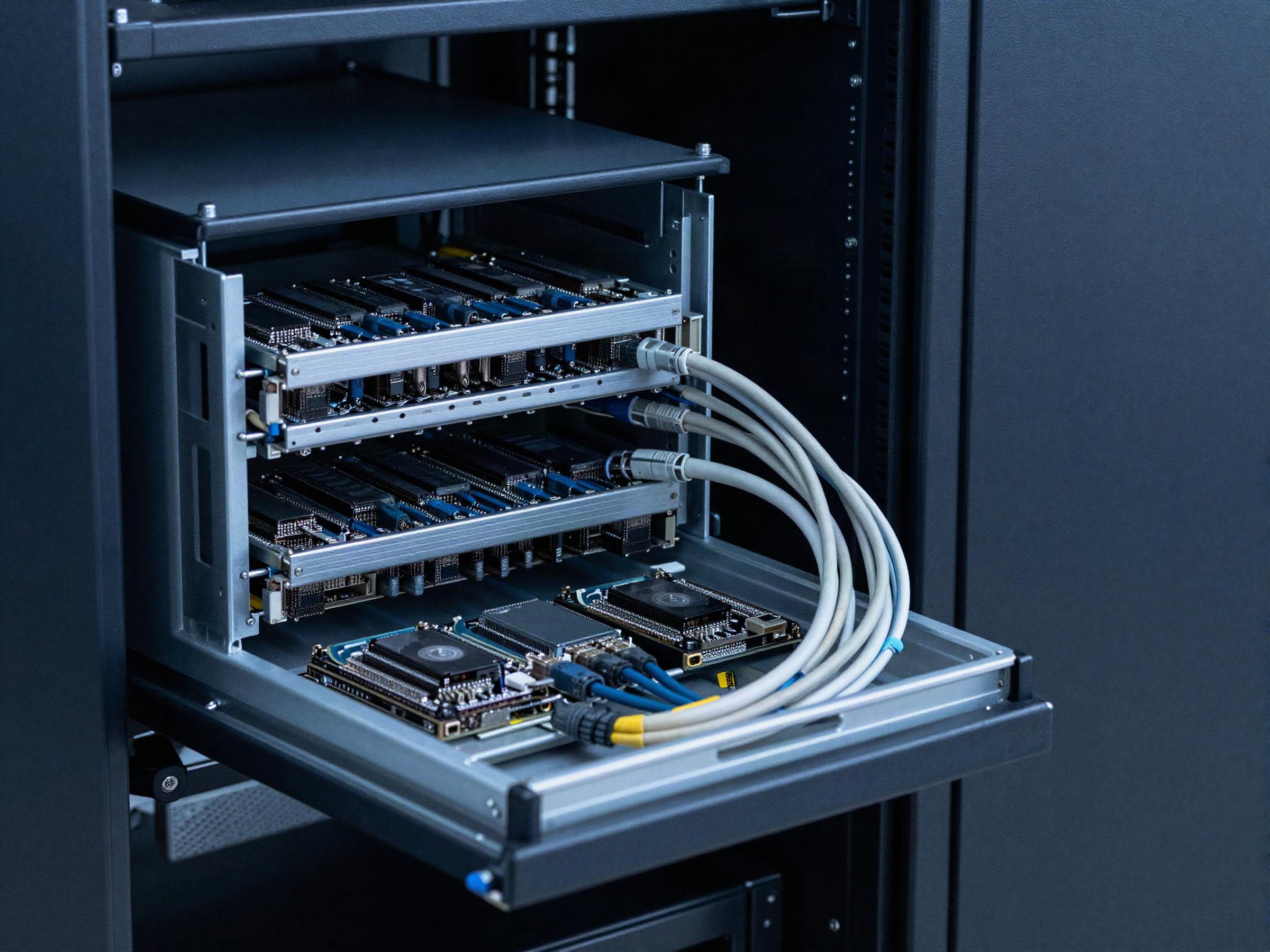
- Unit of scope
- The rack — frame, rails, PDUs, airflow and the row around it
- Sized against
- Deepest chassis, loaded weight, per-rack draw and available circuits
- Deepest priced shelf
- Rack PDUs — metered, switched and three-phase, across several makers
- Boundary
- Floor loading and facility cooling stay with your engineer
Tell us the project — AI server racks
Tell us where to reach you and a Uniqcli specialist follows up by email to scope the work with you — what has to be covered, how many sites or buildings, and what already exists — then comes back with a quoted bill of materials across the equipment, the software licensing and the deployment work.
Priced against your own site rather than a package tier, sourced through US distribution and screened line by line. We specify, supply, stage and integrate; internet access is scoped separately from the equipment on this page, and operating the network stays with your team or the provider you contract.
The first number is our real one, not an opening one.
Tell us the scope and we come back with the best price we can do on it.
- Supporting federal, state & local purchasers
- GPC & P-Card accepted
- TAA & NDAA-889 screening before every quote
Live prices from our catalog right now — a starting point, not the project price. Your quote is scoped to the site and includes the licensing and services the job needs.
A GPU rack fails on weight, depth and watts — rarely on height
Rack units are the easy number, and they are the one most projects lead with. The numbers that actually decide an AI server rack are the ones nobody wrote down: how deep the chassis is once its cable bend allowance and rear service clearance are added, what the cabinet weighs fully populated against its static and its rolling rating, how many watts the row can deliver to that position and on which receptacle, and whether the intake air in front of the door is anywhere near the temperature the platform assumes.
Continue readingShow less
Get those four right and the cabinet choice follows in an afternoon. Get them wrong and the frame is either returned, derated, or quietly running at an intake temperature that turns into throttling and a failure rate three years out. This page is the density-specific version of the problem; general IDF closets, wall-mount enclosures and two-post frames are covered on the network racks and enclosures page.
Four measurements, taken before anything is ordered
Every one of these is cheaper to answer on paper than on a loading dock. Naming a manufacturer here describes the market and the lines we quote, not a Uniqcli partnership, authorization or endorsement.
Depth, and the clearance behind it
Accelerated chassis are deep, and the usable depth of a frame is not the number on the label — it is what remains once the rear posts are set, the cable bend allowance is respected and a technician can still get behind the equipment.
Continue readingShow less
Schneider Electric's APC NetShelter cabinets, Eaton's Tripp Lite SmartRack frames and the Legrand and Panduit rack lines all carry priced rows across the depth range, and the frame is chosen from the deepest chassis in the elevation rather than the average one.
Weight, static and rolling
A populated GPU cabinet is one of the heaviest objects in the room, and frames carry two different ratings — a static one for a cabinet standing in place and a lower dynamic rating for one being rolled.
Continue readingShow less
A cabinet that ships or moves populated is governed by the rolling number, not the static one. We state the shipping and populated weights on the quote so the numbers reach your facilities engineer before the pallet does.
Power, from receptacle to branch circuit
High-density racks change the power question from how many outlets to how many kilowatts, on what phase, through which receptacle, with what redundancy.
Continue readingShow less
Rack PDUs are the deepest priced part of this shelf — Legrand, Panduit, Vertiv, Eaton and Schneider Electric all carry metered, switched and three-phase lines — and we quote the PDU with its cord length, receptacle mix and the circuits it is landing on.
Air in, heat out
Airflow is a discipline before it is a product. Blanking panels in every unused U, brush grommets where cables pass the frame, a sealed roof and floor, and doors with genuine perforation are what keep exhaust air from being re-inhaled.
Continue readingShow less
Fan trays and airflow accessories are quoted where a position needs assistance; containment is quoted where the row does.
Size the rack to the density, not the rack units
Go to the formThree-phase is a density decision, not a preference
General-purpose rows are commonly built for single-phase circuits, and accelerated racks routinely outgrow them. High-density accelerated deployments commonly land somewhere between 8 kW and 40 kW per rack depending on node count and board choice, and past the lower end of that band a single-phase strip stops being practical: you either add more circuits than the cabinet can sensibly terminate, or you move to three-phase and carry the same load on fewer, larger feeds. Which of those is right depends on what the room already has, which is why the circuit inventory is an input to the quote rather than something discovered after it.
Continue readingShow less
Metered, switched and monitored PDU tiers are worth separating deliberately. A metered unit tells you what the rack is drawing, which is the minimum for a density you are about to increase. A switched unit adds per-outlet control, which matters when a node needs a hard power cycle and nobody is on site to do it. Both cost more than a basic strip and both are cheaper than the first tripped breaker that took a rack down with it. Redundant A and B feeds are a separate decision again, and they change the PDU count, the cord run and the branch-circuit plan together.
Receptacle mix is where rack power quotes most often go wrong. The plugs on accelerated hosts and their power supplies are not always what a general-purpose rack was populated for, so we quote the outlet mix against the equipment list and the cord lengths against the actual elevation rather than a default. The PDU selector is a quick way to narrow the field before the conversation, and the quote confirms it against the circuits you have.
Where our shelf ends and your mechanical engineer begins
There is a lot of loose talk about liquid cooling in this category, so it is worth being precise about what is a purchasable line here and what is a facility engagement.
Airflow discipline — a quotable line
Blanking panels, brush grommets, sealing kits, fan trays and airflow accessories are priced, stocked catalog items and they are the highest-return spend in the whole category.
Continue readingShow less
Motivair carries priced rows on the airflow accessory side, alongside the Legrand, Panduit and Eaton rack hardware, and none of it needs a mechanical drawing to specify.
Rack-level liquid accessories — quoted to spec
Where a platform vendor specifies a liquid-cooled configuration, the rack-side parts are quotable: hoses, plumbing fittings, quick-disconnects, manifolds and the mounting hardware the platform calls for.
Continue readingShow less
Motivair carries priced rows on hoses and fittings. These are accessories that connect a rack to a loop — they are not the loop.
Facility plant — not ours to sell you
CRAC and CRAH units, chillers, coolant distribution units, a building chilled-water loop, containment structure tied into the building, and the pipework and controls behind any of them are a mechanical engineering scope.
Continue readingShow less
That is your engineer's call and your mechanical contractor's work. We coordinate the equipment specification with them and quote around that scope rather than through it.
What's included in a GPU rack build
The rack is the unit of scope — frame, rails, PDUs, airflow and the row around it, measured before anything is ordered.
- A frame specified against the deepest chassis and the clearance behind it, once the rear posts are set and the cable bend allowance is respected
- Static and dynamic weight ratings checked against a populated cabinet, and against whether it will be moved loaded
- Rack PDUs — metered, switched and three-phase — against the real per-rack draw, the phase, the receptacle mix and the redundancy the row requires
- Airflow discipline as a quoted line: blanking panels, brush grommets, sealing kits, fan trays and airflow accessories
- Rack-side liquid accessories quoted to the platform vendor's own specification where a liquid-cooled configuration is called for
- Rails, patch fields, cable management, blanking and a growth allowance counted into the rack units
- Delivery as parts or as a build — populated, cabled and dressed to an elevation you keep as a document
- TAA (FAR 52.225-5) and NDAA §889 screening before the quote goes out — floor loading and facility cooling stay with your engineer
Enough to spec a GPU rack in one pass
A photograph of the row and a short equipment list get most of the way there.
- The equipment going in, with the deepest chassis identified and its rear service clearance noted
- Total rack units needed, including patch fields, cable management, blanking and a growth allowance
- Circuits available at that position: count, amperage, single or three-phase, and the receptacle types
- Whether redundant A and B feeds are required, and what happens to the rack on a utility failure
- Room reality — intake temperature, containment if any, floor type, and the clearance in front of and behind the frame
- Any weight constraint your facilities team has already given you, and whether the cabinet will be moved populated
What arrives, and what state it arrives in
A rack can be delivered as parts or as a build, and the difference is worth choosing deliberately rather than by default. Delivered as parts, the cabinet, rails, PDUs, management and blanking arrive as a kit and your team assembles the elevation on site. Delivered as a build, the nodes are mounted, cabled, labeled and burned in against a published elevation before it ships, and the cable schedule is handed over as a document alongside it.
Continue readingShow less
For accelerated racks the second option usually earns its cost, because the install window is where density problems surface: a rail kit that is model-specific and wrong, a cord length that does not reach the intended outlet, a PDU whose receptacle mix was assumed rather than counted. All three are cheap to fix in a staging area and expensive to fix in a live room with a change window closing.
Either way the elevation is a document you keep. Rack units, positions, weights, power draw per position and the receptacle each cord lands on are recorded, so the next expansion starts from a drawing rather than from a torch and a guess.
Send the row and the equipment list
Give us the position, the circuits behind it and what has to go in. The quote comes back as the frame, rails, PDUs, cable management, blanking and airflow accessories as one set, sized to the density rather than the rack-unit count, with availability stated per line.
Continue readingShow less
If you want to narrow the power line first, the PDU selector gets you close in a couple of minutes.
What stays with your engineer
We specify and supply the cabinet and everything mounted in it, and we will tell you what it weighs. We will not tell you your floor can carry it. Structural floor loading, seismic bracing, anchoring into the building fabric, and any permit or inspection those attract belong to your facilities or structural engineer and the authority with jurisdiction — and on a raised floor at accelerated density that is a question worth asking early rather than at delivery.
Continue readingShow less
Facility cooling is the same boundary in a different discipline. We quote blanking, sealing, fan trays, airflow accessories and rack-level liquid parts that a platform vendor specifies. Whether the room can reject the heat you are about to add to it is a mechanical calculation about that room, and it belongs to the engineer who owns it. Where a build has outgrown enclosures altogether and needs containment, precision cooling or switchgear, it has stopped being a rack purchase and become a data center engagement.
We also do not operate what we deliver. Once the rack is handed over with its elevation and cable schedule, the power policy, the monitoring, the change control and the equipment inside it are yours to run.
The row around the rack
The adjacent scopes most often quoted on the same order.
AI server rack questions
How much power should we plan for a GPU server rack?
More than a general-purpose row was built for. High-density accelerated racks commonly land somewhere between 8 kW and 40 kW depending on node count and board choice, which is several times a typical mixed-use cabinet. The useful exercise is to total the nameplate draw of the nodes going in, add the headroom you expect to use within the refresh window, and compare that against the circuits genuinely available at that position — then let the PDU and the frame follow from the answer.
Do we need three-phase power in the rack?
Past the lower end of that density band, usually yes. Single-phase strips stop being practical when the load needs more circuits than a cabinet can sensibly terminate, and three-phase carries the same load on fewer, larger feeds. What decides it in practice is what the room already has: if three-phase is not distributed to that row, the electrical work to bring it there is a facility scope your contractor prices, and we quote the rack-side equipment around it.
Will our existing cabinets take GPU servers?
Sometimes, and it is worth checking properly before buying new frames. The three tests are depth — the chassis plus its cable bend allowance and rear service clearance against the usable depth of the frame — weight against the cabinet's static and rolling ratings, and whether the rail kit for that chassis is available for those posts. Rail kits are model-specific and the wrong one turns a delivery into a return, which is why we confirm the kit against the exact chassis rather than the family.
Do you handle liquid cooling?
We quote the rack-side equipment, not the facility plant. Hoses, plumbing fittings, quick-disconnects, manifolds and the mounting hardware a platform vendor specifies are quotable lines. Coolant distribution units, chillers, building loops, pipework and the controls behind them are a mechanical engineering scope owned by your engineer and their contractor. We coordinate the equipment specification with them and say plainly where our line ends.
Who signs off on floor loading?
Your facilities or structural engineer, with the authority having jurisdiction where a permit applies. We give them what they need to make that call — the shipping weight, the populated weight and the cabinet's static and rolling ratings, stated on the quote rather than discovered at delivery. On a raised floor at accelerated density it is worth raising this at design time, because the answer occasionally changes where the rack goes.
How do we buy a rack build — as a kit or assembled?
Either, and the quote separates them so you can choose. As a kit, the frame, rails, PDUs, management and blanking ship as parts for your team to assemble. As a build, the nodes are mounted, cabled, labeled and burned in against a published elevation before it ships. On the commercial side, GPC and P-Card are accepted up to your cardholder threshold and purchase orders otherwise, with availability and the final total confirmed before you commit.
The solutions atlas
Every solution, by technology area and by customer.
By technology
By customer
- TAA & NDAA-889 Compliance Screening
- CMMC & CUI Solutions
- Federal & DoD
- State, Local & Education
- Healthcare
- Enterprise
- Rapid Procurement & GPC Buys
- Multi-Vendor Integration Projects
- eProcurement & Custom Catalogs
- FISMA Modernization
- CJIS-Compliant Justice Cloud & Local AI
- Federal Storage Modernization
- Government ERP & Business Systems Infrastructure
- Managed Procurement
- Secure AV & Conferencing
- Fiber Network Infrastructure
- Satellite & Resilient Connectivity
- Wavelength & Optical Transport
- Decentralized Data Centers
- Data Center Design & Build
Size the rack to the density, not the rack units
Send the equipment list and the circuits at that position. A Uniqcli specialist returns the frame, rails, PDUs, cable management, blanking and airflow accessories as one document, with weights and power draw stated, availability per line, and TAA (FAR 52.225-5) and NDAA §889 screening performed before it goes out. If the compute is still being scoped, the nodes, their software entitlements and the integration work can be quoted on the same document rather than a second one.