
Solutions
UPS Battery Replacement Programs
UPS batteries fail on a schedule everyone knows and nobody budgets. We map the installed base to the right replacement packs, quote on a cycle, and re-size the runtime before the next outage tests it for you.
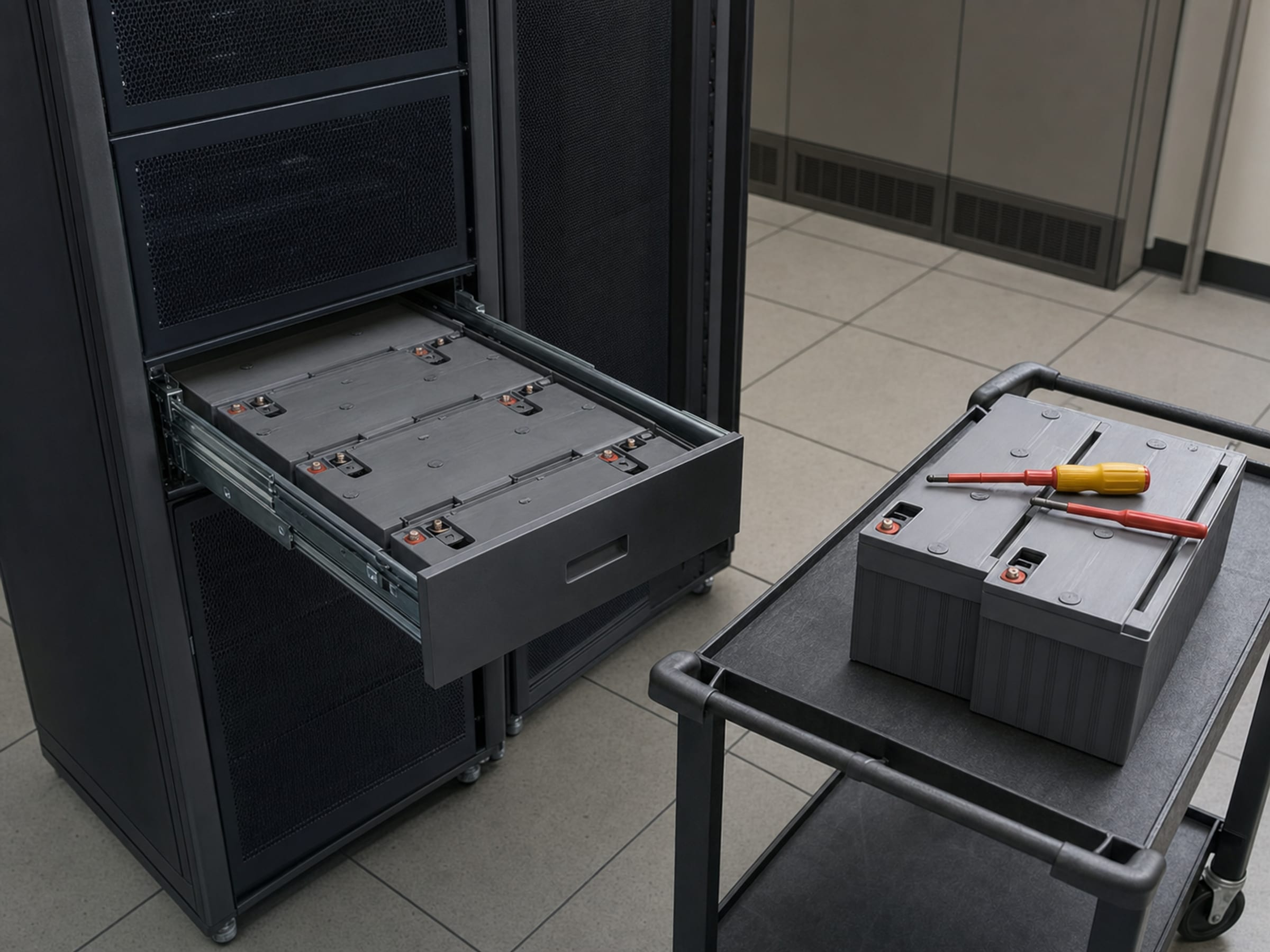
- Scope
- Replacement packs, cartridges and whole-unit swaps on a cycle
- Typical life
- Three to five years for VRLA, shorter in warm rooms
- Tooling
- Runtime sizing at /tools/ups-selector, against vendor data
- Boundary
- We supply the packs; the swap and the waste stream are handled locally
The one failure in the building with a published expiry date
Almost nothing in an IT estate fails predictably. UPS batteries do. A sealed lead-acid pack has a design life measured in years, that life shortens sharply with ambient temperature, and it ends whether or not anyone budgeted for it — usually announced by a unit that beeps for a week and then drops its load during the first real outage of the season. The cruelty is that the replacement is cheap and the consequence is not. Uniqcli maps your installed base to the correct replacement packs, quotes them on a cycle you can put in a budget line, and re-sizes the runtime while we are there, because the load in most racks is nothing like the load the original sizing assumed.
Why the replacement date is earlier than the datasheet suggests
Manufacturers quote a design life for valve-regulated lead-acid cells that assumes an ambient temperature most rooms never actually hold. Heat is the dominant variable: a pack living in a warm closet ages materially faster than the same pack in a cooled hall, which is why a fleet bought on the same day does not need replacing on the same day. Sites should be grouped by environment, not just by purchase date.
Then there is the load drift nobody re-checks. A UPS sized for a rack that held three servers is now protecting eight, plus a switch stack that grew, and the runtime figure printed on the original quote stopped being true years ago. Replacing the pack without re-checking the load reinstates a runtime nobody has verified since the day it was commissioned.
The third decision is pack versus unit. Late in a UPS's own life, a replacement battery kit can approach a meaningful fraction of a new unit that is more efficient, better instrumented and covered by a fresh warranty. We put both numbers side by side rather than quoting the pack because the pack is what you asked for.
Packs, units and the plant behind them
Eaton, Schneider Electric, Vertiv, CyberPower and Para Systems cover the replacement estate from verified priced lines, including the Tripp Lite, APC and Liebert product families that sit under those manufacturers. Naming a manufacturer describes the market, not a Uniqcli partnership or endorsement.
Replacement battery packs and cartridges
Matched to the exact model and revision of the installed unit, because a battery kit that fits physically and reports incorrectly is a worse outcome than no replacement at all. Send the model and serial rather than the pack number — the mapping is the part that goes wrong most often.
Whole-unit replacement
Where the pack price approaches the unit price, or where the existing UPS is past end of support and cannot be instrumented, a new unit is usually the better buy. Rack and tower units across the sizes small rooms and branch sites actually use, sized against the measured load rather than the original one.
Larger and industrial plant
For heavier single-phase and industrial installations the replacement conversation involves service access, weight and disposal logistics as much as price. These are quoted per site against the specific model, with lead time confirmed before commitment rather than assumed.
Turning a fleet of unknown ages into a budget line
- Installed base captured by model, serial, install date and room environment
- Sites grouped by ambient conditions, not purchase date alone
- Correct pack or cartridge mapped per model and revision, never by approximation
- Load re-checked and runtime re-sized before the replacement is quoted
- Pack-versus-unit comparison shown wherever the economics are close
- Replacements quoted on a repeating cycle so the spend lands in a budget year
Battery replacement questions
How often do UPS batteries actually need replacing?
Manufacturers commonly design valve-regulated lead-acid packs for a service life in the three-to-five year range, and warm rooms shorten it. Treat the manufacturer's figure for your specific model as the authority and the room temperature as the reason to plan at the earlier end of it. A self-test passing is not evidence of runtime.
Do you replace the batteries on site?
We supply the packs matched to your units. The physical swap is performed by your own staff or your electrical contractor, following the manufacturer's procedure — many units are hot-swappable and many are not, and that is a per-model fact rather than a general one. We do not send technicians into customer racks.
What happens to the old batteries?
Used lead-acid cells are a regulated waste stream. Where the manufacturer or distributor operates a take-back program for a given product line we will point you at it, and where none exists we say so plainly — the disposal itself is arranged locally by you. We do not operate a battery recycling facility and will not imply one.
Will you tell us the exact runtime we will get?
The runtime calculator at /tools/ups-selector sizes against manufacturer-published data and the load you enter, which makes it a planning estimate rather than a measurement of your rack. A real figure comes from a load test on the actual unit. We are clear about which one we are giving you.
Can this be a standing program rather than a purchase?
That is the point of quoting it on a cycle. Once the installed base is captured, replacements can be scheduled and quoted ahead of each budget year so the spend is planned rather than emergency-funded. Nothing is auto-shipped — every cycle is a quote you approve.
Sizing tools and adjacent power scope
The solutions atlas
Every solution, by technology area and by customer.
By technology
By customer
- TAA & NDAA-889 Compliance Screening
- CMMC & CUI Solutions
- Federal & DoD
- State, Local & Education
- Healthcare
- Enterprise
- Rapid Procurement & GPC Buys
- Multi-Vendor Integration Projects
- eProcurement & Custom Catalogs
- FISMA Modernization
- CJIS-Compliant Justice Cloud & Local AI
- Federal Storage Modernization
- Government ERP & Business Systems Infrastructure
- Managed Procurement
- Secure AV & Conferencing
- Fiber Network Infrastructure
- Satellite & Resilient Connectivity
- Wavelength & Optical Transport
- Decentralized Data Centers
- Data Center Design & Build
Put the batteries on a schedule instead of a surprise
Send the model and serial list with install dates where you have them. We map the packs, re-size the runtime and quote the cycle.