
Business connectivity
Student Housing WiFi
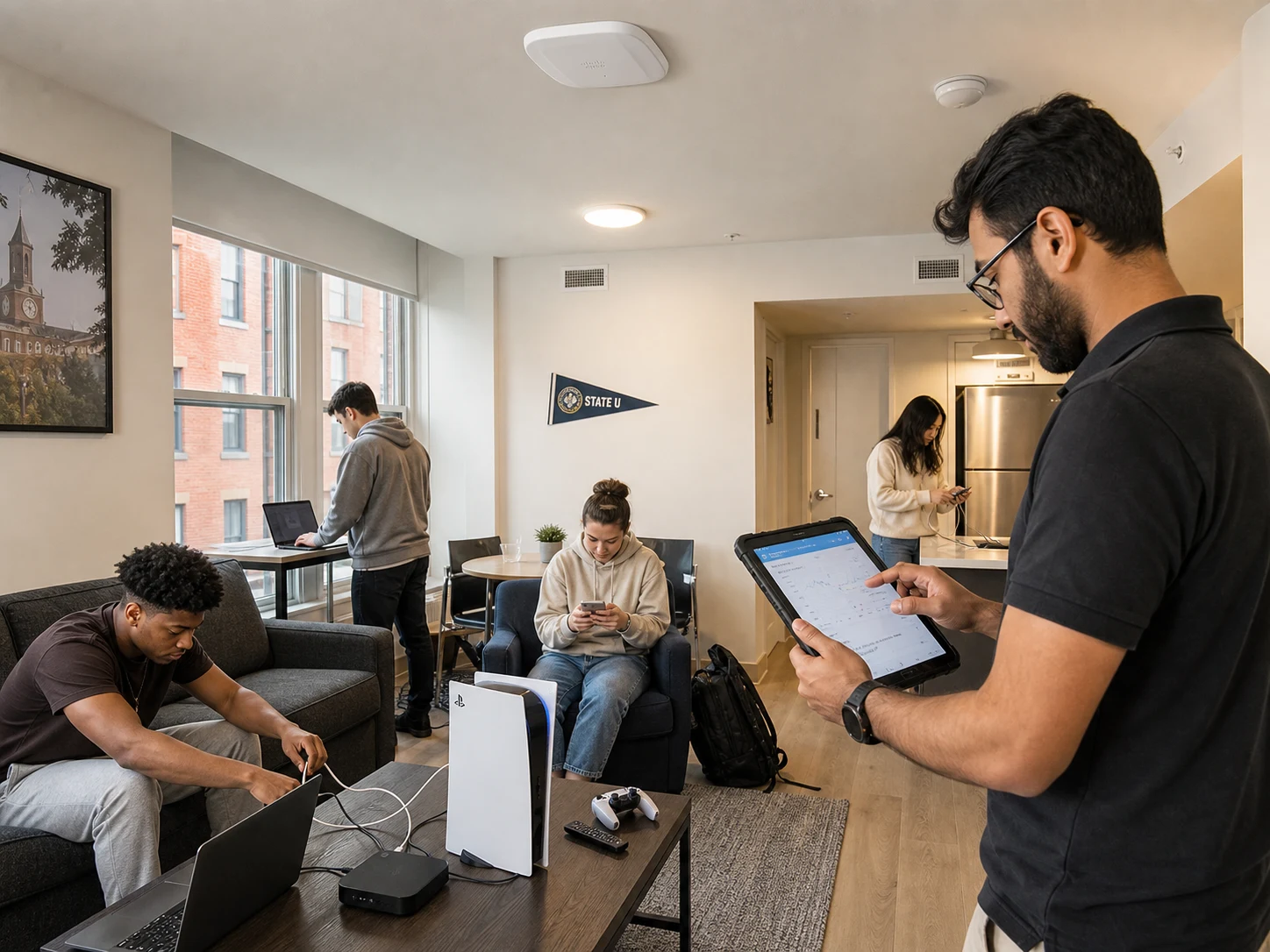
Residence halls carry five or more devices per resident, all of them arriving on the same weekend.
We design for the surge rather than the semester average — rooms, lounges, study spaces and outdoor areas — starting at $100 per room for high-density deployments.
- Unit of scope
- The room or bed, plus lounges, study and outdoor spaces
- Starting rate
- High-density deployments start per room; quoted per property
- Design load
- Peak occupancy and the move-in weekend, not the semester average
- Accountability
- Design, equipment, deployment and support on one quote
Get a quote
Student housing WiFi
Tell us where to reach you and a Uniqcli specialist follows up by email to scope the locations with you, then comes back with a written quote. Serviceability and the final figure are confirmed per location.
The first number is our real one, not an opening one.
Tell us the scope and we come back with the best price we can do on it.
- Supporting federal, state & local purchasers
- GPC & P-Card accepted
- TAA & NDAA-889 screening before every quote
Move-in weekend is the load test, and it repeats every year
Student housing is the densest residential wireless environment there is. Every resident arrives with a phone, a laptop, headphones, a tablet, a games console, a streaming stick and sometimes a television or a printer — five or more devices each is now the floor rather than the ceiling — and they all appear in the same forty-eight hours, in a building where the rooms are small and the walls are close together.
Continue readingShow less
The network that felt adequate in July is the one being judged, publicly and immediately, on the first Sunday of the semester. Everything about the design follows from that: capacity planned against peak occupancy, onboarding that works without a help desk, and lounges and study spaces sized for the evenings they actually fill. We quote high-density deployments from $100 per room. Everything outside the starting rates above is sized rather than priced on a web page: the figure that binds is a written quote against your own addresses, terms and equipment list.
What a residence hall design has to survive
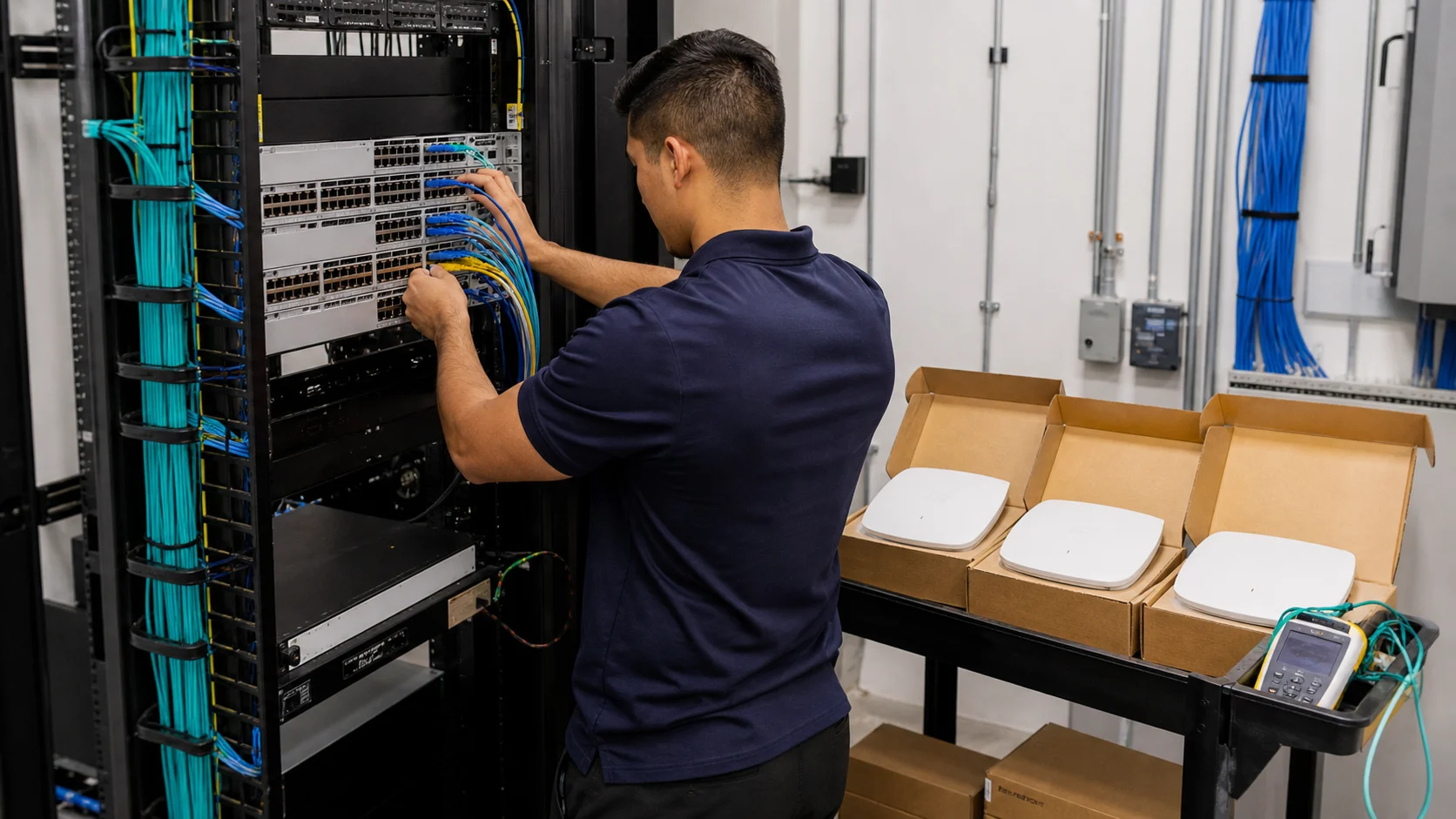
Four pressures, all of them concentrated into a handful of days a year. Assess, design, procure, support: we scope the requirement with you, design against it, source the circuits and equipment, and stay the single point of contact through turn-up and afterwards.
Device density per resident, not per room
Capacity is planned against beds and the devices attached to them rather than against square footage. A double room with two residents can carry a dozen active devices; a suite carries more; a floor in a purpose-built hall carries hundreds within a few metres of each other.
Continue readingShow less
Add the concrete-and-block construction that most residence halls are built from and the design becomes a capacity exercise with a coverage exercise inside it. High-density work starts at $100 per room.
The semester surge
Occupancy in student housing is a step function: near zero, then full, within two days. Designing for the average produces a network that works in October and fails in August when every resident, parent and sibling is in the building at once, streaming, video calling home and setting up devices simultaneously.
Continue readingShow less
We size for the surge and validate against it, because that is the week that sets the reputation of the network for the rest of the year.
Onboarding for devices that cannot use a portal
A student's laptop can fill in a login page. A games console, a smart television, a streaming stick, a wireless printer and a voice speaker cannot, and those are exactly the devices that generate the support tickets.
Continue readingShow less
Getting residents online has to be self-service and has to cover the awkward devices, and each resident's things should find each other without finding everybody else's. That is a design decision, not a help-desk workaround.
Lounges, study spaces and everywhere else
Study lounges, common kitchens, laundry rooms, courtyards and the front steps all fill up on the same evenings, and they are where residents go precisely when their room feels crowded.
Continue readingShow less
Enterprise-grade access points, controllers and switching are quoted through our distribution network against the design, rather than listed with a shelf price. TAA (FAR 52.225-5) and NDAA §889 screening is performed on every hardware line, before the quote goes out.
Quote WiFi for your residence halls
Go to the formWhat we'll ask at quote
Bed count matters more than room count here, and construction matters more than either. These are the questions that produce a design that holds up in week one.
- Bed count and room mix — singles, doubles, suites or apartment-style — plus building count and floors
- Construction and vintage: concrete and block are common in older halls, and they change the design completely
- What residents bring: whether consoles, televisions, streaming devices and printers are permitted, and what your policy says about personal routers
- How residents get online today, whether the credential comes from the institution or from you, and what happens on a Sunday when it does not work
- Common spaces to cover — study lounges, kitchens, laundry, fitness, courtyards and outdoor areas — and which fill up in the evening
- What is installed now, how old the cabling and switching are, and whether this is a refresh, a phase or a new build
- Whether the buildings are used for conferences or summer programs, which changes both the load pattern and the onboarding
- The internet circuits behind the buildings, their term, and who residents contact for support once the network is live
Why residence halls are not hotels with younger guests
The comparison is tempting because the floor plans look similar, and it produces bad designs. A hotel guest stays two nights with three devices and mostly uses them in the evening. A resident lives in the room for four months with seven or eight devices, several of which are permanently connected and some of which stream continuously whether anyone is in the room or not. The result is a sustained load rather than a peaked one, and a device count per square metre that a hotel design was never sized for.
Continue readingShow less
The second difference is behavioral and it shows up in the traffic profile. Residents study together in one lounge, watch the same event at the same time, and play games that are far more sensitive to a congested channel than to a slow one. A network that measures well on a speed test and stutters in a competitive game will generate complaints that a bandwidth graph cannot explain — which is why the design targets airtime and client density rather than a headline rate, and why we validate the busy spaces after install rather than assuming the plan survived contact with the building.
The third is that the population turns over completely every year, and the network has to be self-explanatory to someone who arrived yesterday. Onboarding that depends on a staffed desk works until four hundred people need it in one afternoon. Self-service registration that also handles the console and the television, credentials that live with a resident for the year, and a clear route for the handful of genuinely broken cases is the difference between a quiet move-in weekend and a queue in the lobby.
What else gets scoped with a residence hall
Housing operators and institutions usually buy the network, the connectivity underneath and the access equipment on the same plan.
Student housing WiFi questions
How many devices per resident should we design for?
Five is a sensible floor and it is frequently higher — phone, laptop, headphones, tablet, console, streaming device, and increasingly a television and a smart speaker as well. The number that actually matters is how many are transmitting at once in the evening, which is what we plan capacity against. We would rather size for the residents you will have in two years than for the ones who moved in last year.
What does the per-room starting rate include?
High-density deployments start at $100 per room, which is a starting point for the residential design rather than a building total: lounges, study and laundry spaces, outdoor areas, the wired work behind the access points and any cabling the building needs are scoped on top. Everything outside the starting rates above is sized rather than priced on a web page: the figure that binds is a written quote against your own addresses, terms and equipment list.
How do residents get consoles and televisions online?
Through self-service registration designed for devices that cannot fill in a web page — the resident registers the device once and it stays registered for the term, with their own devices able to find each other and nobody else's. Getting this right removes most of the support volume in the first week, which is the week that decides how residents talk about the network.
Can you handle the move-in surge specifically?
That is what the design is sized for. Capacity is planned against full occupancy plus the visitors who arrive with it, the onboarding path is built to work without a staffed desk, and we validate the busy spaces before the buildings open rather than after the first complaint. If your calendar allows it, the best turn-up window is well before move-in so there is time to walk the building with the design in hand.
How do you deliver this — do you own a network?
No. Circuits are provisioned through our carrier network relationships and quoted per location; equipment is sourced through our distribution network. Naming a service type describes what we quote, not a partnership with any provider. Assess, design, procure, support: we scope the requirement with you, design against it, source the circuits and equipment, and stay the single point of contact through turn-up and afterwards.
How fast can you get a quote back?
How quickly a quote comes back depends on how many addresses have to be checked and which carriers serve them; a single site is usually straightforward, and a multi-site scope moves at the pace of the slowest address. We tell you where each location stands rather than holding the whole quote for the last one.
Send the bed count, get a design sized for week one
Beds, buildings, construction and your common spaces are enough to start. We come back with a design approach, an equipment list and a written quote — sized against move-in weekend rather than a quiet Tuesday in October.
Continue readingShow less
Service commitments are backed by the underlying carrier's published service terms, which are provided with your quote rather than summarized here.
The solutions atlas
Every solution, by technology area and by customer.
By technology
By customer
- TAA & NDAA-889 Compliance Screening
- CMMC & CUI Solutions
- Federal & DoD
- State, Local & Education
- Healthcare
- Enterprise
- Rapid Procurement & GPC Buys
- Multi-Vendor Integration Projects
- eProcurement & Custom Catalogs
- FISMA Modernization
- CJIS-Compliant Justice Cloud & Local AI
- Federal Storage Modernization
- Government ERP & Business Systems Infrastructure
- Managed Procurement
- Secure AV & Conferencing
- Fiber Network Infrastructure
- Satellite & Resilient Connectivity
- Wavelength & Optical Transport
- Decentralized Data Centers
- Data Center Design & Build
Quote WiFi for your residence halls
Send the bed count, the buildings and what residents bring with them. You get a design approach, an equipment list and a written quote sized for peak occupancy. Everything outside the starting rates above is sized rather than priced on a web page: the figure that binds is a written quote against your own addresses, terms and equipment list.