
Business connectivity
Office & Enterprise WiFi
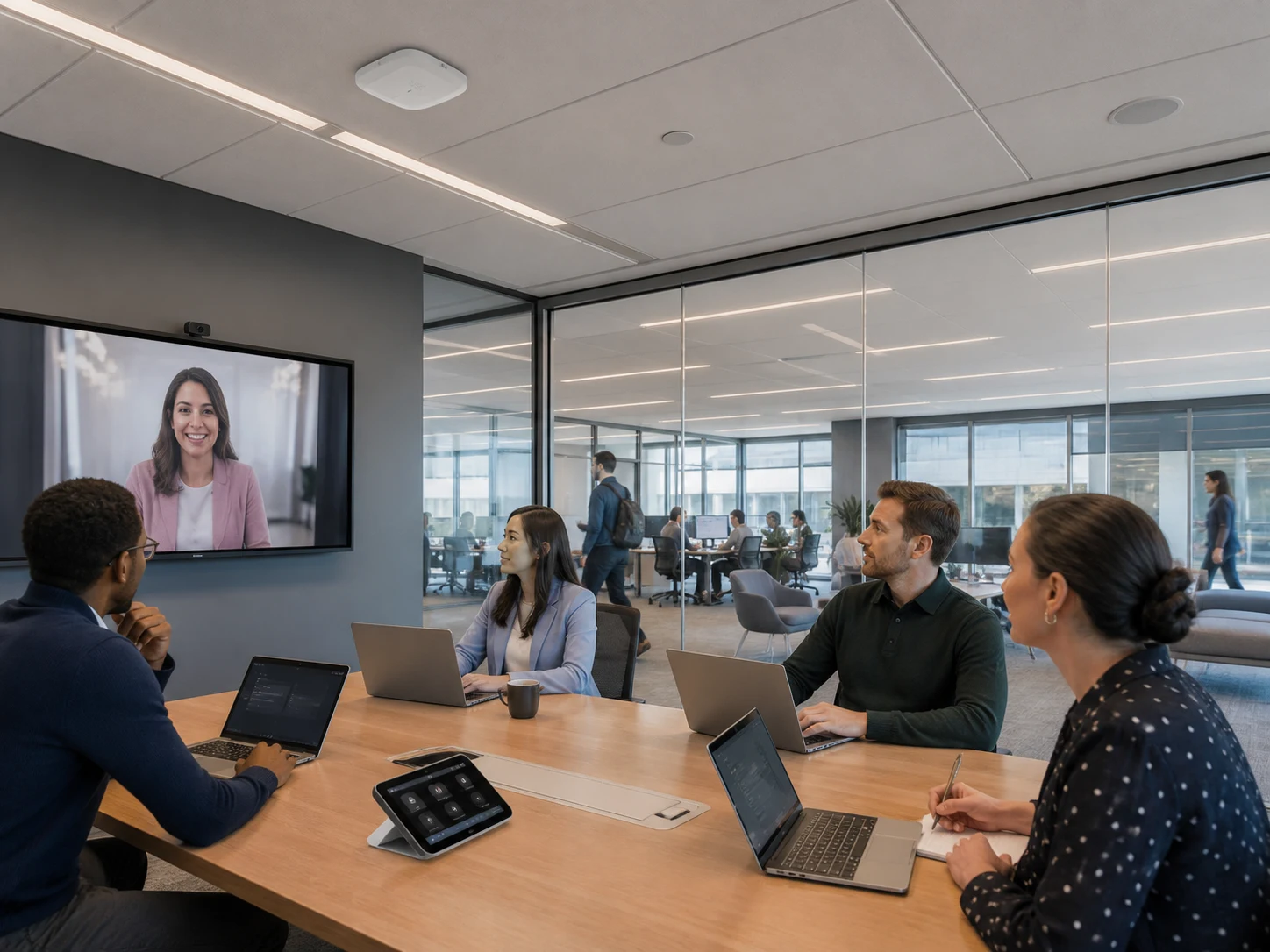
The wireless most offices have was designed for laptops at assigned desks. It now carries all-day video calls, conference rooms full of people dialing in, and an occupancy pattern that changes by the day.
We redesign against how the office is actually used.
- Unit of scope
- Square footage and peak device count per floor, not a headcount
- Design load
- Peak occupancy days and rooms full of simultaneous video calls
- Also in scope
- Guest access, building systems, audiovisual, printers and badge readers
- Accountability
- Design, equipment, deployment and support on one quote
Get a quote
Office & enterprise WiFi
Tell us where to reach you and a Uniqcli specialist follows up by email to scope the locations with you, then comes back with a written quote. Serviceability and the final figure are confirmed per location.
The first number is our real one, not an opening one.
Tell us the scope and we come back with the best price we can do on it.
- Supporting federal, state & local purchasers
- GPC & P-Card accepted
- TAA & NDAA-889 screening before every quote
Live prices from our catalog right now — a starting point, not the project price. Your quote is scoped to the site and includes the licensing and services the job needs.
The office changed; most of the wireless in it did not
An office network installed a few years ago was designed around a predictable pattern: a known headcount at assigned desks, traffic that was mostly download, and conference rooms used for meetings held in the room.
Continue readingShow less
Almost none of that is still true. The same floor now carries video calls all day from desks and rooms alike, an occupancy that swings between a quiet Monday and a packed Wednesday, and conference rooms where half the participants are remote and every laptop in the room is transmitting. Scoped per square footage and device count rather than per room, because coverage in these buildings is set by the structure and the client mix rather than by a unit count. We design against the busy day and the busy room, and quote the wireless, the switching behind it and the deployment as one scope.
What an office design has to handle now
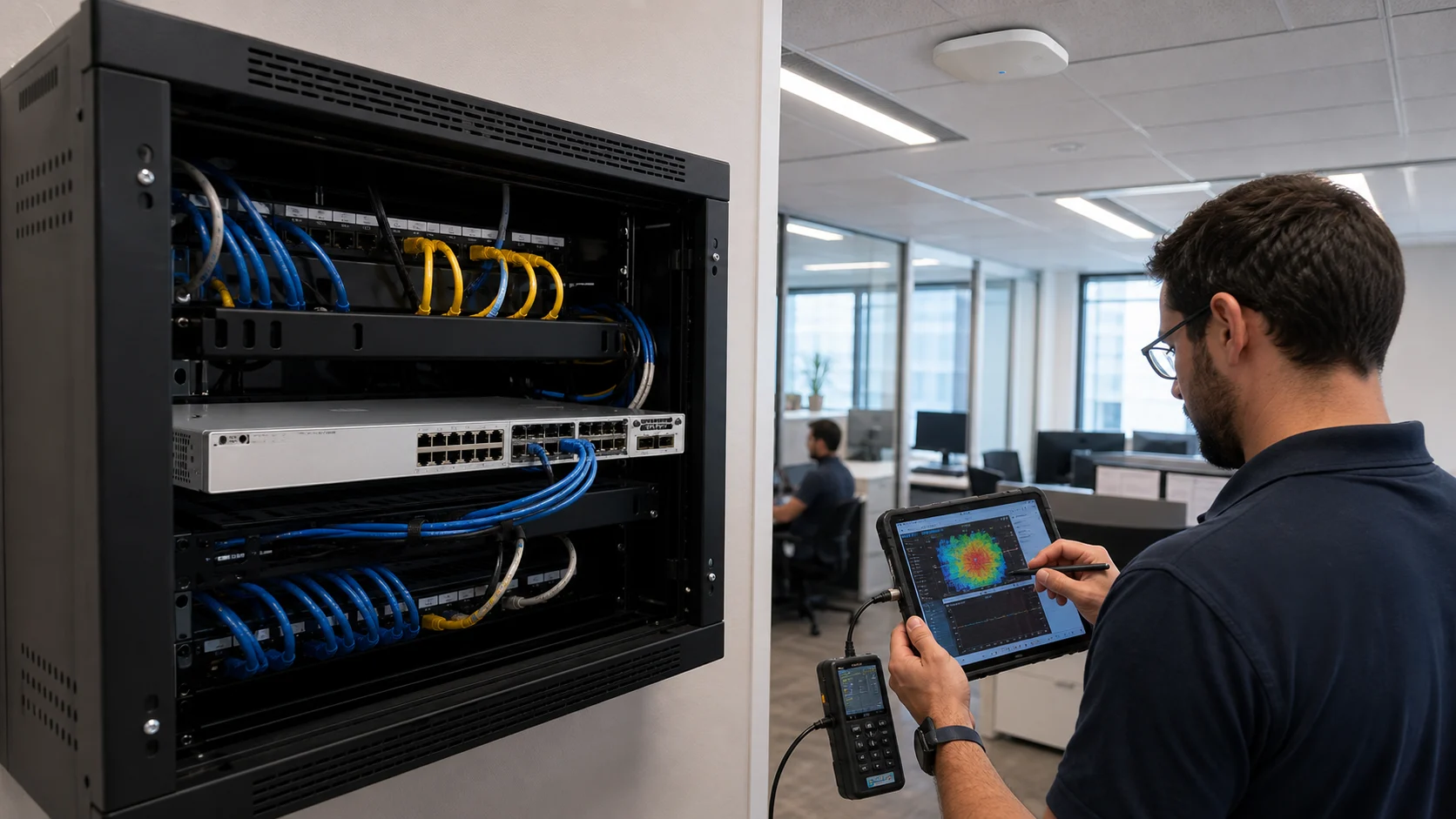
Four things, and the first one is what people actually notice. Assess, design, procure, support: we scope the requirement with you, design against it, source the circuits and equipment, and stay the single point of contact through turn-up and afterwards.
Roaming that survives the walk to a meeting
The most visible failure in an office network is a call that drops as somebody walks from their desk into a conference room, because their device held on to the wrong access point a few seconds too long.
Continue readingShow less
Fixing it is design work rather than an equipment purchase: placement and power set so the handoff happens where it should, coverage in the corridors and stairwells that the plan usually treats as gaps, and the same treatment for lobbies, kitchens and outdoor terraces where people take calls.
SSID and VLAN segmentation decided up front
Corporate devices, guests, contractors, building systems, audiovisual equipment, printers and badge readers do not belong on the same network, and retrofitting that separation later is far more disruptive than designing it in.
Continue readingShow less
We scope how many networks you need and what sits behind each, keep the count deliberately small because every additional broadcast network costs airtime, and hand over documentation that says what lives where.
Conference rooms sized as their own spaces
A room with fourteen people in it, each on a laptop and a phone, with a video system running and someone screen-sharing, is a density problem inside an otherwise ordinary floor.
Continue readingShow less
Rooms get capacity planned against how they are actually booked, including the large all-hands space that fills a few times a month and is remembered for how it behaved rather than for how often it is used.
Guest access that is genuinely separate
Visitors, contractors and interview candidates need a path that is simple to hand out and structurally unable to reach anything internal, whether that is a printed code at reception, a self-service page or a sponsored login.
Continue readingShow less
Enterprise-grade access points, controllers and switching are quoted through our distribution network against the design, rather than listed with a shelf price. TAA (FAR 52.225-5) and NDAA §889 screening is performed on every hardware line, before the quote goes out.
Quote WiFi for your office
Go to the formWhat we'll ask at quote
Enough to design against the office as it is used rather than as it was drawn. A floor plan and an honest headcount on your busiest day covers most of it.
- Square footage per floor, floor count, and the building's construction — glass curtain wall, concrete cores, demountable partitions or older interior walls
- Peak occupancy rather than badge count: how many people are in on the busiest day, and how that compares to a quiet one
- Conference and meeting rooms — how many, how large, and which ones host all-hands or town-hall sessions
- Which separate networks you need for corporate devices, guests, contractors, building systems, audiovisual equipment and printers
- How guests get online today, and whether reception, a self-service page or a sponsor is meant to be involved
- Devices beyond laptops and phones: badge readers, cameras, digital signage, room panels, sensors and anything drawing power over the network
- Existing switching, PoE capacity and cabling age — and whether this is a refresh, a floor expansion or a fit-out of new space
- Whether the internet circuits are in scope for the same quote, and who supports the network after turn-up
Hybrid occupancy, and why headcount is the wrong input
Sizing an office network by headcount produces a network that is wrong twice. It is oversized for the quiet days, which costs money, and undersized for the busy ones, which costs credibility — and hybrid schedules have made the gap between those two days larger than it has ever been. The honest input is peak concurrent devices in each area: what a floor carries on its busiest day, what the largest meeting room carries when it is fully booked, and how many devices each person now brings, which is reliably more than one. Where an office is in flux, we would rather scope for the pattern you expect in eighteen months and say so than quietly design for last year.
Continue readingShow less
The second correction is that a modern office floor is full of devices nobody counts. Room booking panels, digital signage, cameras, badge readers, sensors, wireless presentation systems and printers all sit on the network permanently, many of them powered over the same cabling, and collectively they consume both airtime and switch power budget. They are also the devices most likely to be sitting on the wrong network entirely, which is worth fixing during a refresh rather than after an audit. Counting them properly is part of scoping, and it frequently changes the switching answer more than it changes the wireless one.
The third is that video is a different kind of load. It is sustained rather than bursty, it is sensitive to congestion in a way a file download is not, and it happens in exactly the places offices historically covered least well — small rooms, phone booths, corridors, kitchens and terraces. An office network that measures well on a speed test can still produce a bad experience on a call, so the design targets consistency across the floor rather than a headline number at the best desk in the building.
What gets quoted alongside an office refresh
A wireless refresh usually touches the switching, the circuit and the building systems on the same floor — these are the lanes most often scoped together.
Office WiFi questions
How is an office quoted if there is no per-room rate?
Scoped per square footage and device count rather than per room, because coverage in these buildings is set by the structure and the client mix rather than by a unit count. An open floor, a wing of small offices and a conference center are not interchangeable units, so a per-room figure would be a false simplification. Starting rates are published on the lanes where a room or a residential unit genuinely is the unit of scope — hotels, apartments, student housing and senior living. Everything outside the starting rates above is sized rather than priced on a web page: the figure that binds is a written quote against your own addresses, terms and equipment list.
Our calls drop when people walk between rooms — is that fixable?
Usually, and usually without replacing everything. That symptom is almost always a roaming problem: access point placement and power set so devices hold on to a distant radio too long, or corridors and stairwells left out of the coverage plan because nobody sits in them. A survey of the floor tells us whether the fix is a design change to what you already own, a partial addition, or a refresh — and we will tell you which one it is even when the smaller answer is the right one.
How many separate networks should we have?
Fewer than most offices end up with. Each broadcast network consumes airtime whether anyone uses it or not, so the goal is the smallest set that keeps the things that must be separated apart — typically corporate devices, guests, and the building and audiovisual systems, with contractors handled through the guest path or a scoped extension of it. We will document what sits where, so the next person to look at it does not have to guess.
Can you quote the switching and cabling with it?
Yes, and for a refresh it is usually the honest way to scope it — a wireless design commonly needs drops where cable does not currently run and more power budget than an older switch stack can supply. Enterprise-grade access points, controllers and switching are quoted through our distribution network against the design, rather than listed with a shelf price. TAA (FAR 52.225-5) and NDAA §889 screening is performed on every hardware line, before the quote goes out.
How do you deliver this — do you own a network?
No. Circuits are provisioned through our carrier network relationships and quoted per location; equipment is sourced through our distribution network. Naming a service type describes what we quote, not a partnership with any provider. Assess, design, procure, support: we scope the requirement with you, design against it, source the circuits and equipment, and stay the single point of contact through turn-up and afterwards.
How fast can you get a quote back?
How quickly a quote comes back depends on how many addresses have to be checked and which carriers serve them; a single site is usually straightforward, and a multi-site scope moves at the pace of the slowest address. We tell you where each location stands rather than holding the whole quote for the last one.
Send the floor plan, get a design for your busiest day
Square footage, peak occupancy and your meeting rooms are enough to start. We come back with a design approach, an equipment list that includes the switching and cabling work, and a written quote — with the circuits on the same order if you want them there.
Continue readingShow less
Service commitments are backed by the underlying carrier's published service terms, which are provided with your quote rather than summarized here.
The solutions atlas
Every solution, by technology area and by customer.
By technology
By customer
- TAA & NDAA-889 Compliance Screening
- CMMC & CUI Solutions
- Federal & DoD
- State, Local & Education
- Healthcare
- Enterprise
- Rapid Procurement & GPC Buys
- Multi-Vendor Integration Projects
- eProcurement & Custom Catalogs
- FISMA Modernization
- CJIS-Compliant Justice Cloud & Local AI
- Federal Storage Modernization
- Government ERP & Business Systems Infrastructure
- Managed Procurement
- Secure AV & Conferencing
- Fiber Network Infrastructure
- Satellite & Resilient Connectivity
- Wavelength & Optical Transport
- Decentralized Data Centers
- Data Center Design & Build
Quote WiFi for your office
Send the floor plans, the peak occupancy and the meeting rooms. You get a design approach, an equipment list including the wired work, and a written quote against the office as it is actually used. Everything outside the starting rates above is sized rather than priced on a web page: the figure that binds is a written quote against your own addresses, terms and equipment list.