
Business connectivity
Hotel & Resort WiFi
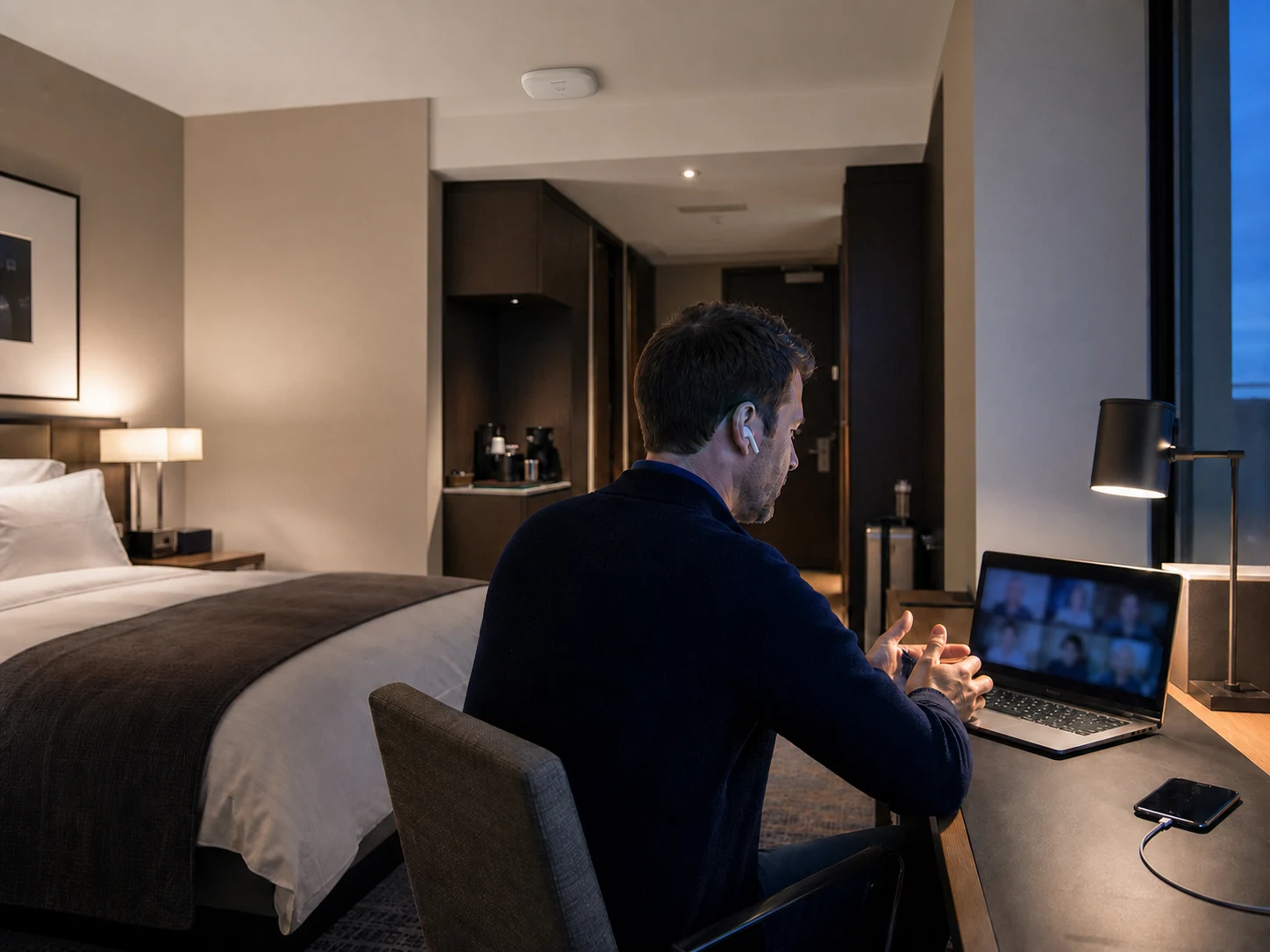
Guest WiFi is the amenity every review mentions and the one nobody notices when it works.
- Starting at $100 per room for high-density deployments
- Guest rooms, meeting space, lobby and outdoor areas
- Design, equipment, deployment and support on one quote
We design for a full house rather than an average Tuesday — guest rooms, meeting space, lobby and outdoor areas — starting at $100 per room for high-density deployments.
- Unit of scope
- The guest room, plus the public and event spaces around it
- Starting rate
- High-density deployments start per room; quoted per property
- Also in scope
- Meeting and ballroom space, lobby, pool and outdoor areas, back of house
- Accountability
- Design, equipment, deployment and support on one quote
Get a quote
Hotel & resort WiFi
Tell us where to reach you and a Uniqcli specialist follows up by email to scope the locations with you, then comes back with a written quote. Serviceability and the final figure are confirmed per location.
The first number is our real one, not an opening one.
Tell us the scope and we come back with the best price we can do on it.
- Supporting federal, state & local purchasers
- GPC & P-Card accepted
- TAA & NDAA-889 screening before every quote
The amenity guests rate, and the one they rate you down for
A guest arrives with three or four devices, expects them to work the way they do at home, and only ever mentions the WiFi in a review when it did not. That is the whole economics of hotel wireless: it is invisible when correct and disproportionately expensive when wrong, because the complaint does not stay at the front desk — it goes to the same page your next guest reads before booking.
Continue readingShow less
The failures are predictable, too. Corridor access points that tested beautifully in an empty building, a property that is fine on a Tuesday and unusable when a wedding block fills every room, a ballroom that becomes the hardest wireless environment on site the moment four hundred people walk into it with a phone each. We design against the full house and the busy event, and we quote high-density deployments from $100 per room. Everything outside the starting rates above is sized rather than priced on a web page: the figure that binds is a written quote against your own addresses, terms and equipment list.
What a hotel design has to get right
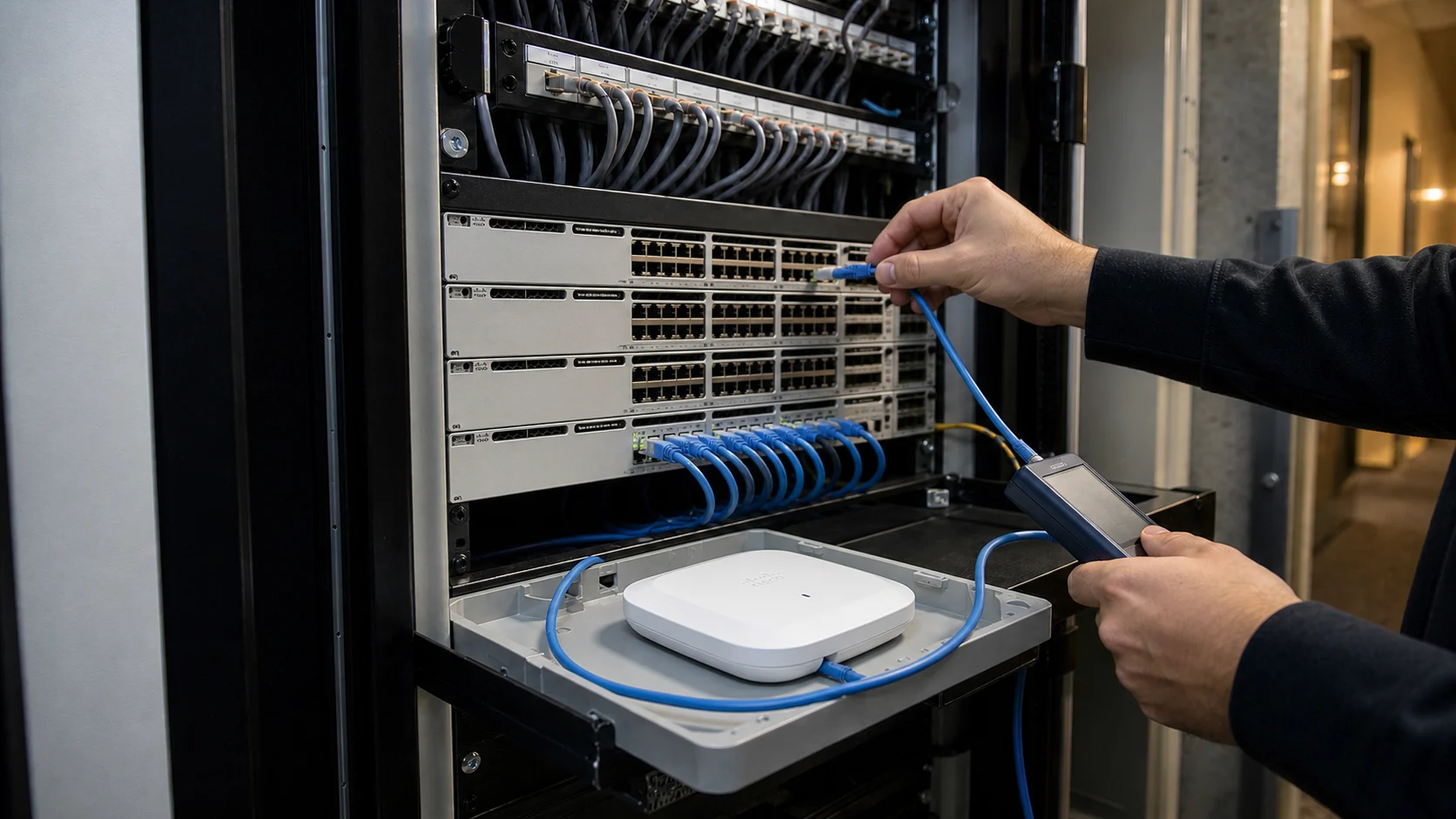
Four things, and three of them are decided before any equipment is ordered. Assess, design, procure, support: we scope the requirement with you, design against it, source the circuits and equipment, and stay the single point of contact through turn-up and afterwards.
Per-room density that survives full occupancy
The question is not whether a signal reaches the room — it is whether the room still works when every room around it is occupied and streaming.
Continue readingShow less
That answer depends on what the walls are made of, and hotel construction is unusually hostile: concrete floors, plaster walls, tiled bathrooms, and mirrors that are often metal-backed. Whether access points belong in the rooms, in the corridors, or in a mix is a design decision per property rather than a house style, and it is the decision that most affects both the outcome and the cost. High-density work starts at $100 per room.
Meeting and event space as its own problem
A ballroom at capacity is a different network from the guest floors above it, and it is the space your highest-value bookings judge you on. Hundreds of devices in one open room, a stage that needs its own reliable path, an organizer who asked for a dedicated network with its own name, and a load that appears for six hours and then disappears.
Continue readingShow less
We scope event space by peak headcount and what the room is sold for, not by square footage alone.
Guest onboarding, the portal and the systems behind it
How a guest gets online is a design question with real answers: an open network with a splash page, a room-number-and-name landing page, a code at check-in, or tiered access where a paid or loyalty tier gets more.
Continue readingShow less
Whether that page talks to your property management system, and what it is allowed to ask a guest for, is scoped with you and your brand standard rather than assumed — including where a brand program dictates the answer. We scope the integration; we do not claim a partnership with any platform vendor.
The rest of the property, and one contact for all of it
Lobby, restaurant, pool deck, parking, staff areas and back of house are on the same design, because a guest walking from the elevator to the terrace does not know where your coverage plan stopped.
Continue readingShow less
Enterprise-grade access points, controllers and switching are quoted through our distribution network against the design, rather than listed with a shelf price. TAA (FAR 52.225-5) and NDAA §889 screening is performed on every hardware line, before the quote goes out.
Quote WiFi for your property
Go to the formWhat we'll ask at quote
Enough to design against, and most of it is on your property fact sheet already. A walk-through or a survey confirms the rest before anything is ordered.
- Room count, floor count, and how the property is laid out — a single tower, several wings, or detached buildings and casitas
- Construction and vintage: concrete floors, plaster or drywall, tiled bathrooms, metal-backed mirrors, and when the property was last renovated
- Meeting and event space — how many rooms, their square footage, and the largest headcount you sell each one for
- Public and outdoor areas that have to be covered: lobby, restaurant and bar, pool deck, terrace, parking
- How guests get online today, what your brand standard requires, and which property management or guest-facing systems the portal has to work with
- What is installed now — access points, switching, cabling and their age — and whether this is a refresh, a renovation phase or a new build
- Back of house: housekeeping and engineering devices, point of sale, and anything that runs on the same infrastructure
- Whether the internet circuits behind the wireless, and the in-room television system, are in scope for the same quote
Why corridor coverage tests well and fails on a Saturday
The most common inherited hotel design puts a small number of access points in the corridors and relies on the signal reaching through the guest room doors. It surveys well, it is cheap to cable, and it fails in a specific, recognizable way: fine when the property is half full, degraded when it is not, and worst in the rooms furthest from the corridor unit — which are frequently the rooms you charge the most for. The physics are unforgiving because everything that makes a hotel room quiet and private also attenuates a radio signal, and every additional occupied room adds devices competing for the same air.
Continue readingShow less
The alternative is not simply more access points. It is a design that decides, room type by room type, where the radio has to be, and pairs that with the wired work to support it. Per-room placement costs more in cable and hardware and returns a property that behaves the same at full occupancy as at forty percent, which is the only occupancy level at which the guest experience actually matters to your ratings. Where a mixed approach is right — per-room on the guest floors, corridor coverage on a wing with a different construction — we will say so and show which rooms sit either side of the line.
Event space deserves the same honesty. A ballroom that works for a hundred-person meeting can be unusable for a four-hundred-person general session, and the difference is capacity planning rather than signal strength. If your property sells large events, that room gets designed for its sold capacity rather than its average booking, because the event that overwhelms the network is also the one with the most people forming an opinion about your property at the same time.
The same property usually buys these together
Wireless, the television system and the circuits underneath are one conversation for a hotel — and cameras and door access are frequently on the same capital plan.
Hotel WiFi questions
What does the per-room starting rate include?
High-density deployments start at $100 per room, which is a starting point for the guest-room design rather than a property total: public space, meeting and event space, outdoor areas, the wired work behind the access points and any cabling a building needs are scoped on top of it. Everything outside the starting rates above is sized rather than priced on a web page: the figure that binds is a written quote against your own addresses, terms and equipment list.
Do access points go in the rooms or in the corridors?
That is the central design decision and it is made per property, not by policy. Corridor designs cost less to install and are defensible in some constructions; per-room designs hold up under full occupancy and in properties with heavy walls, which is most of them. We will show you which approach we are recommending for each room type, what it costs, and what the trade-off looks like on a sold-out weekend — and if a mix is right for your building, that is what you will get.
Can the guest portal work with our property management system?
Portal behavior and what it is allowed to check against are scoping questions we work through with you and your brand standard — room number and name lookups, access codes issued at check-in, tiered or loyalty-based access, and what a guest is asked for before they are online. We scope and quote the integration work as part of the design. We do not describe ourselves as a partner of any platform vendor, because naming a system describes what we integrate with, not a relationship with its maker.
How do you deliver this — do you own a network?
No. Circuits are provisioned through our carrier network relationships and quoted per location; equipment is sourced through our distribution network. Naming a service type describes what we quote, not a partnership with any provider. Assess, design, procure, support: we scope the requirement with you, design against it, source the circuits and equipment, and stay the single point of contact through turn-up and afterwards.
How fast can you get a quote back?
How quickly a quote comes back depends on how many addresses have to be checked and which carriers serve them; a single site is usually straightforward, and a multi-site scope moves at the pace of the slowest address. We tell you where each location stands rather than holding the whole quote for the last one.
Can you handle the in-room TV system at the same time?
Yes, and doing both on one design is usually the better outcome — in-room entertainment and guest wireless compete for the same infrastructure, the same install windows and often the same renovation budget. Scoping them together means one set of cabling decisions and one point of contact rather than two vendors negotiating over the same riser.
Send the property, get a design for a full house
Room count, construction and your event spaces are enough to start. We come back with a design approach per room type, an equipment list and a written quote — with the television system and the circuits on the same order if you want them there.
Continue readingShow less
Service commitments are backed by the underlying carrier's published service terms, which are provided with your quote rather than summarized here.
The solutions atlas
Every solution, by technology area and by customer.
By technology
By customer
- TAA & NDAA-889 Compliance Screening
- CMMC & CUI Solutions
- Federal & DoD
- State, Local & Education
- Healthcare
- Enterprise
- Rapid Procurement & GPC Buys
- Multi-Vendor Integration Projects
- eProcurement & Custom Catalogs
- FISMA Modernization
- CJIS-Compliant Justice Cloud & Local AI
- Federal Storage Modernization
- Government ERP & Business Systems Infrastructure
- Managed Procurement
- Secure AV & Conferencing
- Fiber Network Infrastructure
- Satellite & Resilient Connectivity
- Wavelength & Optical Transport
- Decentralized Data Centers
- Data Center Design & Build
Quote WiFi for your property
Send the room count, the construction and the event spaces you sell. You get a design approach, an equipment list and a written quote against the property as it actually fills up. Everything outside the starting rates above is sized rather than priced on a web page: the figure that binds is a written quote against your own addresses, terms and equipment list.