
Business connectivity
Business TV Service (Cable & Satellite)
Television in front of customers is a different product from television at home — a different account, a different lineup, and commercial viewing licensing that has to be right before the install rather than after it.
We quote cable and satellite service, the screens and the distribution behind them, per venue.
- Venues
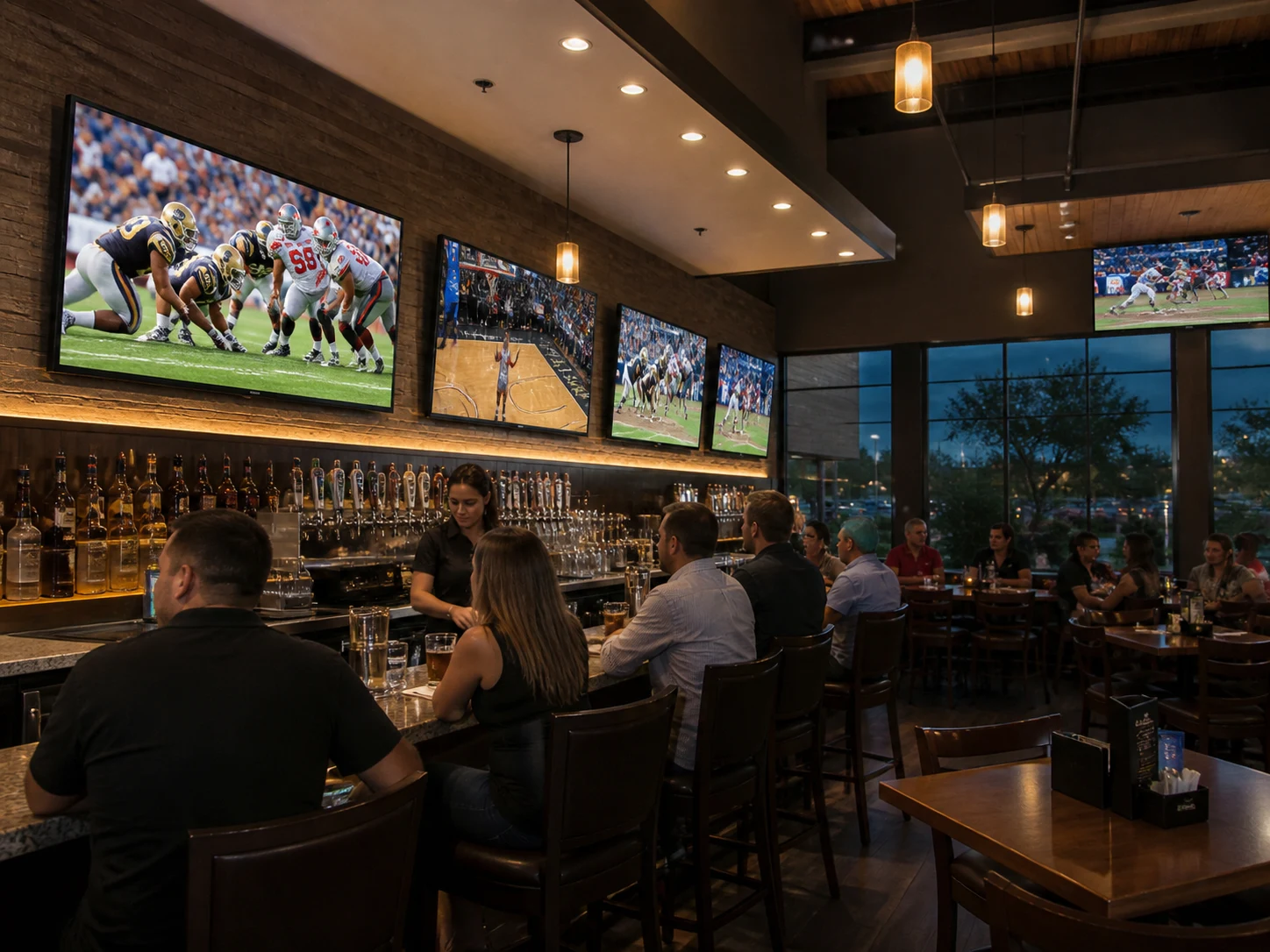
- Waiting rooms, bars and restaurants, gyms, offices and lobbies
- Service types
- Cable and satellite, quoted per location as service types
- Licensing
- Commercial viewing licensing confirmed as part of the quote
- Boundary
- We scope, source and coordinate install; the provider carries the programming
Get a quote
Business TV service
Tell us where to reach you and a Uniqcli specialist follows up by email to scope the locations with you, then comes back with a written quote. Serviceability and the final figure are confirmed per location.
The first number is our real one, not an opening one.
Tell us the scope and we come back with the best price we can do on it.
- Supporting federal, state & local purchasers
- GPC & P-Card accepted
- TAA & NDAA-889 screening before every quote
A screen in front of customers is a different product
Two things change the moment a television is in a business rather than a living room. The first is the account: a residential subscription is written for a household, and a room where customers, patients or members are watching is a commercial service with its own terms, its own lineups and its own equipment rules.
Continue readingShow less
The second is the licensing — what a venue is permitted to show publicly depends on the programming, the venue type and, for some content, the size of the space. Neither is a reason to overthink it, and both are reasons to have someone ask the questions before the install rather than after. We quote cable and satellite service for the venue along with the displays, mounts and distribution that make it usable in a room nobody designed around a television. Business TV is quoted rather than listed: the starting rates we publish belong to dedicated internet and high-density wireless, and neither of those is a television figure. Everything outside the starting rates above is sized rather than priced on a web page: the figure that binds is a written quote against your own addresses, terms and equipment list.
What a business TV quote actually covers
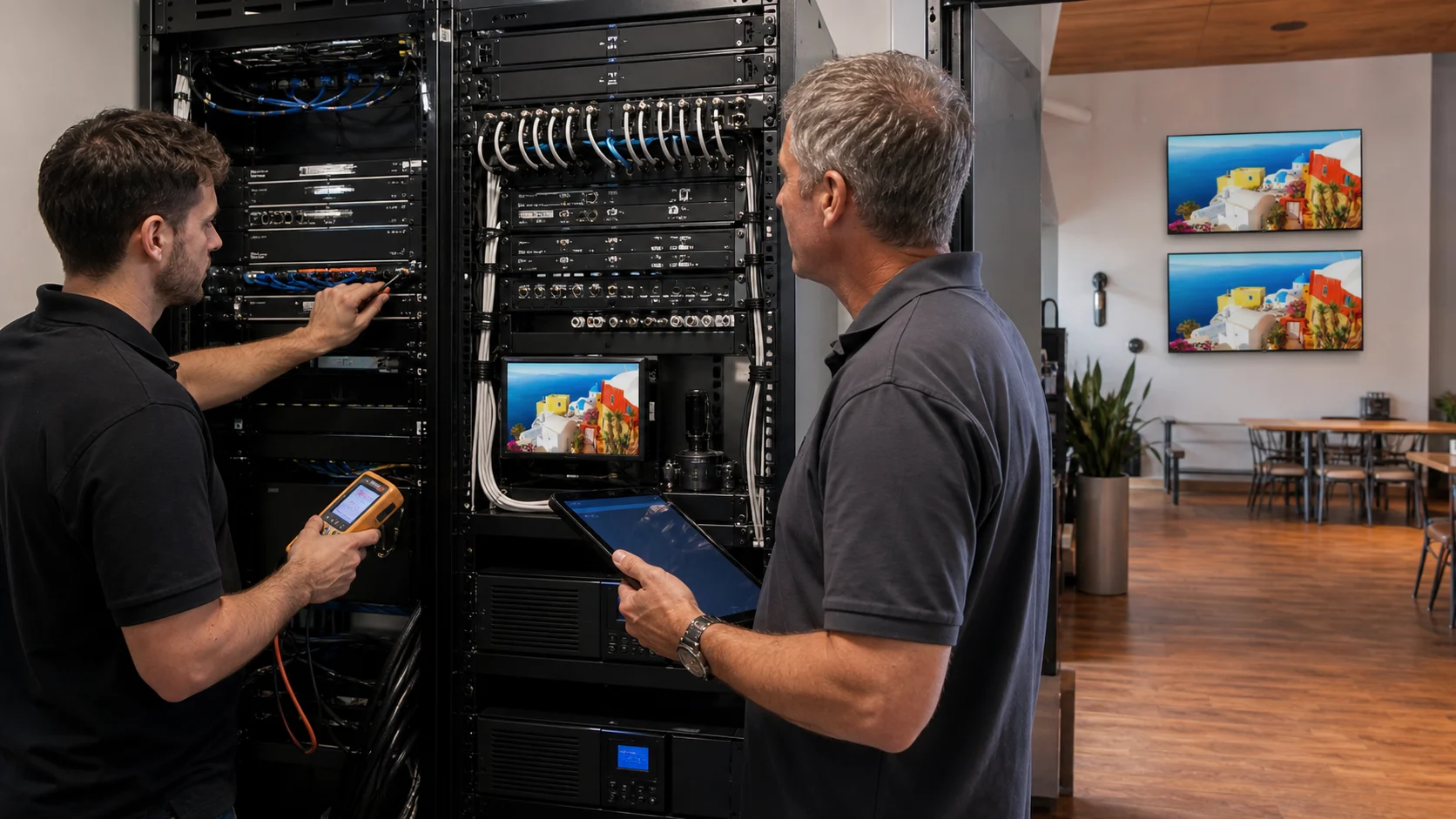
Four things, and the channel lineup is only one of them. Circuits are provisioned through our carrier network relationships and quoted per location; equipment is sourced through our distribution network.
Continue readingShow less
Naming a service type describes what we quote, not a partnership with any provider.
Cable or satellite, chosen by the building
Which service types are genuinely available is an address question before it is a preference. Wired service depends on the plant that reaches the building and the state of the coax inside it; satellite depends on a clear line of sight from a mounting position you are actually allowed to use, which in a leased suite means a landlord conversation rather than a technical one.
Continue readingShow less
We check what is deliverable at each address and quote the options side by side, rather than starting from whichever one is easiest to sell.
A lineup chosen for who is watching
A waiting room, a sports bar, a gym floor and an office lobby want four different things from the same wall. Waiting rooms are usually muted and captioned, running news or lifestyle programming.
Continue readingShow less
A bar is built around live sports and needs enough simultaneous feeds for the screens to differ. A gym is a row of parallel channels people watch through their own headphones. A lobby is often one business-news channel and nothing else. Package, receiver count and audio design all follow from that answer, so it is the first thing we ask.
Screens, mounts and the distribution behind them
Service is half the job. The rest is the receivers or set-back hardware, the coax or IP distribution that reaches every screen position, the displays themselves — commercial-grade panels exist because a business runs them for hours a household never would — and the mounting, cabling and power at each position.
Continue readingShow less
Displays, mounts and distribution hardware are quoted through our distribution network on the same order when you want them there. TAA (FAR 52.225-5) and NDAA §889 screening is performed on every hardware line, before the quote goes out.
One point of contact through install
A multi-screen install touches an account setup, an equipment order, a site survey, sometimes a dish position or a cabling run, and an activation appointment — usually across more than one team, none of whom have met your building.
Continue readingShow less
Assess, design, procure, support: we scope the requirement with you, design against it, source the circuits and equipment, and stay the single point of contact through turn-up and afterwards. Service commitments are backed by the underlying carrier's published service terms, which are provided with your quote rather than summarized here.
Scope business TV for your venue
Go to the formWhat we'll ask at quote
There is no availability checker on this page, because what is deliverable to a specific building comes from a real check with the providers that reach it.
Continue readingShow less
These are the questions that turn a screen count into a written number — most of them can be answered from memory.
- The full street address of every location, including suite or floor — what is deliverable can differ between two units in the same building
- How many screens, where each one sits, and which are in front of customers rather than back of house
- What the venue is and roughly how large the viewing area is — a waiting room, a bar, a gym floor and a lobby are scoped and licensed differently
- What people are meant to watch: live sports, news, lifestyle programming, music channels, or a mix that changes through the day
- Whether screens need to show different channels at once, and how audio should work — muted with captions, zoned, or through a house system
- What is installed today: the current service and account type, the receiver count, the age of the displays, and whether usable coax or structured cabling already reaches each position
- Whether displays, mounts and distribution hardware are in scope for the same quote, plus your target term and install date
Cable or satellite, and why the answer is usually the address
The question arrives as a preference and is answered by a survey. Wired service is straightforward where the plant already reaches the building and the internal cabling is in reasonable condition, and it is a long conversation where it is not — getting a new drop into a tenanted space can involve the landlord, a riser and a schedule that has nothing to do with television. Satellite inverts the constraints: the building's internal wiring matters less, but you need an unobstructed view of the sky from a mounting position you have permission to use, and a route for the cable run from there down to the equipment. Neither is better in the abstract. One of them is usually much easier at your address, and that is the answer.
Continue readingShow less
The second discriminator is the lineup, and it matters most to multi-site operators. Packages, regional channels and the way sports programming is bundled differ between service types and between markets, so a group that wants every location showing the same thing has to be scoped against that rather than assuming it. Where an operator has twenty sites across eight markets, the honest outcome is often mixed: one service type where it is available and sensibly priced, another where it is not, with the lineups matched as closely as the markets allow. We would rather say that at quote than have you discover it at the fourth opening.
Reliability deserves a plain word too. Wired service goes down with the plant that serves the street; satellite is unaffected by that and occasionally affected by heavy weather, which passes. For most venues either is fine and the decision comes down to availability and lineup. For a venue where a blank screen is a real problem — a bar on an evening built around one event, a clinic that uses the screen for its own messaging — the sensible design is a second source or a stored playback path for the screens that matter, scoped up front rather than improvised. Whatever the mix, the internet circuit and the wireless in the same building usually belong in the same conversation, because streaming apps, digital signage and casting all land on the network rather than on the coax.
The services quoted alongside business TV
A screen wall is rarely the only thing being scoped for a venue. These are the lanes most often quoted on the same conversation — including the wireless and the physical-security work for the same property.
Business TV questions
Can we just use a residential TV account in our business?
This is the question we get most, and the honest answer is that a residential subscription is written for a household rather than for a room where customers, patients or members are watching. A commercial service is a different product with its own terms, its own lineups and its own equipment rules, and the public-viewing rights attached to programming are part of what separates the two. We scope the correct account type and the licensing that goes with it as part of the quote, so the venue is set up right the first time. What a specific venue may show is set by the programming provider's terms and the rights holders behind them rather than by us — which is exactly why it gets confirmed in writing instead of assumed.
Who handles the commercial viewing licensing?
It is handled correctly and confirmed as part of the quote. We scope the venue type, the viewing area and what you intend to show, and the account and programming are set up against that with the provider. We are not a rights holder and nothing here is legal advice about a particular event or a particular programme, so this page should not be read as a ruling on what your venue may show. What we do is make sure the question is asked before the install, put the answer in writing with the quote, and flag anything that needs a decision from you.
Cable or satellite — which should we take?
Whichever is genuinely deliverable and better suited to the building, which is an address question rather than a preference. Coverage is nationwide and confirmed per location at quote — what is deliverable to a specific address depends on which carriers reach that building, so we check it per site rather than publishing a map. Send the locations and we check what each service type can do at each one, then quote them side by side — including the case where the honest answer is that one of the two is not practical at that address.
How do you deliver this — are you a TV provider?
No, and we will not describe it that way. Circuits are provisioned through our carrier network relationships and quoted per location; equipment is sourced through our distribution network. Naming a service type describes what we quote, not a partnership with any provider. What we bring is the scoping, the sourcing across more than one service type for the same address, the equipment on the same order, and one accountable relationship through install and afterwards. Assess, design, procure, support: we scope the requirement with you, design against it, source the circuits and equipment, and stay the single point of contact through turn-up and afterwards.
Can you quote the displays, mounts and distribution too?
Yes, and it is usually worth doing together. The most common disappointment on install day is a service that is live and a wall that is not ready for it, because the mounts, the power or the cabling to each position were somebody else's job. Commercial-grade displays, mounts, receivers and the distribution hardware between them are quoted through our distribution network against the layout. TAA (FAR 52.225-5) and NDAA §889 screening is performed on every hardware line, before the quote goes out.
How fast can you get a quote back?
How quickly a quote comes back depends on how many addresses have to be checked and which carriers serve them; a single site is usually straightforward, and a multi-site scope moves at the pace of the slowest address. We tell you where each location stands rather than holding the whole quote for the last one.
Tell us how many screens, and where they are
A street address, a screen count and what the room is for is enough to start. We check which service types reach each building, scope the lineup and the licensing with you, and come back with written options per location — service, equipment and install on one quote if you want it that way.
Continue readingShow less
Everything outside the starting rates above is sized rather than priced on a web page: the figure that binds is a written quote against your own addresses, terms and equipment list.
The solutions atlas
Every solution, by technology area and by customer.
By technology
By customer
- TAA & NDAA-889 Compliance Screening
- CMMC & CUI Solutions
- Federal & DoD
- State, Local & Education
- Healthcare
- Enterprise
- Rapid Procurement & GPC Buys
- Multi-Vendor Integration Projects
- eProcurement & Custom Catalogs
- FISMA Modernization
- CJIS-Compliant Justice Cloud & Local AI
- Federal Storage Modernization
- Government ERP & Business Systems Infrastructure
- Managed Procurement
- Secure AV & Conferencing
- Fiber Network Infrastructure
- Satellite & Resilient Connectivity
- Wavelength & Optical Transport
- Decentralized Data Centers
- Data Center Design & Build
Scope business TV for your venue
Send the addresses and the screen count. You get written options per location — service type, lineup, equipment and install — with the commercial viewing licensing confirmed as part of the quote rather than left to the day of the install. Service commitments are backed by the underlying carrier's published service terms, which are provided with your quote rather than summarized here.