
Solutions
Telehealth Hardware
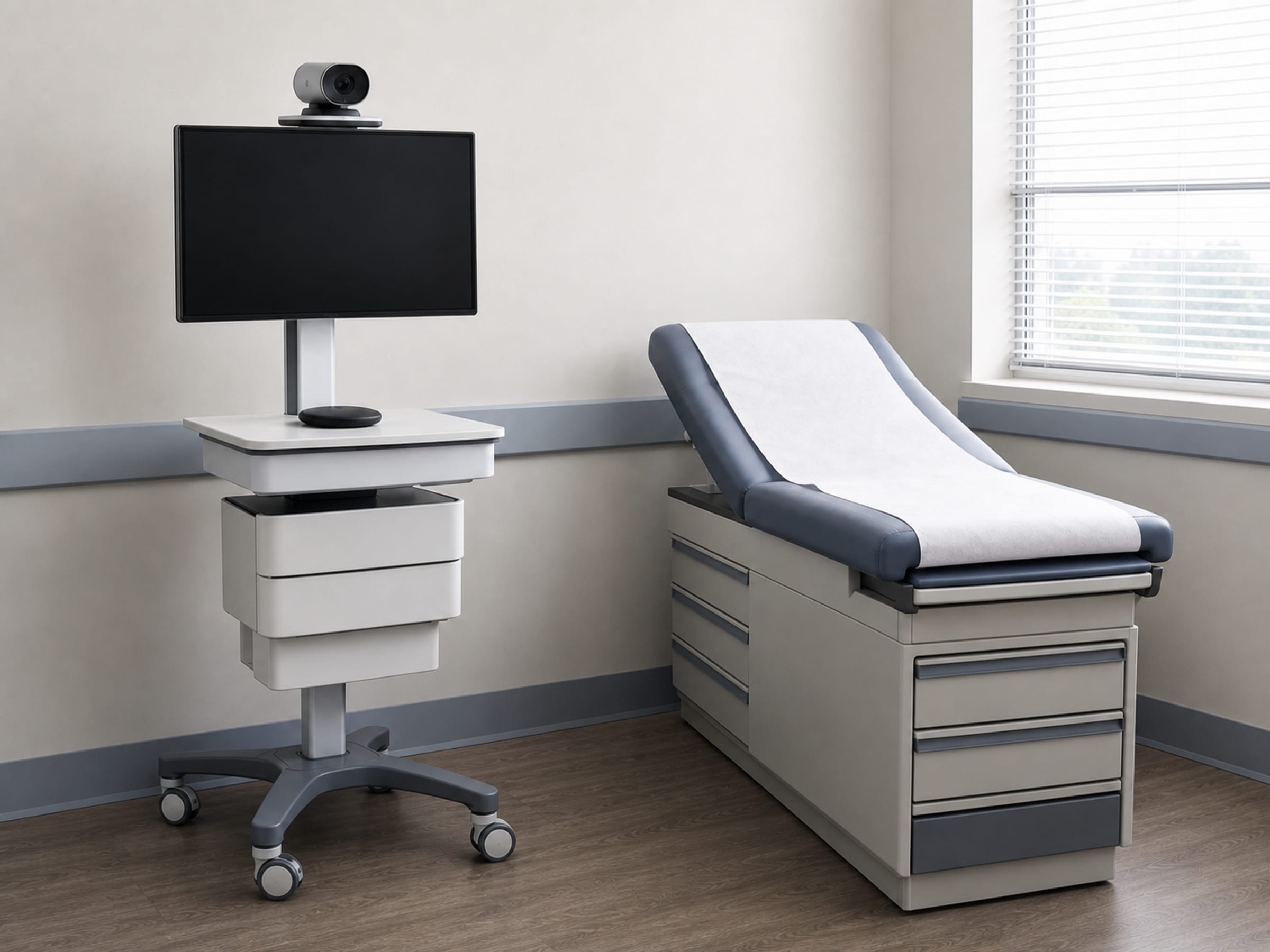
Telehealth sessions fail on audio and lighting long before they fail on bandwidth. We spec the camera, microphone, display and cart for the room type and deliver it configured to the platform the health system already runs.
- Scope
- Cameras, microphones, speakers, displays, carts and endpoints
- Specified by
- Room type — exam room, cart, consult room, home kit
- Platform
- Configured to the platform you run; platforms sourced on request
- Boundary
- Equipment only — no clinical or care-delivery claim
The session fails on audio, not on bandwidth
Ask anyone who supports a telehealth program what actually goes wrong and bandwidth will not be the first answer. It is that the remote clinician cannot make out what the patient said because a laptop's built-in microphone picked up the room instead of the person; that the patient is a silhouette because the only light in the room is behind them; that the camera is fixed at laptop-lid height and shows a ceiling. These are equipment problems with cheap, well-understood fixes, and they get skipped because a laptop technically works. We spec the camera, the microphone, the audio path and the display against the room type, and deliver the kit configured to whichever platform the health system already runs.
Kits built per room type
A room-type kit is specified once and then repeated, so twenty exam rooms get twenty identical, supportable builds. Naming a manufacturer describes the market, not a Uniqcli partnership or endorsement.
Cameras and video capture
Fixed cameras for exam rooms and pan-tilt-zoom for consult and group rooms, chosen for low-light performance because clinical rooms are rarely lit for video. Logitech carries a deep priced camera and conferencing line on our catalog, and AVer carries priced camera rows including PTZ. Specified with the mount, at the height the clinician and patient are actually at.
Microphones and room audio
The half that decides whether a session works. Boundary and table microphones with the pickup pattern the room needs, and loudspeakers positioned so the remote voice is intelligible without being loud. Shure carries a deep priced microphone line on our catalog. Jabra carries priced speakerphone and headset rows for the single-clinician and desk configurations.
Carts, displays and endpoints
Mobile telehealth carts where the session goes to the patient, and fixed displays where the room is dedicated. Ergotron carries a deep priced cart and mounting line on our catalog; Lenovo carries the deepest priced endpoint line. Endpoints are imaged and configured to your platform before delivery so the kit arrives ready to join a session.
The same program needs four different kits
An exam room used for a scheduled remote consultation wants a fixed camera at seated eye height, a boundary microphone that covers both the patient chair and the clinician position, a modest display, and nothing that has to be wheeled anywhere. It is the cheapest kit and the one that benefits most from being identical across every room.
A mobile cart kit goes where the patient is — inpatient rounds, a nursing facility, a rural clinic without a dedicated room. It needs battery runtime, a camera with usable low-light performance and enough audio isolation to work in a room with other equipment running. It is the most expensive kit per unit and the one where cutting the audio budget is most visible.
A consult or group room, where several people on one side join a remote participant, needs pan-tilt-zoom framing and a microphone arrangement that covers a table rather than a chair. And a home or field kit — for remote patient monitoring programs or a traveling clinician — is a packing-list problem: a fixed set of components, packed identically, labeled, tested before it ships. Quoting one generic telehealth kit across all four is the most common way these programs end up with equipment nobody uses.
Standing up a telehealth fleet
- Send the room types and counts, the platform in use and the lighting conditions you actually have
- We specify one kit per room type and quote it as a repeatable unit
- Audio is specified against the room's size and noise, not against a device list
- Endpoints are imaged and configured to your platform before delivery
- Kits ship labeled and identical, so support is troubleshooting one build rather than twenty
- Spares are quoted with the fleet, because a failed camera takes a room out of service
Telehealth equipment questions
Why not just use the laptop the clinician already has?
Because a laptop's built-in microphone picks up the room rather than the person, its camera sits at lid height rather than at eye height, and neither performs well in the lighting clinical rooms actually have. Those three things account for most of what patients and clinicians experience as a bad session. A modest external camera and microphone fix them for a fraction of what the program costs to run.
Do you supply the telehealth platform?
No. Telehealth platforms do not carry priced rows in our catalog. Where a project requires one, it is sourced on request through US distribution against the publisher's terms. What we do is specify and configure hardware that works with the platform you have already chosen, and deliver it ready to join a session.
What is the most common mistake in a telehealth rollout?
Buying one generic kit for every room type. An exam room, a mobile cart, a group consult room and a field kit have genuinely different requirements for framing, audio pickup, battery and packaging. Specifying per room type costs slightly more in design effort and dramatically less in equipment that ends up unused.
Telehealth background and the endpoints behind it
The solutions atlas
Every solution, by technology area and by customer.
By technology
By customer
- TAA & NDAA-889 Compliance Screening
- CMMC & CUI Solutions
- Federal & DoD
- State, Local & Education
- Healthcare
- Enterprise
- Rapid Procurement & GPC Buys
- Multi-Vendor Integration Projects
- eProcurement & Custom Catalogs
- FISMA Modernization
- CJIS-Compliant Justice Cloud & Local AI
- Federal Storage Modernization
- Government ERP & Business Systems Infrastructure
- Managed Procurement
- Secure AV & Conferencing
- Fiber Network Infrastructure
- Satellite & Resilient Connectivity
- Wavelength & Optical Transport
- Decentralized Data Centers
- Data Center Design & Build
Specify one kit per room type
Send the room types and counts, the platform you run and what the lighting is actually like. The quote comes back as a repeatable kit per room type, configured to your platform and quoted with spares. TAA (FAR 52.225-5) and NDAA §889 screening performed on every line before the quote goes out.