
Solutions
Clinical Workstations & Medical Carts
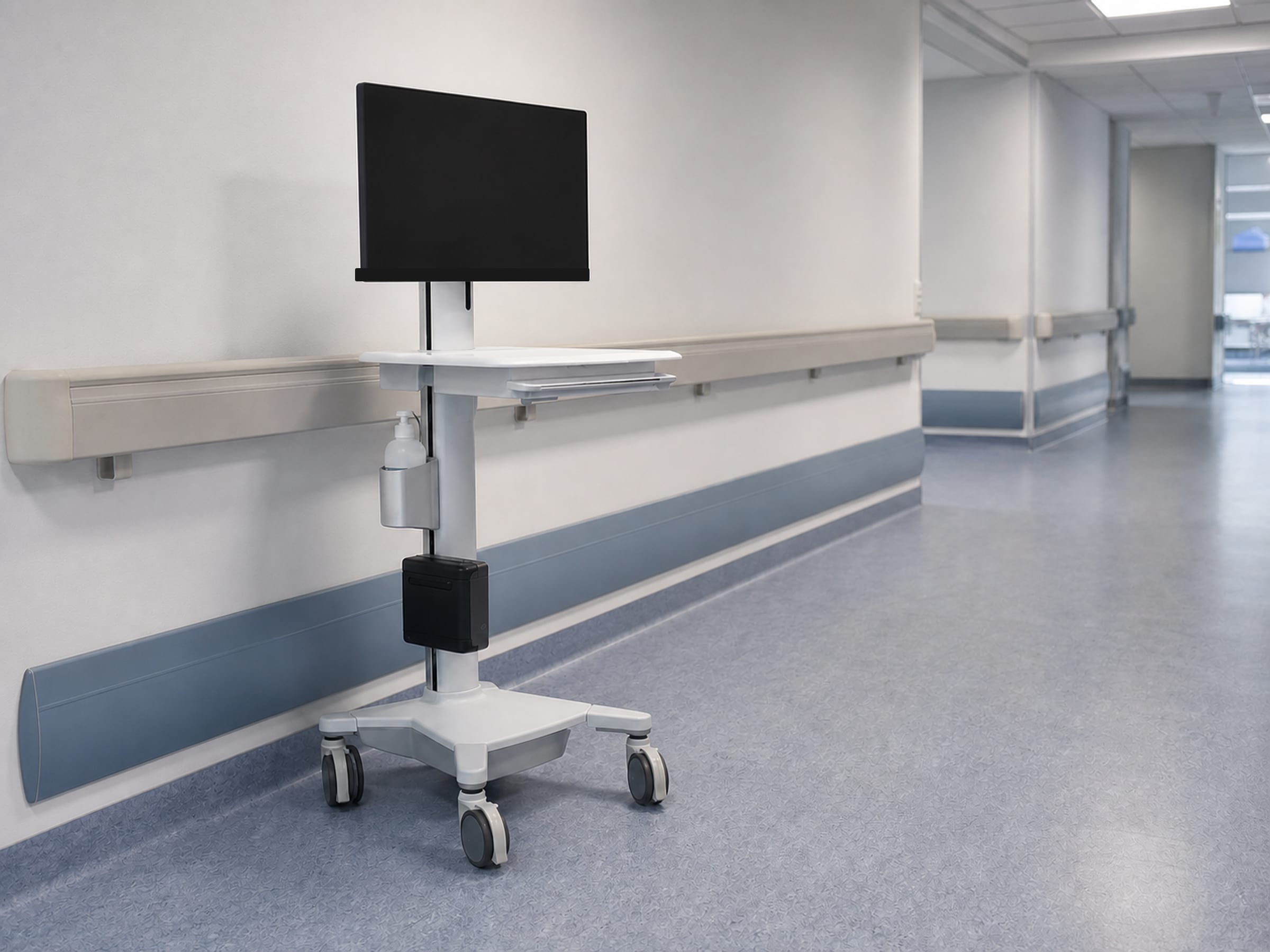
Point-of-care hardware is chosen for cleanability, battery life and how it rolls. We quote the cart, the endpoint and the mounting as a unit, and deliver it imaged to the health system's clinical build.
- Scope
- Carts, endpoints, mounting, batteries and pre-delivery imaging
- Selection drivers
- Cleanability, battery runtime, footprint and ergonomics
- Delivery
- Imaged and asset-tagged to your build before it reaches the floor
- Boundary
- No clinical-workflow or patient-safety claim is made or implied
Specified by the shift, not by the spec sheet
Point-of-care hardware gets chosen on criteria that barely appear on a manufacturer's specification sheet: whether the surface tolerates the disinfectant the infection-prevention team actually mandates, whether the battery lasts a full shift with the screen at working brightness, whether the cart fits through the doorways on the unit it serves, and whether a nurse can raise it to standing height with one hand while holding something in the other. Get those wrong and the cart is parked in a corridor within a month. We quote the cart, the endpoint and the mounting as one unit, specify against the units they will actually serve, and deliver them imaged and tagged to the health system's clinical build.
What actually determines whether a cart gets used
Cleanability comes first, and it is a materials question rather than a marketing one. Facilities differ on which disinfectant they mandate, and some formulations degrade plastics and coatings that stand up perfectly well to others. The right process is to confirm the compatibility of the specific chemistry against the specific product before ordering a fleet, not after infection prevention rejects it. We will ask which agent your facility uses.
Battery runtime is where powered carts succeed or fail. A cart that needs a mid-shift swap or a charging break creates exactly the friction that pushes staff back to a fixed workstation and paper. Runtime is a function of the battery capacity, the endpoint's real draw and the display brightness the unit actually runs at, which is usually higher than the test conditions. Hot-swappable battery designs change the calculation entirely and are worth pricing where twenty-four-hour units are involved.
Then the physical realities. Footprint and turning radius against real corridor and doorway dimensions. Height adjustment range that covers both a seated and a standing user without a tool. Weight, because someone pushes this thing for twelve hours. And where a cart is the wrong answer — high-frequency, fixed-position use — a wall-mounted articulating arm with a thin endpoint is cheaper, cleaner and never needs charging. Most units end up with a mix, and specifying that mix accurately is most of the value.
The unit, not the parts
Cart, endpoint and mounting priced together and delivered as one configured item. Naming a manufacturer describes the market, not a Uniqcli partnership or endorsement.
Powered and non-powered carts
Mobile workstations in powered and lightweight non-powered configurations, with height adjustment, work-surface options and battery systems. Ergotron carries a deep priced line across carts, mobile workstations and mounting on our catalog. Specified against your corridor and doorway dimensions, your shift length and the disinfectant your facility mandates.
Point-of-care endpoints
The compute on the cart or the wall: thin all-in-one units, small-form-factor desktops and tablets for the roles that need to leave the cart behind. Lenovo carries by far the deepest priced endpoint line on our catalog, and Microsoft carries priced tablet rows for the mobile roles. Specified for real draw and thermal behavior, since both feed straight back into cart runtime.
Displays, arms and wall mounts
For fixed positions — nurse stations, exam rooms, medication areas — a wall-mounted articulating arm and a thin endpoint beat a cart on cost, cleanliness and reliability. ViewSonic carries priced display rows on the hub. Ergotron carries priced arm and mount rows. Quoted with the wall-construction question asked up front, because that is what determines the mount.
From unit survey to configured delivery
- Tell us the units, the shift length, the doorway and corridor constraints and the disinfectant in use
- We quote carts, endpoints and mounts as configured units rather than as separate part numbers
- Battery runtime is specified against real display brightness and endpoint draw, not a best-case figure
- Endpoints are imaged to your clinical build and asset-tagged before delivery
- Carts arrive assembled and configured, staged by unit rather than dropped at central receiving
- Battery replacement and refresh timing is priced with the initial buy
What we do not claim
We make no clinical claim. Nothing on this page asserts an effect on clinical workflow, documentation quality, patient safety or care outcomes, and no equipment purchase produces any of those on its own. What hardware can do is stop being an obstacle: a cart that holds charge, cleans properly and moves through the doorway is one that gets used. Whether that helps depends entirely on decisions clinicians and informatics teams make, not on the procurement.
Clinical software — the electronic health record, its modules and the clinical applications around it — does not carry priced rows in our catalog and is not something we quote as inventory. We build and image endpoints to the specification your informatics team provides and to the vendor's documented hardware requirements. Validation of the build against the clinical application, and the change control around it, stay inside the health system.
Point-of-care hardware questions
How long should a powered cart battery last?
The practical target is a full shift at real working brightness with the endpoint you are actually deploying — anything less produces mid-shift charging behavior that undermines the deployment. Quoted runtimes are typically measured under conditions gentler than a hospital floor, so we size against the endpoint's real draw and the brightness the units run at. Where twenty-four-hour coverage is needed, hot-swappable battery designs are usually the better economics.
Which disinfectants can these surfaces tolerate?
It depends on the specific product and the specific chemistry, and the differences are real — some formulations degrade plastics and coatings that others leave untouched. We will ask which agent your facility mandates and confirm compatibility against the manufacturer's own documentation before a fleet is ordered. That is a question to settle before purchase, not after infection prevention reviews it.
Cart or wall-mounted arm?
Carts suit mobile work where the endpoint follows a clinician between rooms. Wall-mounted articulating arms suit fixed, high-frequency positions — nurse stations, exam and medication rooms — where they cost less, clean more easily and never need charging. Most units are best served by a mix, and getting that mix right per unit is where most of the savings are.
Can endpoints be imaged before delivery?
Yes. Imaging to your clinical build, asset tagging to your scheme and staging by unit are done before delivery, so carts arrive assembled and ready rather than as boxes at central receiving. Validation of the build against your clinical applications, and the change control around it, remain with your informatics team.
Clinical background and the carts around it
The solutions atlas
Every solution, by technology area and by customer.
By technology
By customer
- TAA & NDAA-889 Compliance Screening
- CMMC & CUI Solutions
- Federal & DoD
- State, Local & Education
- Healthcare
- Enterprise
- Rapid Procurement & GPC Buys
- Multi-Vendor Integration Projects
- eProcurement & Custom Catalogs
- FISMA Modernization
- CJIS-Compliant Justice Cloud & Local AI
- Federal Storage Modernization
- Government ERP & Business Systems Infrastructure
- Managed Procurement
- Secure AV & Conferencing
- Fiber Network Infrastructure
- Satellite & Resilient Connectivity
- Wavelength & Optical Transport
- Decentralized Data Centers
- Data Center Design & Build
Specify it against the unit, not the catalog
Send the unit list, the shift pattern, the doorway constraints and the disinfectant in use. A Uniqcli specialist returns configured cart-and-endpoint units, imaged to your build, with battery replacement and refresh timing priced alongside. TAA (FAR 52.225-5) and NDAA §889 screening performed on every line before the quote goes out.