
Business connectivity
K-12 School & District WiFi
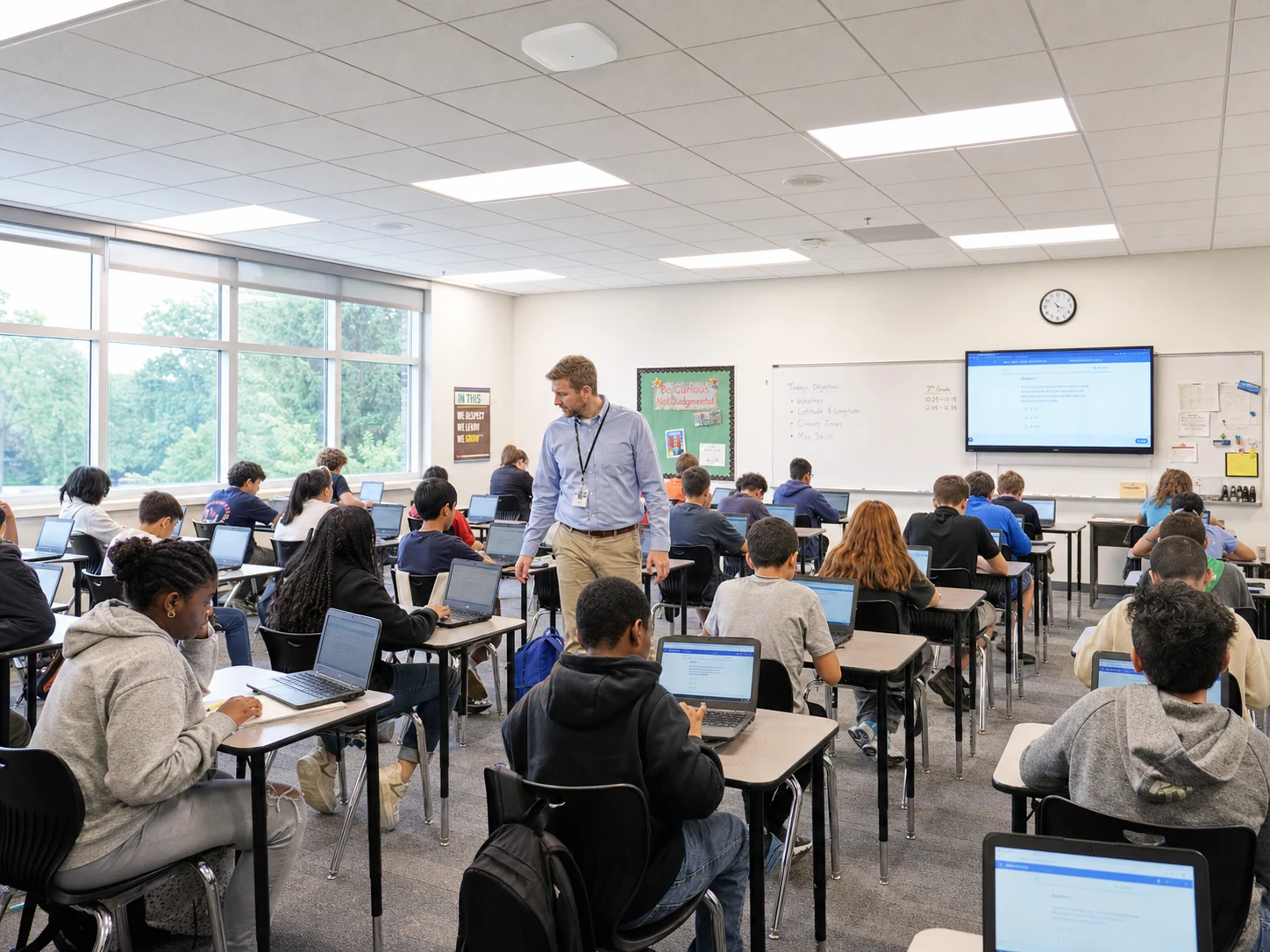
A 1:1 device program puts thirty simultaneous clients in every classroom, and testing day puts them all on the network in the same hour.
We design against that load, building by building, with content-filtering-ready designs and one point of contact through deployment.
- Unit of scope
- Square footage and device count per building, not a room count
- Design load
- Testing-day concurrency and 1:1 classroom density
- Also in scope
- Gymnasiums, cafeterias, libraries, portables, athletic and outdoor areas
- Accountability
- Design, equipment, deployment and support on one quote
Get a quote
School & campus WiFi
Tell us where to reach you and a Uniqcli specialist follows up by email to scope the locations with you, then comes back with a written quote. Serviceability and the final figure are confirmed per location.
The first number is our real one, not an opening one.
Tell us the scope and we come back with the best price we can do on it.
- Supporting federal, state & local purchasers
- GPC & P-Card accepted
- TAA & NDAA-889 screening before every quote
Live prices from our catalog right now — a starting point, not the project price. Your quote is scoped to the site and includes the licensing and services the job needs.
Thirty devices in one room, then every room at once
A 1:1 program changes the wireless problem in a school from coverage to concentration. Thirty clients inside four walls is a density most office buildings never see, and it repeats in every classroom along the corridor, behind block walls that were poured before anyone was thinking about radio.
Continue readingShow less
Then comes the day the whole grade level starts an online assessment in the same period, and the network is judged on a load it carries a handful of times a year and cannot be allowed to fail. Scoped per square footage and device count rather than per room, because coverage in these buildings is set by the structure and the client mix rather than by a unit count. We design against the busiest hour of the busiest week, building by building, and quote the equipment, the wired work behind it and the deployment as one scope.
What a school design has to account for
Four pressures, and the last one is the reason the first three are worth doing carefully. Assess, design, procure, support: we scope the requirement with you, design against it, source the circuits and equipment, and stay the single point of contact through turn-up and afterwards.
Classroom density for 1:1 programs
Capacity is planned per instructional space against the devices actually in it — a class set of laptops or tablets, the teacher's devices, a display or casting device, and whatever else the room has acquired.
Continue readingShow less
Older school construction makes this harder in a useful way: block walls contain a room's signal, which helps, but they also stop coverage from reaching where you assumed, so placement is decided room by room rather than by a spacing rule on a floor plan.
Testing day, sized deliberately
Online assessment is the load that matters most and occurs least often: a whole grade level, sometimes a whole building, starting simultaneously with a strict window and no tolerance for a stall.
Continue readingShow less
We size for that hour rather than for the daily average, and we identify in advance which spaces are marginal so a testing schedule can work around a room instead of discovering it in the middle of a session.
Content-filtering-ready designs
The network is designed so your filtering and monitoring can sit where it needs to sit — traffic paths that route through it, segmentation that keeps student, staff and guest devices distinguishable, and a wired design that does not force filtering into a corner.
Continue readingShow less
The filtering platform, its policy and the certifications around it belong to the district and its chosen vendors; what we provide is a design that is ready for them.
Every other space in the building
Gymnasiums, cafeterias, libraries, auditoriums, portables and athletic fields all get used for instruction and events, and each is a different design problem from a classroom.
Continue readingShow less
Enterprise-grade access points, controllers and switching are quoted through our distribution network against the design, rather than listed with a shelf price. TAA (FAR 52.225-5) and NDAA §889 screening is performed on every hardware line, before the quote goes out.
Quote WiFi for your schools
Go to the formWhat we'll ask at quote
Enough to size every building honestly rather than applying one district-wide rule. Most technology directors have all of this to hand already.
- Every building, its square footage, floor count and approximate age — and which ones were added or renovated later
- Instructional space count per building, and the devices in a typical room during a full class
- Your 1:1 program: which grades, what devices, and whether the count is growing next year
- Testing windows — how many students are assessed simultaneously, in which spaces, and how strict the window is
- Filtering, monitoring and device-management platforms already in place, and where they sit on the network today
- Which separate networks you need: student, staff, guest, BYOD, building systems and anything a policy already dictates
- The existing wired plant — switch age, PoE capacity, cabling vintage and where the equipment rooms are — since that often sets the sequence
- Non-classroom spaces to cover: gym, cafeteria, library, auditorium, portables, athletic fields and bus loops
The wired half of a wireless project, and the funding question
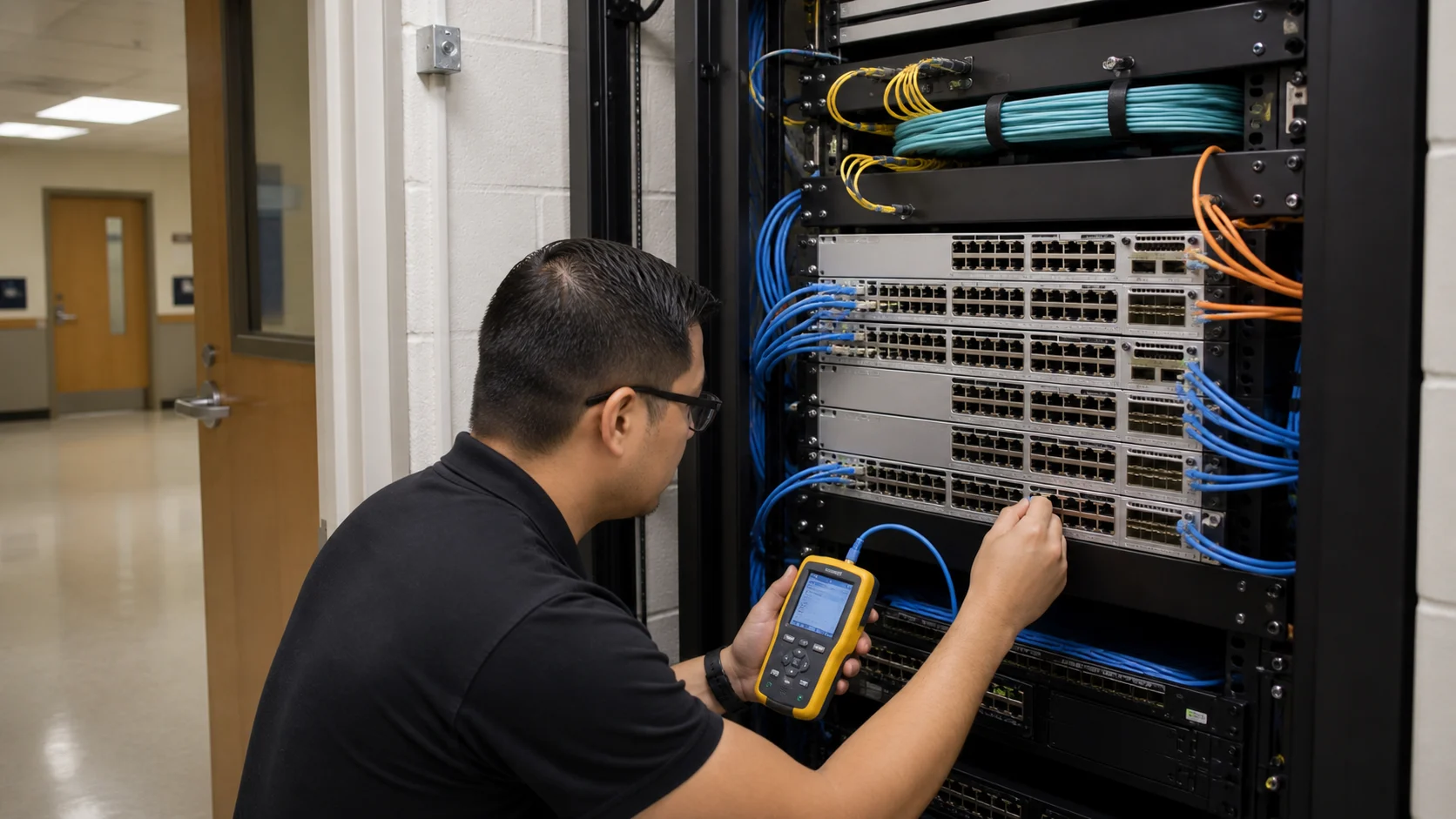
The part of a school wireless refresh that surprises districts is how much of it is wired. Access points need cable to the right places rather than to the places cable already goes, and a class-set-per-room design usually needs more drops than the building has. They need switch ports with enough power budget to run them all at once, which is where an older switch stack quietly becomes the constraint, and uplinks between the closets and the core sized for the aggregate rather than for what a hallway used to carry. A design that ignores this produces a beautiful wireless plan and a project that stalls in a wiring closet, so we look at both together and phase the work where a building needs it.
Continue readingShow less
The second thing worth planning around is the calendar. Schools have short, immovable windows in which disruptive work can happen, and equipment lead times do not care about them. The practical consequence is that scoping in the spring for summer work is a completely different project from scoping in July, and it is worth telling us which one you are doing so the sequence and the ordering are honest about it. Where the work has to happen in phases across occupied buildings, the phasing is part of the design rather than an afterthought.
On funding, we will be straightforward about our position. E-rate is a federal program that helps schools and libraries pay for eligible network equipment and services, and many districts use it for exactly this kind of work. Whether a specific item is eligible, how a district files, and which providers it can use are matters between the district, its own consultants and the program administrator — this page makes no claim about our status in that program, and nothing here should be read as one. What we can do is provide a written quote with the line-item detail, quantities and descriptions your own process needs, in whatever form your business office asks for it.
What districts usually scope alongside the wireless
The network, the circuits behind it and the safety equipment in the buildings are frequently one plan and one budget cycle.
School and district WiFi questions
How is a school quoted if there is no per-room rate?
Scoped per square footage and device count rather than per room, because coverage in these buildings is set by the structure and the client mix rather than by a unit count. A gymnasium, a classroom wing and a portable are not interchangeable units, so a per-room figure would be a worse answer rather than a simpler one. Starting rates are published on the lanes where a room or a residential unit genuinely is the unit of scope — hotels, apartments, student housing and senior living. Everything outside the starting rates above is sized rather than priced on a web page: the figure that binds is a written quote against your own addresses, terms and equipment list.
Can you design for our testing windows?
Yes, and it should be an explicit input rather than an assumption. Tell us how many students are assessed at once, in which spaces, and how tight the window is, and those spaces get sized for that hour and validated against it. We will also flag the rooms we consider marginal, so scheduling can work around them while a phase is still pending.
Is this CIPA compliant?
Compliance belongs to the district, not to a network design, so we describe what we build as content-filtering-ready: traffic paths that route through your filtering platform, segmentation that keeps student, staff and guest devices distinguishable, and a wired design that gives your monitoring somewhere sensible to sit. Choosing the filtering platform, setting policy and certifying compliance stay with the district and the vendors it selects.
Where does E-rate fit into this?
As information rather than a claim. E-rate helps schools and libraries fund eligible network equipment and services, and many districts use it for wireless refreshes — but eligibility, filing and provider selection are between the district, its consultants and the program administrator. We make no representation about our status in that program. We can provide a written quote with the line-item detail and descriptions your business office needs for its own process.
Which equipment do you use, and who supports it after install?
Enterprise-grade access points, controllers and switching are quoted through our distribution network against the design, rather than listed with a shelf price. TAA (FAR 52.225-5) and NDAA §889 screening is performed on every hardware line, before the quote goes out. Assess, design, procure, support: we scope the requirement with you, design against it, source the circuits and equipment, and stay the single point of contact through turn-up and afterwards.
How fast can you get a quote back?
How quickly a quote comes back depends on how many addresses have to be checked and which carriers serve them; a single site is usually straightforward, and a multi-site scope moves at the pace of the slowest address. We tell you where each location stands rather than holding the whole quote for the last one.
Send the buildings, get a design sized for testing day
A building list with square footage, instructional space counts and your device program is enough to start. We come back with a design approach per building, an equipment list including the wired work, and a written quote your business office can read line by line.
Continue readingShow less
Service commitments are backed by the underlying carrier's published service terms, which are provided with your quote rather than summarized here.
The solutions atlas
Every solution, by technology area and by customer.
By technology
By customer
- TAA & NDAA-889 Compliance Screening
- CMMC & CUI Solutions
- Federal & DoD
- State, Local & Education
- Healthcare
- Enterprise
- Rapid Procurement & GPC Buys
- Multi-Vendor Integration Projects
- eProcurement & Custom Catalogs
- FISMA Modernization
- CJIS-Compliant Justice Cloud & Local AI
- Federal Storage Modernization
- Government ERP & Business Systems Infrastructure
- Managed Procurement
- Secure AV & Conferencing
- Fiber Network Infrastructure
- Satellite & Resilient Connectivity
- Wavelength & Optical Transport
- Decentralized Data Centers
- Data Center Design & Build
Quote WiFi for your schools
Send the building list, the device program and your testing windows. You get a design approach per building, an equipment list that includes the wired work, and a written quote. Everything outside the starting rates above is sized rather than priced on a web page: the figure that binds is a written quote against your own addresses, terms and equipment list.