
Solutions
Out-of-Band Management & KVM
Remote hands cost more than a console server. We spec the KVM, the serial console and the out-of-band path so a remote or dark site can be recovered without a truck roll — and so a failed change does not become a four-hour drive.
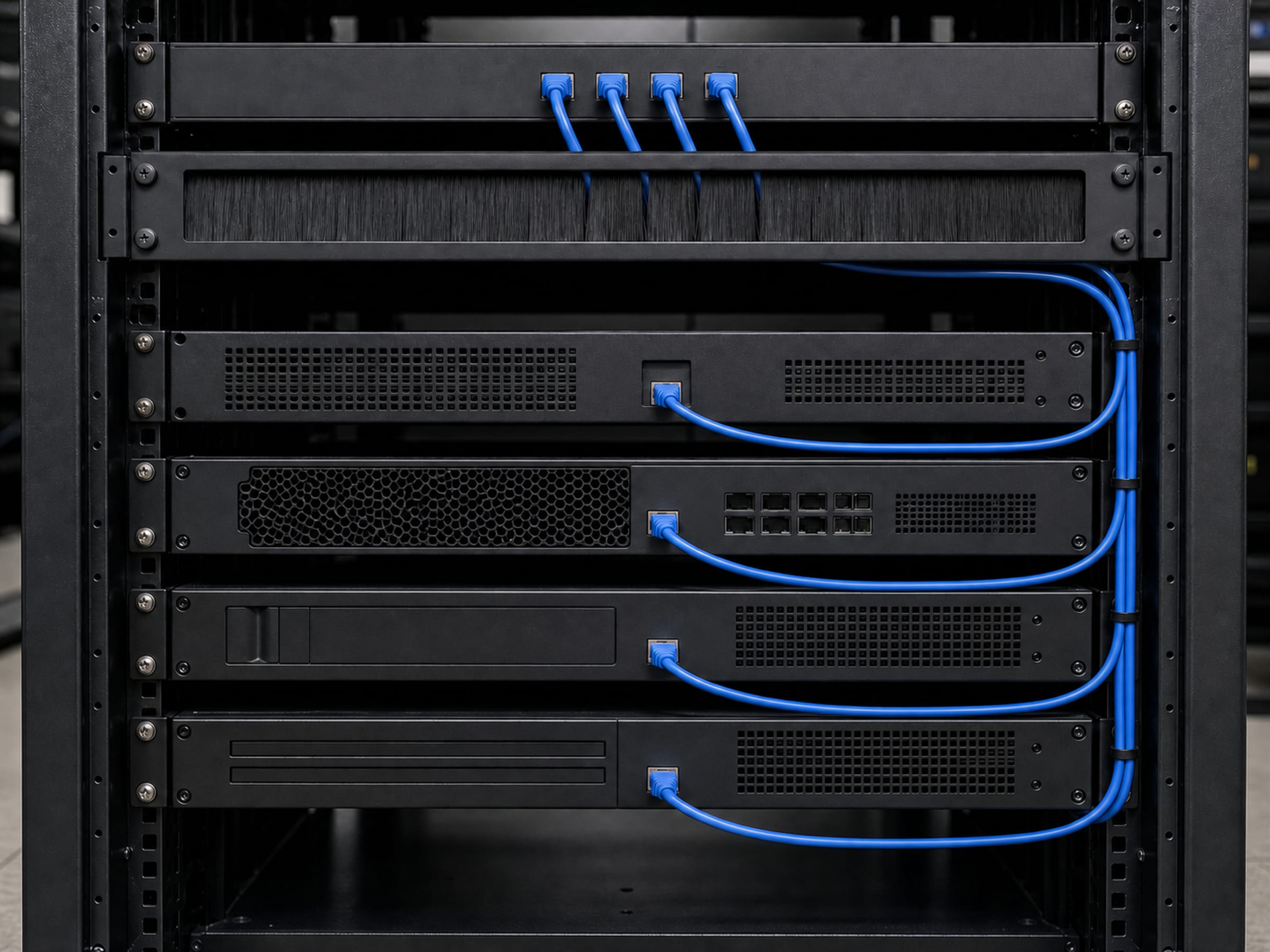
- Scope
- KVM, serial console, rack consoles and out-of-band paths
- What we quote
- Switches, terminal servers, LCD consoles, cellular routers
- Boundary
- We hold no credentials and access no customer device
The change that locks you out is the reason this hardware exists
Out-of-band access is bought after the first incident, almost without exception. Someone pushes a configuration that drops the management VLAN, or a firmware update leaves a switch at a bootloader prompt, or a server hangs before the operating system that hosts the remote-access agent has loaded. In-band tools cannot help with any of those, because in-band is precisely what has failed. What helps is a path that does not depend on the thing being fixed: a serial console on the device, a KVM on the server, and — where the site has one link and no second option — a cellular route that comes up when the primary circuit does not. Uniqcli specifies and supplies that path. We never operate it, and we never hold credentials to it.
Four ways back into a site that will not answer
Which of these you need depends on what is at the site and how far away the nearest pair of hands is. Naming a manufacturer describes the market, not a Uniqcli partnership or endorsement.
KVM switches
Keyboard, video and mouse access to servers below the operating system — the layer that still answers when the OS does not. Black Box carries a fully priced KVM switch line across port counts and connection types, and specification turns on port count, whether the access has to be over IP, and whether any of the connected systems sit on separated networks.
Serial console and terminal servers
The workhorse of network out-of-band: a console server aggregates the serial ports of every switch, router and firewall in the rack so a device stuck at a bootloader prompt is still reachable. Sized by port count and by whether the console server itself needs a dedicated management path independent of the production network.
Rack consoles and extenders
A rack-mount LCD console keeps a keyboard and screen in the cabinet without permanently consuming desk space, and extenders put an operator position outside a noisy or restricted room. Black Box carries the deepest priced line across KVM consoles and extenders on the hub, with Legrand covering the rack and cable-management hardware around it.
Cellular out-of-band path
Where a site has a single circuit, the out-of-band path has to leave the building by a different route. Peplink carries a fully priced cellular and multi-WAN line used for exactly this — a management route that comes up when the primary link is down. The carrier plan behind it is a contract you hold directly.
An out-of-band path has to survive what it exists to recover from
The common design failure is dependence. A console server that reaches the network through the same switch it is meant to rescue, an IP KVM on the production VLAN, a management route that shares the site's only circuit — each of those is out-of-band in name and in-band in practice, and each is discovered at the worst possible moment.
The second question is power. If the console server and the cellular router are fed from the same PDU branch as the equipment they manage, a power event takes the recovery path down with everything else. Pairing out-of-band gear with a metered or switched PDU on a separate branch is a small line item that changes the outcome of a whole class of incident.
The third is physical: separated networks. Where one operator works across two networks that must stay apart, the KVM is the boundary device, and a secure model evaluated under the appropriate protection profile is the right answer rather than an ordinary switch. That is a requirement you state and we quote against — never a claim we make about a part on your behalf.
From site list to a recoverable estate
- Send a requirement, an installed-base export or a spreadsheet of part numbers
- Off-catalog lines are sourced by RFQ through US distribution
- TAA (FAR 52.225-5) and NDAA §889 screening runs before the quote goes out
- Quotes, orders, approvals and documents live in your buyer portal
- GPC / P-Card accepted up to your cardholder threshold; POs otherwise
- Stock and final total confirmed before you commit; free US shipping over $2,500
Out-of-band questions
Do you manage the out-of-band access for us?
No. We supply and integrate the hardware and can stage it against your configuration, but we hold no credentials, we do not connect to customer devices, and we operate no remote-access service. The path exists for your team or your MSP to use. The program stays yours to run — the policy, the schedule, the decisions and the records. What a supplier puts behind it is the hardware, the licensing and the integration work that puts either into service.
KVM or serial console — which is right?
Generally both, for different equipment. Servers need KVM, because the failure you are recovering from is often before the operating system loads and the useful output is graphical. Network devices need serial, because that is where a switch or firewall prints during boot and where a bootloader prompt lives. A rack with both usually needs both.
Can the out-of-band path use the site's normal internet circuit?
It can, and it is better than nothing, but it shares a failure mode with the thing it is meant to rescue. Where a site is genuinely remote or dark, a cellular route on a different carrier is the design that survives a circuit outage. We will quote either and tell you plainly which risk each one leaves open.
The solutions atlas
Every solution, by technology area and by customer.
By technology
By customer
- TAA & NDAA-889 Compliance Screening
- CMMC & CUI Solutions
- Federal & DoD
- State, Local & Education
- Healthcare
- Enterprise
- Rapid Procurement & GPC Buys
- Multi-Vendor Integration Projects
- eProcurement & Custom Catalogs
- FISMA Modernization
- CJIS-Compliant Justice Cloud & Local AI
- Federal Storage Modernization
- Government ERP & Business Systems Infrastructure
- Managed Procurement
- Secure AV & Conferencing
- Fiber Network Infrastructure
- Satellite & Resilient Connectivity
- Wavelength & Optical Transport
- Decentralized Data Centers
- Data Center Design & Build
Spec the path back in
Send the site list with what sits in each rack and how far the nearest hands are. We come back with KVM, console and out-of-band routing as one package.