
Solutions
Outdoor & Point-to-Point Wireless
Linking two buildings across a campus, a yard or a river is almost always cheaper over the air than through a trench. We spec the radios, mounts, surge protection and power for the actual path — the distance, the obstruction and the weather it has to survive.
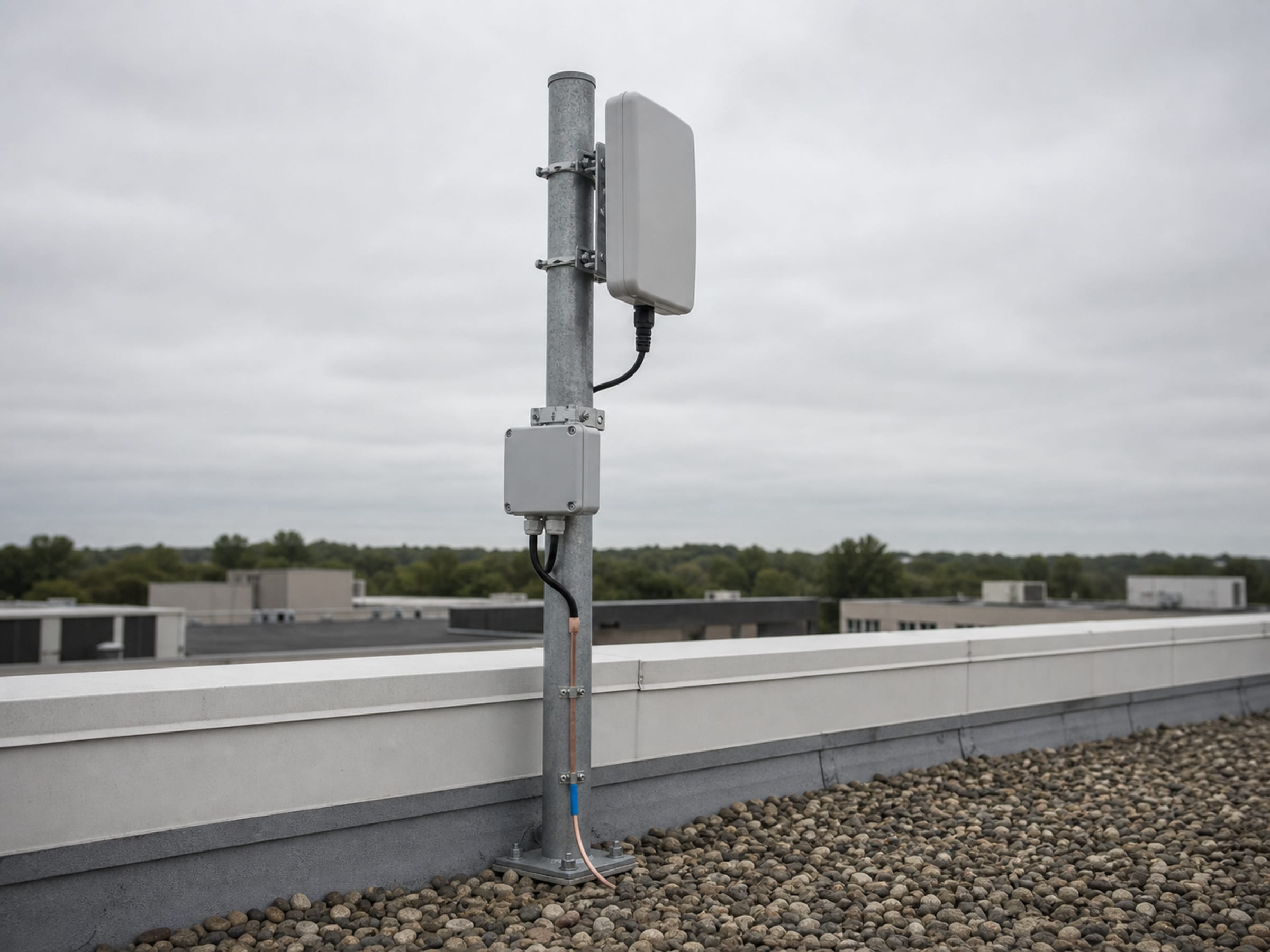
- Scope
- Building-to-building bridges, outdoor coverage, yard and perimeter links
- Quoted
- Radios, mounts, grounding and surge, outdoor power, weatherproofing
- Boundary
- Path survey, line of sight and permits stay with the site owner
The trench is the expensive option
Two hundred meters of open ground between a main building and an outbuilding is a fiber trench, a permit, a restoration bill and a schedule — or it is a pair of radios on two poles and an afternoon. Point-to-point wireless earns its place in exactly this gap, and it fails in exactly one predictable way: when the link was specified from a map rather than from the path. Line of sight, mounting height, the tree that is currently bare, the yard crane that swings through the Fresnel zone, the lightning risk on an exposed mast — those decide the equipment, not the advertised range on the datasheet.
What we need before we spec a link
- Both endpoints — addresses or coordinates, and the height available at each
- Honest line of sight: what is between them now, and what could be there later
- Throughput the link has to carry, and whether it is the only path or a backup
- Mounting reality at each end — parapet, pole, mast, non-penetrating roof frame
- Power available at each endpoint, or whether the far end needs PoE over a long run
- Environment: coastal salt, industrial dust, extremes of temperature, ice loading
A link is five line items, not one
The radios are usually the smallest number on the page. The rest is what keeps them working.
Bridge radios and outdoor APs
Ubiquiti anchors the outdoor and bridging estate with deep priced inventory, alongside EnGenius and TRENDnet for outdoor access and shorter links. Peplink covers the cases where the far end also needs a routed edge with cellular backup.
Mounts, masts and antennas
Mounting is where outdoor links are won or lost. Non-penetrating roof mounts, pole and mast hardware, alignment brackets and external antennas are quoted with the radio, sized to the wind and ice loading of the location.
Grounding, surge and outdoor power
An exposed radio at the top of a mast is a lightning path into your switch room. Surge protection at both ends, proper grounding hardware, outdoor-rated cable and the UPS behind the closet are quoted as part of the link, not as an upgrade.
What stays yours to run
We do not perform the path survey, confirm line of sight, climb the mast or pull the permits. Those belong to your site team or the integrator doing the physical work, and the difference between a link that works and one that does not is usually decided there rather than in the equipment choice. What we do is turn a confirmed path into a complete, screened bill of materials — radios, mounts, grounding, surge, cable and power — so the crew that goes up the ladder has everything in one delivery.
We also will not quote you a guaranteed throughput at a distance. Real links are shaped by obstruction, interference, weather and mounting rigidity, and a number lifted from a datasheet is a laboratory figure. Where a path is marginal we say it is marginal and price the more capable radio rather than the cheaper one.
Point-to-point questions
How far will a point-to-point link actually reach?
Far enough that the limiting factor is almost never the radio — it is line of sight, mounting height, interference and weather. Rather than quote a range figure, we ask for the two endpoints and the obstructions between them, and spec to that path. Where it is marginal, we say so and price the equipment that gives you margin.
Can a wireless bridge replace a fiber run between buildings?
For many campus and yard links, yes — and at a fraction of the cost of trenching. Where the link carries something that genuinely cannot drop, the honest answer is that wireless is a superb primary path with a weather dependency, so we will usually recommend it alongside a plan for what happens on the worst day of the year.
What does the far end need if there is no power there?
Usually PoE over the run, which brings distance limits and cable specification into the design, and sometimes an outdoor enclosure with its own supply. We quote the injector, the outdoor-rated cable and any enclosure with the radio so the far end is a complete package.
Outdoor links and the sites they connect
The solutions atlas
Every solution, by technology area and by customer.
By technology
By customer
- TAA & NDAA-889 Compliance Screening
- CMMC & CUI Solutions
- Federal & DoD
- State, Local & Education
- Healthcare
- Enterprise
- Rapid Procurement & GPC Buys
- Multi-Vendor Integration Projects
- eProcurement & Custom Catalogs
- FISMA Modernization
- CJIS-Compliant Justice Cloud & Local AI
- Federal Storage Modernization
- Government ERP & Business Systems Infrastructure
- Managed Procurement
- Secure AV & Conferencing
- Fiber Network Infrastructure
- Satellite & Resilient Connectivity
- Wavelength & Optical Transport
- Decentralized Data Centers
- Data Center Design & Build
Send the two endpoints
Give us the endpoints, the height available and what is between them. The quote comes back as the radios, mounts, grounding, surge protection and power as one screened bill of materials, with availability stated per line.