
Solutions
Mass Notification & Paging
Intelligibility is the requirement, not loudness. We spec the speakers, amplifiers, IP paging endpoints and the network path for the building as it actually is — and the notification policy, its activation and any code determination stay with you and your authority having jurisdiction.
- Scope
- Paging and notification audio hardware and its network path
- Designed for
- Intelligibility across the space — coverage, not volume
- Boundary
- No life-safety or code-compliance outcome is ever promised
A message nobody can make out is not a notification
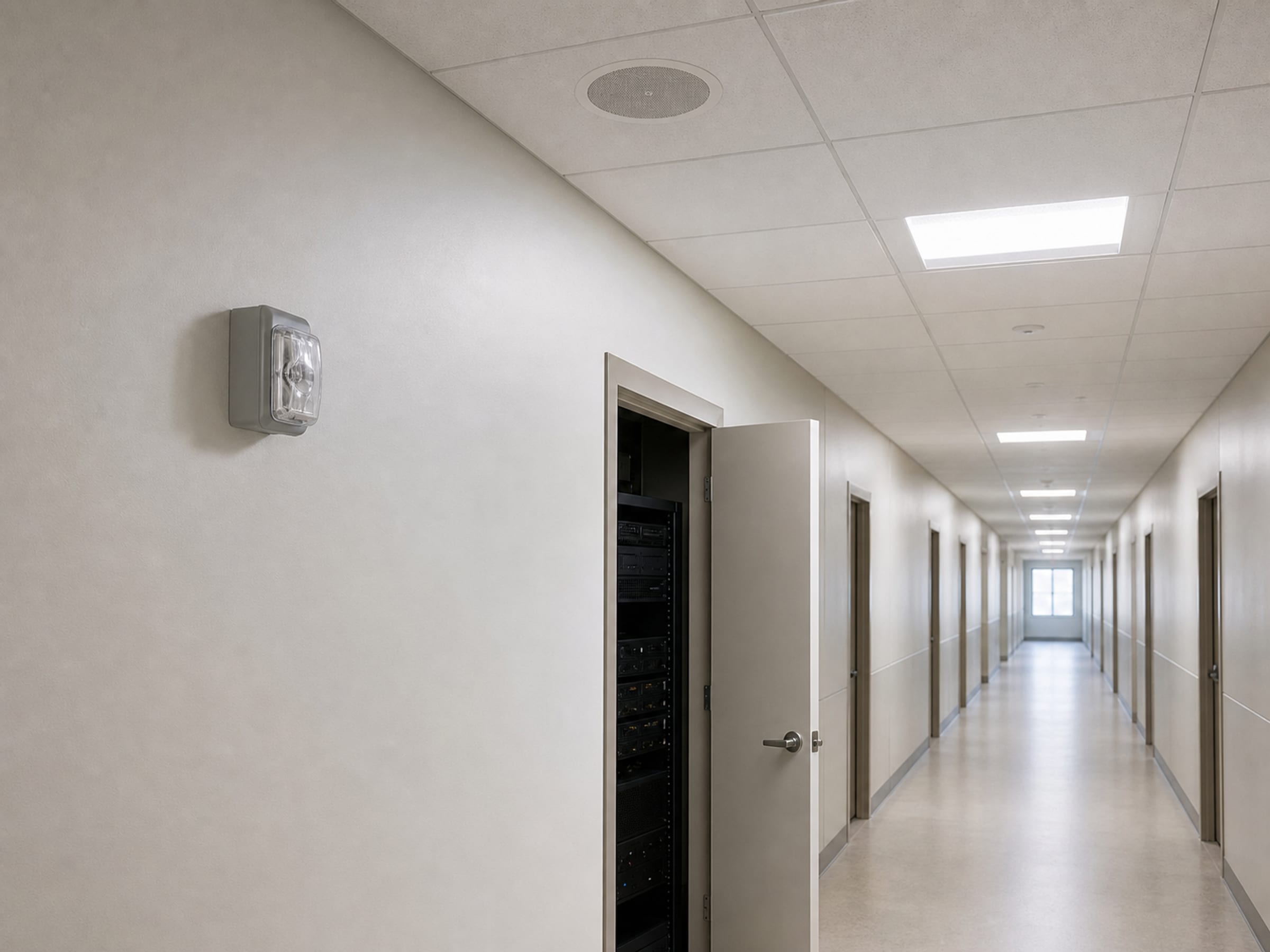
The failure mode of paging and notification audio is almost never silence. It is a loud, reverberant announcement in a hard-surfaced corridor that arrives as noise, or a gymnasium where the words wash into each other, or a plant floor where the message is simply beneath the ambient level. Intelligibility is the actual requirement, and it is a function of speaker placement and density, the acoustics of the space, amplifier headroom and the source audio — not of how many watts the amplifier is rated at. That is why coverage is designed per space rather than per building.
What a notification build is made of
The speaker layer comes first and is space-specific: ceiling speakers on a grid in an office fit-out, horn speakers outdoors and in industrial spaces, higher-density placement in reverberant halls, and weather-rated hardware anywhere exposed. More, quieter speakers almost always beat fewer, louder ones for intelligibility.
Then the amplification and distribution. Traditional constant-voltage distribution remains the workhorse for zoned building audio; IP-based endpoints have moved a great deal of that onto the data network, where each speaker or zone controller is a network device with a power draw. That decision changes the switching, PoE budget and cabling underneath, which is why we quote the network layer with the audio.
The source and control layer is where the notification software sits — the piece that triggers a message, selects zones, and integrates with whatever else your program uses. Those platforms do not carry priced rows in our catalog, so they are sourced on request through US distribution rather than named to look deeper than we are.
Audio, amplification and the network under it
AtlasIED, Harman, Shure and Bose carry priced rows across the audio estate; the switching layer is quoted with them.
Speakers and horns
AtlasIED and Harman carry priced inventory across ceiling, pendant, horn and weather-rated speakers. Placement density is quoted per space type rather than as a single figure for the building.
Amplifiers and distribution
Amplification with real headroom, zone distribution and the processing that keeps a message intelligible rather than merely loud. Quoted with the speaker count it has to drive.
The network path underneath
IP-based paging endpoints are network devices with a PoE draw. Allied Telesis and Netgear switching is quoted with the power budget totalled, because a notification system on an under-powered closet is a system with a single point of failure.
What stays yours to run
We make no life-safety claim and no code-compliance promise. Whether a system meets a fire alarm, emergency communication or life-safety code in your jurisdiction is a determination made by your designer of record, your authority having jurisdiction and, where the system is listed equipment, by the listing itself. We source and integrate audio hardware and its network path; we do not certify a system, and we would treat any supplier who did with caution.
The notification policy is equally yours. Who can activate a message, what it says, which zones it reaches, how it is tested and how often — that is your emergency management program. Where your program requires a particular listed system, tell us which and we will source to it rather than substituting toward what we happen to carry.
Notification and emergency-communication software platforms are sourced on request through US distribution. We do not hold priced inventory in that category today and will not name a vendor we cannot verify.
Notification and paging questions
Will this system meet our fire and life-safety code?
That determination belongs to your designer of record and your authority having jurisdiction, and often depends on specific equipment listings. We source and integrate the audio hardware and the network path it runs on. We do not certify systems or promise a compliance outcome — if a supplier tells you otherwise, ask them who signs it.
How many speakers does a space need?
Intelligibility, not volume, sets the answer, and it varies sharply with the acoustics. Reverberant halls, gymnasiums and hard-surfaced corridors need higher density than a carpeted office. We quote per space type from the plans you send rather than applying one figure to the whole building.
IP paging or traditional amplified zones?
Both are in service and both are quotable. Constant-voltage zones remain simple and robust for building audio; IP endpoints simplify zoning and integration but move the system onto your data network, with a PoE budget and switch resilience to plan. We quote the network layer either way so the dependency is visible.
Can you supply the notification software?
Those platforms are sourced on request through US distribution rather than priced in our catalog, and we quote them with honest lead times. We will not name a platform vendor we cannot verify in order to look broader than we are.
Notification background and the network under it
The solutions atlas
Every solution, by technology area and by customer.
By technology
By customer
- TAA & NDAA-889 Compliance Screening
- CMMC & CUI Solutions
- Federal & DoD
- State, Local & Education
- Healthcare
- Enterprise
- Rapid Procurement & GPC Buys
- Multi-Vendor Integration Projects
- eProcurement & Custom Catalogs
- FISMA Modernization
- CJIS-Compliant Justice Cloud & Local AI
- Federal Storage Modernization
- Government ERP & Business Systems Infrastructure
- Managed Procurement
- Secure AV & Conferencing
- Fiber Network Infrastructure
- Satellite & Resilient Connectivity
- Wavelength & Optical Transport
- Decentralized Data Centers
- Data Center Design & Build
Send the plans and the space types
Give us the building plans, the spaces that need coverage and any listed system your program requires. A Uniqcli specialist returns speakers, amplification and the network path per space — screened, availability-stated, with no compliance claim attached.