
Solutions
Courtroom Audio-Visual Systems
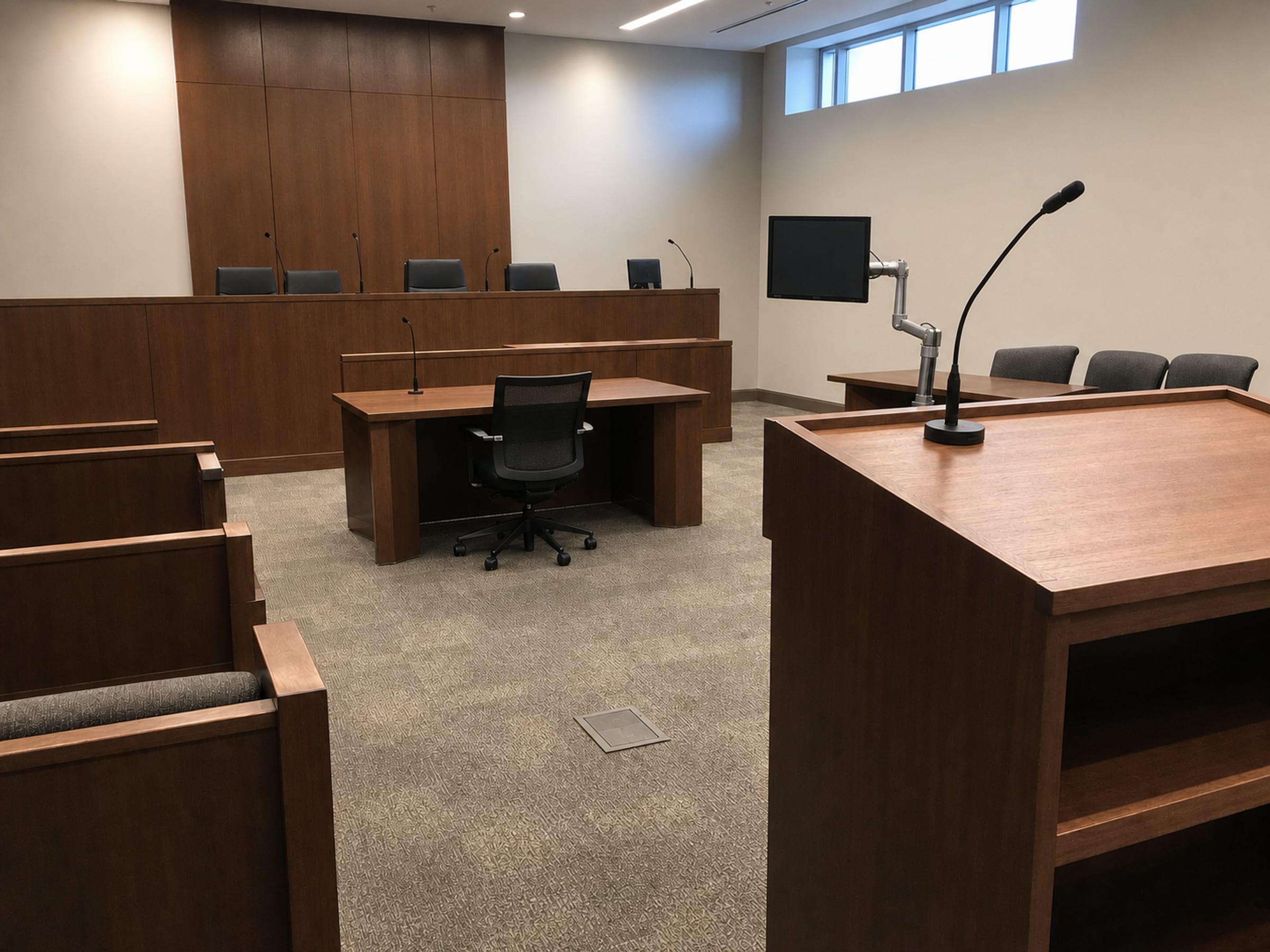
A courtroom needs intelligible audio, evidence everyone can see, and a record that holds up. We quote and integrate the microphones, displays, cameras and distribution against the room's actual sightlines and acoustics.
- Scope
- Microphones, evidence display, cameras, distribution, infrastructure
- Design driver
- The room's sightlines and acoustics, not a standard package
- Software
- Case management and transcription are sourced on request
- Boundary
- No evidentiary or records-admissibility claim is made or implied
Three requirements that the room itself sets
Every courtroom AV project reduces to the same three requirements: everyone in the room can hear what is said, everyone entitled to see the evidence can actually see it from where they sit, and the proceeding produces a record. What varies wildly is the room — a 1920s courtroom with plaster walls, a hard ceiling and fixed millwork sets a completely different problem than a 2015 hearing room with an acoustic ceiling and movable furniture. That is why courtroom AV resists the standard package. We survey the room, specify against its acoustics and sightlines, and quote the microphones, displays, cameras, switching and infrastructure as one integrated system with the installation scoped alongside it.
What each part of the system has to do
Audio is the hardest half and the half that gets cut first. A courtroom needs discrete pickup at the bench, the witness stand, the lectern and both counsel tables, with enough gain-before-feedback that a soft-spoken witness is intelligible without the room ringing. Gooseneck and boundary microphones at fixed positions, a mixer or DSP that handles the automixing, assistive-listening capability for the gallery, and loudspeakers positioned for even coverage rather than for volume. In a hard-surfaced historic room, the DSP work is most of the project.
Evidence display is a sightline problem before it is a display problem. Counsel, the bench, the witness, the jury box and the gallery each need a view, and they are not looking from the same place — which usually means several displays fed from one source rather than one large screen everyone squints at. The switching layer decides which source reaches which display, and it needs to be operable by a clerk during a proceeding, not only by an integrator. Where the bench needs the ability to cut the jury's feed, that is a switching requirement to state explicitly at design time.
Recording and remote participation have moved from optional to assumed. Cameras covering the bench, the witness and the well; audio feeds taken from the same DSP that serves the room rather than from a separate microphone set; and enough network capacity to carry a remote appearance without degrading the in-room audio. The room-side infrastructure — the racks, the cable pathways, the power and the AV distribution — is the part that is impossible to retrofit cheaply, so it is worth specifying generously the first time.
The system, line by line
Specified against the room survey and quoted with the integration work costed alongside the equipment. Naming a manufacturer describes the market, not a Uniqcli partnership or endorsement.
Microphones and audio processing
Gooseneck and boundary microphones at the fixed positions, wireless where a presenter moves, and the mixing and DSP behind them. Shure carries a deep priced microphone line on our catalog and Harman carries priced rows across amplification and loudspeakers. In a hard-surfaced room the processing is where the intelligibility is won, so it is specified against the survey rather than against a room size.
Loudspeakers and assistive listening
Even coverage across the bench, the well, the jury box and the gallery, plus assistive-listening capability where the room requires it. AtlasIED and Harman both carry priced speaker and amplification rows on the hub. Coverage is designed against the room's geometry and reverberation time — a specification that starts from speaker count rather than coverage is starting in the wrong place.
Evidence display and switching
Multiple displays fed from a switching layer a clerk can operate during a proceeding, including the ability to cut a feed to a specific position where the bench requires it. Crestron carries priced control and distribution rows on our catalog. Quoted with the mounts, the cable runs and the millwork integration, because those are what make it look permanent rather than bolted on.
Cameras and room infrastructure
Cameras for the record and for remote appearances, plus the racks, pathways, power and structured cabling that carry the whole system. AVer carries priced camera rows on the hub and Legrand carries a very deep priced line across AV infrastructure, cable management and power distribution. This is the layer that is expensive to retrofit, so it is specified with headroom.
What we do not claim
We make no claim about evidentiary sufficiency or records admissibility. Whether a recording satisfies a jurisdiction's requirements for the official record is a question of court rule and state law, answered by the court and its clerk, not by the equipment specification. We build the system the court's requirements describe; we do not certify that it produces an admissible record.
Court case-management, digital-recording and transcription software does not carry priced rows in our catalog. Where a project needs it, it is sourced on request through US distribution against the publisher's terms — we will tell you that plainly rather than implying shelf availability. Configuration of the court's own systems, and the operation of the room during proceedings, stay with the court.
Courtroom AV questions
Why does a courtroom need more than a couple of microphones?
Because a courtroom has several fixed speaking positions that must be independently intelligible — bench, witness, lectern and both counsel tables — and because the record and any assistive-listening feed are taken from the same audio path the room hears. One or two shared microphones produce a room where the soft-spoken witness is inaudible and the record is thin, which is exactly the failure mode these systems exist to prevent.
Can you work in a historic courtroom with fixed millwork?
That is the common case rather than the exception, and it changes the approach: pathways and device positions are constrained by what can be touched, and the acoustic problem is usually harder because the surfaces are hard and the ceiling is high. Those rooms need a survey before a specification, and more of the budget lands in processing and in careful device placement than in the display count.
Do you supply the recording or case-management software?
Those categories do not carry priced rows in our catalog. Where a project requires them, they are sourced on request through US distribution against the publisher's terms and quoted alongside the hardware. We will not describe software we do not stock as though it were on a shelf.
Court AV and adjacent records work
The solutions atlas
Every solution, by technology area and by customer.
By technology
By customer
- TAA & NDAA-889 Compliance Screening
- CMMC & CUI Solutions
- Federal & DoD
- State, Local & Education
- Healthcare
- Enterprise
- Rapid Procurement & GPC Buys
- Multi-Vendor Integration Projects
- eProcurement & Custom Catalogs
- FISMA Modernization
- CJIS-Compliant Justice Cloud & Local AI
- Federal Storage Modernization
- Government ERP & Business Systems Infrastructure
- Managed Procurement
- Secure AV & Conferencing
- Fiber Network Infrastructure
- Satellite & Resilient Connectivity
- Wavelength & Optical Transport
- Decentralized Data Centers
- Data Center Design & Build
Start with the room, not the package
Send the room dimensions, the construction, the fixed positions and what the court requires of the record. A Uniqcli specialist returns a specification and quote covering audio, display, switching, cameras and the infrastructure behind them. TAA (FAR 52.225-5) and NDAA §889 screening performed on every line before the quote goes out.