
Solutions
Edge AI Hardware
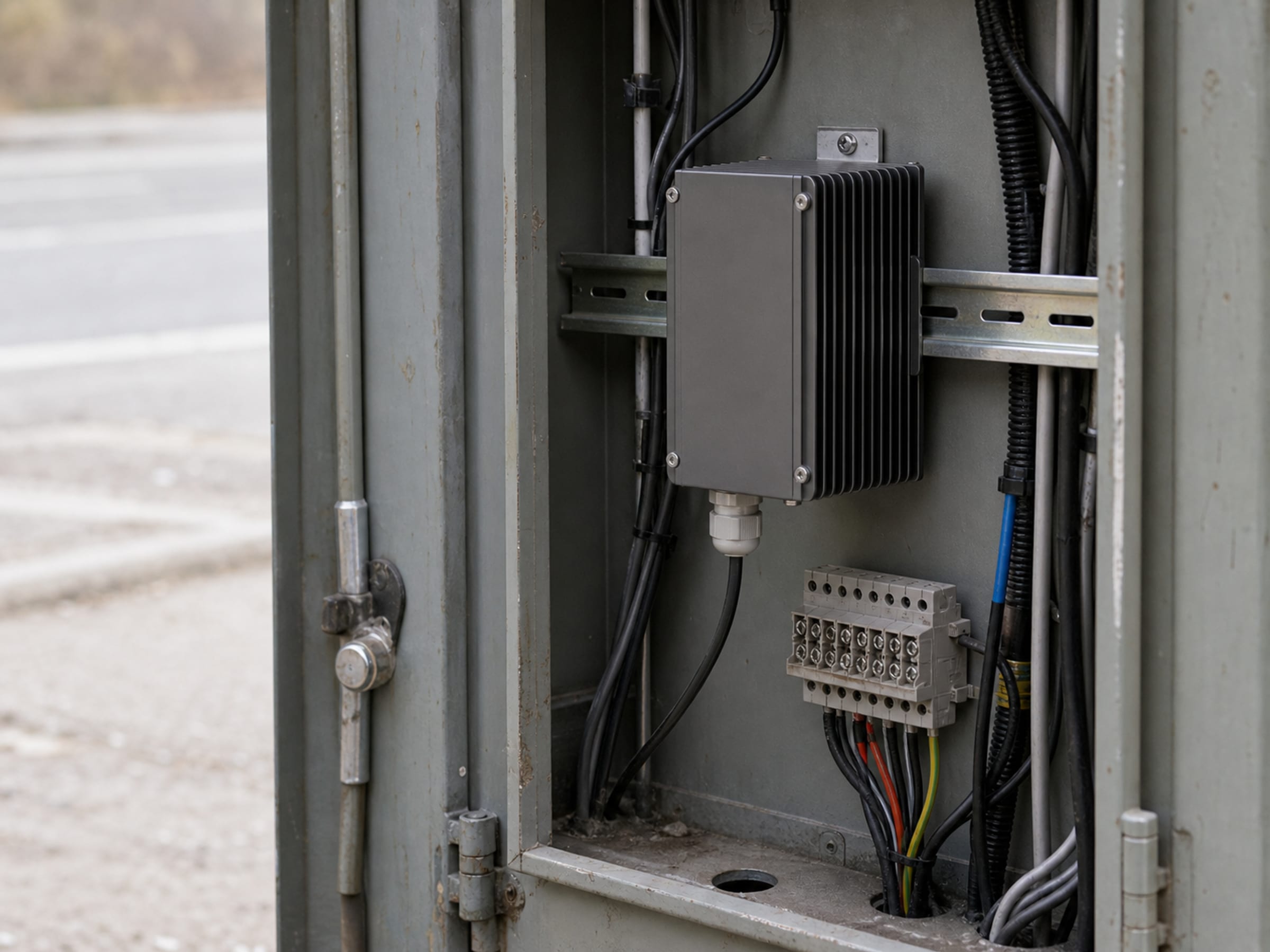
Inference at the edge is constrained by power, temperature and physical access. Uniqcli specifies and builds the field node, its power and its backhaul so a remote site does not need someone to drive out and reboot it.
- Category
- Inference nodes for field, vehicle and remote-site deployment
- We quote
- Edge accelerators, hosts, cellular backhaul, site power and antennas
- Designed for
- Unattended operation — remote power cycling and out-of-band access
- Boundary
- We build and stage the node; the model and the site's operation stay yours
Every truck roll is a design failure you paid for twice
Edge inference is not data-center inference in a smaller box. The site may have a single 15-amp circuit, no conditioned air, an ambient temperature that swings forty degrees across a day, and a locked cabinet three hours' drive from the nearest engineer. Those constraints — not raw throughput — decide the specification. What matters is a node that runs inside the available power and thermal envelope, a backhaul path that comes back on its own after an outage, and enough remote access that a stuck process is a command rather than a journey. Uniqcli specifies, builds and stages that node, including the power and connectivity around it.
What actually kills edge deployments
Power is first, and it is rarely the wattage everyone quotes. It is the circuit that is genuinely available, the inrush at power-on, the UPS runtime needed to ride through a brief outage, and whether anything on site can cycle a wedged device remotely. A switched PDU or a UPS with remote outlet control is a small line item that eliminates the most common cause of a site visit.
Thermal is second. Enclosures in a plant room, a roadside cabinet or a vehicle bay operate far outside a data hall's assumptions, and a node that throttles at noon every day looks like a software bug for months before anyone measures it. We specify against the real ambient range and note the operating limits the platform vendor publishes, rather than quietly hoping.
Connectivity is third. Wired backhaul where it exists, cellular where it does not, and increasingly both — with the failover behavior specified rather than assumed. Antenna placement, cable loss and mounting are part of that specification; a well-chosen router with a badly mounted antenna is an unreliable site.
The field node and everything that keeps it up
Quoted as a site kit rather than a parts list, and screened per line before the quote goes out. Naming a manufacturer describes the market, not a Uniqcli partnership or endorsement.
Edge inference nodes
NVIDIA edge and embedded accelerator lines, and compact Lenovo hosts where a small-form-factor server suits the cabinet better than an embedded module. Sized to the model and the power envelope the site can actually deliver.
Cellular and fixed backhaul
Peplink and Cradlepoint routers and gateways for cellular backhaul, failover and bonded links, quoted with the carrier interface and antenna configuration the site needs rather than a bare appliance.
Site power
CyberPower and Eaton UPS units and switched power distribution sized for ride-through and — just as important — for remote power cycling, so a wedged node is a command instead of a drive.
Antennas and mounting
Antennas, mounts, enclosure hardware and the low-loss cabling between them, specified for the placement the site allows rather than the placement a datasheet assumes.
Configured as a site kit, not a parcel of parts
A field deployment goes badly when parts arrive separately and someone assembles them on a tailgate. We build the kit as a unit: node imaged and configured, router provisioned, power hardware fitted, everything labeled and packed so an installer with no context can put it in place and bring it up.
Rugged and environmentally hardened chassis requirements are specified against the actual site conditions and sourced through US distribution. Where a build needs mechanical or environmental engineering rather than integration, we say so — the rugged-compute capability statement lives on our electronics capability page and describes what we do and do not perform.
- Node imaged and configured before it leaves our facility
- Router provisioned with the carrier profile and failover behavior set
- Remote power cycling designed in, not added after the first site visit
- Labeled, kitted and packed for an installer working from a checklist
- Identical build across sites, recorded and repeatable
Edge deployment questions
How many sites does this make sense for?
The staging economics improve with count, but the approach is the same for five sites or five hundred. What changes is how much the identical-build discipline saves you — at scale, one undocumented variation becomes a support problem that repeats itself everywhere.
Can you handle the cellular data plans?
No. Carrier contracts and data plans are procured directly by you or through your carrier representative. We quote and provision the router hardware, specify the antenna configuration, and hand over a device ready for the SIM or eSIM profile you supply.
Do you install at the sites?
We build, configure, kit and stage. Physical installation at each site is normally performed by your field team or an installation contractor, working from the labeling and documentation we ship with the kit. Tell us what the install plan looks like and we will package to suit it.
What about genuinely rugged environments?
Environmentally hardened and vehicle-mount hardware is sourced against the site's real temperature, shock and ingress requirements. We are specific about what we perform — sourcing, configuration, integration and staging — and we do not claim environmental engineering or certification testing we do not do.
Related edge and field infrastructure
The solutions atlas
Every solution, by technology area and by customer.
By technology
By customer
- TAA & NDAA-889 Compliance Screening
- CMMC & CUI Solutions
- Federal & DoD
- State, Local & Education
- Healthcare
- Enterprise
- Rapid Procurement & GPC Buys
- Multi-Vendor Integration Projects
- eProcurement & Custom Catalogs
- FISMA Modernization
- CJIS-Compliant Justice Cloud & Local AI
- Federal Storage Modernization
- Government ERP & Business Systems Infrastructure
- Managed Procurement
- Secure AV & Conferencing
- Fiber Network Infrastructure
- Satellite & Resilient Connectivity
- Wavelength & Optical Transport
- Decentralized Data Centers
- Data Center Design & Build
Describe the site, not just the box
Power available, ambient range, backhaul options and how far the nearest engineer is. We will quote a site kit built to come back up on its own.