
Short answer
Edge AI runs a trained model on hardware at the site that produces the data, so inference happens locally instead of in a remote data centre. Training stays central; inference moves out. Choose it when a decision must beat a network round trip, when the link is intermittent or expensive, or when the raw data should not leave the site — otherwise the cloud is simpler.
Key facts
- The split is training versus inference: training is compute-heavy and stays central; inference is lighter and latency-sensitive, so it is what moves outward.
- Four drivers push it outward — latency, intermittent or costly connectivity, bandwidth cost on raw video, and keeping regulated data on site.
- Edge sites are not data centres. The hardware is industrial: sealed, often fanless, wide-temperature, vibration-tolerant, with long production lifecycles.
- Compute runs from a CPU with an integrated neural engine, through embedded modules such as NVIDIA Jetson, to low-profile cards sized for a 1U or 2U chassis.
- NVIDIA's L4 is the reference low-profile accelerator for this shape: a single-slot card with 24 GB of memory that fits a space- and power-constrained server.
- Edge AI does not replace the cloud. The usual design trains centrally, infers at the edge, and sends summaries and exceptions upstream.
By Uniqcli Team
Edge AI is the practice of running artificial-intelligence models — most often the inference step, where a trained model makes a prediction or decision — on computing hardware located at or near the place the data is generated, rather than shipping that data to a centralized cloud or data center to be processed. The "edge" is the boundary of the network closest to the physical world: a camera over a production line, a computer bolted inside a vehicle, a sensor gateway in a substation, a kiosk in a store. Running the model there means the decision happens locally, in milliseconds, without a round trip across the internet.
The idea rests on separating two distinct phases of machine learning. Training — teaching a model from large datasets — is compute-heavy and still usually happens centrally on powerful servers or in the cloud. Inference — applying the finished model to new, live data — is comparatively lightweight and latency-sensitive, which makes it a natural fit for the edge. Edge AI pushes that inference step outward onto industrial computers, rugged endpoints, and compact servers so analysis happens where the data lands, and only summaries, alerts, or exceptions travel upstream.
How does edge AI work?
A typical edge-AI pipeline starts with a sensor or camera producing data, feeds it into local compute, runs the trained model to reach a result, and acts on that result on the spot — flagging a defect, triggering a stop, issuing an alert — before anything leaves the site. To run neural networks efficiently in that footprint, the local device often carries a dedicated accelerator: a GPU, a neural processing unit (NPU), a vision processor, or an FPGA. The model itself is trained elsewhere, then compiled and optimized for the target hardware and deployed to the device, where it is updated remotely as newer versions are released.
The cloud does not disappear in this arrangement; the two work together. Training and fleet management stay central, while inference runs at the edge, and models are periodically retrained on fresh data and pushed back out to the devices. The device also acts as a filter: instead of streaming every video frame or sensor reading upstream, it sends events, exceptions, and distilled metrics. That is why edge AI is often described as moving the compute to the data rather than moving the data to the compute.
Why run AI at the edge?
The first two drivers are latency and connectivity. Some decisions cannot wait for a cloud round trip — a safety stop on a machine, a collision warning in a moving vehicle, a quality-control reject on a fast line — and need responses measured in single-digit milliseconds that a network hop cannot guarantee. Many edge sites also have intermittent, expensive, or nonexistent connectivity: a service vehicle, a remote pipeline, a ship at sea, a temporary field position. Local inference keeps working when the link is down, and it avoids continuously streaming high-bandwidth video to a distant data center just to make a decision that could be made on-site.
The remaining drivers are data control, cost, and resilience. Keeping raw data — video of people, patient information, sensitive operational or field data — on the local system rather than sending it offsite can simplify privacy, residency, and security obligations. Processing locally cuts bandwidth and cloud-compute bills when only refined results travel upstream instead of the full firehose. And it removes a single point of failure: the local system keeps making decisions even when the wider network or the cloud is unavailable, which matters wherever a pause in the process is unacceptable.
Where edge AI runs: the hardware
The physical environment is the defining constraint. Edge sites are rarely climate-controlled data centers — they are factory floors, roadside cabinets, vehicle interiors, and outdoor enclosures — so the hardware is a class of industrial and rugged systems built to run unattended in harsh conditions: sealed against dust and moisture, frequently fanless so there are no moving parts to pull contaminants inside, tolerant of a wide operating-temperature range, resistant to shock and vibration, and supported over long production lifecycles so a fleet can be maintained for years. Advantech illustrates this category well; the Uniqcli catalog lists more than 1,800 Advantech industrial and edge-computing items, from compact fanless boxes to rackmount edge systems. For endpoints doing AI-assisted work in the field — inspection, telematics, public safety — rugged tablets and laptops apply, and the catalog carries the Panasonic Toughbook line among more than 500 Toughbook listings.
The compute itself spans a range. Light inference can run on a capable CPU or an integrated neural engine; heavier machine-vision and generative workloads call for a discrete accelerator. Because edge chassis are tight on space, power, and cooling, low-profile and half-height accelerators matter — for example, the 24 GB, low-profile / half-height NVIDIA L4 class of card that fits a compact server without demanding a full-height slot or a large thermal budget. Between the rugged endpoint and the full data center sits a category of compact and rackmount edge servers that place data-center-style compute in a smaller, more environmentally tolerant package close to the operation. One planning note that follows from the catalog: most edge and industrial hardware is configured to order rather than held as shelf stock, so lead time is part of the specification, not an afterthought.
Edge AI vs cloud AI: what's the difference?
Cloud AI centralizes everything: data flows to large shared compute where models are trained and often run, giving effectively unlimited scale and straightforward central management, at the cost of latency, bandwidth, and sending data offsite. Edge AI runs the inference step locally for speed, autonomy, and data control, at the cost of constrained per-device compute, hardware at every site, and the overhead of managing a distributed fleet. The two are complementary rather than competing — most real deployments use both.
The common pattern is hybrid: train in the cloud, infer at the edge, and send only distilled results back for aggregation, dashboards, and the next round of training. Deciding what runs where comes down to a few practical questions — how fast the decision has to be, how reliable the network link is, how sensitive the data is, and how much it costs to move that data. Workloads that are fast, disconnected, or privacy-bound tend to move to the edge; everything else can stay central.
What should you weigh when specifying edge AI hardware?
Start with the environment and the model. Match the enclosure and thermal design to the site — temperature range, dust and moisture, vibration, and whether fanless or filtered airflow is appropriate — then size the compute to the actual model and frame rate. An oversized accelerator wastes power and heat budget you may not have at the edge, while an undersized one drops frames or stalls. Confirm the power input (AC, wide-range DC, or PoE), the physical fit (low-profile or half-height slots), the I/O needed for the cameras and sensors, and the connectivity — wired, cellular, or private wireless — including how the device behaves when the link drops.
Then plan for the fleet and the risk. Edge devices live outside the data center, so remote management, secure boot, encryption, and a zero-trust posture matter as much as raw performance, because every camera and gateway is a potential entry point. Favor long product-availability windows so a deployed fleet can be imaged and maintained consistently. And for regulated buyers, supply-chain provenance belongs in the specification: as part of building a quote, Uniqcli screens each line for country of origin at the substantial-transformation level and for NDAA §889 covered-vendor status. That is a screening service performed on the sourcing, not a certification Uniqcli holds — the origin documentation is attached to the quote so you have the records to support your own determination.
Key takeaways
- Edge AI runs machine-learning inference on hardware near where data is created — a factory line, vehicle, field site, or store — instead of sending the data to the cloud.
- It separates training (compute-heavy, still usually central) from inference (lightweight and latency-sensitive) and pushes the inference step out to the edge.
- The drivers are latency (decisions too fast for a cloud round trip), connectivity (intermittent or costly links), bandwidth, data sovereignty and privacy, cost, and resilience when the network is down.
- Edge sites are not data centers, so the hardware is industrial and rugged: sealed, often fanless, wide operating-temperature, and vibration-tolerant, with long production lifecycles.
- Compute ranges from CPUs and integrated neural engines to low-profile / half-height accelerators that fit power- and space-constrained chassis; compact and rackmount edge servers sit between the endpoint and the data center.
- Spec to the environment and the model first, then plan the fleet — remote management, secure boot, and a zero-trust posture, plus supply-chain screening for country of origin and NDAA §889 handled as a service on the quote.
Shop it at Uniqcli
Parts for this job
Compact edge node
Lenovo
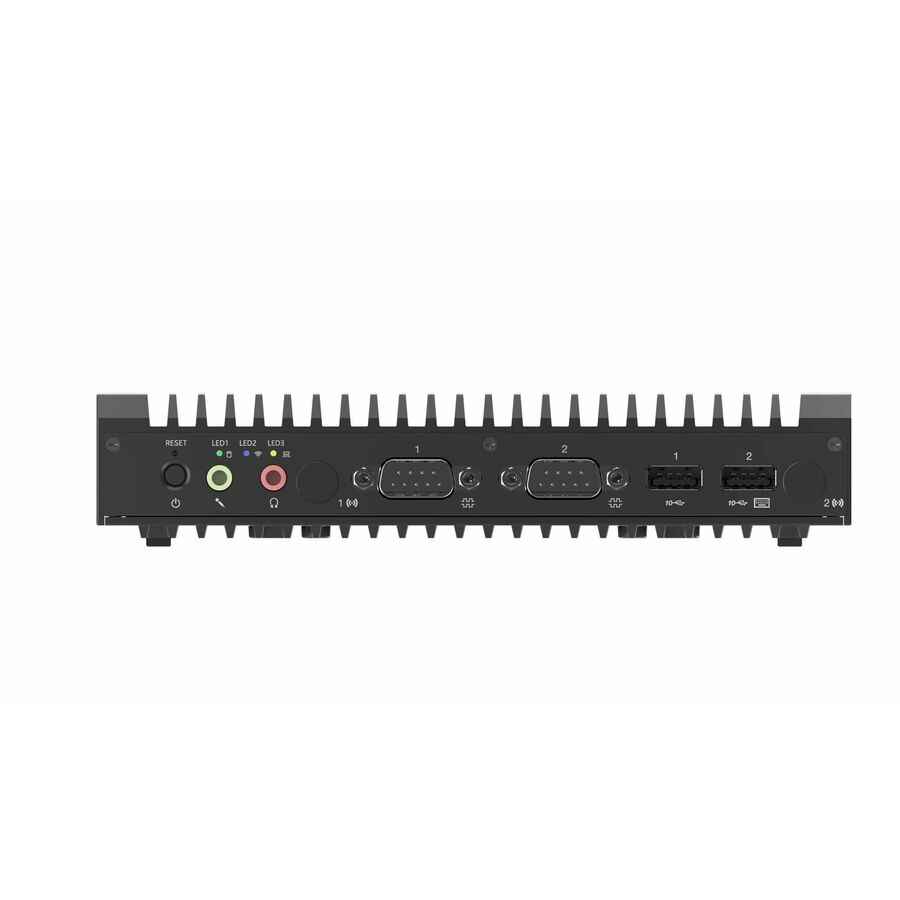
SE10 1.90 GHz W11IoTLTSC 16.0GB 512GB PCIe
12NK001JUT
A ThinkEdge SE10 with a low-power Atom, 16 GB and a 512 GB NVMe on an IoT LTSC build — the small sealed box for a shop floor or a closet, not a rack.
Request pricingEmbedded accelerator
Advantech
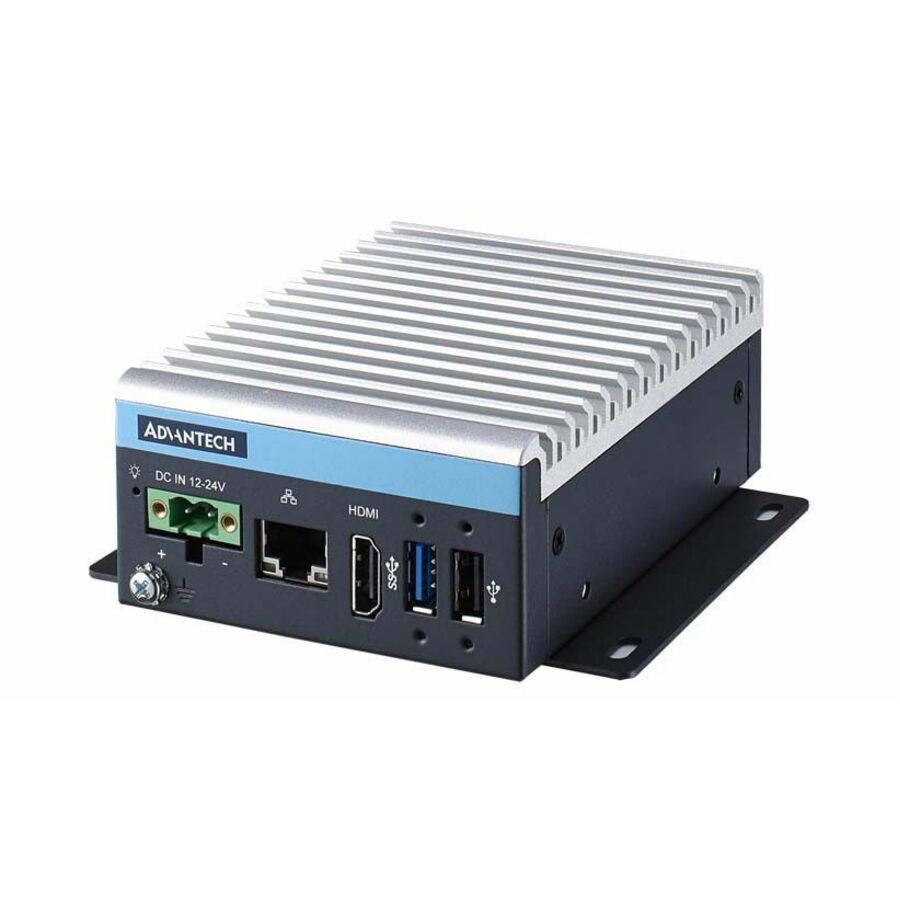
Advantech MIC-710AILX Industrial Computer
MIC-710AILX-00B1
An Advantech MIC-710AILX industrial computer built on an NVIDIA embedded module with 8 GB of LPDDR4 — the shape for camera-side vision inference.
$1,319.21Back-orderedMore headroom, still industrial
Lenovo
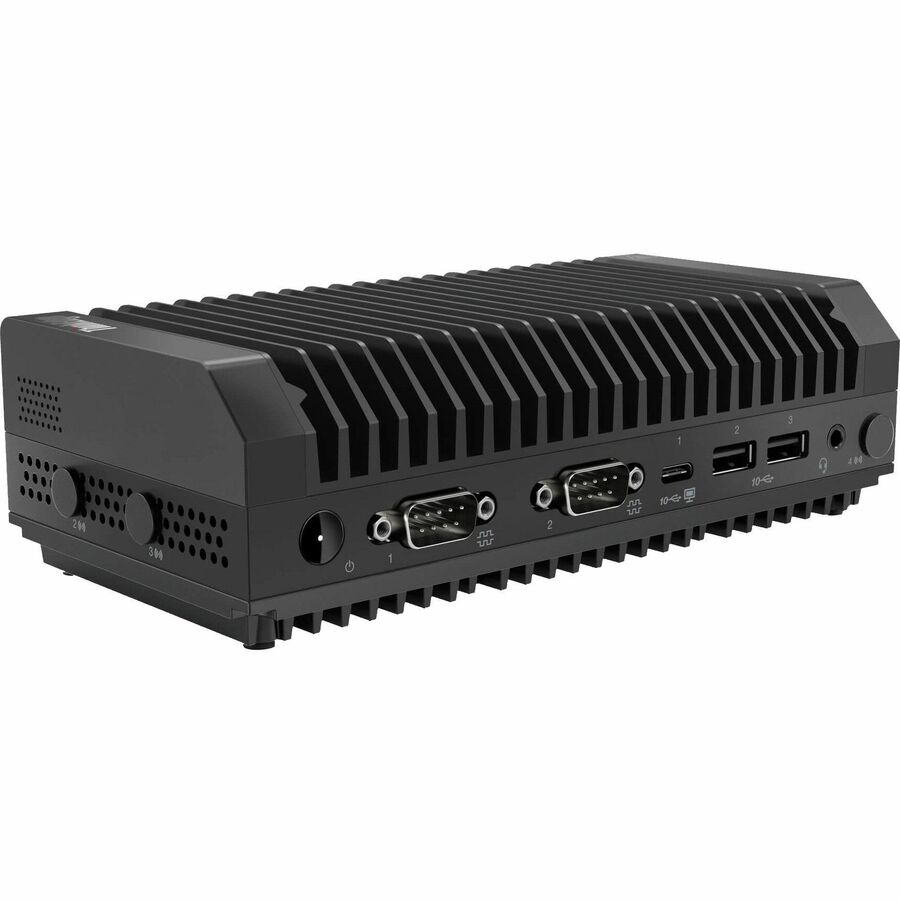
Lenovo ThinkEdge SE30 11NA002LUS
11NA002LUS
A ThinkEdge SE30 on an 11th-gen embedded Core i5 for sites that run several models, or a model plus the local application feeding it.
Size to the model and the environment first; the rack decision comes after.
Request pricingFrequently asked
- Is edge AI the same as edge computing?
- Not quite. Edge computing is the broader practice of processing data near where it is generated instead of in a central cloud. Edge AI is a subset of that: specifically running machine-learning models — usually the inference step — on edge hardware. All edge AI is edge computing, but plenty of edge computing (filtering, protocol translation, local storage, caching) involves no AI at all.
- Does edge AI replace the cloud?
- No. Training large models and managing device fleets still usually happens centrally, and the cloud aggregates results across many sites. Edge AI handles the fast, local inference step. The common design is hybrid: train centrally, infer at the edge, and send distilled results back upstream for dashboards, aggregation, and the next round of training.
- Why not just run everything in the cloud?
- Latency, connectivity, bandwidth, and data control. Some decisions must happen in milliseconds with no network round trip; some sites have poor or no connectivity; streaming raw video to the cloud is expensive; and keeping sensitive data on-site can simplify privacy and residency obligations. Edge AI addresses all four, which is why it is used even where cloud connectivity exists.
- What hardware do you need for edge AI?
- It depends on the model and the environment. Light inference can run on a capable CPU or an integrated neural engine, while heavier vision or generative workloads need a discrete accelerator — often a low-profile or half-height card so it fits a compact chassis. In harsh settings the platform should be industrial-grade: sealed, often fanless, wide-temperature, and vibration-tolerant, with rugged tablets or laptops used for field endpoints.
- What is a low-profile accelerator, and why does it matter at the edge?
- A low-profile (half-height) accelerator is a shorter GPU or AI card that fits a compact or 1U/2U chassis without a full-height slot, and it typically draws less power and produces less heat than a full-size card. That matters at the edge because edge servers are constrained on space, power, and cooling. Cards such as the 24 GB, low-profile NVIDIA L4 class are designed for exactly that footprint.
- Does Uniqcli certify that edge AI hardware is TAA-compliant or Section 889-clear?
- No — issuing that as a certification is not something Uniqcli does. What we provide is a screening service: as part of building a quote, each line is screened for country of origin at the substantial-transformation level and for NDAA §889 covered-vendor status, and the origin documentation is attached to the quote so you have the records to support your own determination. Assemble your part numbers in the catalog or the BOM Builder and submit the list through Get a quote to have it applied line by line.
Sources
- 1.NVIDIA — L4 Tensor Core GPUnvidia.com
- 2.NVIDIA — Jetson embedded systems for edge AInvidia.com
Keep reading