
Solutions
AI Storage Infrastructure
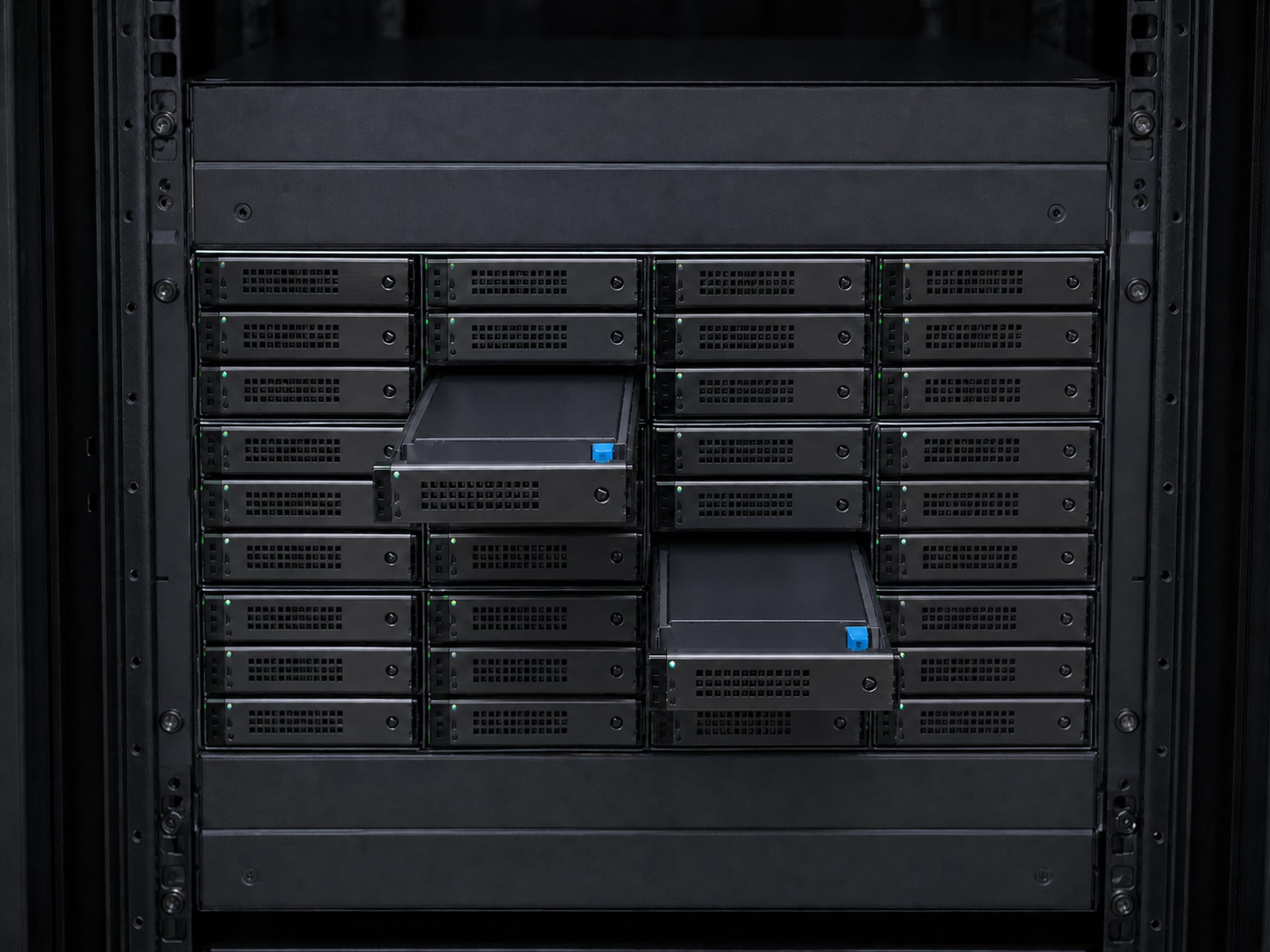
Idle accelerators are usually a storage problem. Uniqcli sizes the flash tier, the capacity tier and the network path between them to keep GPUs fed, and quotes it as part of the cluster instead of six weeks after it.
- Sized against
- Dataset size, read pattern and sustained throughput per node
- We quote
- NVMe scratch, flash arrays, capacity tiers and the storage network path
- Boundary
- We supply the storage; the filesystem, the data and its governance stay yours
Expensive silicon waiting on cheap disks
The most common disappointment in an AI deployment is a set of accelerators running at a fraction of their capability because the data cannot arrive fast enough. Training reads the same dataset over and over in patterns that punish spinning media. Fine-tuning and evaluation add small random reads that punish it further. Inference has a quieter but real requirement: loading model weights after every restart, and holding a growing archive of inputs and outputs that someone will eventually need to retain. Uniqcli sizes storage against the read pattern rather than the headline capacity, and quotes it with the cluster so the throughput question gets answered before the GPUs arrive, not after.
Three jobs, not one storage purchase
The scratch tier lives inside the node: NVMe drives holding the working set close enough to the accelerators that the network never enters the picture. It is sized by working-set size and rebuilt cheaply, so it is the right place to spend on speed rather than on resilience.
The shared tier is the one that decides whether a cluster scales. It has to sustain the aggregate read rate of every node at once, which is a bandwidth calculation rather than an IOPS marketing number — and it has to do so over a network path with enough headroom that the array is never being throttled by the switch in front of it. This is where flash arrays, drive shelves and the adapters and optics behind them get quoted as one item rather than three separate hopeful purchases.
The capacity tier is where datasets, checkpoints and outputs live once they are no longer hot. High-capacity drives, drive cabinets and the enclosures around them are far cheaper per terabyte, and the discipline is simply deciding what moves there and when. That policy is yours; the shelves are ours to quote.
Storage lines that sit under an AI cluster
Quoted against sustained throughput, not headline capacity, and screened per line before the quote goes out. Naming a manufacturer describes the market, not a Uniqcli partnership or endorsement.
NVMe scratch and flash
Micron, Western Digital and Kingston NVMe for node-local working sets, sized to the dataset that has to stay next to the accelerators. Endurance rating is quoted deliberately — training rewrites scratch far harder than a general-purpose server does.
Shared arrays and shelves
Nexsan storage arrays and drive cabinets sized to the aggregate read rate of the whole node group, quoted with the host adapters and cabling that connect them so the array is not delivered without a path to the cluster.
Capacity and archive tier
High-capacity drives from Seagate and Western Digital, plus the drive cabinets and enclosures around them, for checkpoints, datasets and retained outputs that no longer need flash economics.
What stays yours to run
We do not operate storage, host data, or run a filesystem on your behalf. The parallel or shared filesystem, the namespace design, the snapshot and retention policy, the access controls and the classification of what lives where are all program decisions with consequences we are not positioned to own.
What we own is the hardware chain and its integrity: drives, arrays, shelves, adapters, optics and cabling sourced through US distribution, screened per line for origin and covered-entity status, configured to your specification and delivered with a serial and configuration record. Where a design needs a filesystem or data-management product we cannot verify in our catalog, we say it is sourced on request rather than implying we shelve it.
AI storage questions
How do we know how much throughput we need?
Start with the number of nodes, the size of the working dataset and roughly how long an epoch or a pass should take. That converts into a sustained aggregate read rate, which is the number that actually sizes an array. If you do not have those figures yet, we will quote a configuration with headroom and say clearly which assumption we used.
Is NVMe always the right answer?
For the hot tier under an accelerator, usually. For checkpoints, archives and cold datasets it is frequently a waste of budget that would buy more capacity elsewhere. We quote the tiers separately so the trade-off is visible rather than buried in one number.
Can you quote storage for hardware we already have?
Yes. Adding NVMe, drive shelves or a faster host adapter to an existing array or server group is a common upgrade, and we will tell you when the existing controller or PCIe topology means the upgrade would not deliver what the drives are capable of.
Related storage and AI infrastructure
The solutions atlas
Every solution, by technology area and by customer.
By technology
By customer
- TAA & NDAA-889 Compliance Screening
- CMMC & CUI Solutions
- Federal & DoD
- State, Local & Education
- Healthcare
- Enterprise
- Rapid Procurement & GPC Buys
- Multi-Vendor Integration Projects
- eProcurement & Custom Catalogs
- FISMA Modernization
- CJIS-Compliant Justice Cloud & Local AI
- Federal Storage Modernization
- Government ERP & Business Systems Infrastructure
- Managed Procurement
- Secure AV & Conferencing
- Fiber Network Infrastructure
- Satellite & Resilient Connectivity
- Wavelength & Optical Transport
- Decentralized Data Centers
- Data Center Design & Build
Size the storage before the GPUs arrive
Send the node count, the dataset size and the read pattern. We will quote the scratch, shared and capacity tiers with the network path that connects them.