
Cybersecurity
OT & ICS Security
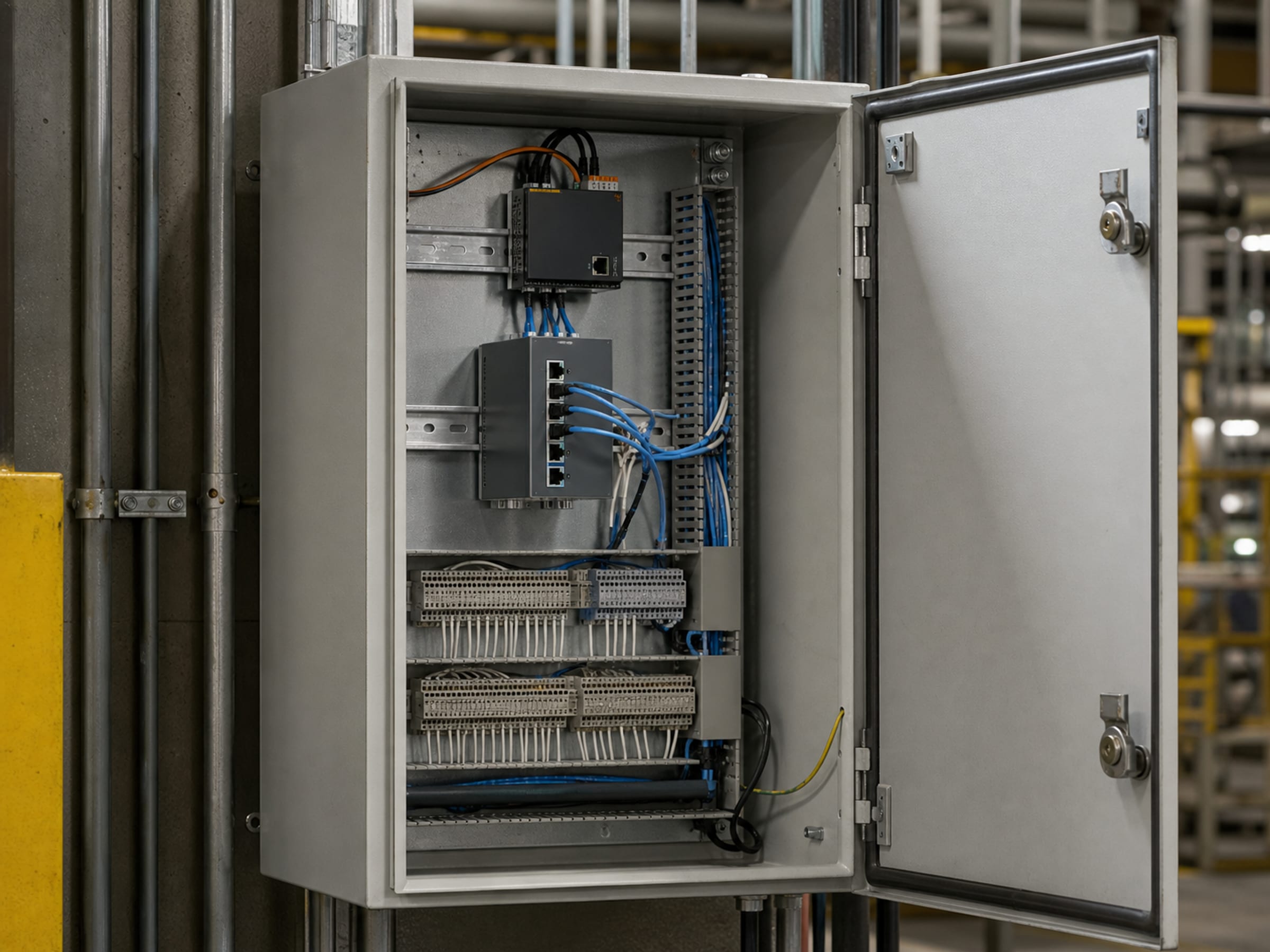
Plant and utility networks need gear that survives the environment and a boundary that does not drop a process. We quote the industrial switching, the appliance and the power protection as one package, and stage it before it goes near a live line.
- Category
- Plant-floor and substation networking, boundary control and power protection
- What we quote
- Industrial switching, firewalls, industrial UPS and enclosure hardware
- Environment
- Temperature range, mounting and power form factor priced as requirements
- Boundary
- We never touch a live process; commissioning stays with your controls team
The constraint is the environment, not the threat model
Operational technology networks fail procurement on physical grounds long before anyone argues about security architecture. A cabinet on a plant floor runs hotter than a comms room and has no air conditioning. A substation enclosure sees temperature swings a commercial switch is not rated for. There is often no rack at all — just a DIN rail, a 24-volt supply and a cable run that was installed before the equipment being replaced. And the process cannot stop, which means a change window measured in minutes rather than hours, scheduled around production. Those constraints decide the bill of materials. We quote to them: industrial-rated switching with the right mounting and temperature range, a boundary appliance sized for the segment, and power protection that keeps a controller alive through a sag, all staged and configured before it goes near a live line.
What an OT bill of materials has to account for
Start with the physical layer. Mounting form factor — DIN rail, panel or rack — and the temperature range at the worst point in the year. Power input, which is frequently 24 or 48 volts DC rather than mains, and often redundant. Media, because fiber between buildings is standard where copper would carry a ground potential difference. Ingress rating where the equipment sits outside a cabinet. None of these appear on a commercial switch datasheet in a way that survives a plant environment.
Then the boundary. The segment between the process network and the business network is where a firewall belongs, and the sizing question is unusual: throughput is often trivial, but availability is absolute and the ruleset is narrow and static. A modest appliance with a well-defined policy, deployed in a pair, is the ordinary answer — not a large chassis sized for inspected internet traffic.
Finally power. Controllers, historians and the network gear that connects them ride through sags on industrial-rated UPS with the right form factor and battery chemistry for the ambient temperature. Battery life in a hot cabinet is materially shorter than the datasheet figure, which is a maintenance cost as much as a specification.
Equipment sized for the plant, not the office
Priced lines from the hub catalog. Industrial-rated and DIN-rail mountable variants are a narrower set than the general range, so the quote states which specific models meet the environmental requirement. Naming a manufacturer describes the market, not a Uniqcli partnership or endorsement.
Industrial and DIN-rail switching
Hardened and DIN-rail mountable switches quoted against the temperature range, power input and mounting the cabinet actually has. Allied Telesis managed switching covers the wider estate where the environment is closer to commercial.
Boundary appliances
SonicWall and WatchGuard appliances at the process-to-business boundary, sized for availability and a narrow static ruleset rather than inspected internet throughput. Quoted in pairs where the segment cannot tolerate a single point of failure.
Industrial UPS and power
Eaton, Schneider Electric and Vertiv industrial UPS lines, quoted with runtime sized against the controllers on the circuit and battery chemistry chosen for the ambient temperature the cabinet really runs at.
Enclosures, cabling and staging
Cabinet hardware, fiber and copper runs, and the integration work to assemble and label a cabinet before it ships — so the change window is a swap rather than a build. Scoped on the same order as the equipment.
What we need to specify OT equipment correctly
- Mounting form factor available — DIN rail, panel, rack — and the space in the cabinet
- Operating temperature range at the worst point in the year, not the nameplate ambient
- Power input and whether redundant feeds are required
- Media and distances, including any inter-building runs that need fiber
- The change window the site can actually give you, and the season it falls in
- Which vendor's controllers are on the segment, so protocol handling is not assumed
OT and ICS questions
How is OT security different from IT security?
The priorities invert. IT ranks confidentiality first; OT ranks availability and safety first, because the system controls a physical process that cannot be paused for a patch cycle. That changes the equipment — hardened, long-life, environmentally rated — and it changes the design toward segmentation and monitoring rather than aggressive inline blocking.
Do you carry dedicated OT security platforms?
Not as priced inventory. The specialist OT-monitoring and asset-discovery platforms are sourced on request through US distribution against the product you name. What we carry priced depth in is the infrastructure layer — industrial switching, boundary appliances, power protection and enclosure hardware.
Can equipment be staged before it reaches the plant?
Yes, and it usually should be. Cabinet assembly, configuration, firmware baselining and labeling can be done before delivery, so the site change window is a physical swap rather than a build. We do not commission against a live process — that stays with your controls engineers and their vendor.
The solutions atlas
Every solution, by technology area and by customer.
By technology
By customer
- TAA & NDAA-889 Compliance Screening
- CMMC & CUI Solutions
- Federal & DoD
- State, Local & Education
- Healthcare
- Enterprise
- Rapid Procurement & GPC Buys
- Multi-Vendor Integration Projects
- eProcurement & Custom Catalogs
- FISMA Modernization
- CJIS-Compliant Justice Cloud & Local AI
- Federal Storage Modernization
- Government ERP & Business Systems Infrastructure
- Managed Procurement
- Secure AV & Conferencing
- Fiber Network Infrastructure
- Satellite & Resilient Connectivity
- Wavelength & Optical Transport
- Decentralized Data Centers
- Data Center Design & Build
Specify equipment for the environment you have
Send the cabinet constraints, the temperature range, the power form factor and the change window. We return a bill of materials of industrial-rated equipment, staged and labeled so the site visit is a swap rather than a build.