
Best HDMI Matrix Switchers for Conference Rooms and Control Rooms
Cross-point HDMI switching for boardrooms, classrooms, operations floors and signage walls — every unit on this page states its own input and output count in the manufacturer's title.
HDMI matrix switchers in stock at Uniqcli
How to choose →A curated selection with live pricing — in-stock lines first, then back-ordered lines with a typical lead time. Every line is sourced through US distribution and screened for NDAA §889 status before checkout, with TAA verified on request.
- EatonEaton Tripp Lite Series 4x4 HDMI Matrix Switch with Video Wall Controller - 4K 60 Hz, 4 HDMI Inputs, 4 HDMI Outputs, HDR, 4:4:4, Multi-Resolution Support - 3840 x 2160 - 4K, 4K UHD - 1080p4 x 4 - Display, Monitor, TV, Projector, Blu-ray Disc Player, Notebook - 4 x HDMI OutB119-4X4-4K6-VW
$1,545.05
$1,421.45
165 in stock







Small room, 4x2
Eaton
Tripp Lite series B119-4X2-4KL 4x2 HDMI Matrix Switch/Splitter
B119-4X2-4KL
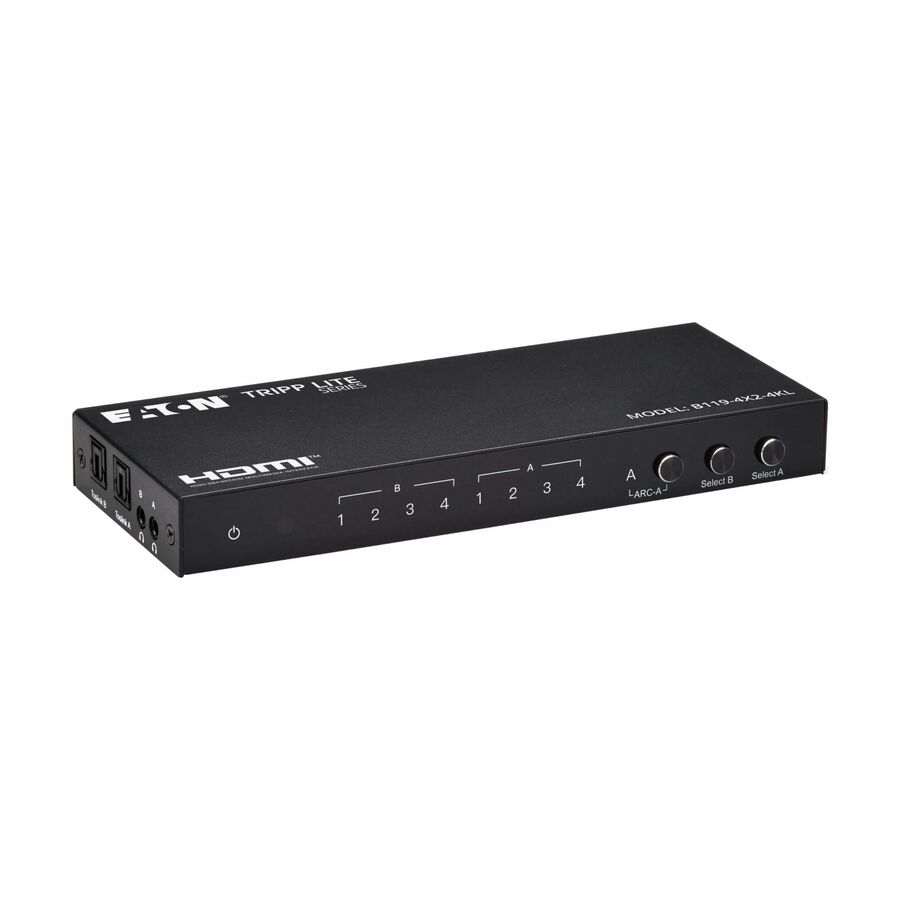
The entry shape for a two-screen room: a 4x2 HDMI matrix switch and splitter carrying four sources to two displays at up to 4096 x 2160, with digital signage, notebooks, monitors, projectors and Blu-ray players all named as supported sources on the part itself.
$119.60In stock2x2 with fast switching
StarTech.com
StarTech 2x2 HDMI Matrix Switch, 4K with Fast Switching, Auto-Sensing…
VS222HD4K
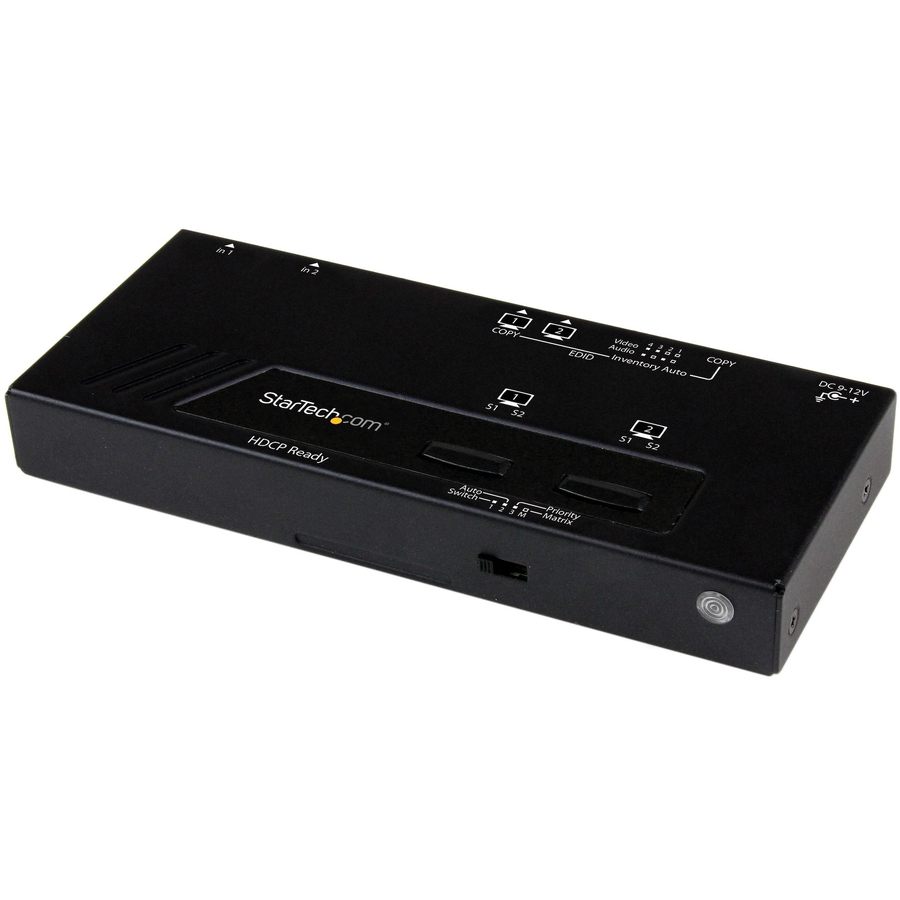
A 2x2 matrix built around the transition rather than the ports — fast switching to keep the picture from dropping out between sources, auto-sensing so an unplugged laptop does not leave a dead screen, and serial control for a room driven from a control system.
Titled TAA Compliant by the manufacturer; verify the designation on the exact part number on your order.
$168.78*In stock2x2, 4K
Black Box
Black Box 4K HDMI Matrix Switch - 2 x 2
VSW-HDMI2X2-4K
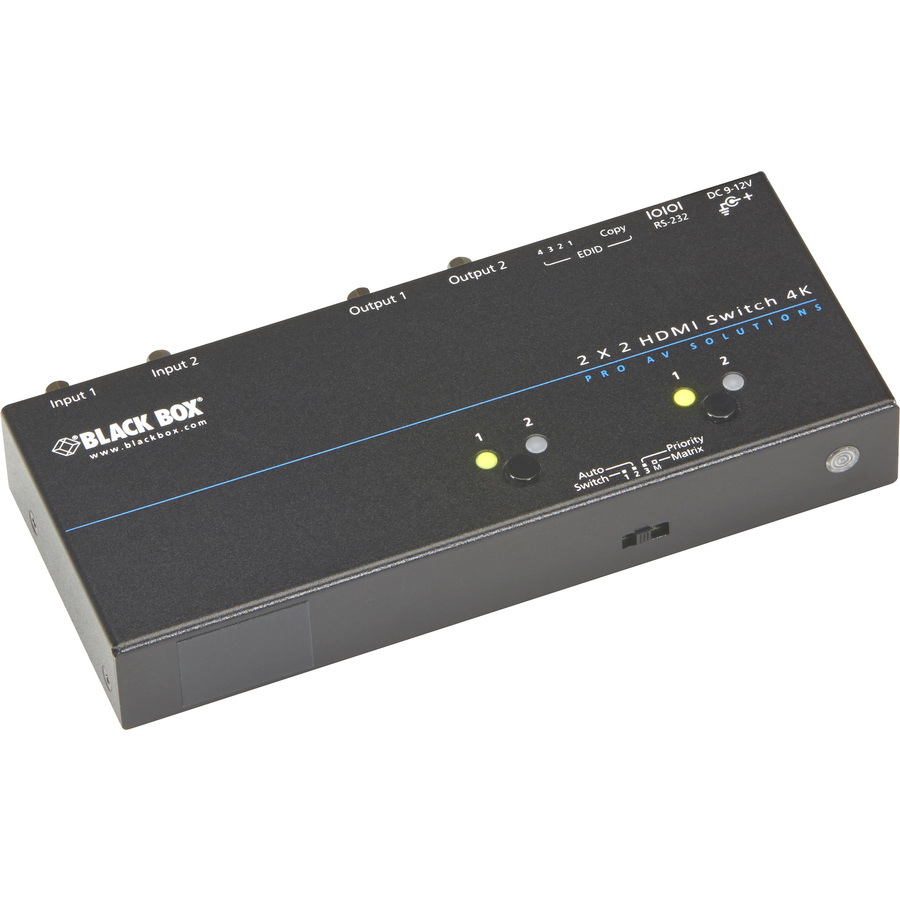
Two sources to two displays at up to 4096 x 2160, with the source list on the title spanning computers, A/V receivers, Blu-ray players and TVs — the plain answer for a two-and-two room that needs independent routing and nothing else.
$248.67In stock4x2, 4K
Black Box
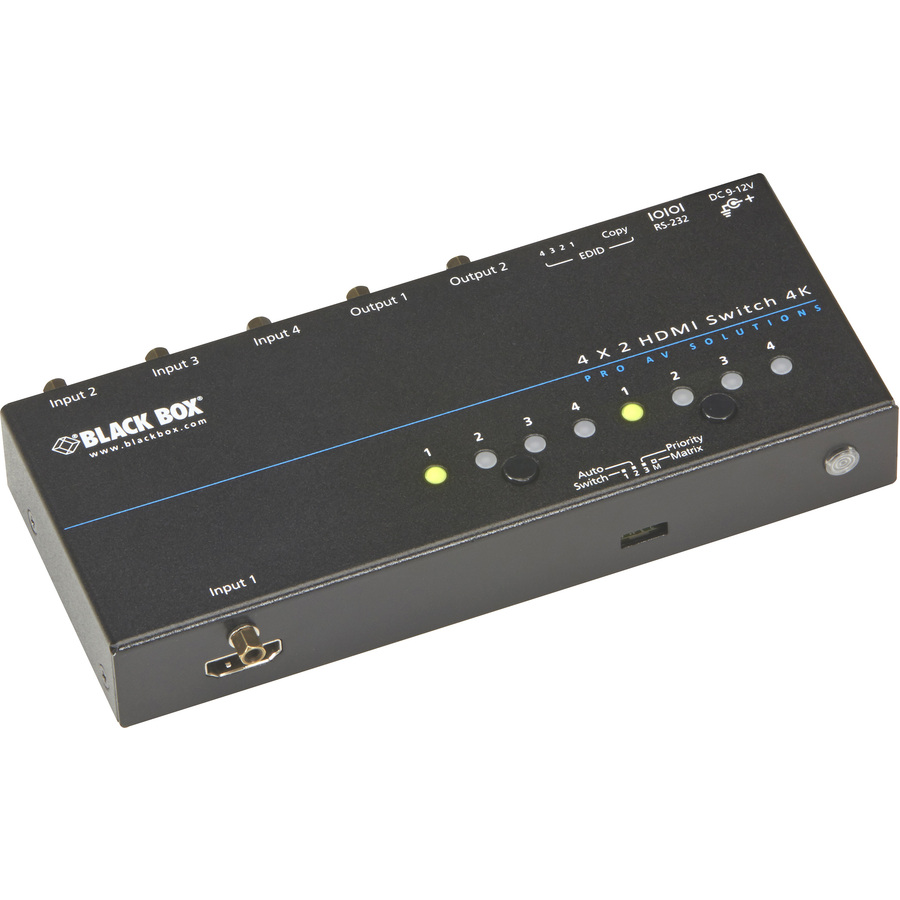
Black Box 4K HDMI Matrix Switch - 4 x 2
VSW-HDMI4X2-4K
The same platform widened to four sources across two displays at 3840 x 2160, which is the arrangement most two-screen boardrooms actually settle on once the wireless receiver and the room PC are counted alongside the guest laptops.
Titled TAA Compliant by the manufacturer — a per-part designation, not a family rule.
$298.70*In stock4x4 with audio extractor
Eaton
Tripp Lite by Eaton 4x4 HDMI Matrix Switch/Splitter with Audio… - 4 x 4
B302-4HX4H-4K
A 4x4 matrix at 4K 60 Hz with an audio extractor and remote access, for a room where the sound has to leave the video chain and land on a house system rather than coming out of a display's own speakers. Multi-resolution support handles mismatched sources.
$553.84In stock4x4 rack-mount
StarTech.com
StarTech 4x4 HDMI Matrix Switch with Audio and Ethernet/RS232 Control…
VS424HD4K60
Four sources across four displays at 4K 60 Hz in a rack-mountable body, with a web GUI plus Ethernet and RS-232 control so the routing is driven from the control system rather than the front panel. The shape a divisible training room takes.
Titled TAA Compliant by the manufacturer; confirm on the part number that appears on the order.
$574.27In stock4x4 true 4K
ATEN Technology
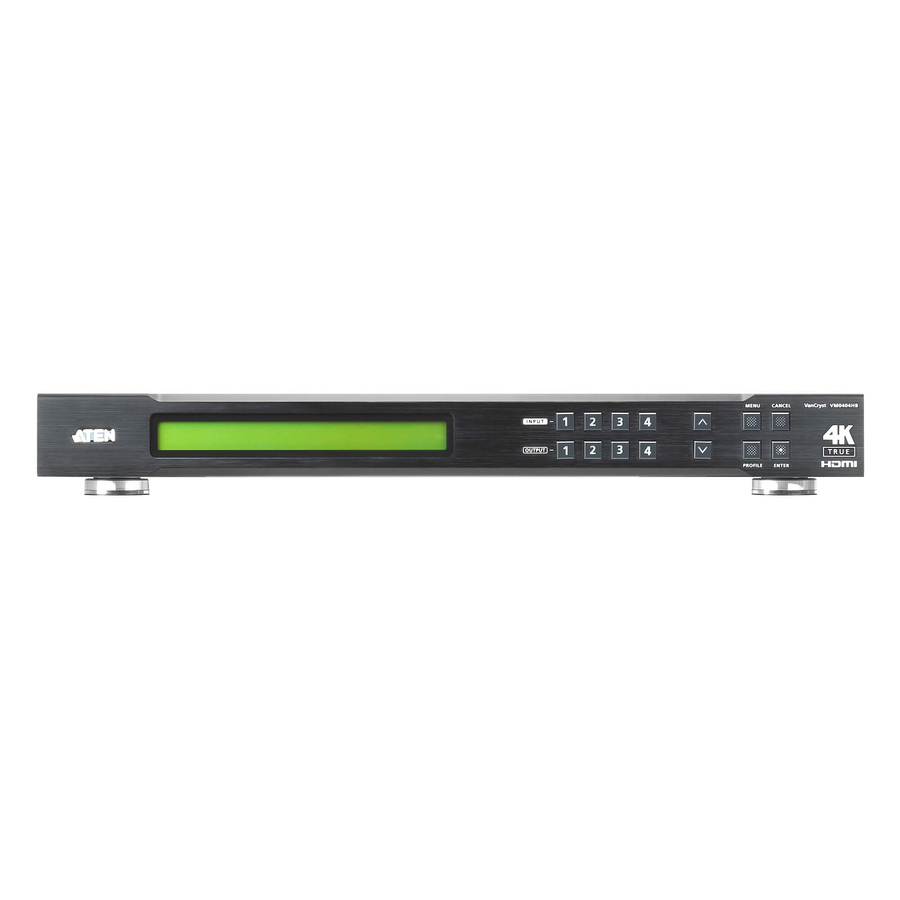
VanCryst VM0404HB 4 x 4 True 4K HDMI Matrix Switch-TAA Compliant - 4 x 4
VM0404HB
A four-in, four-out true 4K matrix at up to 4096 x 2160 with four HDMI outputs, aimed squarely at fixed installations where every source and every display is specified and the job is clean independent routing at full resolution.
Titled TAA Compliant by the manufacturer, per part number.
$802.63Back-ordered4x4 multiviewer
StarTech.com
StarTech 4x4 HDMI Matrix Switch with Picture-and-Picture Multiviewer…
VS424HDPIP
The 4x4 with picture-and-picture multiviewer and video-wall modes on board — four sources shown together on one screen, or one image split across four, which is the pair of behaviours an operations desk and a lobby wall respectively actually ask for.
Titled TAA Compliant by the manufacturer.
$701.03*In stock8x8 with LCD
SIIG
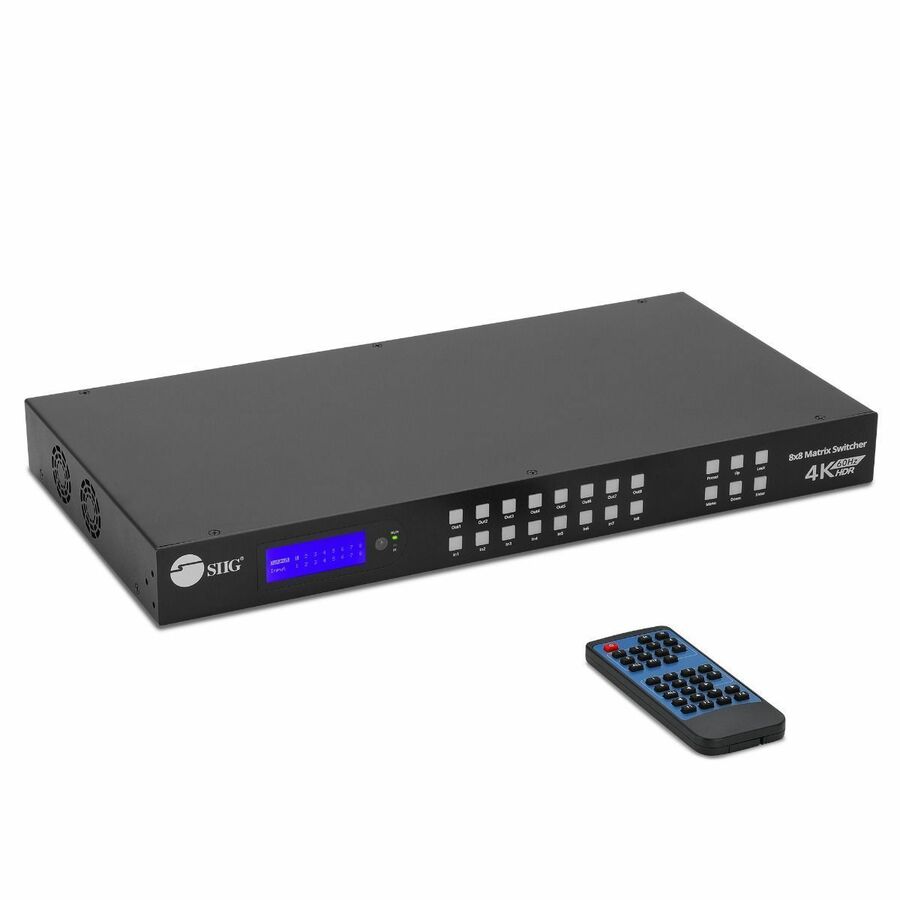
SIIG 8x8 HDMI 4K60Hz Matrix Switcher with LCD
CE-MX0011-S1
An 8x8 matrix switcher at 4K 60 Hz over 18 Gbps with an LCD on the unit, EDID management, downscaling, ARC, analogue audio embedding and HDMI audio extraction — the density and the housekeeping features a permanent multi-room install needs in one metal chassis.
$1,237.74In stock4x4 video wall
Eaton
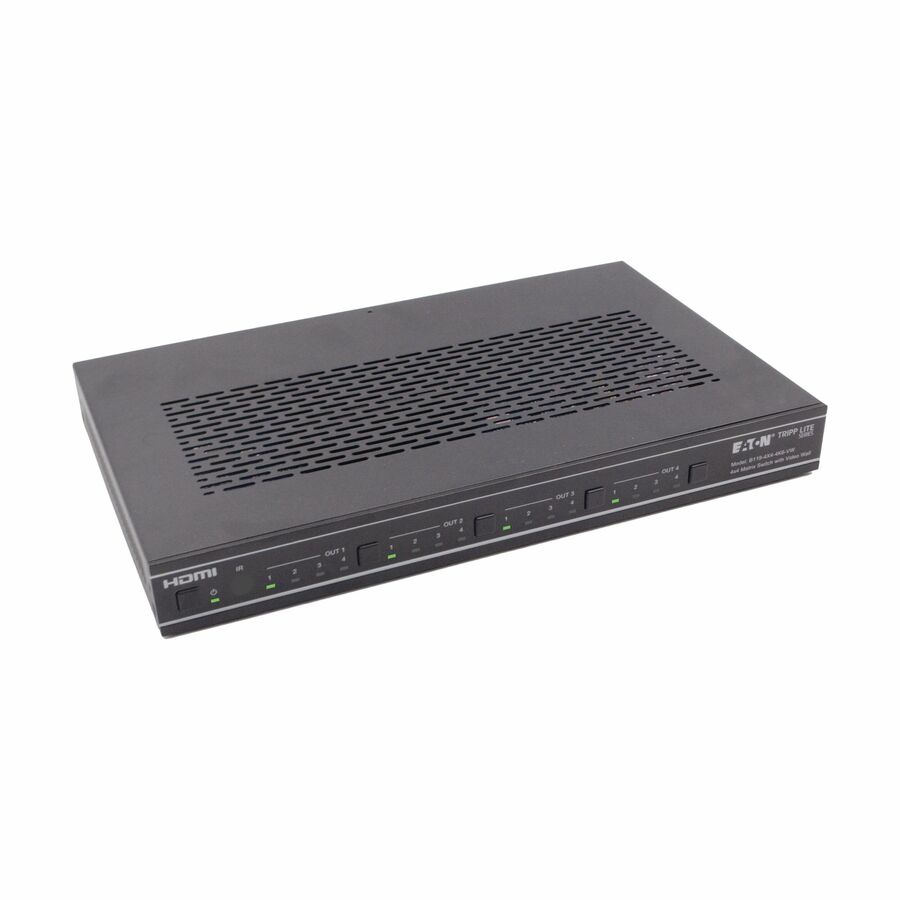
Eaton Tripp Lite Series 4x4 HDMI Matrix Switch with Video Wall…
B119-4X4-4K6-VW
A 4x4 matrix with a video-wall controller built in, at 4K 60 Hz with HDR and 4:4:4 chroma and multi-resolution support across four HDMI inputs and four outputs — one box where a lobby otherwise needs a matrix and a wall processor.
$1,421.45In stock4x4 quad-viewer
SIIG
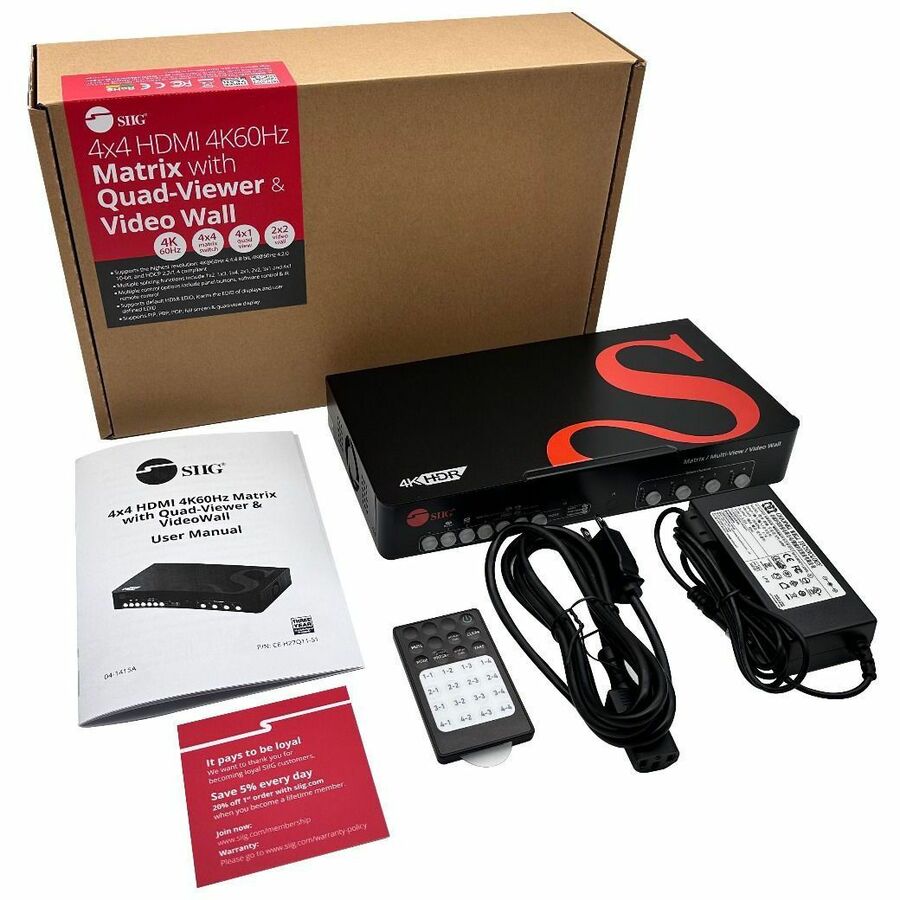
SIIG 4x4 HDMI 4K60Hz Matrix with Quad-Viewer & VideoWall
CE-H27Q11-S1
A 4x4 at 4K 60 Hz that adds a quad-viewer and video-wall processor with seamless switching, seven wall modes, five quad-view display modes, EDID management and push-button, IR and software control — the busiest feature set on this page for its size.
Titled TAA Compliant by the manufacturer.
Request pricing8x8 true 4K
ATEN Technology
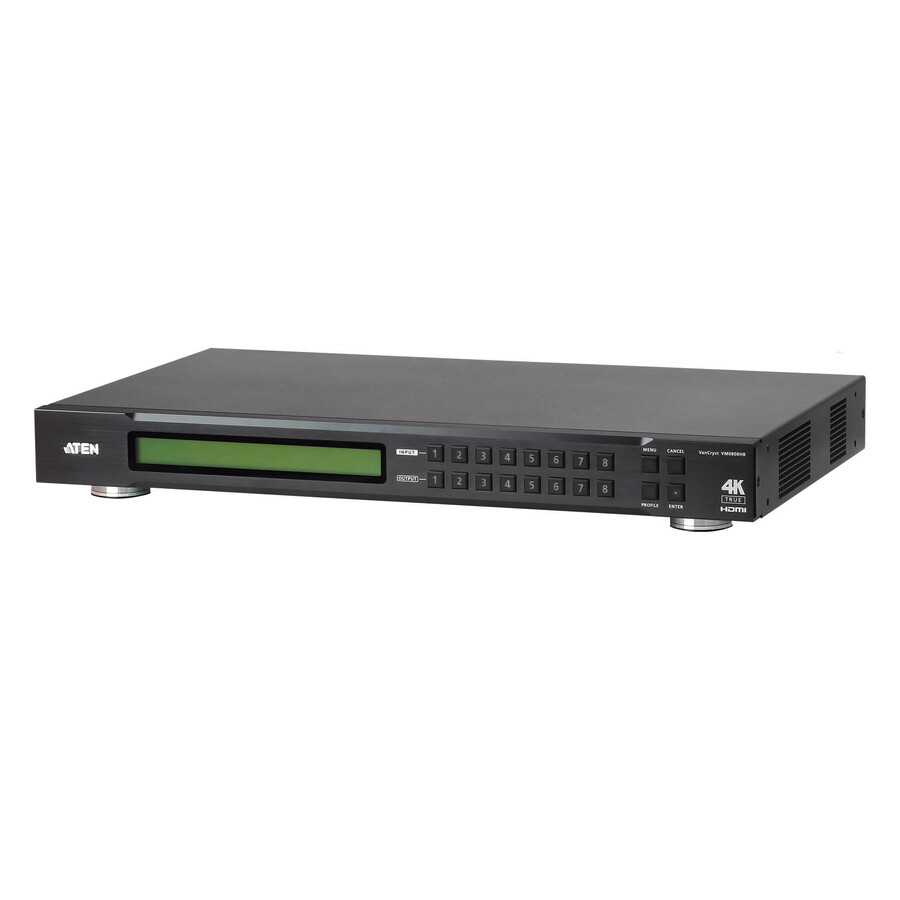
ATEN VM0808HB 8 x 8 True 4K HDMI Matrix Switch-TAA Compliant - 8 x 8
VM0808HB
Eight sources across eight displays at up to 4096 x 2160 with eight HDMI outputs. The step up from a room matrix to a floor matrix, for a control room or a signage estate where the source pool and the screen count grew past four.
Titled TAA Compliant by the manufacturer, per part number.
$2,204.12In stock16x16 with scaler
ATEN Technology
ATEN 16 x 16 HDMI Matrix Switch with Scaler - 16 x 16
VM51616H
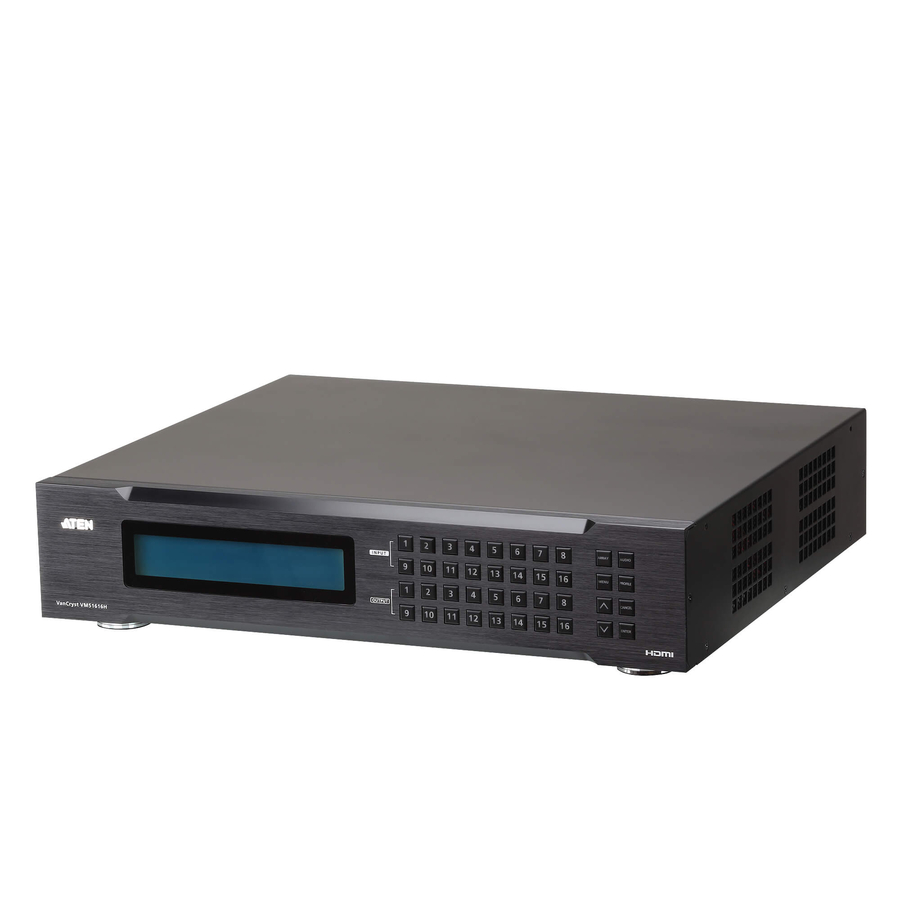
The top of this shelf: sixteen sources across sixteen outputs at 1080p over twisted pair, with a scaler and seventeen HDMI outputs. A 1080p ceiling is the trade for that density — read it against the operator displays actually on the floor.
$10,782.93In stockMore video switchers and splitters in the Uniqcli catalog
See all 189 video switchers and splittersMore from across this category. In-stock lines lead, and a back-ordered line carries the same estimated availability its product page does — with live pricing throughout, NDAA §889 screening before checkout and TAA verified on request.
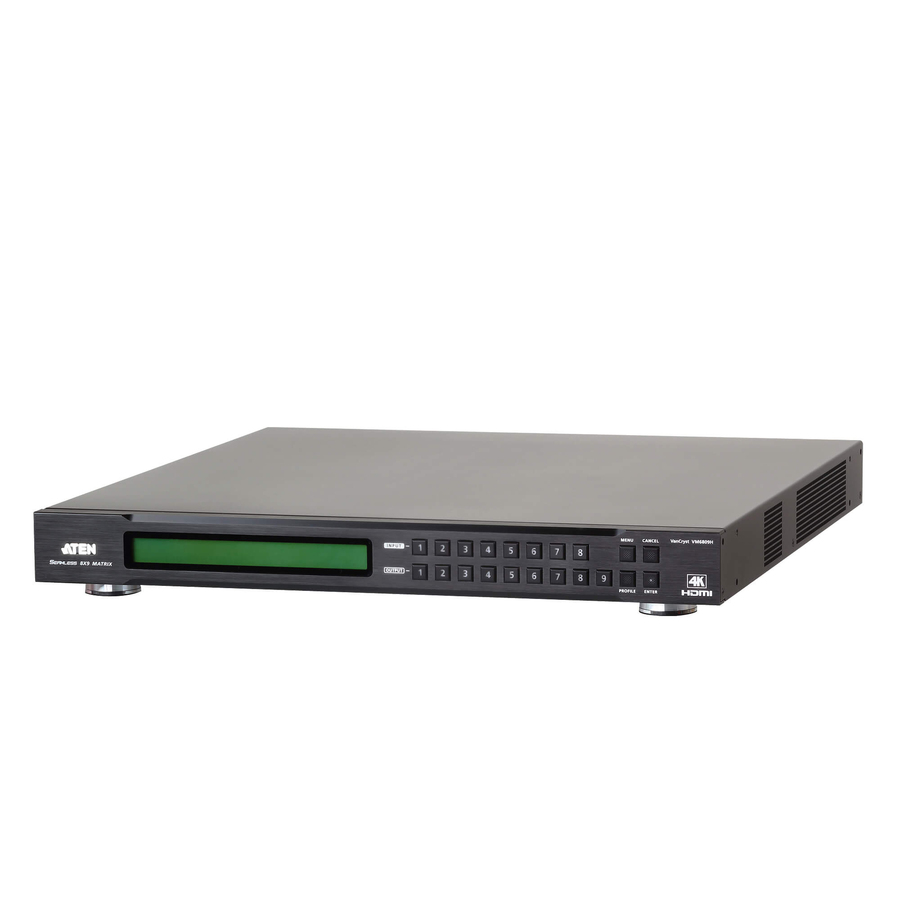
- ATEN TechnologyATEN 8 x 9 4K HDMI Matrix Switch with Scaler-TAA Compliant - 4096 x 2160 - 4K - 8 x 8 - Display - 9 x HDMI OutVM6809H
$8,685.00
$6,588.50
Back-orderedBack-ordered — estimated OEM lead time 3–8 weeks (Nov 12 – Dec 17 if ordered today).
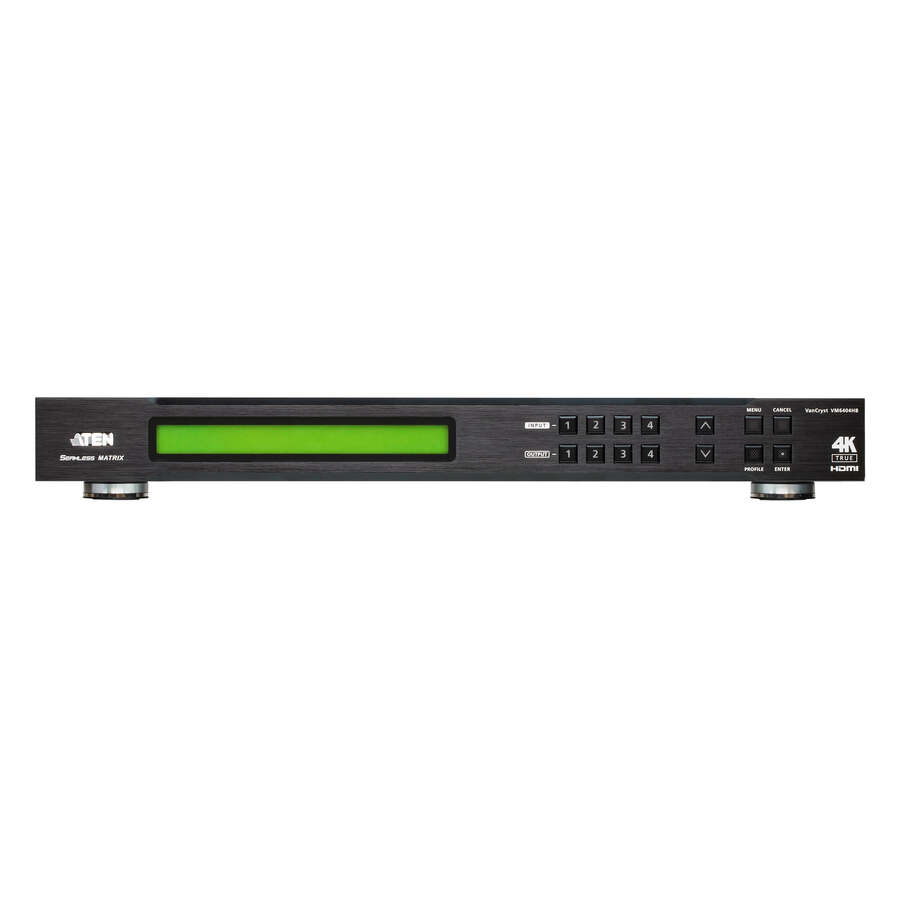
- ATEN TechnologyATEN 4 x 4 True 4K HDMI Matrix Switch with Scaler - 3840 × 2160 - 4K - Twisted Pair - 4 x 4 - Display - 4 x HDMI OutVM6404HB
$4,582.00
$3,493.89
Back-orderedBack-ordered — estimated OEM lead time 3–8 weeks (Nov 12 – Dec 17 if ordered today).
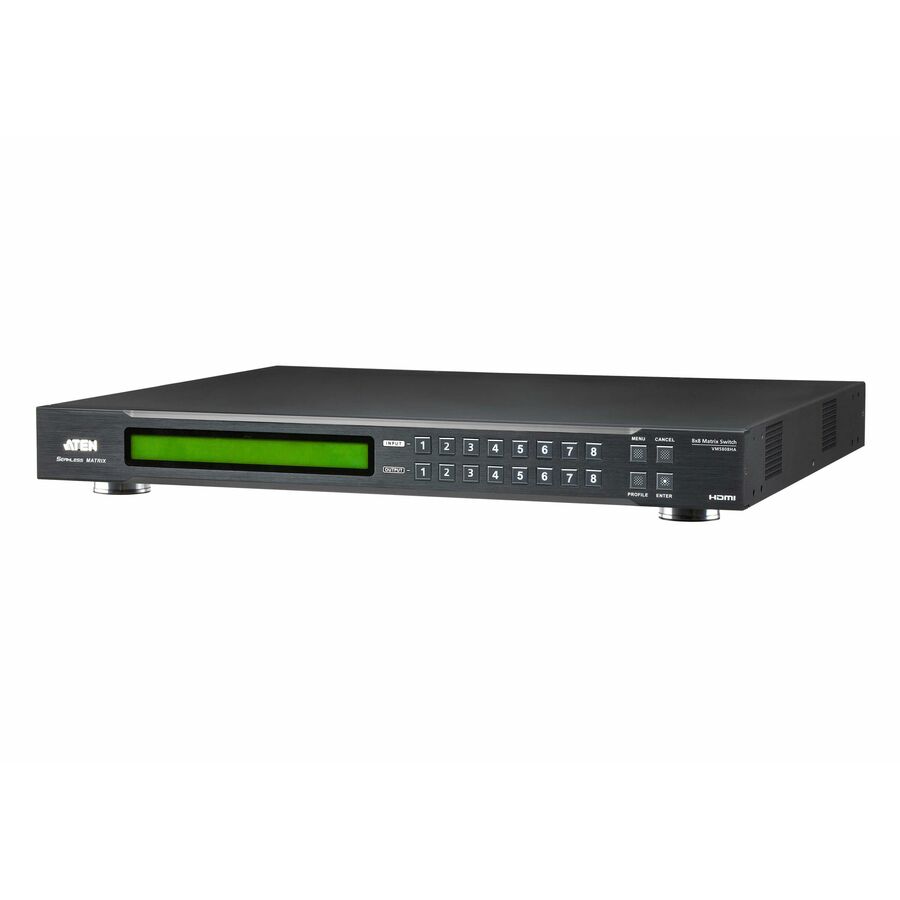
- ATEN TechnologyATEN 8 x 8 HDMI Matrix Switch with Scaler - 1920 x 1080 - 1080p - Twisted Pair - 8 x 9 - Display - 9 x HDMI OutVM5808HA
$5,086.00
$4,087.38
Back-orderedBack-ordered — estimated OEM lead time 3–8 weeks (Nov 12 – Dec 17 if ordered today).
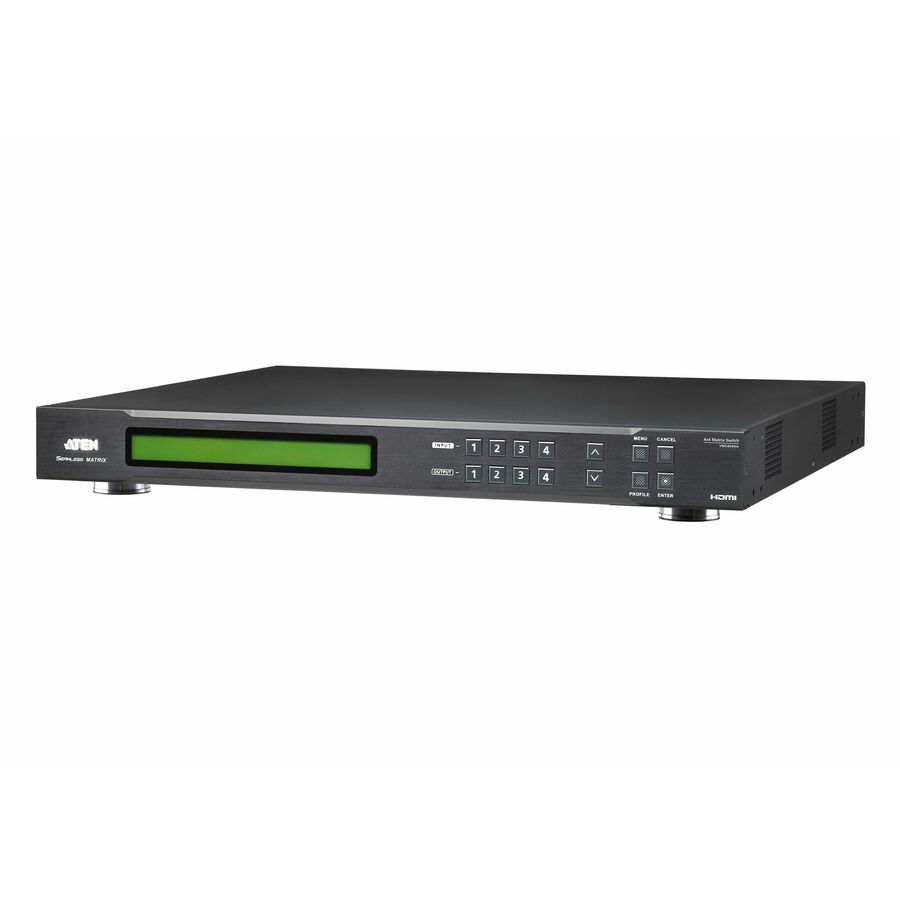
- ATEN TechnologyATEN 4 x 4 HDMI Matrix Switch with Scaler - 1920 x 1080 - Full HD - 1080p4 x 4 - Display - 5 x HDMI OutVM5404HA
$3,073.00
$2,472.61
Back-orderedBack-ordered — estimated OEM lead time 3–8 weeks (Nov 12 – Dec 17 if ordered today).
- ATEN TechnologyVanCryst VM0404HB 4 x 4 True 4K HDMI Matrix Switch-TAA Compliant - 4096 x 2160 - 4K - 4 x 4 - Computer, Display - 4 x HDMI OutVM0404HB
$1,295.00
$802.63
Back-orderedBack-ordered — estimated OEM lead time 3–8 weeks (Nov 12 – Dec 17 if ordered today).
Need pricing on HDMI matrix switchers?
Tell us where to reach you and a Uniqcli specialist will follow up by email with current pricing, availability and lead time for the quantities you need — including parts that aren’t shown on this page.
Buying for an organization or for yourself — both work. No payment up front.
A matrix switcher is what you buy when "which source goes to which screen" stops having a single answer. An ordinary switch picks one input for one output and a splitter mirrors one input to several; a matrix does neither, because it routes any input to any output independently and at the same time. That is the difference between a boardroom where the laptop at the head of the table takes both displays and one where the far display holds the video call while the near one shows the drawing under discussion — and it is the whole design of an operations floor, where six feeds have to land on eight screens in an arrangement that changes with the shift.
Buy on the numbers in the part's own title, because on this shelf the title is the specification. Every row on this page names its cross-point count the way the manufacturer does — 2x2, 4x2, 4x4, 8x8, 8x9, 16x16, and a 9x2 and 5x2 among the presentation units — and most of them also state the resolution ceiling they support, whether a scaler is on board, and whether the outputs run over HDMI directly or over twisted pair. Those are the four facts that decide whether a unit fits, and they change part to part inside a single series, so they have to be read on the exact part number you intend to order rather than on the family name in the brochure.
The selection below is a spec-verification exercise and nothing more. Nothing here was tested, ranked by opinion or scored: the grid is fenced to the parts whose own catalog titles read "HDMI Matrix", which is why every card under this heading is the product class the heading names, and the picks under it restate what those titles state. Live pricing renders on each card from the catalog index rather than from this copy.
Buyer's checklist
How to choose an HDMI matrix switcher
- Count sources and displays separately, then buy the next size up on whichever number is tighter. A 4x2 and a 2x4 are different products, and the cross-point count is stated per part in these titles — a matrix that is full the day the room opens is a second matrix the following year.
- Decide whether outputs run direct or over twisted pair before you decide the model. Several parts here are titled "Twisted Pair", which means the far displays are reached over structured cable with receivers rather than over HDMI cable, and that is a cabling decision with a budget line of its own.
- Read the resolution ceiling on the exact part. These titles carry it explicitly — 1920 x 1080, 3840 x 2160 and 4096 x 2160 all appear on this shelf — and a 1080p matrix in a 4K room is the single most common ordering mistake in this category.
- Ask whether you need a scaler. A matrix with a scaler normalizes mismatched source and display resolutions so a legacy laptop does not black out a 4K wall; several parts here are titled "with Scaler" and the rest expect the endpoints to agree on their own.
- Treat multiviewer and video-wall behaviour as separate features, not synonyms. A multiviewer puts several sources on one screen; a video-wall mode splits one image across several. Some parts on this page are titled with one, some with both, and the title is where that is settled.
- Plan the control path with the room, not after it. Titles here name web GUI, RS-232 serial, Ethernet, IR remote and front-panel buttons in different combinations, and a matrix that can only be driven from its own front panel is a matrix somebody has to walk to.
- Where the purchase order names TAA, read the designation on the part number. Several units on this page carry "TAA Compliant" in the manufacturer's own title and others in the same category do not; it is a per-part fact, never a family or brand rule, and screening is performed before the quote.
Matrix, switch, splitter, extender — four products that get ordered for each other
The four device classes in this category solve four different problems, and the reason they get confused is that all four end in a picture on a screen. A switch selects one of several sources for a single display; it is the right answer for a small huddle room with one screen and three cables on the table. A splitter takes one source and mirrors it to several displays showing the same thing, which is what a menu board or a waiting-room bank actually needs. An extender does not switch at all — it carries one signal further than an HDMI cable will reliably go, usually over twisted pair. A matrix is the one that routes independently: any input to any output, simultaneously, with the routing changeable at run time. If two people in the room ever need two different pictures on two different screens from a shared pool of sources, no amount of switches and splitters will do it, and that is the moment a matrix is the cheaper answer rather than the fancier one.
The practical test is to draw the worst state the room ever has to be in, not the normal one. A four-source, two-display boardroom looks like a switch problem right up until the quarterly review, when the far screen holds a remote presenter for an hour while the near screen cycles through three local laptops. Signage is the same story from the other direction: a lobby with six panels showing one loop is a splitter, but the same six panels showing three zones of content is a matrix, and the zoning requirement usually arrives after the panels are on the wall. Sizing for the worst state costs a cross-point or two at purchase and saves a rip-out.
Reading the titles: resolution, twisted pair, scaling and the control path
Resolution ceilings on this shelf are stated as pixel counts rather than marketing names, and the distinction between them matters. 3840 x 2160 is UHD, the resolution consumer displays and most commercial panels actually run; 4096 x 2160 is DCI 4K, a wider frame that appears on the professional units. A part titled 1920 x 1080 is a 1080p matrix regardless of how modern the rest of its feature list looks — there are capable, current 8x8 and 16x16 units on this page whose ceiling is 1080p, and they are excellent buys for a control room full of 1080p operator displays and the wrong buy for a 4K signage wall. Refresh rate is the second half of the same question: several parts state 4K 60 Hz explicitly, and a 4K matrix that tops out at 30 Hz will show a usable picture and an unusable mouse pointer.
"Twisted Pair" in a title is an architecture, not an accessory. Those units send outputs over structured cabling to receivers at the display, which is how you reach a screen at the other end of a floor without running an HDMI cable the whole way — and it means the order has to include the cable plant and the receiver units, plus a decision about whether the run is inside the distance the manufacturer states for that part. Scaling is the compatibility insurance underneath all of it: a unit titled "with Scaler" will take a source that does not match the display and reshape it, which in a room where the sources are whatever laptop walks in is the difference between an AV system and a support ticket. Finally, read the control path off the title and match it to how the room is actually operated — web GUI and RS-232 for a room that is driven from a control system, IR and front-panel buttons for a room that is driven by whoever is standing in it.
One thing no title on this page settles is content protection. HDCP is negotiated between the source, every device in the chain and the display, and a link that fails it shows a black screen rather than an error message; where a part states an HDCP version in its own data that is what we are reporting, and where it does not, the question has to be answered against the actual sources and panels in the room before the order is placed.
What ships around a matrix switcher
A matrix lands in the middle of a build, and the parts that make it work are rarely on the same line of the requisition. HDMI cabling of the right length and rating comes first, and on the twisted-pair units the structured cable and the receiver at each display is a second line entirely. Rack position and power matter more than the size of the box suggests, because the matrix is the single point every source and every screen passes through — it belongs on the same protected power as the rest of the rack, and it belongs somewhere a technician can reach the front panel. Mounting and display hardware, the panels themselves and the control system that drives the routing are all part of the same room.
Uniqcli quotes all of that on one document rather than as a shopping list: the matrix, the extenders and receivers, the cabling, the mounts and the displays, along with the low-voltage cabling and installation work that puts them in. Send the room — the sources, the number and position of the displays, the resolutions involved, the distances between them and how the room is meant to be controlled — and it comes back as part numbers, availability, lead times and volume pricing before anything is committed.
FAQ
Common questions
- What is the difference between an HDMI matrix switch and an HDMI switch or splitter?
- A switch selects one source for one display. A splitter sends one source to several displays, all showing the same picture. A matrix routes any input to any output independently and at the same time, so four sources and four displays can show four different things and the routing can change while the room is in use. The rule of thumb: if two screens in the same room ever need two different pictures from a shared pool of sources, that is a matrix, and no combination of switches and splitters will do the same job.
- How do I read a matrix's size — is a 4x2 the same as a 2x4?
- No, and getting it backwards is the most common ordering error in this category. The first number is inputs (sources) and the second is outputs (displays), so a 4x2 takes four sources to two screens and a 2x4 takes two sources to four screens. Count the two separately against the room, including the sources that are added rather than replaced — a wireless presentation receiver, a room camera feed, a signage player — and buy the next size up on whichever number is tighter. Every part on this page states its cross-point count in the manufacturer's own title.
- Do I need a matrix with a scaler?
- Buy one if the sources are not under your control. A scaler normalizes mismatched resolutions between what is plugged in and what is on the wall, so a legacy laptop, a document camera or a media player that cannot drive the display's native resolution still produces a correct picture rather than a black screen or a letterboxed one. In a fixed installation where every source and every display is specified and identical, a scaler is optional. In a meeting room where the source is whatever device the visitor brought, it is the feature that stops the support calls. Several parts on this page are titled "with Scaler"; the rest expect the endpoints to negotiate on their own.
- What does "Twisted Pair" mean on some of these units?
- It means the outputs leave the matrix over structured cabling to a receiver at each display, rather than over an HDMI cable running the whole distance. That is how a matrix reaches screens at the far end of a floor or in adjacent rooms, and it turns the order into three parts rather than one: the matrix, a receiver per remote display, and the cable plant between them. Confirm the distance the manufacturer states for the specific part against the actual run, and plan the cabling work alongside the hardware — it is usually the longer lead item of the two.
- Can business, government and education buyers order these?
- Every line Uniqcli quotes is sourced through US distribution and screened for TAA country-of-origin and NDAA §889 status before checkout — with documentation tied to the specific part number, not a product family.
Need HDMI matrix switchers pricing?
Send a bill of materials or part numbers — we confirm stock and a below-market total, with TAA verified on request. No payment up front.