
Short answer
A metal screen is what separates STP from UTP. UTP relies only on the twist of each pair to reject noise; STP adds a foil or braid screen that has to be bonded into the building's telecommunications grounding system. The category rating and the 100 m channel are otherwise the same, so shielding buys noise immunity, not speed — and an unbonded screen performs worse than none at all.
Key facts
- Shielding does not change the category rating: shielded and unshielded Cat6 are both swept to 250 MHz and both carry 1G to 100 m.
- A screen only works when it is bonded. ANSI/TIA-607-E specifies the generic telecommunications bonding and grounding infrastructure it connects to.
- TIA's bonding requirements reach all metallic telecommunications pathways, not just the cable — patch panels and hardware included.
- Cat6a is specified to 500 MHz, the frequency where alien crosstalk between adjacent cables is worst and a screen has the most to do.
- Neither construction changes reach: standard Ethernet runs a 100 m channel on UTP and STP alike.
The real question is rarely "which cable is better" but "how noisy is the environment, and can the shield be grounded correctly." Both UTP and STP are balanced twisted-pair media that reject most interference through the pair twist and differential signaling. UTP relies entirely on that twist and balance; STP adds a metallic foil or braid (F/UTP, U/FTP, or S/FTP in ISO/IEC nomenclature) as a second barrier against external EMI and alien crosstalk. For a quiet office run, that extra barrier is often solving a problem you don't have.
Where it matters, it matters a lot: near variable-frequency drives, large motors, high-voltage runs, imaging suites, or in tightly packed 10GBASE-T bundles, shielding buys measurable margin. But a shield is only as good as its bonding path. An STP link grounded improperly can act as an antenna and perform worse than plain UTP, and shielded cable costs more in material, connectors, and skilled labor. The decision comes down to your noise floor, your grounding infrastructure, your PoE power levels, and your budget for termination discipline.
At a glance
Side by side
| Factor | UTP (unshielded) | STP (shielded) |
|---|---|---|
| EMI/noise immunity | Pair twist plus balanced signaling reject common-mode noise; adequate for typical offices and commercial spaces | Adds a foil/braid barrier against external EMI and crosstalk; stronger margin in high-noise environments |
| Grounding & bonding | No shield to ground; nothing to bond, so fewer ways to get it wrong | Shield must be bonded end-to-end with shielded connectors/panels; poor bonding can form ground loops that worsen noise |
| Alien crosstalk (dense 10G) | Managed by larger cable diameter and physical separation between bundled runs | Foil suppresses pair-to-pair coupling between adjacent cables, allowing tighter bundling at 10GBASE-T |
| PoE / bundle heat | Depends on conductor gauge (e.g. 23 AWG) to shed heat; large high-power bundles may need derating | Metallic foil helps conduct heat out of the bundle, typically lowering temperature rise under high-wattage PoE |
| Termination & handling | Thinner, more flexible, faster to terminate; forgiving of field labor | Stiffer, larger bend radius, and slower to terminate because shield continuity must be maintained |
| Installed cost | Lower cost for cable, connectors, jacks, and labor | Higher material cost (shielded cable, connectors, panels) plus added labor for bonding and careful termination |
| Typical fit | Offices, classrooms, and general commercial or light-commercial horizontal cabling with no dominant noise sources | Industrial floors, VFD/motor-adjacent runs, medical and imaging suites, and high-density data-center rows |
| Performance ceiling | Practical ceiling is Cat6A 10GBASE-T to 100 m (tested to 500 MHz); higher grades become impractically bulky | Mandatory construction for Cat8 25/40GBASE-T (~30 m, two connectors, to 2 GHz); tighter margins at the top frequencies |
Choose UTP (unshielded) when
- The environment is a typical office, classroom, or commercial space with no significant EMI sources nearby
- Budget and installation speed matter, and you want forgiving, lower-cost termination and labor
- You cannot guarantee a properly bonded, equipotential grounding path end-to-end for a shield
- Runs are standard Ethernet or moderate PoE that stay within normal bundle-heat and 100 m channel limits
Choose STP (shielded) when
- Cabling passes near motors, variable-frequency drives, high-voltage runs, or other strong EMI sources on an industrial or medical floor
- You are running dense 10GBASE-T where alien crosstalk between tightly bundled cables is a concern
- High-wattage PoE (Type 3/4) in large bundles makes heat dissipation a design constraint
- You require Cat8 speeds or need documented EMC margin, and your facility already has a disciplined bonding/grounding system
Bottom line
Run UTP unless a measured EMI problem or a bonding plan says otherwise — an unbonded shield is worse than none. UTP is the sensible default for offices and general commercial work: cheaper, faster to install, and hard to get wrong. STP earns its premium in genuinely noisy settings, dense high-speed bundles, and high-power PoE, but only when the shield is bonded correctly end-to-end. A well-installed UTP link beats a poorly grounded STP one. Match the media to the noise floor and to your team's ability to maintain shield continuity, not to a spec-sheet preference.
Products for this decision
S/FTP, fully screened
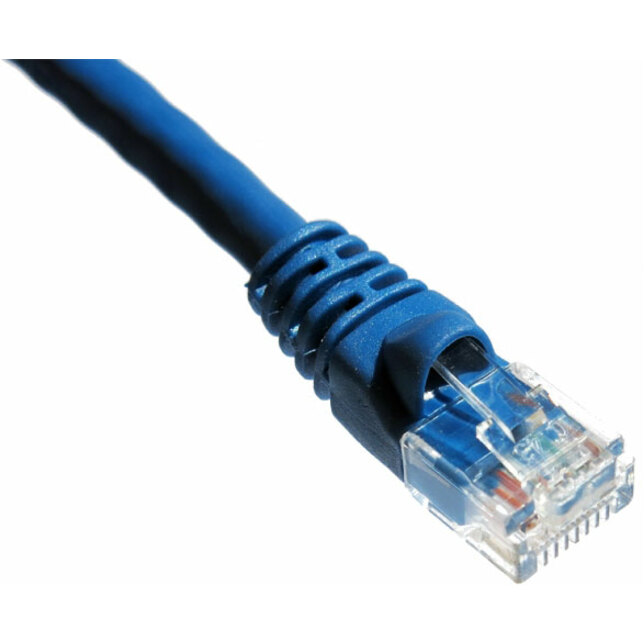
Axiom Memory Solutions
Axiom 10FT CAT6 550mhz S/FTP Shielded Patch Cable Molded Boot (Blue)
C6MBSFTPB10-AX
A 10 ft Cat6 cord with a braid over foil-screened pairs — the heaviest screening in common use, for runs beside motors, drives or parallel power.
A screened cord needs screened jacks and a bonded panel to do anything; an unbonded shield is worse than none.
$11.35In stockF/UTP, overall foil
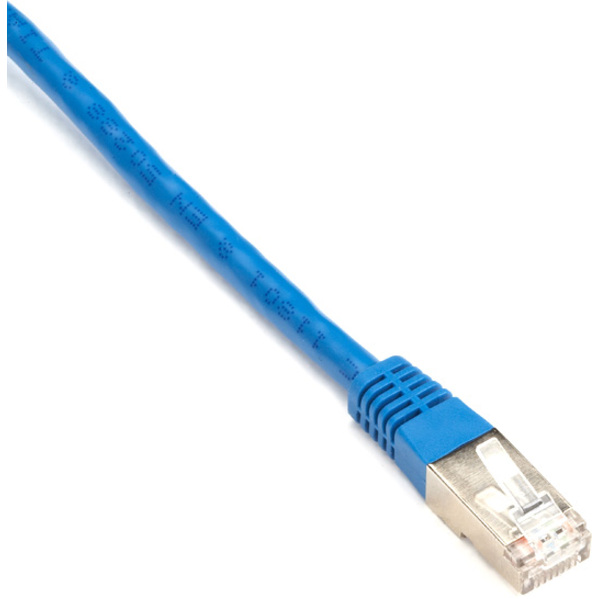
Black Box
Black Box CAT5e 100-MHz Stranded Patch Cable Slim Molded Boot - 6 ft
EVNSL0172BL-0006
A 6 ft Cat5e cord with one overall foil and unshielded pairs — the middle rung, and the construction most people mean when they say shielded.
$7.19Back-orderedKeeping the screen continuous
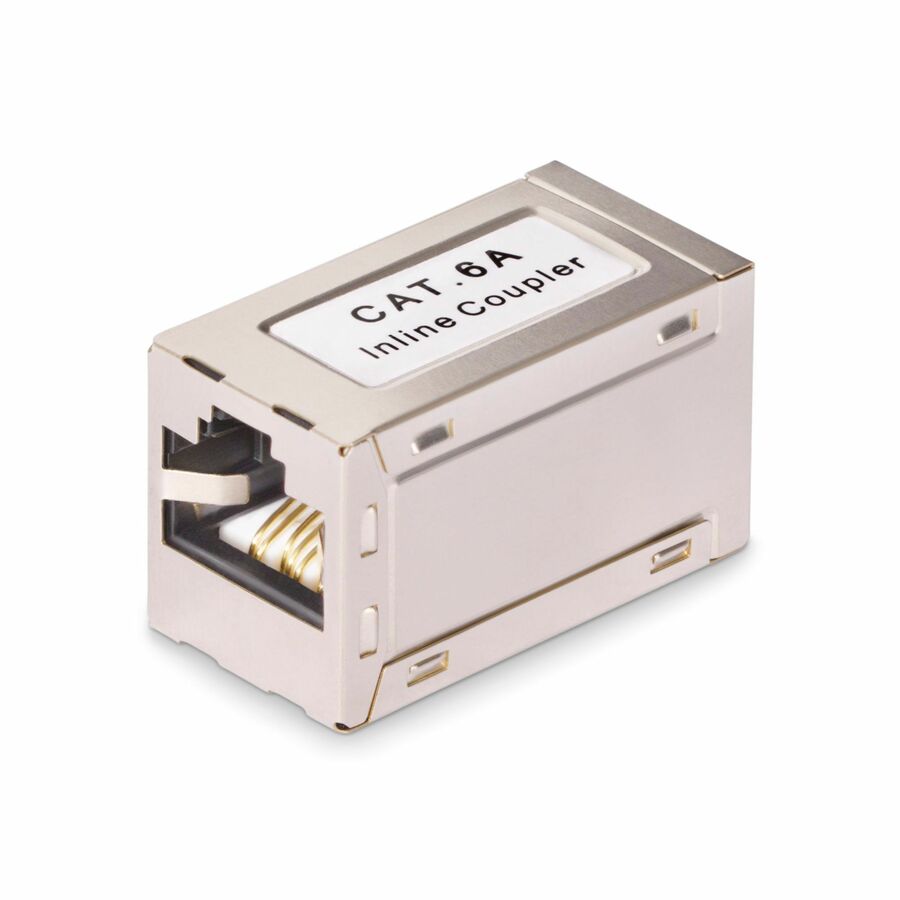
StarTech.com
StarTech Shielded RJ45 Coupler, Inline Cat6a Coupler, Female to Female…
IN-CAT6A-COUPLER-S1
A shielded inline RJ45 coupler in a metal housing. A plastic coupler breaks the screen at that point and turns a screened channel into a partial one.
$15.08In stockShop it at Uniqcli
FAQ
Common questions
- Does STP always outperform UTP?
- No. STP only helps when the shield is continuous and bonded to ground correctly. An improperly grounded shield can pick up current and act as an antenna, making an STP link perform worse than a clean UTP run. In low-EMI offices, the shielding often adds cost without measurable benefit.
- Should the shield be grounded at one end or both?
- Current standards generally call for bonding the shield at both ends within a properly bonded, equipotential grounding system so it drains noise across the full frequency range. Single-end grounding leaves the far end floating and is less effective at high frequencies. Both-end bonding only works safely when the grounding infrastructure is equipotential; otherwise it risks ground-loop current.
- Does shielding help with PoE heat?
- It can. In large bundles carrying high-wattage PoE, the metallic foil spreads and conducts heat outward, so shielded constructions often show lower temperature rise than unshielded ones of the same gauge. Conductor size still matters most, but the shield provides an added thermal dissipation path.
- Do UTP and STP support the same distances?
- For standard Ethernet, both use the same 100 m channel (about 90 m of permanent link plus patch cords); shielding does not extend distance. The exception is Cat8 for 25/40G, which is specified only as a shielded construction and is limited to roughly 30 m for its two-connector channel.
- What is the difference between STP and UTP cable?
- STP carries a metal screen — foil, braid, or both — around the pairs or the whole bundle; UTP has none and relies on the twist of each pair to cancel noise. Everything else can be identical: the same category rating, the same 100 m channel, the same RJ45. The screen adds noise immunity and a bonding obligation, and it costs more to buy and to terminate.
- Is UTP better than STP?
- In an ordinary office, usually yes — it is cheaper, thinner, easier to terminate, and it has no bonding to get wrong. STP wins where the environment is electrically noisy: plant floors, lift shafts, cable trays sharing a route with power, or dense bundles running high-wattage PoE. Choose by environment, not by which one sounds more capable.
- What is better, UTP or FTP?
- FTP — an overall foil screen with unshielded pairs — is the cheapest step up from UTP and handles most real-world interference. It only beats UTP if the screen is bonded end to end; if the jacks, panel and coupler are unscreened, you have paid for foil that terminates nowhere. In a clean environment with a properly installed UTP plant, FTP adds cost and no measurable benefit.
- Is Cat6 STP or UTP?
- Either. Category is a performance grade and shielding is a construction, so Cat6 ships as U/UTP, F/UTP and S/FTP, and all of them are Cat6. Read the designation on the jacket: the letters before the slash describe the overall screen, and the letters after describe each pair.
Sources
- 1.TIA — ANSI/TIA-607-E, Generic Telecommunications Bonding and Grounding for Customer Premisestiaonline.org
- 2.Cabling Installation & Maintenance — ANSI/TIA-607-C and what it changedcablinginstall.com
- 3.CommScope — bandwidth and supported distances by cable categorycommscope.com
- 4.CommScope — Cat 6A structured cabling: the fact file (alien crosstalk at 500 MHz)commscope.com